🦁 California Condor
🧾 Quick Facts
The California Condor, Gymnogyps californianus, is a highly specialized scavenger known for its impressive wingspan and critical endangered status. Once on the brink of extinction, intensive conservation efforts have allowed this magnificent bird to slowly recover.
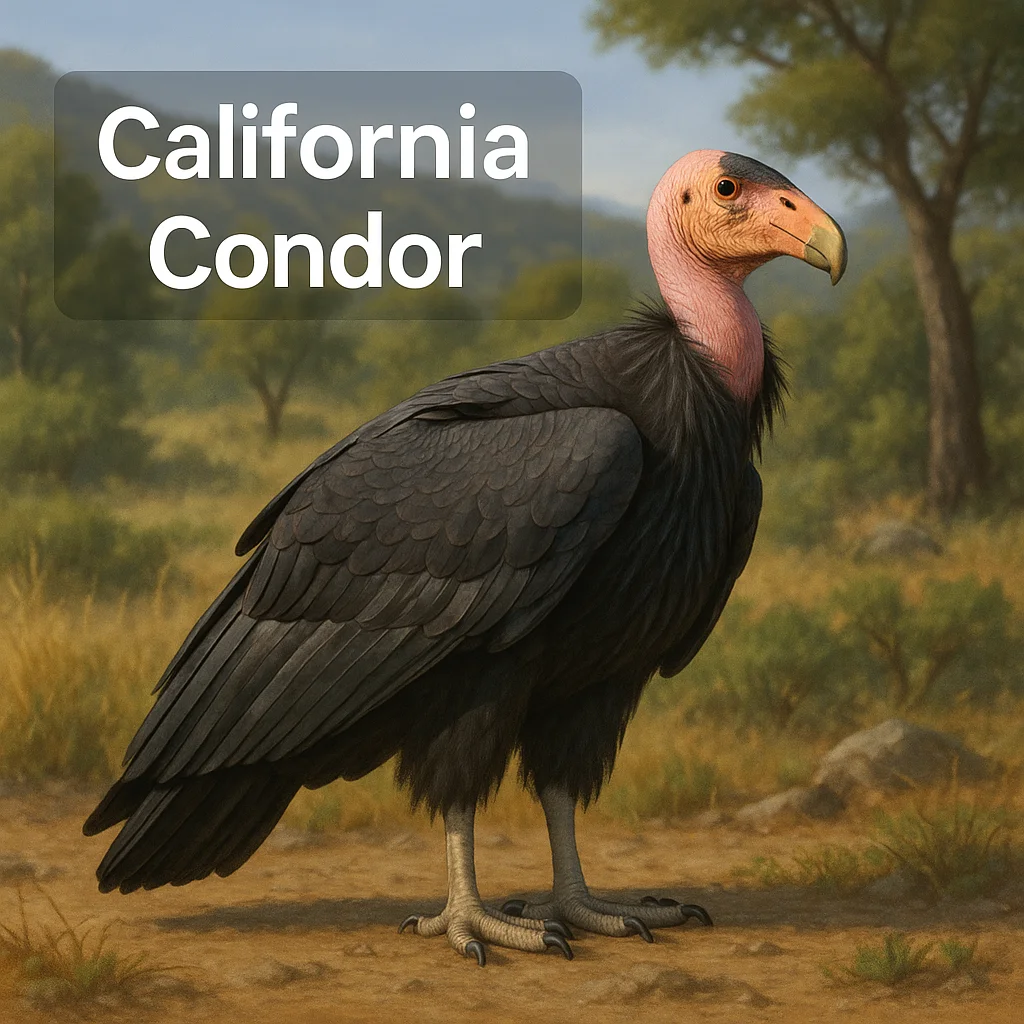
- Common name(s): California Condor
- Scientific name: Gymnogyps californianus
- Animal type: Bird
- Typical adult size: 109–140 cm (43–55 in) in length; wingspan 2.49–3.00 m (8.2–9.8 ft)
- Typical lifespan: 50–60 years in the wild, longer in captivity
- Diet type: Scavenger; feeds on carrion
- Activity pattern: Diurnal
- Social structure: Social when feeding; often seen in groups
- Speed / movement highlights: Soars using thermals, rarely flaps wings
- Intelligence/learning: Adapt at locating food, familial learning
- Primary habitats: Grasslands, rocky shrublands, forested mountains
- Geographic range: Historically widespread in western North America; now mainly in California, Arizona, and Baja California
- Predators/threats: Few natural predators; human-related threats include habitat loss, lead poisoning
- Conservation status: Critically Endangered
🔍 Identification & Appearance
California Condors are among the largest flying birds in North America. They are easily recognizable by their vast wingspan and distinct black plumage contrasted with white underwings. Adults have bald, orange or yellowish pink heads, which distinguish them from immature condors that have dark heads.
- Body shape and silhouette: Large, heavy-bodied with broad wings
- Key colors/patterns: Black with white underwing patches
- Distinctive features: Bald head, hooked beak
- Tracks, scat, or other field signs: Rarely leave tracks due to flight-based lifestyle
- Common look-alikes: Turkey Vulture; distinguishable by larger size and differently shaped tail
- Top ID Tips
- Look for a massive wingspan with distinctive white underwing patterns
- Bald, brightly-colored head in adults
- Perched silhouette is large and upright
- Flight is steady with few wing flaps
- Seen soaring at high elevations
- Vocalizations are infrequent
- Observe distinct basking posture with spread wings
- Check for numbered wing tags used by researchers
🧱 Body Structure & Physical Adaptations
The California Condor has a highly adapted body structure optimized for scavenging and soaring. Powerful legs and a strong beak allow it to tear into tough carcasses.
- Build and proportions: Robust, heavy-bodied with wide wings
- Teeth/beak/jaw adaptations: Strong hooked beak for tearing flesh
- Claws/hooves/wings/fins: Strong feet for gripping; large wings for gliding
- Sensory strengths: Excellent eyesight to spot carcasses from great heights
- Key Adaptations
- Huge wingspan aids in efficient soaring
- Non-feathered head prevents bacterial infections from carrion
- Excellent vision for spotting food sources
- Strong, hooked beak for tearing tough hide
- Thermoregulatory adaptations through basking
- Large airsacs in lungs for extended flight
- Capable of digesting rotten flesh
🌍 Range & Distribution
Once wide-ranging across western North America, the California Condor now occupies a reduced range due to habitat destruction and other pressures.
- Continents/regions: North America
- Typical countries/biomes: Present in scattered locations across California, Arizona, Utah, and Baja California
- Elevation range or latitude/climate range: From sea level up to 7,000 feet (2,100 m)
- Seasonal movements or migration: Largely stationary, occasional local dispersal
- Where You Might Find It
- Rugged coastlines of California
- Grand Canyon National Park in Arizona
- Los Padres National Forest
- Pinnacles National Park
- Ventana Wilderness
- Mojave Desert's mountainous areas
- Sierra de San Pedro Mártir National Park
🏞️ Habitat & Shelter
The California Condor favors open landscapes like grasslands and forested mountain ranges where thermal updrafts are readily available.
These birds roost in large trees or on cliffs, using their environment to avoid extreme weather by selecting sheltered roosting sites. They are known for preferring high altitudes where the air currents support effortless gliding.
🧭 Behavior & Ecology
California Condors demonstrate complex behaviors centered around scavenging and maintaining long-term pair bonds. They play a crucial role in their ecosystem by disposing of carrion.
- Daily routine includes soaring long distances in search of carrion
- Rest and bask in large groups during mid-day
- Notable use of thermals to maintain flight with minimal energy
- Play a significant ecological role as scavengers
- Rarely aggressive, but may scuffle over food sources
- Minimal vocalizations, primarily communicates non-verbally
- Highly cooperative with long-term mates
👥 Social Life & Group Dynamics
Social behavior in California Condors varies between solitary and group dynamics. They often gather at feeding sites and roost in groups, enhancing social interactions.
- Typically found in groups when feeding
- Establishes pair bonds lasting for decades
- Group sizes can range from a small family unit to larger social congregations
- Feeding hierarchies observed, yet minimal conflict
- Social Structure Notes
- Social at roost sites
- Maintain lifelong partnerships
- Form social bonds within group dynamics
- Occasional solitary foraging flights
- Non-aggressive interactions dominate
🍽️ Diet, Prey & Predators
As obligate scavengers, California Condors feed exclusively on carrion. They lack natural predators due to their size and social structure but face significant threats from environmental factors.
- Feed primarily on large mammal carrion
- Capable of eating from carcasses untouched by other scavengers
- Utilize their keen vision to locate food
- Face threats primarily from ingestion of toxic substances like lead
- Feeding Notes
- May carry pieces of food over great distances
- Efficient scavenging is socially facilitated
- Relies on communal feeding sites
- Shares meals with mates and kin
- Non-aggressive feeding competition
🦌 Hunting, Foraging & Movement
California Condors are masters of the sky, using thermal updrafts for effortless soaring. Their flight method is based on finding carrion rather than actively hunting prey.
- Glide over diverse terrains in search of food
- Movement typically involves soaring on thermals
- Foraging is sporadic; dependent on carrion availability
- Utilize large home ranges but are not territorial
- Movement & Strategy
- Travel extensive distances without flapping wings
- Always vigilant for food sources
- Unperturbed by terrain, capable of high-altitude flight
- Routinely share food location information with conspecifics
- Preferred flight paths may cross several biomes
🧠 Intelligence & Senses
California Condors exhibit problem-solving behavior mostly in resource acquisition and social interactions. Equipped with extraordinary eyesight, they can spot food sources over vast distances.
- Possess significant visual acuity
- Demonstrate memory of landmarks and food sites
- Social knowledge is passed among generations
- Notable Abilities
- Persistent search patterns for food discovery
- Adaptive in navigating diverse environments
- Capable of engaging in long-term resource tracking
- Complex social interactions with minimal vocal sounds
- Awareness of human-induced changes in environment
🪺 Reproduction, Pregnancy & Parenting
California Condors have a slow reproductive rate, typically producing one egg every two years. Both parents invest in the care and feeding of a single chick, demonstrating a strong cooperative parenting approach.
- Breeding season occurs from late winter to spring
- Monogamous with pairs lasting multiple breeding seasons
- Incubation period lasts 54–58 days
- Chicks are altricial, requiring extensive parental care
- Both parents share incubatory and feeding duties
- Reproduction Snapshot
- Usually lay a single egg per breeding cycle
- Chicks dependent for 6–8 months
- Extended parental care up to two years
- Parents regurgitate food for chicks
- Courtship can involve elaborate displays
♀️♂️ Male vs Female Differences
California Condors are generally similar in appearance between genders, though subtle differences exist, mainly in the form of size. Males are typically slightly larger than females.
- Size/weight differences: Males tend to be larger
- Coloration: Both sexes exhibit similar plumage and coloration
- Behavioral role differences: Both sexes equally participate in nurturing young
- Sex Differences at a Glance
- Males larger by marginal estimate
- No distinct plumage dimorphism
- Both sexes share territorial defense roles
- Collaborative breeding tasks
- Subtle size variations can aid in sexing adults
🧬 Subspecies & Variation
There are no recognized subspecies of the California Condor; however, slight regional variations can exist due to environmental conditions. The species is highly managed and genetic diversity is a key focus in conservation efforts.
- Known subspecies: Historically categorized as a single species
- Local adaptations: Minimal given small population
- Variation Notes
- Genetic monitoring crucial for species recovery
- Population's future linked to managed and natural diversity
⚠️ Threats, Conservation & Human Interaction
The California Condor's survival faces numerous challenges, including lead poisoning from ingested bullets, habitat loss, and other anthropogenic pressures. Conservation strategies are crucial for mitigating these threats, focusing on habitat protection and reintroduction programs.
- Natural challenges include limited food availability
- Human-related pressures: lead poisoning, habitat development
- Responsible Notes
- Avoid using lead ammunition in condor areas
- Support habitat restoration projects
- Participate in local conservation awareness campaigns
- Educate others on the importance of species conservation
- Respect nesting sites during breeding seasons
✨ Fun Facts & Unique Traits
- California Condors have the largest wingspan of any North American bird.
- They can soar for hours without flapping their wings.
- Their bald heads help stay clean when feeding on carcasses.
- Scavenging roles make them vital for ecosystem health.
- Leeches energy from updrafts, perfecting energy efficiency.
- Unusual nesting sites include rocky cliffs and caves.
📌 Summary
- Identification: Large, black and white-plummaged massive bird
- Habitat: Prefers rocky areas, high altitudes with thermal updrafts
- Distribution: Restricted to California, Arizona, Mexico
- Diet: Scavenger, relying entirely on carrion
- Predators: Face few, mainly impacted by human activities
- Social Life: Social at feeding, lifelong pair bonds
- Reproduction: Slow-breeding with high parental involvement
- Key adaptations: Exceptional flight capabilities, strong vision
- Unique: Critical role as efficient natural cleanup specialists