🦁 Bald Eagle
🧾 Quick Facts
The Bald Eagle (Haliaeetus leucocephalus) is a powerful symbol of freedom and resilience, known for its majestic appearance and expansive range across North America. This large bird of prey is integral to its ecosystem, featuring prominently in cultural and ecological contexts alike.
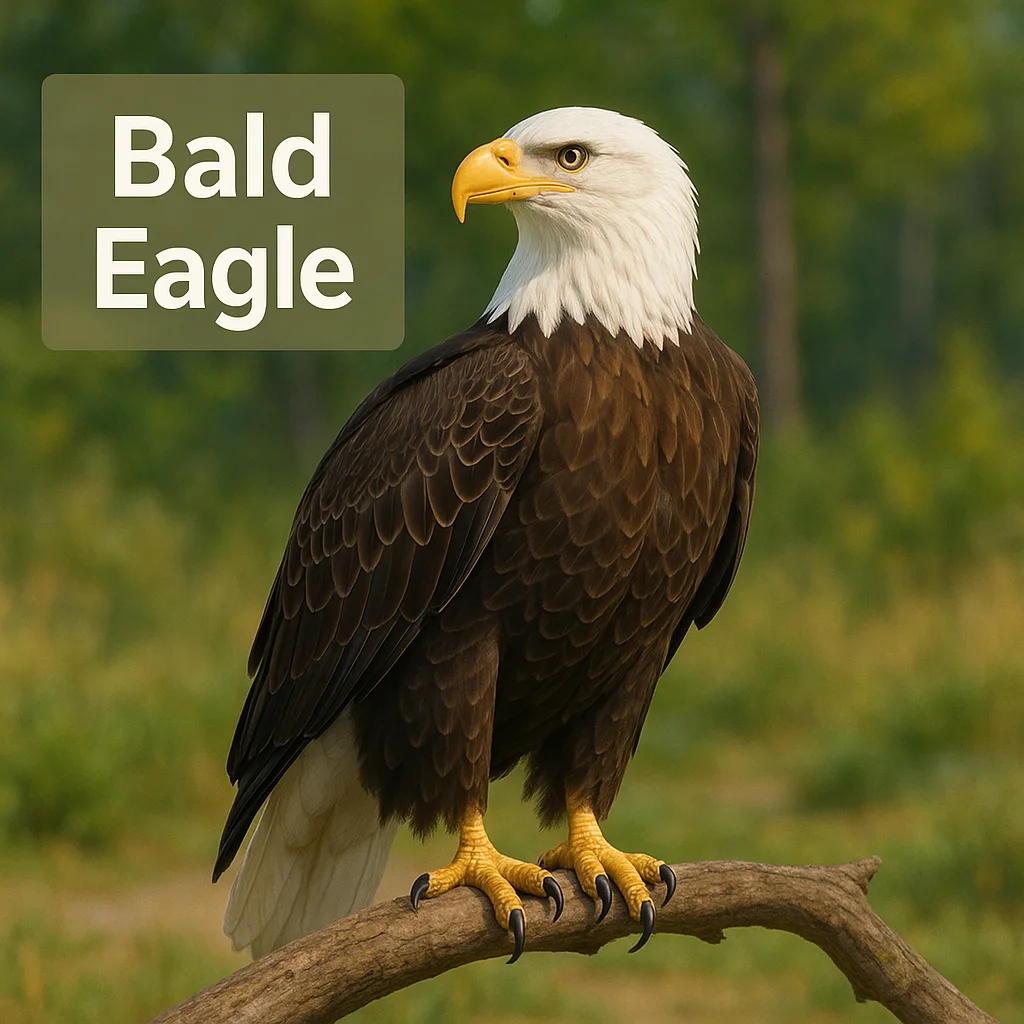
- Common name(s): Bald Eagle
- Scientific name: Haliaeetus leucocephalus
- Animal type: Bird
- Typical adult size: 28 to 40 inches in length, with a wingspan of 6 to 8 feet
- Typical lifespan: 20 to 30 years in the wild; up to 50 years in captivity
- Diet type: Carnivore; primarily fish, but also small mammals and carrion
- Activity pattern: Diurnal
- Social structure: Usually solitary or in pairs; gathers in groups during migration or in abundant feeding spots
- Speed / movement highlights: Flying speeds of 30 to 40 mph; can reach up to 100 mph in a dive
- Intelligence/learning: Exhibits problem-solving skills and complex social behaviors
- Primary habitats: Forests, rivers, large lakes, and coastal regions
- Geographic range: North America, from Alaska and Canada down to northern Mexico
- Predators/threats: Human interference, lead poisoning, habitat destruction
- Conservation status: Least Concern, but varies locally due to habitat changes
🔍 Identification & Appearance
The Bald Eagle is immediately recognizable with its distinctive white head and tail contrasting against a dark brown body and wings. Juveniles are mostly brown with speckles of white throughout and gain adult plumage at about five years of age. Their hooked yellow beak and powerful talons are hallmark features.
- Body shape and silhouette: Broad wings and a large, elongated neck
- Key colors/patterns: Adults feature a striking white head and tail, while juveniles are dark brown with mottled plumage
- Distinctive features: Large yellow beak, intense yellow eyes, and powerful yellow talons
- Tracks or field signs: Large talon prints, typically near water bodies
- Common look-alikes: Immature Bald Eagles often confused with Golden Eagles; look for larger size and different flight patterns
- Top ID Tips
- Look for the distinctive white head and dark body
- Juveniles have mottled brown plumage
- Notice the large, hooked yellow beak
- Spot their broad wingspread during flight
- Check for large talons in prints along waterways
- Observe their soaring pattern with occasional flaps
🧱 Body Structure & Physical Adaptations
The Bald Eagle has a robust build with strong, feathered legs and muscular wings adapted for soaring. Its beak is a powerful tool for tearing flesh, while the reticulated pad structure on its talons ensures a secure grip on slippery prey. These eagles possess advanced eyesight, enabling them to spot potential prey from a distance.
- Build and proportions: Large, sturdy build ideal for powerful flight
- Teeth/beak/jaw adaptations: Hooked beak designed for tearing flesh
- Claws/hooves/wings/fins: Talons for grasping prey; broad wings for gliding
- Sensory strengths: Exceptional vision; can spot a fish from a mile away
- Key Adaptations
- Large wings allow for efficient soaring and gliding
- Hooked beak ideal for tearing prey
- Powerful talons designed for catching and carrying
- Sharp eyesight for detecting prey from significant distances
- Toughened pad structures for gripping slippery surfaces
🌍 Range & Distribution
The Bald Eagle's range covers large portions of North America, inhabiting a variety of ecosystems from the coasts to the forested interiors. Seasonal migrations occur as needed in colder climates, but many populations remain resident year-round.
- Continents/regions: North America
- Elevation range: Sea level to several thousand feet, depending on location
- Seasonal movements: Northern populations may migrate to warmer regions during winter
- Where You Might Find It
- Coastal Alaska and British Columbia
- The Great Lakes region
- Along large river systems in the lower 48 states
- Southern Canadian provinces
- Florida's wetlands and coastal areas
🏞️ Habitat & Shelter
Bald Eagles prefer habitats near large bodies of open water with abundant food supply and old-growth trees for nesting. They may also be found in coastal regions, rivers, and large lakes. Seasonal changes influence their need for different types of shelter, particularly in regions with harsh winters.
Understanding their habitat preferences helps in conservation efforts and provides insights into their behavioral patterns, such as seasonal areas like migrating or feeding grounds.
🧭 Behavior & Ecology
Bald Eagles are noted for their impressive courtship displays, territorial defense, and strong pair bonds. They communicate using vocalizations and aerial displays, staking claim over their territory. As apex predators, they play a crucial role in maintaining balanced ecosystems, keeping fish populations healthy by preying on the sick and weak.
- Daily routine: Active during the day for hunting and patrolling territory
- Communication: Loud calls and aerial displays
- Typical interactions: Compete with other predators for resources
- Role in ecosystem: Apex predator; controls fish and small mammal populations
- Behavior Highlights
- Highly territorial and protects nesting sites
- Performs elaborate courtship flights
- Uses keen vision for hunting
- Shows a preference for hunting in open water areas
- Displays play behavior in juveniles
👥 Social Life & Group Dynamics
The Bald Eagle is generally a solitary bird outside of the breeding season, wherein strong monogamous pair bonds are formed. These pairs work together to build and defend their nests. Territorial disputes sometimes occur, but are typically resolved through displays rather than physical combat.
- Solitary vs. social tendencies: Mostly solitary except when mating
- Group types: Forms monogamous pairs; gathers in groups during migrations
- Cooperation: Cooperative nesting and care of young
- Social Structure Notes
- Pairs are highly territorial
- Gather in large numbers around abundant food sources
- Young often help with nest maintenance
- Territorial disputes resolved through non-violent displays
- Migrate in small groups along established routes
🍽️ Diet, Prey & Predators
Primarily piscivorous, the Bald Eagle's diet mainly consists of fish, although it will not hesitate to opportunistically feed on carrion and other small animals. They employ various hunting techniques, including swooping down from heights to catch fish with their talons. They face relatively few natural threats but are vulnerable to human activities.
- What it eats: Mainly fish, supplemented by waterfowl and small mammals
- Main natural predators: Few; young may be vulnerable to other birds of prey
- Scavenging behavior: Often scavenge carrion, especially in winter
- Feeding Notes
- Prefers fresh fish as a primary food source
- Employs ambush hunting strategies
- Known to pirate food from ospreys
- Will consume small mammals if available
- Scavenges carrion from shores and roadkill
🦌 Hunting, Foraging & Movement
Bald Eagles are powerful fliers with exceptional speed and agility, particularly when diving. They can soar for hours on thermal currents, conserving energy. Hunting usually occurs near water, where they exploit their acute vision to catch prey by swooping down with their talons.
- Locomotion style: Powerful, high-altitude soarer
- Speed and endurance: Can dive at speeds up to 100 mph
- Typical hunting tactics: Ambush hunting from high perches
- Movement & Strategy
- Masters of thermal soaring
- Swoops down on prey with precise aim
- Capable of long-distance migration
- Flies low over water to catch fish
- Vigilant, often staying motionless to conserve energy
🧠 Intelligence & Senses
Bald Eagles are equipped with a superb sense of vision, essential for detecting prey. Their intelligence allows them to adapt to various environments and utilize different hunting strategies. While research into their cognitive abilities remains limited, there is evidence of problem-solving skills, particularly in young eagles.
- Problem-solving: Known to adapt tactics for catching prey
- Senses: Exceptional eyesight, essential for hunting
- Notable Abilities
- Highly acute vision, particularly in detecting movement
- Adapts hunting strategies to local conditions
- Can learn to pirate food from other birds
- Strong memorization of flight paths
- Some capacity for play and exploration observed in juveniles
🪺 Reproduction, Pregnancy & Parenting
Bald Eagles are monogamous, often bonding for life with elaborate courtship displays. They build large nests (or eyries) high in trees or on cliffs. The incubation period lasts about 35 days, with both parents sharing the responsibility of nurturing and feeding the chicks until they fledge at around 10 to 12 weeks.
- Breeding seasonality: Late winter to early spring
- Mating system: Long-term monogamy
- Incubation period: 35 days
- Litter size: Usually 1 to 3 eggs
- Reproduction Snapshot
- Nests reused and expanded every season
- Both sexes incubate eggs
- Mature at 4-5 years old
- Chicks altricial, requiring extensive parental care
- Juveniles depend on parents for food access initially
♀️♂️ Male vs Female Differences
The differences between male and female Bald Eagles are relatively subtle. Generally, females are slightly larger than males, a typical trait among birds of prey. Adult plumage and general appearance are quite similar, making it tough to differentiate them from a distance.
- Size/weight differences: Females tend to be larger and heavier
- Behavioral role differences: Both engage in nest building and chick-rearing
- Sex Differences at a Glance
- Females larger overall
- Both sexes equally engaged in rearing of young
- Males often more involved in territory defense
- Subtle size differences can be noted when paired together
- Both participate in fishing and food provision
🧬 Subspecies & Variation
Bald Eagles exhibit little subspecies variability compared to some other birds of prey. However, size and coloration can vary slightly based on geographical location. Northern birds are generally larger, exhibiting a form of clinal variation based on habitat and available resources.
- Known subspecies: Generally consistent across range with minor regional variations
- Local adaptations: Larger size in colder, northern regions
- Variation Notes
- Subtle size differences based on latitude
- Coloration consistent among adults
- Juvenile plumage varies with age, not location
- Resilience to diverse climatic conditions
- Adaptive to a wide range of North American environments
⚠️ Threats, Conservation & Human Interaction
Despite rebounding from near extinction in the contiguous United States, the Bald Eagle faces ongoing challenges such as habitat loss, poisoning from lead, and climate change. Conservation efforts, including legal protections and habitat restoration, have significantly bolstered their populations. Interaction with humans should always be at a respectful distance, recognizing the enduring significance of this iconic bird.
- Natural challenges: Harsh weather in certain parts of their range
- Human-related pressures: Environmental contamination, especially from pesticides and heavy metals
- Conservation efforts: Legal protection under various national laws
- Responsible Notes
- Adhere to wildlife viewing guidelines
- Support conservation organizations
- Be mindful of lead contamination risks
- Avoid disturbing nesting sites
- Advocate for clean habitats
✨ Fun Facts & Unique Traits
- The Bald Eagle is not actually bald; its name comes from an older meaning of "white-headed."
- They build enormous nests, sometimes weighing over a ton.
- Bald Eagles have an estimated 1,000 times better vision than humans.
- Their impressive aerial courtship involves talon locking mid-air.
- The Bald Eagle is the national bird and symbol of the United States.
- Although primarily fish eaters, they can swim using their wings when needed.
- They can spot prey at distances over two miles.
- Bald Eagles can live up to 50 years in captivity.
📌 Summary
- Bald Eagles are known for their distinctive white heads and large brown bodies.
- Inhabit a variety of North American habitats including coastal and forested regions.
- Primarily feed on fish but can adapt their diet to available food sources.
- Possess few natural predators but face human-related threats.
- Notable for their large wingspan and powerful flight capabilities.
- Exhibit strong monogamous pair bonds with collaborative parenting.
- Conservation efforts have helped recover their populations from previous declines.
- Serve as a key apex predator within their ecosystems.