🦁 Andean Condor
🧾 Quick Facts
The Andean Condor is a remarkable bird species known for its impressive size and soaring capabilities. Found in the Andes mountain range of South America, this bird is a quintessential symbol of the region's rich biodiversity.
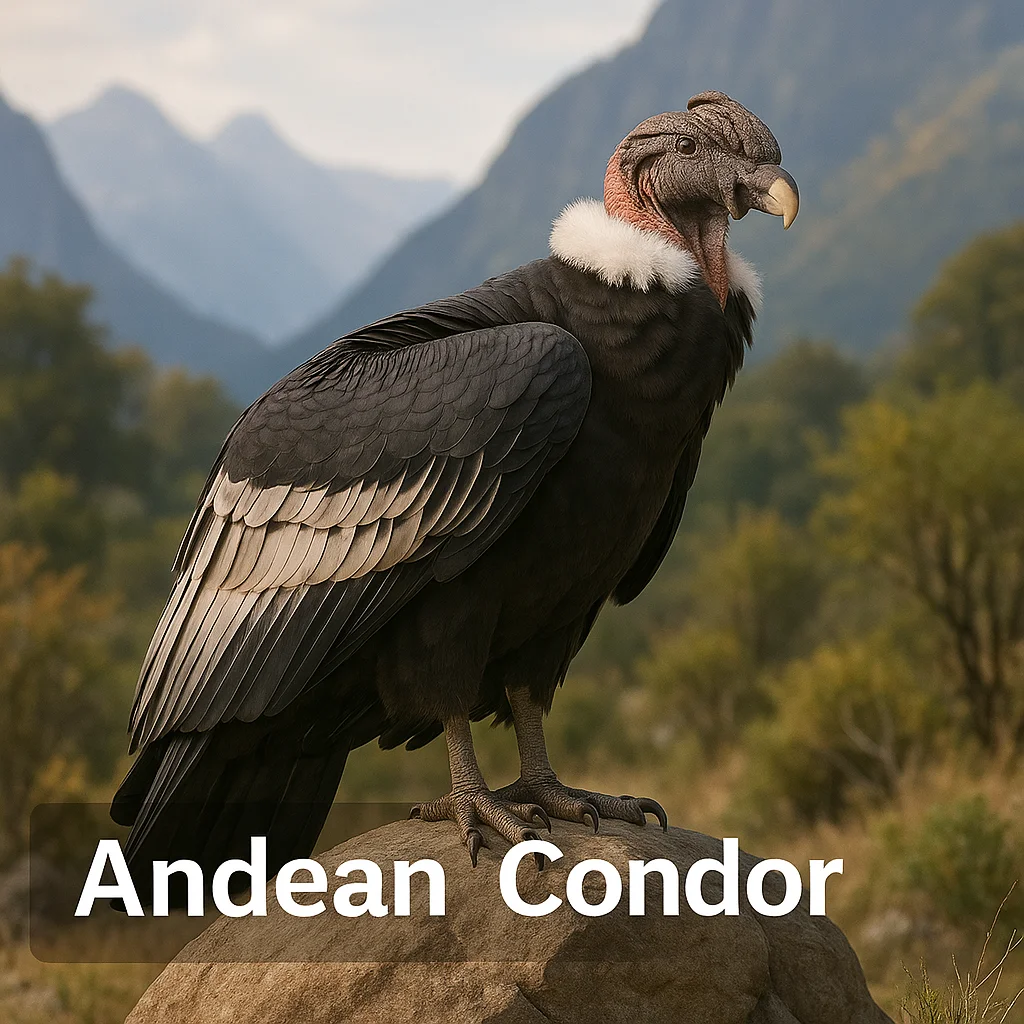
- Common name(s): Andean Condor
- Scientific name: Vultur gryphus
- Animal type: Bird
- Typical adult size: Wingspan up to 3.3 meters (10.8 feet), weight between 11 to 15 kg (24 to 33 lbs)
- Typical lifespan: 50 years in the wild, up to 75 years in captivity
- Diet type: Carnivore; primarily feeds on carrion
- Activity pattern: Diurnal
- Social structure: Often solitary or in small groups
- Speed / movement highlights: Soaring bird, relies on thermal currents to travel long distances
- Intelligence/learning: Highly capable of soaring and navigation
- Primary habitats: Mountainous regions
- Geographic range: Throughout the Andes from Venezuela to Patagonia
- Predators/threats: Few natural predators; threatened by human activity
- Conservation status: Near Threatened
🔍 Identification & Appearance
The Andean Condor is notable for its large body and impressive wingspan. Its distinct coloring and physical features make it recognizable in its native habitats.
- Body shape and silhouette: Large, stocky build with broad wings
- Key colors/patterns: Mainly black with white plumage surrounding the neck and upper wings
- Distinctive features: White ruff of feathers around the neck, bald head that can vary in color
- Tracks, scat, or other field signs: Scat often found near feeding sites, predominantly feathers are a common find
- Common look-alikes: California Condor, distinguishable by size and region
- Top ID Tips:
- Look for a bald head and massive wingspan
- Notice the white feather ruff around the neck
- Observe the soaring behavior high in the sky
- Check the black and white coloration pattern
- Spot the large body size among other flying birds
- Focus on a hooked beak typical of scavengers
- Identify large feet adapted for gripping
- Look for presence in high mountains and rugged terrains
🧱 Body Structure & Physical Adaptations
The Andean Condor possesses a range of adaptations that enable it to efficiently navigate its high-altitude environment.
- Build and proportions: Robust body with strong bone structure, suited for long-distance gliding
- Beak adaptations: Hooked beak for tearing flesh
- Wings: Long, broad wings designed for soaring on thermal currents
- Sensory strengths: Excellent vision for spotting carrion from great heights
- Key Adaptations:
- Large wingspan for sustained flight without frequent flapping
- Muscular build aids in powerful takeoffs and gripping
- Featherless head prevents carrion clinging during feeding
- Exceptional eyesight for locating food over vast areas
- Efficient lungs and metabolism for high-altitude survival
- Bald head keeps hygiene manageable when feeding
- Specialized talons aid in holding down prey
🌍 Range & Distribution
The Andean Condor is primarily found along the Andes mountain range, thriving in a variety of high-altitude environments.
- Regions and typical countries: From Venezuela through Colombia, Ecuador, Peru, Bolivia, Chile, and Argentina
- Elevation range: Typically found at elevations of 3,000 to 5,000 meters (9,800 to 16,400 feet)
- Seasonal movements: Generally non-migratory, but may travel large distances within range for food
- Where You Might Find It:
- High-altitude cliffs in the Andes
- Open grasslands and semi-arid regions near mountains
- Coastal areas where cliffs meet the sea
- National parks and protected areas throughout the Andes
- Remote highland plateaus and valleys
- Mountain edges during thermal updrafts
- Locations near large ungulate populations
- Rugged, isolated terrains in South America
🏞️ Habitat & Shelter
Andean Condors prefer open landscapes typical of mountainous environments, where they can easily locate and access food sources.
- Preferred habitats: Mountainous regions, cliffs, and highlands
- Microhabitats and shelter: Nests in cliffs or overhangs, uses thermal currents for flying
- How weather/season changes behavior: Relies more on thermal currents during cooler seasons for efficient flight
- Importance: Understanding habitats aids in conservation efforts and helps protect this Near Threatened species
🧭 Behavior & Ecology
As a scavenger, the Andean Condor plays a crucial ecological role by helping keep the environment clean.
- Daily routine: Soars during the day in search of food, rests and roosts at night on cliffs
- Communication: Utilizes body language; social with other condors at feeding sites
- Typical interactions with other species: Scavenges on carcasses left by predators, reduced competition due to high-altitude range
- Role in the ecosystem: Essential scavenger, helps decompose dead animals
- Behavior Highlights:
- Highly efficient at soaring on air currents
- Critical for nutrient cycling through scavenging
- Limited vocal communication; more reliant on visual cues
- Frequent interaction at communal feeding sites
- Significant for cultural and ecological symbolism
- Adapts well to various high-altitude environments
- Dominance dynamics observed at feeding sites
👥 Social Life & Group Dynamics
The Andean Condor is primarily a solitary bird, but it shows some social behaviors especially when feeding.
- Solitary vs social tendencies: Generally solitary; engages in social interactions at communal feeding sites
- Group types and size range: Often seen alone or in pairs, but can gather in groups of up to several dozen at craggy cliffs
- Cooperation: Some coordination seen when establishing pecking order at feeding sites
- Social Structure Notes:
- Tends towards solitary life except during feeding
- Occasionally travels in groups when searching for food
- Display of dominance observed at carcasses
- Engagement in social preening activities
- Loose hierarchies evident when food is available
🍽️ Diet, Prey & Predators
As a scavenger, the Andean Condor's diet predominantly consists of carrion. It rarely faces predation but is affected by human threats.
- What it eats: Carrion from large mammals such as deer and livestock
- Main natural predators: Few predators; occasionally threatened by foxes or large cats during nesting
- Scavenging behavior: Often seen circling overhead before descending to feed
- Feeding Notes:
- Relies on vision to locate carrion from afar
- Has strong jaws for tearing flesh
- Rarely consumes fresh kills, prefers carcasses
- Competitions often occur at feeding sites
- Uses beak and feet to manipulate large carcasses
- Able to go several days without food but feasts heavily when available
🦌 Hunting, Foraging & Movement
Andean Condors are adept at utilizing air currents to travel efficient distances while conserving energy.
- Locomotion style: Stellar fliers, notable for their ability to glide
- Speed and endurance: Capable of soaring for hours with minimal energy expenditure
- Typical foraging times: Primarily daytime foraging; can travel great distances for suitable feeding grounds
- Movement & Strategy:
- Relies on soaring to cover large areas in search of food
- Exploits thermal updrafts over mountains
- Employs visual cues to locate feeding opportunities
- Known for long-distance flying potential
- Strategically lands and takes off from elevated terrain
🧠 Intelligence & Senses
The Andean Condor is well-equipped sensory-wise to fulfill its ecological niche, although research on learning behavior remains limited.
- Problem-solving, learning: Capable of recognizing potential feeding areas
- Senses and usage: Exceptional eyesight for tracking and locating carrion
- State uncertainties: Behavioral studies are relatively constrained; more research needed
- Notable Abilities:
- Incredible distance vision for airborne and ground tracking
- Adept at identifying food resources over vast areas
- Demonstrates intelligence through migratory patterns
- Limited voice vocabulary, despite their imposing presence
- Displays impressive conspecific recognition skills
🪺 Reproduction, Pregnancy & Parenting
Andean Condors invest considerable effort in raising their young, typically rearing only one chick at a time with significant parental involvement.
- Breeding seasonality: Breeds biennially, with courtship including aerial displays
- Mating system: Monogamous
- Incubation period: Around 54 to 58 days
- Litter/clutch size: Usually a single egg is laid
- Parenting roles: Both parents share feeding and caring duties
- Reproduction Snapshot:
- Nests are often located on ledges of inaccessible cliffs
- Takes turns incubating egg until it hatches
- Parents feed regurgitated food to chicks
- Young remain with parents for over a year until independent
- Long breeding cycle reflects significant parental investment
♀️♂️ Male vs Female Differences
Male and female Andean Condors exhibit minor differences in size and features.
- Size/weight differences: Males are typically larger than females
- Coloration: Both sexes appear similar, though males might have a larger comb and wattle
- Behavioral role differences: Both sexes participate in raising offspring
- Sex Differences at a Glance:
- Males are usually larger and heavier
- Males might show more pronounced fleshy neck wattles
- Both sexes are collaborative in nesting
- Minimal plumage differences between genders
🧬 Subspecies & Variation
The Andean Condor does not have distinct subspecies; however, there might be slight variations in size depending on the geographical range.
- Realized adaptations: Variations to accommodate different local habitats
- Climate traits: High-elevation adjustment for temperature tolerance
- Coloration: Uniform coloration generally, despite habitat differences
- Variation Notes:
- No subspecies officially recognized
- Some adaptation to different climates observed
- Size might slightly vary by regional availability of carrion
- Potential local adaptations not fully understood
⚠️ Threats, Conservation & Human Interaction
The Andean Condor faces several challenges ranging from habitat encroachment to broader ecological issues. Conservation efforts continue to address these threats and safeguard future generations of these majestic birds.
- Natural challenges and human-related pressures: Habitat loss, pollution, and secondary poisoning from carcasses
- Coexistence tips: Efforts to educate locals on the importance of biodiversity naturally benefit condor populations
- Presence in captivity: Conservation breeding programs operate in zoos
- Responsible Notes:
- Preservation of high-altitude habitats critical
- Monitoring and protection of nesting sites encouraged
- Public awareness to reduce environmental impacts vital
- Expanding research and study initiatives crucial
- Supporting sustainable land practices aids species preservation
✨ Fun Facts & Unique Traits
- Andean Condors can travel up to 200 km in a day while searching for food.
- They have the largest wingspan of any living flying bird.
- Andean Condors are an important cultural symbol in many Andean societies.
- They can live longer than 50 years in the wild, which is rare for birds.
- Young condors stay with their parents for up to two years, learning essential life skills.
- Despite their size, they can soar at altitudes of 5,000 meters with ease.
- Unlike other birds, condors do not have a syrinx and are therefore typically silent.
- They have been regarded as a threatened species, reinforcing their ecological importance.
📌 Summary
- Identification: Large, black and white plumage, balding head, broad wingspan
- Habitat: Mountains, cliffs, high-altitude regions
- Distribution: Andes mountain range, from Venezuela to the southern tip of South America
- Diet: Primarily feeds on carrion, serves as a natural cleaner
- Predators: Few natural enemies, faces human-induced threats
- Social Life: Generally solitary, but engages socially at feeding sites
- Reproduction: Monogamous, significant parental investment in young
- Key Adaptations: Adapted for soaring flight with exceptional vision
- Distinct Features: Cultural significance, extraordinary wingspan, ecological role as scavenger