🦁 Western Gorilla
🧾 Quick Facts
The Western Gorilla, often referred to scientifically as Gorilla gorilla, encompasses two subspecies known for inhabiting the dense forest regions of Central Africa. This primate, recognized for its intelligence and complex social structures, plays a crucial role in its ecosystem as both a seed disperser and a subject of conservation efforts. Below, you will find key details about this remarkable species group.
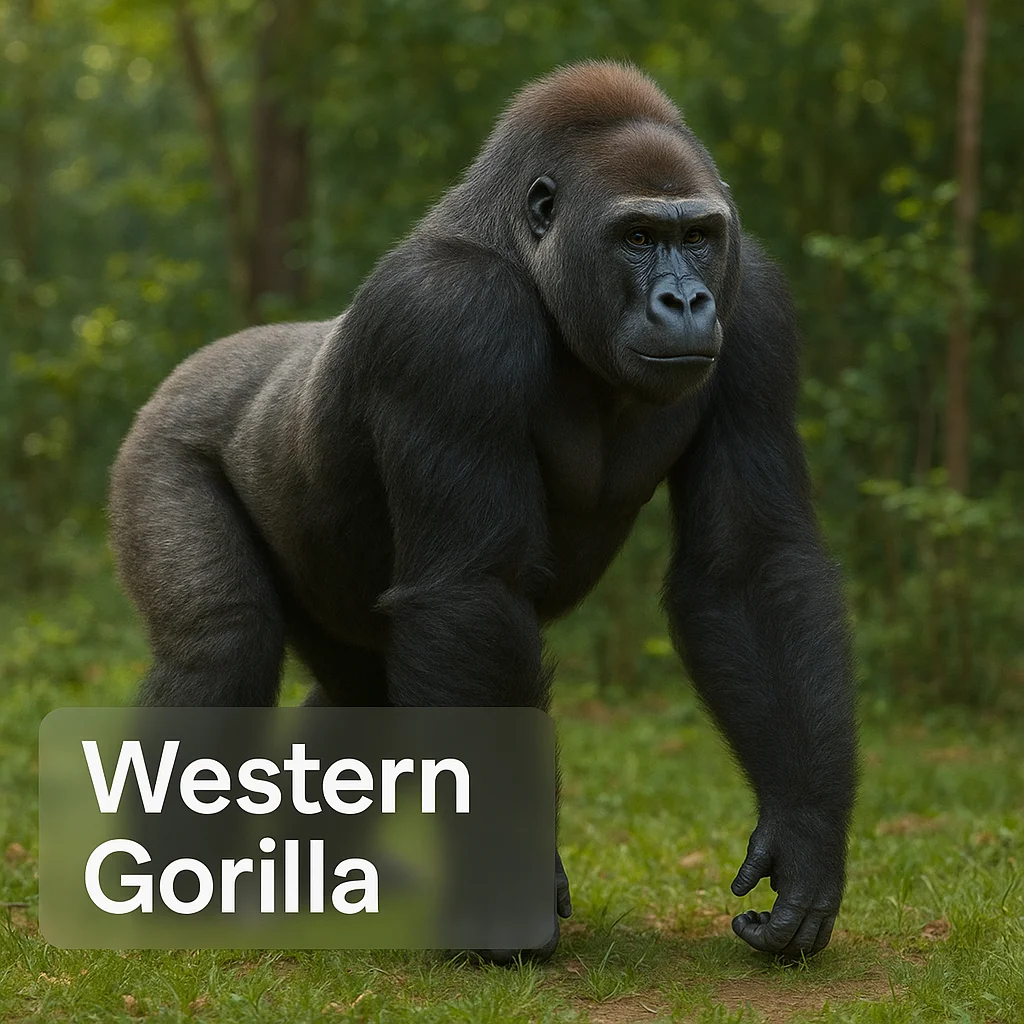
- Common name(s): Western Gorilla
- Scientific name: Gorilla gorilla
- Animal type: Mammal
- Typical adult size: Around 1.5–1.8 meters in height, weighing between 68–270 kg
- Typical lifespan: Approximately 35–40 years in the wild, up to 50 years in captivity
- Diet type: Herbivore, primarily eating fruits, leaves, and shoots
- Activity pattern: Diurnal
- Social structure: Group-living, typically in troops
- Speed / movement highlights: Primarily knuckle-walking, capable of climbing
- Intelligence/learning: High; known for using simple tools and complex social behaviors
- Primary habitats: Tropical and subtropical forests
- Geographic range: Central and Western Africa
- Predators/threats: Mainly humans, potential threats from leopards
- Conservation status: Critically endangered (varies by region)
🔍 Identification & Appearance
Western Gorillas are robust primates with broad chests and shoulders, thick necks, and a prominent sagittal crest, especially in males. Their dense, coarse fur ranges from dark gray to brownish-black, with silverbacks being adult males with distinctive silver hair on their backs. While juveniles exhibit black skin, mature males develop more leathery skin with age.
These gorillas can be distinguished by their wide nostrils and prominent brow ridges. Unlike many other animals, their fingerprints are unique to each individual, similar to humans. Their tracks are identifiable by handprints from knuckle-walking.
- Large, broad-shouldered body
- Dark gray to brown-black fur
- Silverback in adult males
- Wide nostrils and prominent brow ridges
- Knuckle-walking handprints
🧱 Body Structure & Physical Adaptations
The physical build of Western Gorillas is adapted for strength and agility in a forested environment. They possess long, powerful arms and short legs, facilitating their primary mode of locomotion—knuckle-walking. Their broad chests and flat noses are adaptations to life in thickly vegetated habitats.
Gorillas have strong jaws and large, flat teeth to grind fibrous plant materials. Their sensory adaptations include a keen sense of smell and acute hearing, although their sense of vision relies more on motion detection than color differentiation, which is beneficial in the forest's dappled light.
- Powerful arms for knuckle-walking
- Strong jaws and large teeth for plant processing
- Broad chest for muscle attachment
- Keen sense of smell and hearing
- Vision adapted for motion detection
🌍 Range & Distribution
Western Gorillas primarily inhabit the tropical forests of Central Africa. They are found in countries such as Cameroon, the Central African Republic, Gabon, Congo, and Equatorial Guinea. These gorillas prefer dense, lowland tropical and subtropical forests, where they can find abundant food sources to support their dietary needs.
While Western Gorillas are mainly resident in their preferred habitats, they may seasonally move in search of fruit and other food resources within their home ranges.
- Central and Western Africa
- Countries: Cameroon, Gabon, Congo
- Dense tropical forests
- Lowland areas at various altitudes
- Mostly non-migratory, but may move seasonally
🏞️ Habitat & Shelter
Western Gorillas thrive in the thick, humid rainforests of Central Africa, which offer abundant food sources year-round. These primates build nests for sleeping by bending branches in trees or, more commonly, on the ground. They are highly adaptable within these environments, allowing them to use various forest-level habitats from canopy to forest floor.
Knowledge of their habitat is crucial for understanding the social dynamics and survival strategies of Western Gorillas. Changes in weather, such as rainy and dry seasons, influence food availability and, subsequently, gorilla movement patterns.
🧭 Behavior & Ecology
Western Gorillas are social creatures, spending their days in search of food, grooming, and caring for young. They are primarily peaceful but exhibit behaviors to establish dominance within their groups. Dominance displays include chest-beating and loud vocalizations to communicate across distances.
These gorillas play a significant ecological role as seed dispersers, aiding in the regeneration of their forest habitats. They interact with other species through competition and mutualism, maintaining the balance within their ecosystems.
- Spend days foraging and resting
- Grooming is common for bond formation
- Dominance displays include chest-beating
- Seed dispersers for forest regeneration
- Communicate with varied vocalizations
👥 Social Life & Group Dynamics
Western Gorillas live in close-knit groups known as troops, typically consisting of a dominant male silverback, several females, and their offspring. The silverback leads the group, making decisions regarding movement, feeding, and conflict resolution.
These troops exhibit cooperation in childcare, with all members participating in the protection and upbringing of young gorillas. Although conflicts can arise, they are often resolved through displays and vocal cues rather than outright aggression.
- Group-living in troops
- Led by a dominant silverback male
- Cooperative childcare within groups
- Conflict resolved through displays
- High social cohesion and communication
🍽️ Diet, Prey & Predators
The diet of Western Gorillas is herbivorous, predominantly composed of fruits, leaves, and shoots. They exhibit seasonal variation in food preference, favoring fruit when in abundance and resorting to leaves and shoots when fruit is scarce.
While they do not have many natural predators, young gorillas may occasionally be preyed upon by leopards. Adult gorillas rely on group cooperation and the protective presence of the silverback for defense against threats.
- Primarily frugivorous diet
- Leaves and shoots consumed when fruit is scarce
- Occasional predation by leopards
- Group defense against threats
- Regular foraging times dictated by food availability
🦌 Hunting, Foraging & Movement
As herbivores, Western Gorillas forage for food throughout their territory. They usually travel on all fours using knuckle-walking, which is energy-efficient over long distances. Although they are not particularly fast or enduring travelers, they cover considerable ground daily while foraging.
Their foraging strategy adapts to the availability of resources, with movements within home ranges designed to exploit fruiting trees and preferred plant patches.
- Predominantly knuckle-walking
- Forage throughout the day
- Non-migratory within established home ranges
- Travel dictated by resource availability
- Adept at climbing when necessary
🧠 Intelligence & Senses
Western Gorillas are among the most intelligent non-human animals. They have demonstrated the use of simple tools in the wild, such as sticks for foraging. Their social intelligence is evidenced by complex group interactions and role differentiation in troop activities.
Their senses, particularly smell and hearing, are well-developed to navigate their dense forest environment, helping them detect food, danger, and communicate effectively with one another.
- Use of simple tools observed
- Complex social interactions
- Strong olfactory and auditory senses
- Adapted for low-light forest environments
- High problem-solving ability
🪺 Reproduction, Pregnancy & Parenting
Western Gorillas exhibit a polygynous mating system, often with the dominant silverback fathering most of the offspring in a troop. Breeding occurs throughout the year, with a gestation period lasting about 8.5 months. Female gorillas typically give birth to a single infant, with twins being a rare occurrence.
Newborn gorillas are dependent on their mothers for food and protection. Mothers carry infants during their first two to three years of life. Silverbacks often play a protective role in the upbringing of young gorillas.
- Year-round breeding
- Gestation lasts 8.5 months
- Typically single offspring
- Infants carried by mothers
- Protective silverback involvement
♀️♂️ Male vs Female Differences
Sexual dimorphism is significant in Western Gorillas. Adult males are notably larger than females and exhibit the characteristic silverback trait. Males possess larger canines and more robust builds, adaptations linked to their role in defense and dominance within the troop.
Females, while smaller and less aggressive, play pivotal roles in nurturing the young and maintaining group cohesion.
- Males larger and heavier than females
- Distinct silverback in adult males
- Males have larger canines
- Role differences in defense and childcare
- Females more involved in nurturing
🧬 Subspecies & Variation
There are two recognized subspecies of Western Gorillas: the Western Lowland Gorilla (Gorilla gorilla gorilla) and the Cross River Gorilla (Gorilla gorilla diehli). The Western Lowland Gorilla is more widespread, adapted to a variety of forest environments, while the Cross River Gorilla is critically endangered and found in a limited area along the Nigeria-Cameroon border.
Subspecies variation can include differences in size, habitat preferences, and subtle morphological traits.
- Western Lowland Gorilla more widespread
- Cross River Gorilla critically endangered
- Variation in size and habitat
- Limited geographic range for Cross River
- Subtle trait differences between subspecies
⚠️ Threats, Conservation & Human Interaction
Western Gorillas face significant threats from habitat loss due to logging, agriculture, and illegal hunting. Diseases such as Ebola have also heavily impacted populations. Conservation efforts focus on habitat protection and reducing human-gorilla conflict through community-based programs.
Western Gorillas are occasionally found in zoos, where programs aim to educate the public and support conservation efforts. It is crucial to promote ethical interactions in captivity and support initiatives that involve local communities in conservation strategies.
- Threats: habitat loss and hunting
- Impact of diseases like Ebola
- Conservation focuses on habitat protection
- Importance of ethical interaction in captivity
- Community-based conservation programs
✨ Fun Facts & Unique Traits
- Western Gorillas share 98% of their DNA with humans.
- They are known to create tools to assist in foraging for food.
- Their vocal array includes up to 25 different sounds for communication.
- Adult males develop a distinctive silverback at around 12 years old.
- Gorilla groups often travel over 2,000 meters in a single day for foraging.
- Each gorilla's fingerprint is as unique as a human's.
- They build new sleeping nests every night for safety and comfort.
📌 Summary
- Robust primates with significant social structures known as troops.
- Inhabit dense forests in Central Africa.
- Primarily herbivorous, with a preference for fruits and leaves.
- Face threats from habitat loss and disease.
- High intelligence and tool use observed among gorillas.
- Distinct sexual dimorphism; males are larger with silverbacks.
- Bare organized social structures with a dominant silverback male.
- Critically important as seed dispersers in their ecosystems.
- Conservation efforts are crucial for their survival.