🦁 Tarsier
🧾 Quick Facts
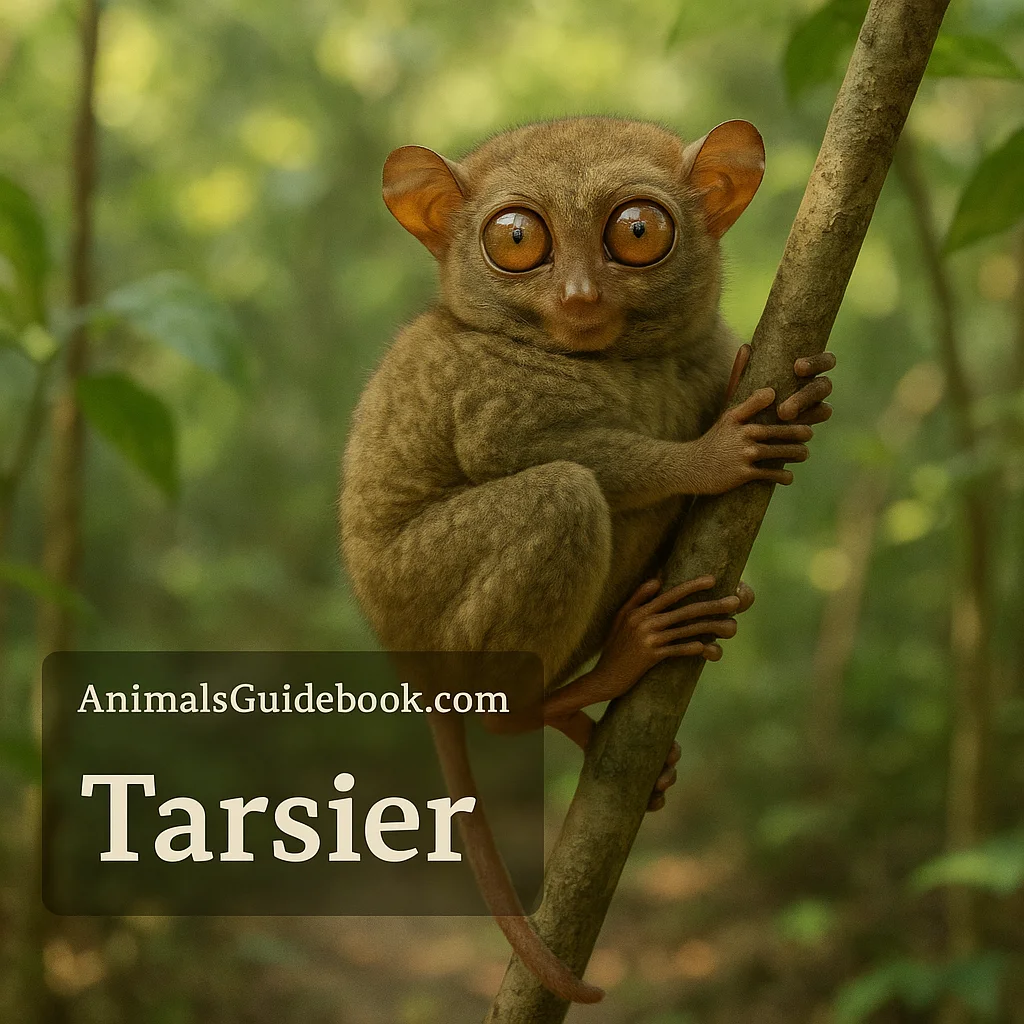
Tarsiers are small primates known for their distinctive appearance and unique behaviors. They are found primarily in Southeast Asia and are famous for their enormous eyes, which aid in nocturnal hunting.
- Common name(s): Tarsiers
- Scientific name: Tarsiidae (family, various genera and species)
- Animal type: Mammal
- Typical adult size: 9 to 16 cm in length; weight 80-160 grams
- Typical lifespan: 12 to 20 years in captivity; less documented in the wild
- Diet type: Carnivore (primarily insectivorous)
- Activity pattern: Nocturnal
- Social structure: Often solitary or living in small family groups
- Speed/movement highlights: Highly agile leapers
- Intelligence/learning: Known for complex problem-solving abilities
- Primary habitats: Tropical rainforests and mangroves
- Geographic range: Southeast Asia, including the Philippines, Borneo, and Sumatra
- Predators/threats: Birds of prey, snakes; human-driven habitat loss
- Conservation status: Varies by region, with some species endangered
🔍 Identification & Appearance
Tarsiers can be recognized by their small, compact bodies, long hind legs, and disproportionately large eyes. Their fur is typically gray to brownish, providing camouflage in their forest habitats.
- Body shape: Compact with long limbs
- Eye size: Very large and forward-facing
- Distinctive features: Long fingers and toes, elongated ankle bones (tarsal bones)
- Tail: Long and slender, used for balance
- Tracks/scat: Rarely seen due to arboreal habits
- Common look-alikes: None; unique among primates
- Top ID Tips:
- Look for large eyes relative to body size
- Notice the elongated hind limbs
- Check for long, thin fingers
- Look for fur color matching the forest floor
- Observe their quick, agile movements
- Note their tendency to cling vertically to trees
🧱 Body Structure & Physical Adaptations
Tarsiers have evolved unique physical structures to thrive in their nocturnal, arboreal lifestyle. Their long limbs and specially adapted ankle bones enable incredible leaping abilities, while their eyes provide acute night vision.
- Build and proportions: Slender with elongated hind limbs and long tail
- Teeth: Sharp for catching and consuming prey
- Claws: Nails adapted for climbing
- Sensory strengths: Excellent night vision and hearing
- Key Adaptations:
- Enormous eyes for enhanced night vision
- Powerful leaping abilities, up to 40 times their body length
- Rotating head for better prey detection
- Nails suited for climbing and gripping
- Acute sense of hearing to locate insects
- Flexible ankle joints for secure landings
🌍 Range & Distribution
Tarsiers inhabit regions in Southeast Asia and are primarily found in tropical and subtropical climates. They do not migrate and usually stay within a particular range that offers ample cover and food supply.
- Philippines having several species endemic to different islands
- Borneo, primarily in forested areas
- Sumatra's rainforest regions
- Occur in lowland and montane tropical rainforests
- Do not inhabit open or arid regions
- Reside mainly in dense forest regions
- Where You Might Find It:
- In dense canopy layers of rainforests
- Mangrove areas with sufficient cover
- High biodiversity regions
- Philippine islands like Bohol and Leyte
- Forested parts of Borneo and Sumatra
- In tree hollows or nests built in dense foliage
🏞️ Habitat & Shelter
Tarsiers find shelter in the forest canopy or thickets, rarely descending to the ground. They require dense vegetation for both cover and the abundant insect life it supports. Understanding these requirements is crucial to their conservation.
- Preferred habitats: Tropical rainforests
- Shelter: Tree hollows and dense foliage
- Behavior changes: More active after dark; less visible during the day
- Survival: Relies on habitat for food and safety
🧭 Behavior & Ecology
Tarsiers are primarily nocturnal, engaging in active hunting during the night. They exhibit solitary behaviors but maintain territories marked by vocalizations and scent marking.
- Daily routine: Nocturnal; active hunting at night
- Communication: High-pitched vocalizations, scent marking
- Interactions: Minimal, except for mating and caring for young
- Ecological role: Insect population control via predation
- Behavior Highlights:
- Leap to capture insects mid-air
- Utilize acute hearing for prey detection
- Defend territory through vocalizations
- Engage in elaborate grooming behaviors
- Rarely observed on the ground
- Exhibit rapid response to prey movements
👥 Social Life & Group Dynamics
Though often solitary, tarsiers form tight-knit family units when raising offspring. They exhibit limited cooperative behaviors outside parental care and remain territorial.
- Solitary tendencies: Remarkable; interact mainly for mating
- Group types: Small family units, typically mating pairs and offspring
- Cooperation: Seen primarily in care for young
- Conflict: Resolved by vocal exchanges rather than physical conflict
- Social Structure Notes:
- Pairs may defend a shared territory
- Females more likely to be found in groups
- Strong maternal bonds in parenting
- Males typically less involved in group dynamics
- Limited social hierarchy complexity
- Intense territorial calls to deter intruders
🍽️ Diet, Prey & Predators
Tarsiers primarily consume insects but will also prey on birds, reptiles, and small mammals when available. They use stealth and quick leaps to capture food and rely on their acute senses to detect movement in the dark.
- Diet: Carnivorous; mainly insects, sometimes small vertebrates
- Hunting style: Quick strikes and leaps
- Natural predators: Birds of prey, snakes, large mammals
- Anti-predator strategies: Stealth, agility, and excellent night vision
- Feeding Notes:
- Consumes largely insects like grasshoppers and beetles
- Opportunistic feeding on lizards and small birds
- Nest in densely covered areas for protection from birds
- Stealthy hunting methods to avoid attracting predators
- Primarily visual and auditory prey detection
🦌 Hunting, Foraging & Movement
Tarsiers are agile climbers and leapers, using these abilities to forage for insects in the darkness. Their nocturnal habits allow them to exploit prey activity at night, using stealth and patience to ambush their targets.
- Locomotion: Climbers and powerful leapers
- Speed: Fast leaping, moderate endurance
- Foraging tactic: Ambush and pursue with quick precision
- Home range: Tend to occupy well-defined territories
- Movement & Strategy:
- Uses trees for support in leaping
- Space within canopy for ambush potential
- Efficient energy use in nocturnal hunting
- Able to pivot rapidly in response to prey movement
- Exploits vertical space in forest
🧠 Intelligence & Senses
Tarsiers show advanced sensory capabilities, particularly in vision and hearing. Their intelligence is evidenced by complex problem-solving and territorial behaviors, though research is limited in social cognition.
- Cognitive skills: Good problem-solving, spatial awareness
- Senses: Outstanding night vision, keen hearing
- Limitations: Social intelligence less understood
- Notable Abilities:
- Can remember intricate territory layouts
- Recognize different vocalizations
- Detect prey movement with high accuracy
- Rapid problem-solving in navigation
- Limited research in tool use and abstract reasoning
🪺 Reproduction, Pregnancy & Parenting
Tarsiers breed seasonally, often corresponding to food availability, and exhibit monogamous pair bonds. The gestation period is notably long for their size, with mothers providing extensive care to the single offspring, which is born relatively mature.
- Breeding seasonality: Correlates with wet season
- Mating system: Primarily monogamous
- Gestation period: Approximately 6 months
- Litter size: Usually a single offspring
- Parenting: High maternal care; father may assist
- Reproduction Snapshot:
- Single offspring with each birth
- Relatively well-developed at birth
- Young cling to mother's fur for transportation
- Vocalizations and grooming as bonding activities
- Long inter-birth intervals to ensure resource availability
♀️♂️ Male vs Female Differences
While sexual dimorphism in tarsiers is not striking, slight size differences may occur. Behavioral roles in reproduction and territory defense can also vary between genders.
- Size differences: Males and females are nearly the same size, though males may be slightly larger
- Coloration and markings: No significant differences
- Behavioral roles: Males may be more territorial
- Sex Differences at a Glance:
- Males slightly larger on average
- No distinctive coloration differences
- Males can exhibit more aggressive territory defense
- Parental care primarily by females
- Both participate in territorial vocalizations
🧬 Subspecies & Variation
Tarsier subspecies vary in size and coat patterns, often correlating with their distinct island environments. Some subspecies classifications are debated due to overlapping features and genetic analyses.
- Subspecies: Different on Philippine islands, Sumatra, Borneo
- Local adaptations: Islands show size and behavior variations
- Classification challenges: Genetic studies still refining subspeciation
- Variation Notes:
- Island populations may show significant differences
- Biodiversity hotspots have unique adaptations
- Coat color aligns with habitat background
- Size varies to fit ecological niche
- Debates continue over the classification of certain populations
⚠️ Threats, Conservation & Human Interaction
Factors such as habitat destruction from logging and agricultural expansion seriously threaten tarsiers. Conservation efforts focus on habitat protection and sustainable practices, and understanding local customs aids in their protection.
- Natural challenges: Predator competition
- Human pressures: Habitat loss, fragmentation
- Coexistence tips: Support habitat-friendly policies and practices
- Responsible Notes:
- Habitat protection is crucial to sustainability
- Ecotourism can benefit conservation
- Engage local communities in conservation efforts
- Support biodiversity initiatives
- Contribute to reforestation projects
✨ Fun Facts & Unique Traits
- Tarsiers have the largest eyes relative to body size among mammals
- Capable of turning their heads nearly 180 degrees
- Named after their elongated tarsal bones, crucial for leaping
- Sensitive to high-frequency sounds, including moth wingbeats
- Unique among primates for their entirely carnivorous diet
- Have been part of Southeast Asian folklore due to their distinctive appearance
📌 Summary
- Recognizable by large eyes and elongated limbs
- Inhabit Southeast Asian rainforests and mangroves
- Carnivorous diet mainly consisting of insects
- Mostly solitary but form small family bonds
- Exhibit unique adaptations for nocturnal hunting
- Vulnerable to habitat destruction and fragmentation
- Conservation dependent on habitat protection
- Unique physiology allows powerful leaps
- Tarsiers' distinct look and behaviors make them fascinating subjects for study