🦁 Striped Skunk
🧾 Quick Facts
The striped skunk, noted for its distinctive coloration and defensive spray, is a common mammal found across North America. This animal has fascinated both researchers and the general public with its surprisingly varied diet and adaptable nature.
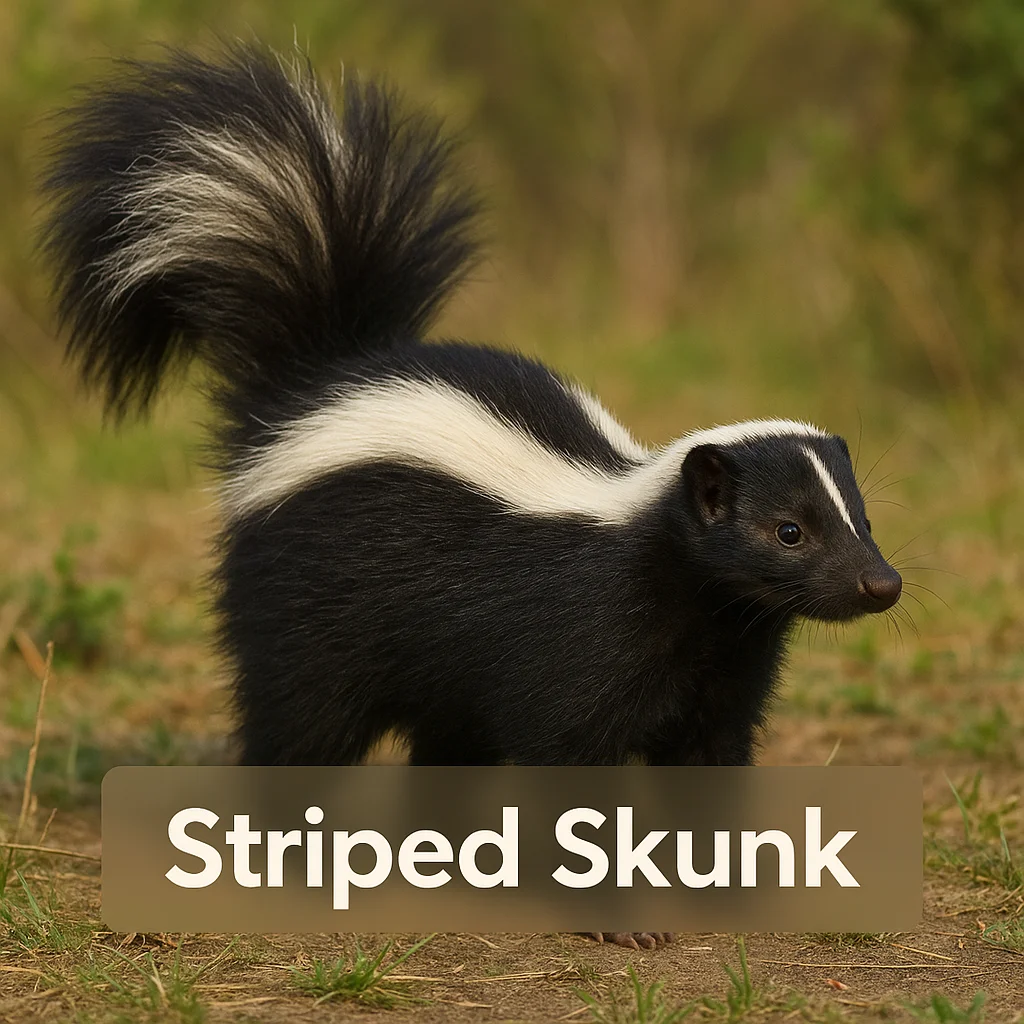
- Common name(s): Striped Skunk
- Scientific name: Mephitis mephitis
- Animal type: Mammal
- Typical adult size: 20-30 inches length, including tail; 6-14 pounds in weight
- Typical lifespan: 3-7 years in the wild; up to 10 years in captivity
- Diet type: Omnivore; includes insects, small mammals, eggs, fruits, and plants
- Activity pattern: Nocturnal
- Social structure: Solitary, except during breeding season
- Speed / movement highlights: Slow-moving; capable of short bursts of speed when threatened
- Intelligence/learning: Intelligent with good problem-solving abilities; known for learning avoidance behaviors
- Primary habitats: Woodlands, grasslands, and suburban areas
- Geographic range: Across North America, from southern Canada to northern Mexico
- Predators/threats: Predators include great horned owls, coyotes, and domestic dogs; human-related threats include habitat loss and vehicle collisions
- Conservation status: Least Concern
🔍 Identification & Appearance
The striped skunk is recognized by its black fur adorned with two prominent, white stripes running from the head to the tail. Its body is robust, designed for burrowing and defense rather than speed. The tail is bushy and often raised in a threat display.
Skunks may leave tracks that show five toes on each paw with noticeable claw marks. Their scat is often tubular, reflecting an omnivorous diet. Look-alikes include spotted skunks, which are smaller and have distinct spot patterns rather than stripes.
- Robust, medium-sized mammal with distinct black-and-white coloring
- Two white stripes from the head to the tail
- Large, bushy tail
- Tracks with five clawed toes
- Noticeable musty scent even when spray is not present
- Short, rounded ears and small eyes
- Often mistaken for spotted skunks, which are smaller
- Distinct waddling movement when walking
- Characteristic defensive posture when threatened
🧱 Body Structure & Physical Adaptations
The striped skunk has a stocky build with short legs, adapted for digging. Its forefeet are equipped with curved claws, optimal for burrowing. It possesses a small head, short muzzle, and a highly sensitive nasal area for detecting food.
Teeth are adapted for an omnivorous diet, with structures suitable for grinding plant material and handling small prey. Skunks have poor eyesight but compensate with remarkable olfactory and auditory senses.
- Sturdy, burly body
- Sharp, curved claws for digging
- Broad, flexible snout for detecting prey
- Adapted teeth for varied diets
- Exceptional sense of smell used for foraging
- Acute hearing
- Short limbs facilitate slow, careful movement
- Large scent glands for defense
- Built to endure cold climates
- Bristly but muscular tail for display and balance
🌍 Range & Distribution
The striped skunk is found primarily throughout North America, inhabiting regions from southern Canada through most of the United States and into northern Mexico. It favors diverse habitats, thriving in areas ranging from forests to suburban landscapes.
Skunks do not tend to migrate, but they may adjust their range slightly based on seasonal food availability. They are resident creatures most of the year.
- North America as a broad range
- Common in the United States and southern Canada
- Frequent in grasslands and open fields
- Often seen in suburban areas with plentiful food sources
- Present in regions with mild to warm climates
- Prefers areas near water sources
- May be less frequently observed in dense, humid forests
- Occasionally found in urban settings
🏞️ Habitat & Shelter
Striped skunks show adaptability, inhabiting a variety of environments. They prefer open areas such as fields and grasslands but are also found in forests, agricultural lands, and urban areas. Skunks often use abandoned burrows created by other animals for shelter, as well as under logs, buildings, or rock piles.
Weather and seasonal changes influence skunk activity; during colder months, they become less active and rely on stored fat reserves. Shelter knowledge is vital in understanding skunk behavior, as it takes advantage of human-modified environments for survival.
🧭 Behavior & Ecology
Striped skunks are nocturnal, spending daylight hours in dens. They are adept foragers, using their sense of smell to locate food. Skunks communicate through vocalizations and a range of body signals, utilizing prominent scent marking as a defense mechanism.
They play an important ecological role as omnivorous foragers, helping control insect populations and acting as seed dispersers. Skunks are also prey for larger predators, maintaining a balanced food web.
- Nocturnal foraging patterns
- Seeks shelter during daylight hours
- Relies heavily on olfactory cues
- Bold scent-marking as a defensive strategy
- Interactions include mutualism with pollinators
- Ecosystem role includes seed dispersal
- Communicates through hisses, growls, and squeaks
- Plays a part in controlling insect populations
- Non-territorial with overlapping home ranges
👥 Social Life & Group Dynamics
Skunks are generally solitary animals, only coming together for breeding. They do not form structured groups or packs and maintain individual territories that may overlap with others. During harsh weather, they may share dens temporarily for warmth.
- Solitary except during mating
- Individual territories with overlapping ranges
- No fixed leadership or dominance hierarchy
- Tolerates temporary den sharing in winter
- Minimal to no cooperative behavior
- Utilize ritualized displays to minimize conflict
- Communication limited to brief vocal exchanges
- Social interactions are typically brief and breeding-focused
🍽️ Diet, Prey & Predators
The striped skunk has an omnivorous diet that includes insects, small mammals, eggs, berries, and plant materials. They adapt their food sources based on availability, which can vary with the seasons and location.
Natural predators of skunks include great horned owls, coyotes, and occasionally domestic dogs. The skunk's notorious defensive spray serves as a potent deterrent to many would-be predators. Skunks may also scavenge when opportunities arise.
- Omnivorous, adaptable diet
- Feeds on insects like grasshoppers and beetles
- Will consume small rodents and bird eggs
- Enjoys fruits and plant materials
- Forages for grubs and larvae underground
- Mainly threatened by predatory birds
- Scent spray for defense against mammals
- Scavenges waste in suburban environments
- May eat carrion if encountered
🦌 Hunting, Foraging & Movement
The skunk uses a methodical foraging strategy, relying on its sense of smell to detect hidden food sources. It is not a fast animal but is capable of quick bursts of speed if threatened. Skunks conduct most foraging at night and are deliberate in excavation efforts.
These mammals are not migratory, remaining within a familiar home range throughout their life. They are known to adapt their diet to seasonal changes, efficiently using local resources.
- Forages mainly at night
- Sensitive nose for locating food underground
- Adapted to digging and uncovering hidden prey
- Capable of brief, rapid movement when necessary
- Home range remains relatively stable over time
- Utilizes scent cues for navigation
- Feeding involves solitary, independent foraging
- Not a migratory species
🧠 Intelligence & Senses
The striped skunk displays notable problem-solving abilities, learning behaviors rapidly when food or threats are involved. It possesses a robust memory for locations and food storage. While visually limited, it has exceptional olfactory and auditory senses for detecting prey and avoiding danger.
Current research on skunk intelligence is limited, and much remains to be explored in understanding their cognitive abilities fully.
- Advanced olfactory senses for tracking food
- Sharp hearing for detecting danger
- Demonstrates problem-solving through learning patterns
- Memory for remembering den locations and food caches
- Limited visual acuity, relies on other senses
- Capable of associative learning in captivity
- Adaptability in urban environments
🪺 Reproduction, Pregnancy & Parenting
Striped skunks breed once a year, typically in early spring. They are polygamous, with males breeding with multiple females. Gestation lasts around 60 to 75 days, resulting in a litter of 4-7 kits. Kits are altricial, born blind and deaf, relying entirely on the mother.
Female skunks undertake all caring responsibilities, nurturing the kits in a safe den until they are capable of independent foraging, typically by two months old.
- Breeding occurs in spring
- Mating is polygamous
- Gestation period is approximately 2.5 months
- Litter size ranges from 4 to 7 kits
- Kits are blind and helpless at birth
- Mother provides sole parental care
- Kits follow the mother after one month
- Independent by three months of age
- Breeding takes place once per year
♀️♂️ Male vs Female Differences
There are subtle differences between male and female skunks, with males typically being slightly larger and heavier. Both sexes exhibit similar coloration and defensive behaviors. Behaviorally, females tend to be more secretive, especially when caring for young.
Skunk sexual dimorphism is not very pronounced, making visual differentiation difficult without closer observation or measurement.
- Males generally larger than females
- Similar coloration between sexes
- Both sexes produce defensive spray
- Females more protective during the nurturing period
- Larger males may exhibit bolder behavior
- Subtle behavioral variances during breeding season
🧬 Subspecies & Variation
The striped skunk is a single species with some geographic variations in size and subtle color differences. There are no widely recognized subspecies, but regional adaptations may occur, such as thicker coats in northern populations for better insulation.
While subspecies classification is not extensively debated, geographic variance in appearance and size is noted through casual observation.
- No distinct subspecies recognized
- Geographic variation in size
- Adaptations include thicker northern coats
- Color pattern remains consistent across range
- Subtle regional size differences
⚠️ Threats, Conservation & Human Interaction
The striped skunk faces natural predators and human-induced challenges like habitat loss and vehicle collisions. As urban environments expand, skunks often find refuge in suburban areas, leading to potential human-wildlife conflicts.
Skunks can be beneficial in controlling pest populations, making them valuable in some agricultural systems. Coexistence strategies include securing trash and avoiding provoking their defensive spray.
- Primary natural threats include predatory birds
- Human-related threats: habitat fragmentation
- Vehicle traffic poses significant risk
- Indirect agricultural benefits through pest control
- Encourages urban coexistence with measured distance
- Non-aggressive unless provoked or threatened
- Conservation status is generally stable
✨ Fun Facts & Unique Traits
- Skunks have scent glands that can spray as far as 10 feet.
- Their musk is notorious for being difficult to remove from fabrics and fur.
- Skunks are one of the few mammals that use odor to defend against predators.
- Their striped pattern signals a warning to potential threats.
- Despite poor vision, skunks can detect movement well.
- Their scientific name, Mephitis mephitis, underscores their reputation through the term's Latin root indicating poor smells.
- Skunks are known to play a role in the spread of seeds, contributing to plant reproduction.
- They are not true hibernators but enter a state of torpor during periods of extreme cold.
📌 Summary
- Identified by their black and white striped fur and stout body
- Commonly inhabit forests, grasslands, and suburban areas
- Range includes most of North America
- Omnivorous diet with a focus on insects and small animals
- Predators include coyotes and large birds; human conflicts arise with urban encroachment
- Solitary, with a mating season interaction
- Polygamous with a seasonal breeding pattern
- Displays physical adaptations for defense and digging
- Unique for using scent-based defense mechanisms