🦁 Siamang
🧾 Quick Facts
The siamang is a fascinating primate found in the forests of Southeast Asia. Known for its distinctive calls and unique social behaviors, the siamang captivates researchers and animal lovers alike.
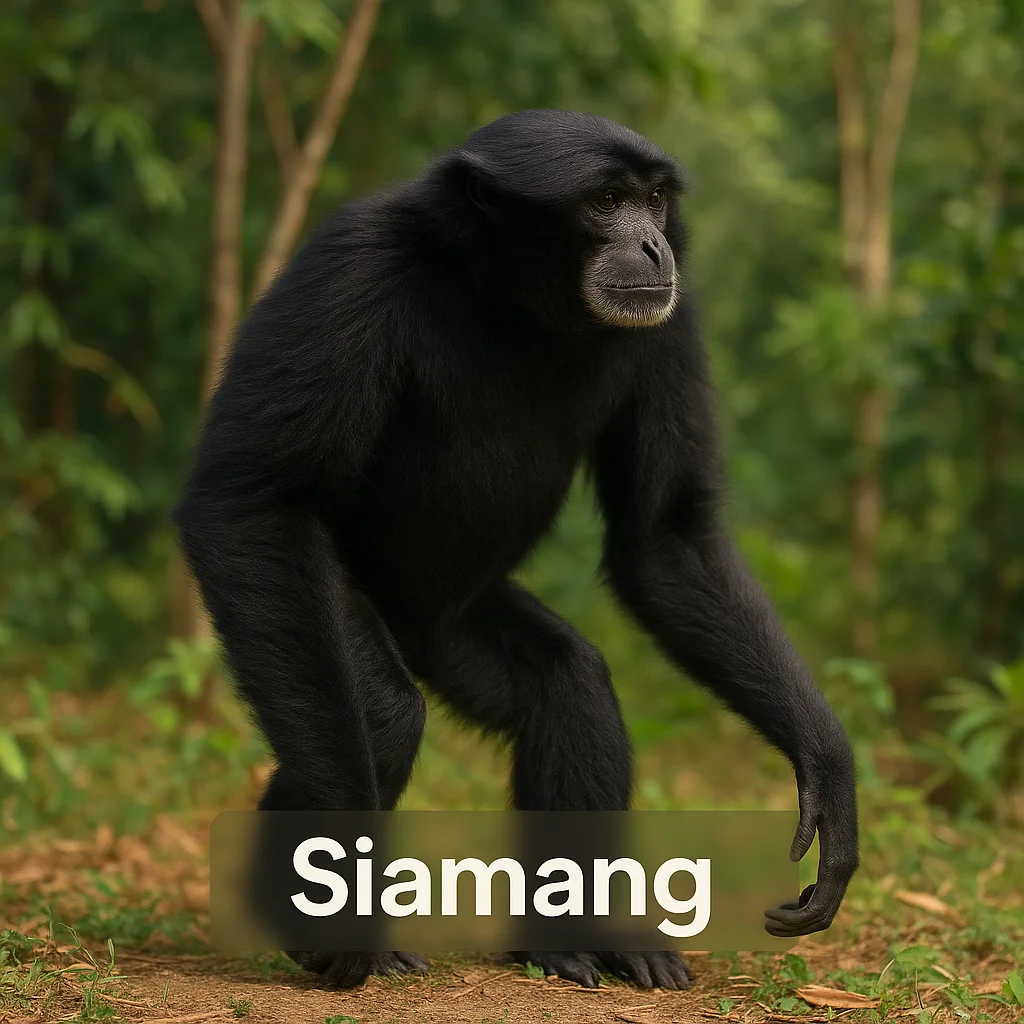
- Common name: Siamang
- Scientific name: Symphalangus syndactylus
- Animal type: Mammal
- Typical adult size: 29–35 inches (length); 20–30 pounds (weight)
- Typical lifespan: Up to 30–40 years (wild and captive)
- Diet type: Omnivore; primarily fruits, leaves, and small invertebrates
- Activity pattern: Diurnal
- Social structure: Family groups
- Speed / movement highlights: Agile brachiators
- Intelligence/learning: High; complex social interactions and problem-solving
- Primary habitats: Rainforests
- Geographic range: Southeast Asia, primarily Sumatra and the Malay Peninsula
- Predators/threats: Occasional large birds of prey, habitat destruction
- Conservation status: Endangered
🔍 Identification & Appearance
Siamangs are recognized by their impressive size, being the largest of the gibbon family. They possess long arms that are ideally suited for swinging through trees and have a distinct throat sac, used to amplify their calls. Siamangs are generally black and have a shaggy appearance.
- Stocky body with long arms
- Black, dense fur covering body
- Inflatable throat sac for vocalization
- No tail, unlike monkeys
- Look-alikes: other gibbon species, but siamang's larger and darker
- Distinctive loud, complex calls
- Facial structure includes a prominent brow
- Swinging motion (brachiation) through trees
- Tracks: difficult to find due to arboreal lifestyle
🧱 Body Structure & Physical Adaptations
Siamangs have evolved specific physical traits that support their arboreal lifestyle. Their long arms allow for efficient brachiation, with hook-shaped hands while their feet provide strong holds on branches. They have a robust mouth structure for processing a variety of plant materials.
- Stocky build for strength
- Long arms and highly mobile shoulder joints
- Strong, non-prehensile feet
- Large mouth with strong jaws
- Sensory reliance on vision
- Throat sac for sound amplification
- Efficient brachiation for traveling through canopy
🌍 Range & Distribution
The siamang's natural habitat extends through the forests of Southeast Asia, notably in Sumatra and parts of the Malay Peninsula. They prefer dense, tropical rainforests and rarely wander out of these green sanctuaries.
- Found in Sumatra and Malay Peninsula
- Lives in dense rainforests
- Generally found at low to mid-altitudes
- Resident, non-migratory species
- Prefers equatorial climate
- Found where trees offer continuous canopy
- Common in national parks and protected areas
🏞️ Habitat & Shelter
Siamangs dwell primarily in tropical rainforests where the rich foliage provides ample food and habitat. Their ability to navigate the treetops affords them shelter and a natural defense against many land-based predators. Seasonal weather changes influence their movement minimally, as their dense canopy homes provide protection from various elements.
🧭 Behavior & Ecology
Siamangs are rangy and energetic, spending most of their daytime hours foraging, grooming, or interacting with group members. They are known for their vocal communication, with family groups performing complex call duets. As seed dispersers, they also play a crucial ecological role in maintaining forest biodiversity.
- Active during the day
- Communicates via loud call songs
- Uses swinging motion to move swiftly
- Grooms regularly to reinforce social bonds
- Employs vocal displays for bonding
- Seed disperser, aiding rainforest ecosystem
- Tends to territory with vocalizations
- Interacts occasionally with neighboring groups
👥 Social Life & Group Dynamics
Living in small family units, siamangs often exhibit a strong pair bond between mates and share parental duties for their offspring. These family groups usually consist of two to six members and are territorial, often asserting dominance through vocalizations rather than physical confrontations.
- Strong pair bonds in family groups
- Group size typically 2-6 individuals
- Both parents aid in raising young
- Vocalizations used for territorial defense
- Avoids physical conflicts, resolves loudly
- Strong cohesion and social bonds
- Structured grooming sessions
- May exhibit playful interactions
🍽️ Diet, Prey & Predators
Siamangs are chiefly frugivores, but their diet can also include leaves, flowers, and small invertebrates. They don't have many natural predators due to their arboreal and elusive lifestyle; however, habitat destruction is a significant threat.
- Eats fruits, leaves, flowers
- Considers insects as part of diet occasionally
- Main predators: large birds of prey
- Anticipates threats with vigilant behavior
- Rarely comes to ground, staying safe in trees
- Food scarcity managed by wide-ranging foraging
🦌 Hunting, Foraging & Movement
The siamang's primary method of travel is brachiation, providing a swift and energy-efficient means to traverse the expansive treetops. Their strong arms and precise navigational skill allow them to access a wide range of resources. They exhibit strategic foraging, timing their travels to avoid competition.
- Moves primarily through brachiation
- Strategically times foraging to minimize conflict
- Adept at navigating dense canopy
- Exhibits patience and precision in movement
- Favors morning foraging routines
- Prefers specific fruiting trees
- Flexible territory range depending on resource availability
🧠 Intelligence & Senses
Siamangs demonstrate impressive cognitive abilities, including complex learning and communication skills. They rely heavily on sight and sound to interact and understand their environment, with vocalization playing a pivotal role in social and territorial negotiations.
- Exhibits problem-solving skills
- Vocal cognition used in group harmony
- Relies on sight for movement and foraging
- Poor sense of smell; not crucially needed
- Development of young involves learning complex vocalizations
- Demonstrates memory of fruitful areas
- Limited research on tool use
🪺 Reproduction, Pregnancy & Parenting
Siamangs are typically monogamous, with both parents involved in child-rearing. Birth intervals usually last two to three years, as infants require prolonged care. Young siamangs remain dependent on parental care for over a year.
- Breeding season varies slightly by location
- Typically monogamous mating pairs
- Gestation lasts 7–8 months
- Usually gives birth to one offspring
- Infants are altricial at birth
- Shared parenting; both parents involved
- Weaning occurs around a year of age
- Maternal bonds remain strong
♀️♂️ Male vs Female Differences
In siamangs, sexual dimorphism is minimal; however, subtle differences exist in size and roles within their social structure. Males may be slightly larger and participate actively in territory defense and group cohesion.
- Minimal sexual dimorphism
- Males slightly larger overall
- Both genders involved in parenting
- Males more vocal in territorial defense
- Both participate equally in foraging
- Shared responsibilities in grooming
🧬 Subspecies & Variation
Currently, siamangs are recognized as a single species without formally defined subspecies. However, variations may occur in their sound and behavior related to geographical distribution, though these are not yet fully characterized.
- No formally recognized subspecies
- Geographical differences in vocal patterns
- Exists in isolated populations due to habitat fragmentation
- Some variance in size and weight
- Adaptations linked to specific environmental conditions
⚠️ Threats, Conservation & Human Interaction
While natural predation poses little threat, human-induced challenges gravely affect siamangs. Deforestation for agriculture and development significantly diminishes their habitat, urging conservation efforts to protect remaining populations and educate on sustainable practices.
- Habitat loss due to logging and agriculture
- Illegal pet trade poses severe risks
- Human-wildlife conflict due to overlapping areas
- Conservation status: Endangered
- Captive breeding programs in place
- Promotes ecotourism for awareness
- Efforts required for habitat corridor creation
- Cultural significance in native lands
✨ Fun Facts & Unique Traits
- Siamangs are sometimes mistaken for chimpanzees due to their dark fur and vocal capacity.
- They have the largest throat sac among the gibbons, aiding in their signature calls.
- Despite their size, siamangs are exceptionally agile in the canopy.
- Siamang family groups often sing in harmony, creating complex vocal duets.
- They can live in harmonious, small groups for years without notable conflict.
- Their social structure is notably monogamous, unlike many primate relatives.
- Capable of swinging distances of up to 10 meters between trees.
- They maintain lifelong pair bonds with strong emotional connections between mates.
- Their diet shifts more towards leaves in fruit-scarce seasons.
📌 Summary
- Siamangs are the largest of the gibbon family.
- Identifiable by their black fur and prominent throat sac.
- Found in the dense rainforests of Southeast Asia.
- Live in small family groups with strong pair bonds.
- Diet primarily consists of fruits with some foliage and invertebrates.
- Endangered due to habitat destruction and illegal trade.
- Voice and sound are crucial for territory communication and social bonding.
- Highly adapted for an arboreal lifestyle, primarily through brachiation.
- No significant sexual dimorphism but differences in size and roles exist.