🦁 Ring-tailed Lemur
🧾 Quick Facts
The Ring-tailed Lemur is a fascinating primate known for its striking tail and vibrant social life. Native to Madagascar, these lemurs captivate both wildlife enthusiasts and researchers alike with their unique behaviors and ecological roles.
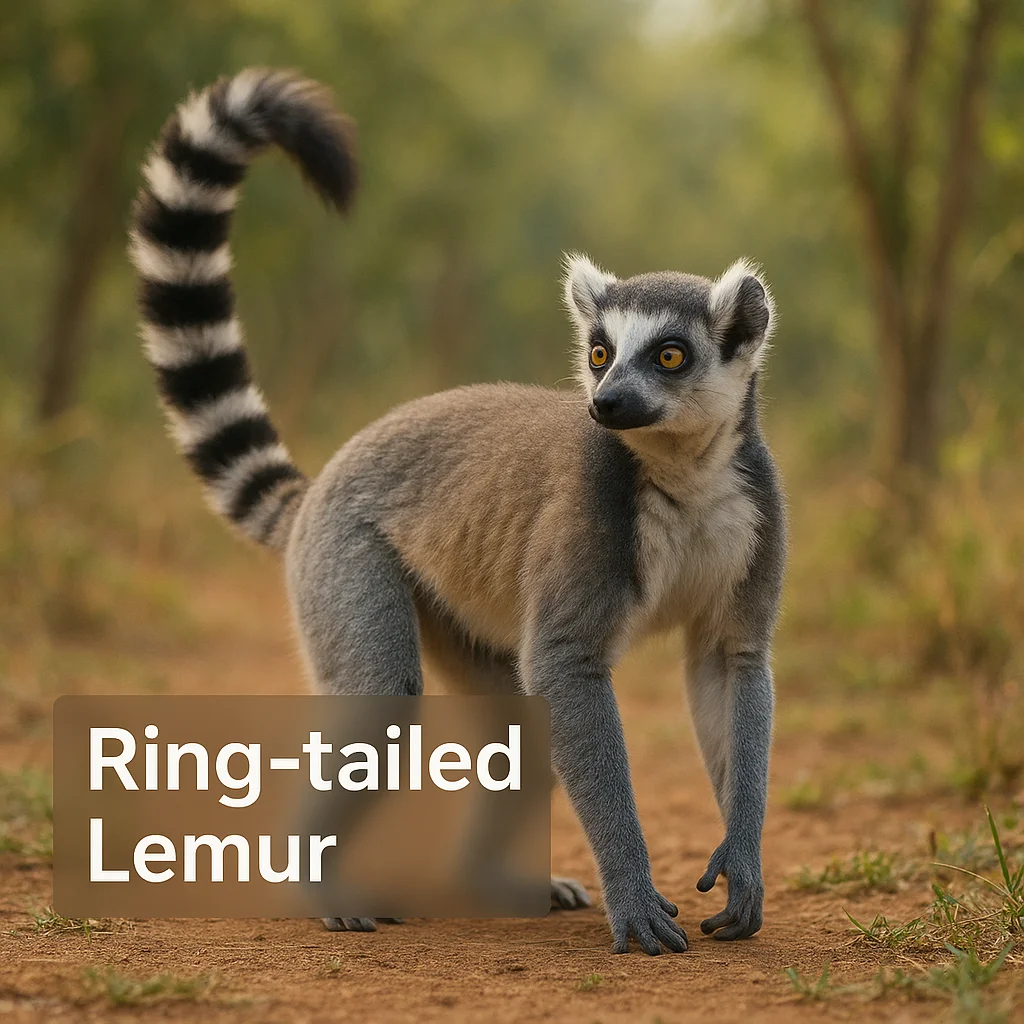
- Common name: Ring-tailed Lemur
- Scientific name: Lemur catta
- Animal type: Mammal
- Typical adult size: 39–46 cm in body length; tail adds another 56–63 cm
- Typical lifespan: 16–19 years in the wild; up to 25 years in captivity
- Diet type: Mostly herbivorous; prefers fruits, leaves, and flowers
- Activity pattern: Diurnal
- Social structure: Live in groups known as troops
- Speed / movement highlights: Agile climbers and ground runners
- Intelligence/learning: Known for complex social interactions and problem-solving abilities
- Primary habitats: Dry forests and bushy areas
- Geographic range: Endemic to Madagascar
- Predators/threats: Birds of prey, fossae; habitat destruction
- Conservation status: Endangered
🔍 Identification & Appearance
The Ring-tailed Lemur is unmistakable due to its iconic long, bushy tail with alternating black and white rings. Their body is mostly gray with a white underside and a face characterized by a white mask with black eye patches. They possess a dense coat that's well-suited to their environment.
- Top ID Tips:
- Long, bushy tail with black and white rings
- Gray body with white underparts
- Distinctive black eye rings
- Pointed snout similar to a fox
- Bright, alert eyes often observed
- Dense, soft fur
- Commonly seen on the ground or in lower forest canopy
- Compare with other lemurs; none have ringed tails
- Tracks may show hand-like prints with thumbprint offset
- Scat is typically pellet-shaped, found on trails
🧱 Body Structure & Physical Adaptations
Ring-tailed Lemurs have a slender build optimized for agility both on the ground and in trees. Their long limbs and tail are crucial for balance and navigation through their varied habitat. With sharp canine teeth and a strong jaw, they are well-equipped for their diet.
- Key Adaptations:
- Strong, agile limbs for climbing and jumping
- Long tail used for balance during locomotion
- Adapted teeth for browsing plant material
- Enhanced sense of smell for detecting food and territory marking
- Acute hearing to detect predators and communicate with troop members
- Dexterous fingers for grooming and grasping food
🌍 Range & Distribution
The Ring-tailed Lemur is exclusively found on the island of Madagascar. They inhabit the southern and southwestern regions of the island, thriving in varied environments from the spiny forests to dry deciduous forests.
- Where You Might Find It:
- Madagascar's Andringitra National Park
- Zombitse-Vohibasia National Park
- Isalo National Park
- Forests along Madagascar's southwest coast
- Inland dry bush areas
- Easily observed in open and semi-arid regions
- Not typically found in dense rainforests
- Elevation from sea level up to 2,600 meters
🏞️ Habitat & Shelter
Ring-tailed Lemurs prefer habitats where they can exploit both arboreal and terrestrial niches. They utilize the open canopy of dry forests for ease of movement and can often be seen basking in the sun on the ground. Knowledge of their habitat preferences is key to understanding their behavioral ecology, especially how they use sunbathing and grooming within their troop dynamics.
🧭 Behavior & Ecology
Ring-tailed Lemurs are highly sociable primates, engaging in a variety of behaviors including grooming and sunning. Each day follows a pattern that includes foraging, vocal communication to maintain group cohesion, and resting. These lemurs are essential seed dispersers in their ecosystems, helping forest regeneration.
- Behavior Highlights:
- Grooming as a form of social bonding
- Regular vocalizations to communicate
- Scent marking for territory establishment
- Engage in sunbathing to regulate temperature
- Adept at using body language for social interaction
- Key role in seed dispersal
- Notable for female-led troops
- Avoiding predators with alertness and group defense
- Displaying unique tail holding behaviors during group movement
👥 Social Life & Group Dynamics
Ring-tailed Lemurs are profoundly social, living in female-dominated troops ranging from 6 to 30 individuals. Each troop is structured hierarchically, with cooperative infant care being common. Female lemurs often stay in their natal groups, while males disperse upon reaching maturity.
- Social Structure Notes:
- Troops of 6 to 30 individuals
- Female-led social structure
- Dominance established through grooming
- Distinct territories marked and defended
- Communal care for offspring
- Males migrate to new groups at maturity
- Vocalizations play key role in troop coordination
🍽️ Diet, Prey & Predators
The diet of a Ring-tailed Lemur is primarily herbivorous, consisting mainly of fruits, leaves, and flowers. During dry seasons, they may also consume bark and sap. Their natural predators include birds of prey and the Madagascan fossa, though habitat destruction is a significant threat.
- Feeding Notes:
- Primarily frugivorous
- Eats a wide variety of plant material
- Seasonal shifts to leaves and flowers
- Occasionally consumes insects
- Fossa and large birds of prey are main predators
- Relies on group vigilance to deter threats
- Displays remarkable dietary flexibility during scarcity
🦌 Hunting, Foraging & Movement
Ring-tailed Lemurs are diurnal foragers, often moving in groups to feed. They rely heavily on sight and smell to locate food, and their agile movement allows efficient searching both on the ground and in trees. They are known for impressive leaping abilities and spend a substantial time navigating forest floors in search of food.
- Movement & Strategy:
- Diurnal and active foragers
- Agile ground and tree navigators
- Leap between tree branches and land efficiently
- Utilize memory and learning to improve foraging success
- Cover significant ground when resources are scarce
- Move collectively to optimize safety during foraging
🧠 Intelligence & Senses
The Ring-tailed Lemur exhibits advanced social intelligence, necessary for maintaining complex group dynamics. They possess acute sensory abilities, especially in vision and olfaction, which are crucial for day-to-day survival and communication.
- Notable Abilities:
- Strong problem-solving skills
- Capable of complex vocal communication
- Excellent memory for food sources
- Efficient in social role recognition within troops
- Heightened olfactory senses for social signaling
- Visual acuity adapted for daytime activity
🪺 Reproduction, Pregnancy & Parenting
Ring-tailed Lemurs typically breed seasonally; the gestation period is approximately 135 days, leading to births occurring in the warmer months. Females give birth to one or two offspring, which are altricial and require substantial parental investment. Groucho parenting is common, with females of the troop assisting each other.
- Reproduction Snapshot:
- Seasonal breeders; births in the wet season
- Gestation period around 135 days
- Usually one offspring per pregnancy
- Altricial young needing maternal care
- Communal childcare practices in troops
- Parental care includes grooming and carrying infants
♀️♂️ Male vs Female Differences
In Ring-tailed Lemurs, sexual dimorphism is subtle, with females generally being slightly smaller. Behavioral differences are more pronounced; females assert dominance in social hierarchies and lead the troop's decision-making processes.
- Sex Differences at a Glance:
- Females are generally smaller
- Males migrate between troops at maturity
- Females dominate social hierarchies
- Behavioral roles split between care and decision-making
🧬 Subspecies & Variation
Ring-tailed Lemurs are monotypic, meaning they lack officially recognized subspecies. However, variations may occur in terms of local population behaviors and coat shades due to environmental adaptations. These differences are still being studied.
- Variation Notes:
- Monotypic species
- Minor coat color variations by region
- Behavioral adaptability based on habitat
⚠️ Threats, Conservation & Human Interaction
The primary threats to Ring-tailed Lemurs include habitat loss due to deforestation and human encroachment. Conservation efforts focus on habitat protection and bolstering population numbers through breeding programs. Educating communities around Madagascar about lemurs is vital for conservation. In captivity, they are under ethical care considerations.
- Responsible Notes:
- Endangered due to habitat destruction
- Conservation through habitat protection is critical
- Adorable ambassadors for wildlife education
- Illegal pet trade poses a risk
- Zoos play a role in conservation via captive breeding
✨ Fun Facts & Unique Traits
- Ring-tailed Lemurs enjoy "sun worship" postures to warm up.
- They employ vocalizations resembling cat meows.
- Their tails are used for communication while in groups.
- They display a sidestepping gait akin to dance moves.
- The only lemur species known for routinely spending significant time on the ground.
- Despite being ancient primates, they have no close living relatives outside Madagascar.
📌 Summary
- Iconic black and white ringed tail aids in identification.
- Native exclusively to Madagascar's varied forest habitats.
- Primarily herbivorous, with adaptable diets to seasonal availability.
- Pivotal group-dynamic behaviors guided by females.
- Significant role in forest seed dispersal and ecosystem maintenance.
- Typically forages during daytime and rests in sunlit areas.
- Endangered due to ongoing habitat destruction.