🦁 Red Panda
🧾 Quick Facts
The red panda, a charming and elusive mammal, captivates both wildlife enthusiasts and researchers alike. With its vibrant fur and tree-dwelling habits, this species, unique in its own family, plays a crucial role in mountainous ecosystems across Asia.
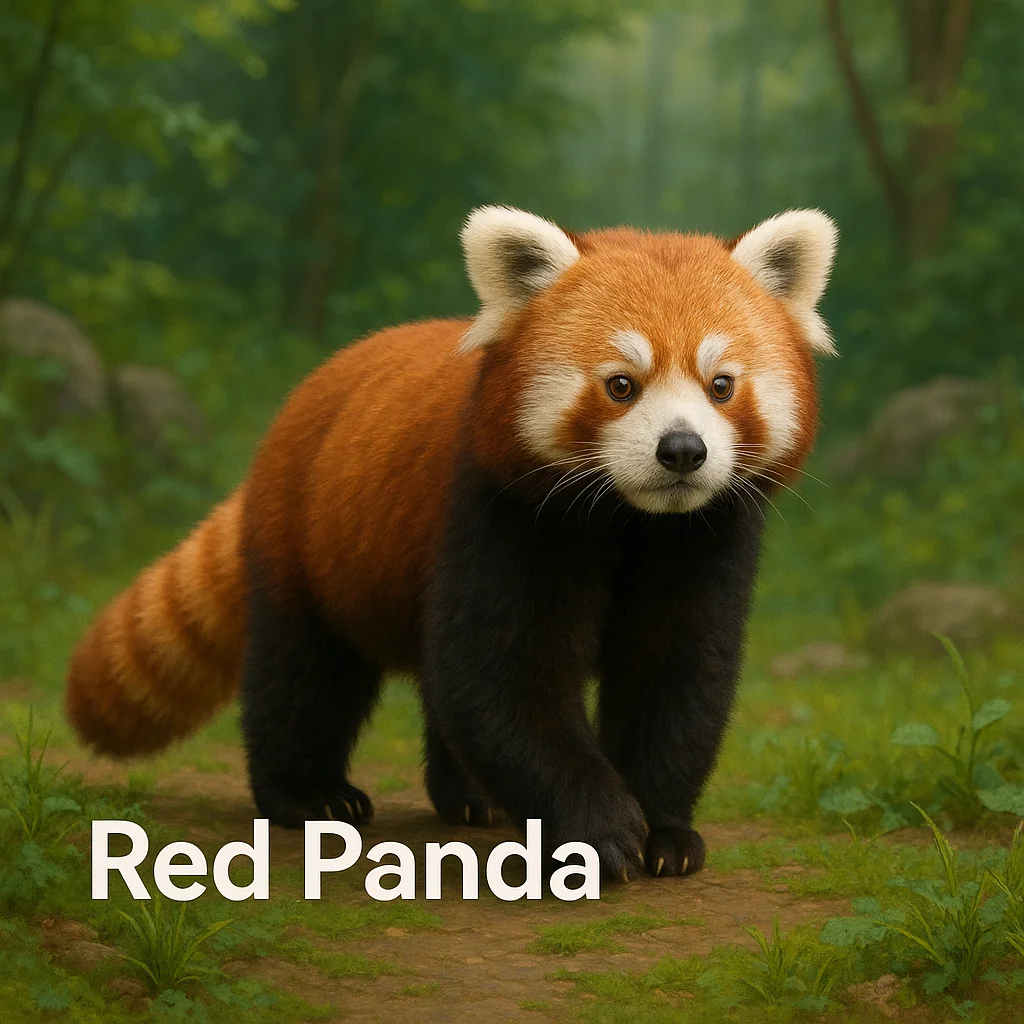
- Common name(s): Red panda, lesser panda
- Scientific name: Ailurus fulgens
- Animal type: Mammal
- Typical adult size: Length 50–60 cm, Tail 30–50 cm
- Typical lifespan: 8–12 years in the wild, up to 15 years in captivity
- Diet type: Herbivore primarily, also omnivorous
- Common foods: Bamboo, berries, eggs, small birds, insects
- Activity pattern: Largely crepuscular and nocturnal
- Social structure: Typically solitary, pairs during breeding
- Speed/movement highlights: Agile climber, moderate speed on ground
- Intelligence/learning: Quick learners, can navigate complex environments
- Primary habitats: Temperate forests with dense canopy cover
- Geographic range: Himalayas and parts of China
- Predators/threats: Snow leopards, martens, habitat loss due to deforestation
- Conservation status: Endangered, varies by region
🔍 Identification & Appearance
The red panda is easily recognizable by its striking reddish-brown coat and bushy tail marked with alternating rings. Its face, adorned with white markings, resembles that of a raccoon, complete with a "mask" over its eyes. The compact body rests on strong, short legs, aiding its arboreal lifestyle.
- Rounded body with short limbs for climbing
- Distinctive reddish-brown fur and whitish face markings
- Long, bushy tail with rings used for balance
- Smaller than the giant panda, lacking its specific facial features
- Padded paws help reduce noise and offer grip on branches
- Claws are semi-retractable, aiding in tree navigation
- Tracks are rarely clear but show distinct claw marks
- Often confused with raccoons due to facial markings
🧱 Body Structure & Physical Adaptations
The red panda's physical traits are fine-tuned for life in the trees. Its strong, curved claws and flexible ankles allow it to move effortlessly across branches. The skeletal build supports both a climbing lifestyle and ground movement.
- Robust body, but not stout, perfectly adapted for climbing
- Sharp, semi-retractable claws for grip and handling food
- Dental structure suited to masticating fibrous bamboo
- Ankles that rotate to assist in descending trees headfirst
- Sensitive whiskers for navigation in dim light
- Tongue used for tasting bamboo leaves before consumption
- Moderate hearing and vision suited for dusk and nighttime activity
🌍 Range & Distribution
The red panda inhabits high-altitude temperate forests in countries such as Nepal, India, Bhutan, Myanmar, and parts of China. These regions feature a mix of deciduous trees and dense bamboo understories supportive of the red panda's dietary needs.
- Mostly found in Eastern Himalayas
- Inhabits areas spanning from mid-Nepal to western China
- Prefers elevations ranging from 2,200 to 4,800 meters
- Non-migratory, but moves across large home ranges seasonally for food
- Thrives in cool, moist climates with ample shade
🏞️ Habitat & Shelter
The red panda's preferred habitats are temperate forests rich in old-growth trees and underbrush, especially bamboo, which makes up the bulk of their diet. These areas also offer ample cover and nesting opportunities in tree hollows or dens.
These forests are crucial for the red panda's survival as they provide food, cover from predators, and climate moderation. Habitat fragmentation poses a severe threat to their already endangered populations.
🧭 Behavior & Ecology
Red pandas spend much of their day resting or feeding high in the canopy. They are known for their meticulous grooming behaviors and marking territories by rubbing secretions from glands or urinating on trunks and leaves. Though generally solitary, they engage in play when meeting another panda.
- Primarily arboreal, rarely seen on the ground
- Vocalizations include squeals and twittering sounds
- Engage in scent marking with a musky secretion
- Vital to maintaining bamboo ecosystems by feeding and spreading seeds
- Play an ecological role in controlling insect populations
👥 Social Life & Group Dynamics
Red pandas are generally solitary creatures, spending most of their lives alone except during mating or when raising offspring. They mark territories and communicate with others through scent markings, vocal calls, and visual cues such as tail postures.
- Usually live alone or in pairs
- Females may share territories with offspring temporarily
- Social interaction peaks during mating season
- Disputes are often resolved through displays rather than physical confrontation
- Territorial boundaries are maintained through marked trails
🍽️ Diet, Prey & Predators
The red panda's diet is overwhelmingly bamboo, complemented by fruits, blossoms, nuts, birds, and small rodents when available. Despite consuming primarily plant matter, it has a carnivorous digestive system, explaining its need for nutritionally fortified food.
Natural predators include snow leopards and martens, while humans pose significant threats through habitat disruption and poaching. The red panda's defenses range from tree-based escape maneuvers to relying on its camouflaging fur.
- Bamboo makes up 85–95% of its diet
- Will opportunistically forage on bird eggs and small mammals
- Requires diverse food sources due to inefficient digestion of cellulose
- Relies on arboreal agility to evade predators
- Acts as both seed disperser and controller of prey populations
🦌 Hunting, Foraging & Movement
The red panda's most notable locomotion is its climbing ability, with a specialized rotary motion in its ankles that aids in descending trees. Most foraging encompasses bamboo shoots and leaves, conducted during twilight and night hours.
Though not an aggressive hunter, it uses ambush tactics for small vertebrates, relying on the element of surprise from above or the underbrush.
- Trees are primarily negotiated using limbs and tail for balance
- Forages primarily during dawn and dusk
- Maintains moderate ground speeds while avoiding predators
- Displays high stamina in tree navigating
- Primarily acts in solitude during food search expeditions
🧠 Intelligence & Senses
The red panda is adept at solving environmental puzzles, such as navigating complex tree structures. Though not known for tool use, they demonstrate problem-solving abilities, particularly in foraging efficiency and social interactions.
Sensory adaptations include keen sense of smell and sensitive whisker-based navigation. Communication and food location are often mediated through olfactory cues.
- Utilizes acute olfaction for locating food and mates
- Whiskers aid in tactile exploration of environments
- Exhibits cautious, calculated interaction with its environment
- Shows capacity for learning and adjusting to environmental changes
- Visual adaptability allows twilight navigation
🪺 Reproduction, Pregnancy & Parenting
Red pandas exhibit seasonal breeding, typically from January to March. A short bonding period leads to brief courtship behaviors, after which females generally seek solitude to give birth.
Gestation lasts five months, culminating in litters of one to four cubs. Cubs are raised in nests built by the female, who solely tends to them with dedication, feeding and grooming them until they become independent.
- Exhibits only limited courtship behaviors
- Monogamous tendencies, though not strictly enforced
- Gestation period spans 4.5 to 5 months
- Liter sizes typically comprise 1–4 offspring
- Cubs remain with the mother for up to a year
♀️♂️ Male vs Female Differences
While sexually dimorphic differences in red pandas are not striking at first glance, subtle variations do exist. Males are generally slightly larger than females, though coloration remains consistent across sexes.
- Males are marginally larger and heavier
- Behavioral roles differ slightly during mating season
- Females lead in nesting and rearing activities
- Larger body size in males aids in territory defense
- Males often engage in more territory marking
🧬 Subspecies & Variation
Red pandas have two distinct subspecies: Ailurus fulgens fulgens and Ailurus fulgens styani, which differ slightly in size and facial markings. The classification continues to see debate among researchers, with some evidence hinting at the need for further subdivision.
- Two main recognized subspecies with slight morphological differences
- Facial marking pattern variations observed in subspecies
- Possible ongoing adaptive traits due to geographic isolation
- Differences in size observed linked to varying habitat conditions
⚠️ Threats, Conservation & Human Interaction
The red panda faces multiple threats, primarily human-induced. Habitat destruction through logging and agriculture, combined with poaching for fur, has critically endangered these creatures. Conservation efforts, including habitat restoration, anti-poaching initiatives, and global breeding programs, are crucial.
Ethical interactions in zoos include mimicry of natural environments and promoting public education on conservation. Human-wildlife conflict is minimal, but awareness is vital for sustained coexistence.
- Habitat loss and fragmentation are primary threats
- Climate change affects bamboo availability
- Conservation efforts include protected area establishment
- Regulated captive breeding programs contribute to species survival
- Efforts focus on public education and awareness
✨ Fun Facts & Unique Traits
- Red pandas have a pseudo-thumb, an extended wrist bone for gripping bamboo
- They can rotate their ankles to climb down trees headfirst
- Possess a unique, musk-like scent used in territorial marking
- Communicate through a variety of sounds, including a distinctive "huff-quack"
- Despite being called "pandas," they are more closely related to weasels and raccoons
- Often sleep stretched out on branches or hidden in tree hollows during the day
- Despite their solitary nature, red pandas can be playful
- Their natural fur pattern provides excellent camouflage among the red-barked trees
📌 Summary
- Recognizable by their distinctive red fur and ringed tails
- Inhabit temperate forests in the Eastern Himalayas
- Depend heavily on bamboo as their primary food source
- Face natural threats from snow leopards and human impacts
- Lead primarily solitary lives with a brief social period during mating
- Females care for their young with limited male involvement
- Adaptations include climbing ability and pseudo-thumb for foliage manipulation
- Conservation efforts are critical due to habitat threats and poaching