🦁 Mandrill
🧾 Quick Facts
The mandrill, often regarded as one of the most colorful and distinctive primates, is a highly social and forest-dependent species found in West and Central Africa. Known scientifically as Mandrillus sphinx, the mandrill displays a complex social structure and remarkable adaptations suited for its environment.
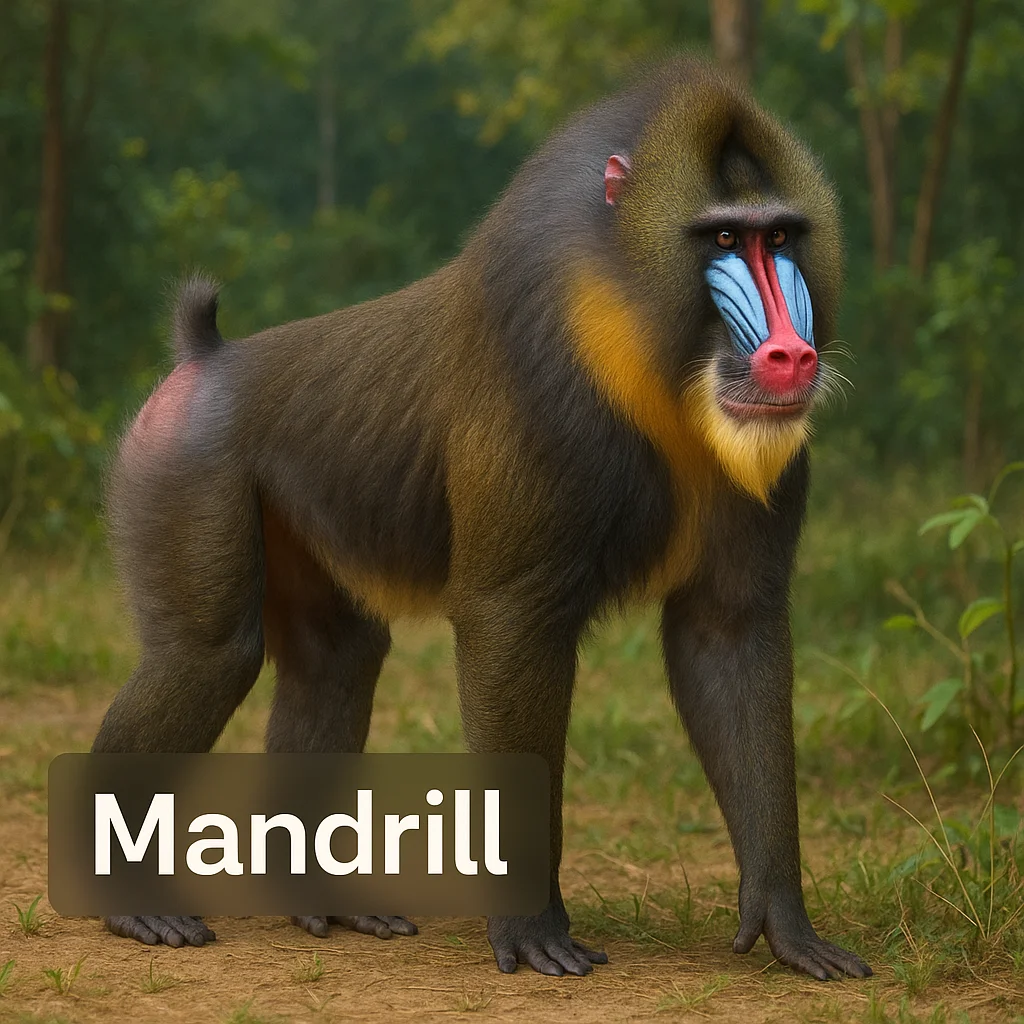
- Common name: Mandrill
- Scientific name: Mandrillus sphinx
- Animal type: Mammal
- Typical adult size: 55–95 cm (21.5–37.5 inches) body length; weight varies significantly, with males up to 37 kg (81 lbs) and females up to 13 kg (29 lbs)
- Typical lifespan: Up to 20 years in the wild; can increase to 30 years in captivity
- Diet type: Omnivore; eats fruits, insects, seeds, and small vertebrates
- Activity pattern: Diurnal
- Social structure: Lives in large, complex groups called troops
- Speed: Capable of running rapidly on the ground
- Intelligence/learning: High intelligence, showing problem-solving skills and social learning
- Primary habitats: Tropical rainforests and occasionally savannas
- Geographic range: Western Africa, from southern Cameroon to Guinea
- Predators/threats: Leopards, pythons, and human-related pressures
- Conservation status: Vulnerable due to habitat destruction and hunting
🔍 Identification & Appearance
The mandrill is unmistakable thanks to its vivid facial and rump coloration. Males possess bright blue and red skin on their faces and hindquarters, which intensifies with age, while females and juveniles have more muted tones. They have a bear-like build with broad shoulders, robust limbs, and a short, stubby tail.
- Top ID Tips:
- Look for the brilliant blue and red facial coloring in mature males
- Observe the golden beard and chest fur
- Note the unique red stripe running down the nose
- Spot the marked sexual dimorphism; males are significantly larger than females
- Mandrills have a more colorful appearance than closely related drills
- Listen for their distinctive grunts and booms when in dense forest
- Notice their baboon-like face, but with more exaggerated features
- Identify juveniles by their more subdued, less vibrant coloration
🧱 Body Structure & Physical Adaptations
The mandrill's robust frame and muscular limbs enable efficient ground movement and agile climbing. Their powerful jaws and sharp teeth are adapted for processing a wide variety of foods, while their opposable thumbs and dexterous fingers facilitate food manipulation.
- Key Adaptations:
- Stocky build for power and endurance
- Strong, long arms suitable for grasping and climbing
- Sharp canine teeth for defense and accessing food
- Colorful skin for visual communication among social groups
- Keen sense of smell to detect food and other mandrills
- Acute vision, particularly in low light conditions
- Adaptable diet allows survival in varying conditions
🌍 Range & Distribution
Mandrills are primarily residents of the dense equatorial rainforests of Central and West Africa. Their range includes countries such as Cameroon, Gabon, Equatorial Guinea, Congo, and occasionally in savanna and riverine forest edges.
- Where You Might Find It:
- Dense tropical rainforests
- Cameroon's southern regions
- Gabonese forests
- Equatorial Guinea's jungle floors
- Riverine forests in Congo
- Occasionally on savanna-forest boundaries
- Rainforest edges adjacent to plantations
🏞️ Habitat & Shelter
Mandrills prefer the damp and sheltered environments of tropical rainforests, where they have access to abundant food sources. They are often found in the undergrowth or canopy, moving through the forest in search of food. Seasonal fruit availability can influence their feeding and movement patterns.
Understanding the mandrill's habitat is crucial to conserving them, as forest loss directly threatens their survival. Habitat enrichment and protection help maintain their natural behaviors and social structures.
🧭 Behavior & Ecology
Mandrills are social primates with complex behaviors. They spend their days foraging, resting, and grooming in large troops. Communication is crucial, involving vocalizations, visual signals, and scent marking.
- Behavior Highlights:
- Large troops led by a dominant male
- Utilize a range of vocalizations, like grunts and hoots
- Grooming is a key bonding activity
- Displays of coloration serve as social signals
- Territorial behavior is often shown through displays rather than confrontation
- Important seed dispersers and ecosystem engineers
👥 Social Life & Group Dynamics
Mandrills form large social groups called troops, which can number over a hundred individuals. These groups usually comprise of females and their offspring, with a dominant alpha male providing protection and mating opportunities. Hierarchies are apparent, with subordinate males often targeting external groups to establish dominance elsewhere.
- Social Structure Notes:
- Dominated by a single, colorful alpha male
- Females form the group's core with strong social bonds
- Young males may form bachelor groups
- Hierarchical social structure within the troop
- Females participate in communal childcare
- Infrequent but significant troop interactions with other groups
🍽️ Diet, Prey & Predators
As omnivores, mandrills have a varied diet that encompasses fruits, seeds, leaves, insects, and occasionally small vertebrates. Their adaptable feeding habits allow them to exploit seasonal resources. Natural predators include leopards and large snakes, while human activities pose indirect threats.
- Feeding Notes:
- Primarily frugivorous, but will eat insects like ants and termites
- Forages on the forest floor and in the understorey
- Insects provide critical protein
- Capable of accessing food lodged in difficult areas using tools
- Winter diets shift to more available resources like foliage
- Humans are primary indirect threat through habitat reduction
🦌 Hunting, Foraging & Movement
Mandrills are adept climbers and move both on the forest floor and through the canopy. They rely on their acute senses and group dynamics for foraging efficiency, often covering several kilometers a day to find food. Most activity occurs during the day.
- Movement & Strategy:
- Climbs trees with ease, though forages mostly on ground
- Travel in cohesive troops to deter predators
- Uses spatial memory to locate food sources
- Primarily ground-dwelling but agile in vegetation
- Faster movements involve bounding on all fours
- Nocturnal resting periods in trees for safety
🧠 Intelligence & Senses
Known for their intelligence, mandrills demonstrate problem-solving skills and social learning. They can recognize individuals within their group and adjust their behavior accordingly. Their sensory perceptions are finely tuned for life in the forest, with excellent vision and a strong sense of smell.
- Notable Abilities:
- Recognizes troop members' identities
- Uses objects as simple tools when necessary
- Quick learners, especially in social contexts
- Detects food from significant distances using smell
- Employs remarkable spatial awareness
🪺 Reproduction, Pregnancy & Parenting
Breeding mainly occurs during the wet season when resources are plentiful. The male mandrill's vivid facial colors become an attraction during this period. Females typically give birth to one offspring after a gestation period of around 6 months. Both males and females ensure juvenile safety, though females provide the majority of care.
- Reproduction Snapshot:
- Breeding is seasonal and aligned with wet season
- Males are polygynous
- Gestation lasts about 6 months
- Usually, a single infant is born
- Newborns are entirely dependent at birth
- Females often move less to protect newborns
- Males indirectly influence offspring survival via troop defense
♀️♂️ Male vs Female Differences
Mandrills exhibit pronounced sexual dimorphism. Males are significantly larger than females and possess ornate coloring that intensifies with sexual maturity. Behavioral roles also differ, with males often taking on protective duties within troops.
- Sex Differences at a Glance:
- Males are much larger with vibrant coloration
- Females are less colorful with smaller body size
- Males lead in territorial displays
- Females focus on foraging efficiency and child-rearing
- Male coloration signals dominance and reproductive status
🧬 Subspecies & Variation
The mandrill is generally not divided into multiple subspecies, though regional variations can arise based on habitat and resources. For instance, slight differences in size and coloration may be seen in geographically isolated populations.
- Variation Notes:
- Few recognized subspecies, mostly one diverse species
- Minor regional size variations
- Adaptations tied to specific forest habitats
⚠️ Threats, Conservation & Human Interaction
Mandrills face multiple threats, primarily from habitat destruction due to agriculture and logging. They are also hunted for bushmeat, exacerbating their vulnerability. Conservation efforts focus on habitat protection and legal enforcement against hunting.
- Responsible Notes:
- Focus on habitat preservation efforts
- Discourage hunting through education and law
- Part of ecotourism initiatives to bring awareness
- Living in national parks and protected areas increase survival chances
✨ Fun Facts & Unique Traits
- Mandrills are the world's largest monkeys, not apes!
- Their colorful skin derives from light-refracting collagen, not pigment
- Their smiles, showing teeth, are a gesture of submission
- Males' colorful faces correlate with their testosterone levels
- Use vocalizations that travel through the dense forest to gather group members
- Play a crucial role in seed dispersal, maintaining forest health
📌 Summary
- Mandrills are the largest and one of the most colorful monkeys
- Found in the dense rainforests of Central and West Africa
- Exhibit a rich social life within large troops
- Sexual dimorphism is significant, with males being brightly colored
- Diet is varied, consisting mainly of fruits and insects
- Mating is seasonal and aligns with greater food availability
- Humans pose threats mainly through habitat destruction and hunting
- Conservation relies on habitat protection and anti-poaching measures
- Important for forest ecosystems as seed dispersers
- Unique social dynamics and ecology make them a fascinating study