🦁 Bonobo
🧾 Quick Facts
The Bonobo, a primate often known as the 'pygmy chimpanzee', inhabits the rainforests of the Democratic Republic of the Congo in Central Africa. Known for their gentle and sociable demeanor, Bonobos share many similarities with chimpanzees yet exhibit distinct behaviors and physical traits, making them an intriguing subject for both study and conservation efforts.
- Common name(s): Bonobo, Pygmy Chimpanzee
- Scientific name: Pan paniscus
- Animal type: Mammal
- Typical adult size: 70-90 cm (27-35 inches) height; 30-40 kg (66-88 pounds) weight
- Typical lifespan: 20-40 years in the wild; up to 50 in captivity
- Diet type: Omnivore; eats fruits, vegetation, insects, and occasionally small mammals
- Activity pattern: Diurnal
- Social structure: Group (known as communities)
- Speed / movement highlights: Quadrupedal knuckle-walking; agile climbers
- Intelligence/learning: High intelligence with complex social structures and communication
- Primary habitats: Tropical rainforests
- Geographic range: Democratic Republic of the Congo, Central Africa
- Predators/threats: Leopards, humans, habitat destruction
- Conservation status: Endangered
🔍 Identification & Appearance
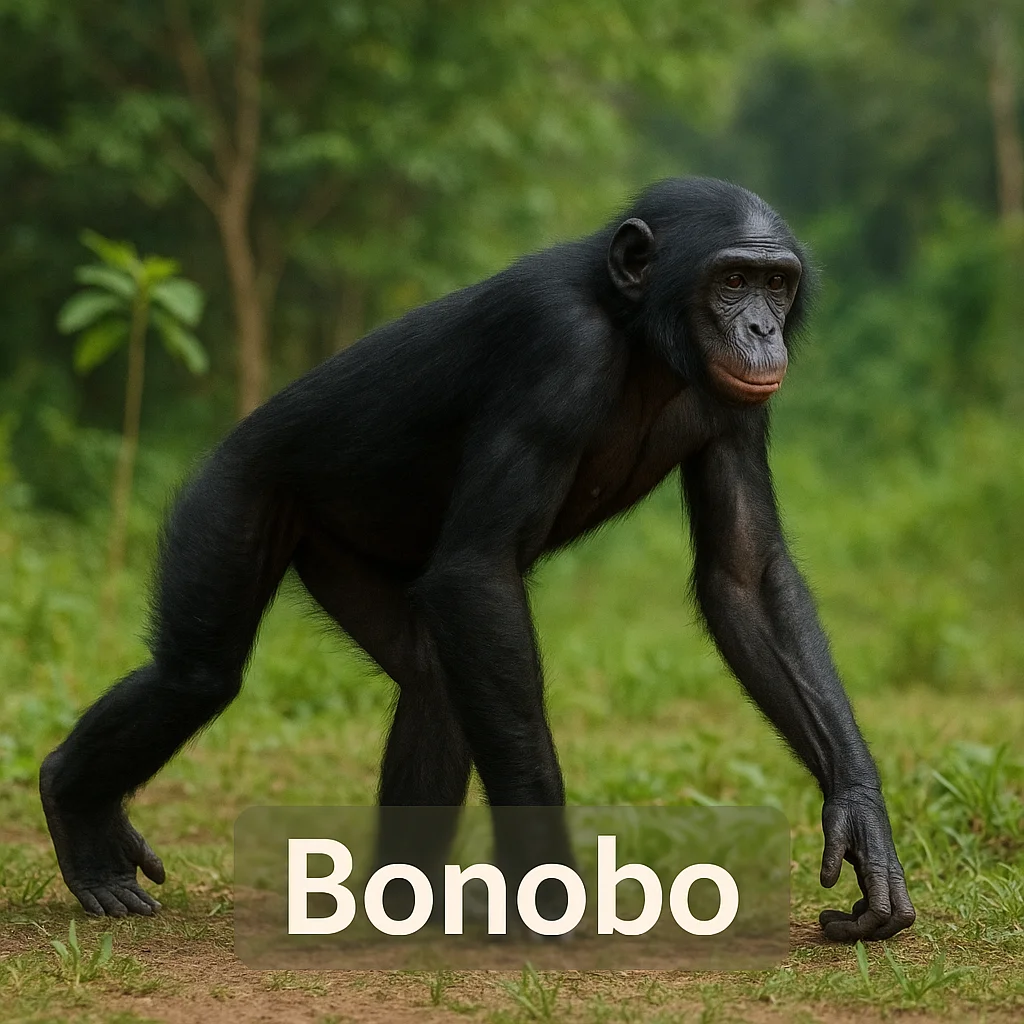
Bonobos can be recognized by their slender build, dark faces, and expressive eyes. They have black fur that covers most of their body, apart from their distinct pink lips and prominent facial features. Unlike chimpanzees, Bonobos have a more upright posture and are generally smaller in size. Their limbs are long and lean, ideal for their arboreal lifestyle in the dense forests.
- Slender body with a narrow torso
- Long arms and legs suited for climbing
- Dark face with pink lips and expressive eyes
- Shorter torso compared to chimpanzees
- Smooth, black coat
- Upright posture when moving through trees
- Visible ears and a pronounced brow ridge
- Distinctive "hairstyle" due to differing hair length on head
- Juveniles often have lighter facial skin
🧱 Body Structure & Physical Adaptations
Bonobos are adapted for a life both on the ground and in the trees, displaying physical characteristics tailored to their environment. Their build, with a narrower torso and longer limbs, enhances their agility and ability to maneuver through dense canopy. Their opposable thumbs and toes are critical for grasping branches and manipulating objects.
- Narrow, elongated torso for slender appearance
- Strong, long arms for brachiation (arm swinging)
- Opposable digits aiding in climbing and tool use
- Large molars for grinding a diverse diet
- Excellent sense of smell aiding in food location
- Keen eyesight, particularly effective in low light
- Sensitive auditory abilities for recognizing complex vocalizations
- Flexibility in shoulder joints for reaching different angles
🌍 Range & Distribution
The range of Bonobos is confined primarily to the lowland rainforests of the Democratic Republic of the Congo. They are endemic to this region and are not found naturally elsewhere. They typically inhabit areas south of the Congo River and east of the Kasai River.
- Exclusively found in the Democratic Republic of the Congo
- Concentrated in the heart of Central Africa
- Dwells mainly in tropical rainforest biome
- Located between the Congo and Kasai Rivers
- Does not exhibit significant seasonal or migration movements
🏞️ Habitat & Shelter
Bonobos thrive in the lush canopy of tropical rainforests, preferring dense, rich environments where food and shelter are abundant. These forests provide a safe haven from predators and a wealth of dietary options, from fruits to small mammals. By understanding their habitat, we gain insights into their behaviors, such as social gatherings and food-sharing practices.
Due to rainforest layers, Bonobos have adaptable sleeping arrangements, often building nests in the trees to avoid ground-dwelling predators. Shelter in these environments allows for communal gatherings and complex social interactions.
🧭 Behavior & Ecology
Bonobo behavior is characterized by their social structures and communication methods. They live in matriarchal communities where females often hold dominant roles. Bonobos use a variety of vocalizations, facial expressions, and body gestures to communicate.
In their ecological role, Bonobos help seed dispersal through their varied diet, ensuring the health of their rainforest habitat. Their social interactions often involve complex relationships, displaying empathy and cooperation within their communities.
- Daytime active; frequent rest periods
- Uses vocal calls to communicate locations and warnings
- Engages in grooming to strengthen social bonds
- Cooperative behaviors in foraging and play
- Relies on large family groups for protection and support
- Display complex social rituals and bonding activities
- Often seen sharing food in communal settings
- Participates in non-aggressive conflict resolutions
👥 Social Life & Group Dynamics
Bonobos are highly social animals, living in groups that exhibit remarkable egalitarian dynamics. These groups, typically matriarchal, consist of several dozen individuals. Social interactions are complex and central to Bonobo life, often characterized by grooming, play, and socio-sexual behaviors that reinforce group bonds and reduce tension.
- Live in communities averaging 20-100 individuals
- Females play central roles in group hierarchy
- Strong mother-offspring bonds
- Non-hierarchical social interactions
- Cooperative childcare and group foraging
- Frequent playful interactions and cooperative behaviors
- Exchange of grooming and food solidifies bonds
🍽️ Diet, Prey & Predators
Bonobos are omnivorous primates with a preference for fruit, but their diet is diverse and includes leaves, flowers, seeds, and the occasional small animal. Their predation in natural settings is minimal, with leopards posing the main threat apart from humans.
Bonobos often forage in groups, covering extensive areas to gather various dietary components, which play a role in seed dispersal within their ecosystems. When faced with threats, they may seek refuge in trees, using cries to alert other group members.
- Diverse diet includes fruit, leaves, and small fauna
- Frequently feeds on nuts and insects
- Group foraging enhances efficiency
- Primarily fruit eaters, especially favor figs
- Use of teamwork to access food sources
- Main predators include leopards and occasionally humans
🦌 Hunting, Foraging & Movement
Bonobos are primarily arboreal and terrestrial foragers, relying on both manual dexterity and keen senses to identify and access food resources. They travel by knuckle-walking or climbing, showcasing great agility. Interestingly, their locomotion allows them to traverse canopy and forest floor with ease, adapting their movement to resource availability and safety.
- Adept climbers in rainforest canopy
- Quadrupedal movement on ground
- Knuckle-walking provides stability
- Typical locomotion spans daily fission-fusion exploration
- Cooperative search for food enhances group cohesion
🧠 Intelligence & Senses
Renowned for their intelligence, Bonobos display advanced problem-solving abilities and utilize tools for foraging, although not as frequently as chimpanzees. They learn socially, observing and mimicking group behaviors for survival. Their sophisticated vocalizations communicate nuances within their social structure.
Their senses are well-honed for jungle life, including acute hearing, which is essential for communication, and strong vision that aids in foraging and detecting danger.
- Capable of complex problem-solving
- Display nuanced communication with vocalizations
- Social learning through observation
- Sharp sense of hearing for group signaling
- Use of basic tools for food access
🪺 Reproduction, Pregnancy & Parenting
Bonobos reproduce all year, although they do not have distinct breeding seasons. The mating process is typically promiscuous, with no rigid pair bonds. Gestation lasts approximately 240 days, resulting in typically one offspring. Bonobos are altricial, requiring extensive parental care, predominantly from mothers.
Mother-offspring bonds are strong, with females investing significant time in nurturing and educating their young. Alloparenting is common, fostering social cohesion.
- No specific breeding season; year-round reproduction
- Gestation period around 240 days
- Births usually single; twins rare
- Extended maternal care of offspring
- Alloparenting reinforces social bonds
- Young typically wean at about 3-4 years
♀️♂️ Male vs Female Differences
While both male and female Bonobos have generally similar appearances, females tend to be slightly smaller in size. Their roles within the social hierarchy differ, with females often holding higher positions of influence. This matriarchal structure influences group dynamics, caregiving, and social stability.
- Females slightly smaller and lighter
- Males and females similar in appearance
- Females are central to group leadership
- Mother-focused social groupings
- Dominance derived from social influence rather than physicality
🧬 Subspecies & Variation
Currently, no recognized subspecies of Bonobos exist, but variations among individuals can be observed based on habitat distribution and social structures tailored to their environments. These differences include slight variations in size, fur density, and behavior, shaped by local environmental conditions.
- No officially recognized subspecies
- Variations in fur texture influenced by environment
- Behavioral adaptations to environmental pressures
- Individual differences more pronounced than group
⚠️ Threats, Conservation & Human Interaction
Bonobos face significant threats from habitat destruction, poaching, and human conflict. Their limited geographic range exacerbates these issues, making conservation efforts critical. Understanding and protecting Bonobo habitats are essential for their survival.
Humans and Bonobos share much genetic similarity, highlighting the need for ethical considerations in their conservation management. Facilities like zoos prioritize education and breeding programs to support wild populations.
- Major threats include deforestation and habitat loss
- Subject to hunting and bushmeat trade pressures
- Human conflict impacts habitat and stability
- Conservation areas critical for survival efforts
- Conservation education promotes awareness and protection
✨ Fun Facts & Unique Traits
- Bonobos have a social structure led by females, unique among great apes
- They are one of our closest living relatives, sharing about 98.7% of their DNA with humans
- Known for resolving conflict through play and grooming rather than aggression
- Bonobos communicate using a complex array of vocalizations and gestures
- Their peaceful nature contrasts sharply with the more aggressive behavior of chimpanzees
- They play an essential role in forest regeneration through seed dispersal
- Bonobos demonstrate empathy and cooperation within their groups, often comforting each other in distress
📌 Summary
- Easily identified by their slender build and dark features
- Exclusive to Central Africa's rainforests
- Omnivorous diet with diverse food sources
- Live in complex, cooperative social structures
- Vulnerable to habitat-related threats
- High intelligence with nuanced communication
- Exhibits remarkable empathetic behaviors
- Females lead in a matriarchal society
- No distinguished subspecies, although variations exist