🦁 Walrus
🧾 Quick Facts
The walrus is an iconic marine mammal known for its distinctive tusks and blubbery body. Primarily found in the Arctic, these large pinnipeds are social creatures that play an essential role in their cold, aquatic ecosystem. Here are some key facts about walruses:
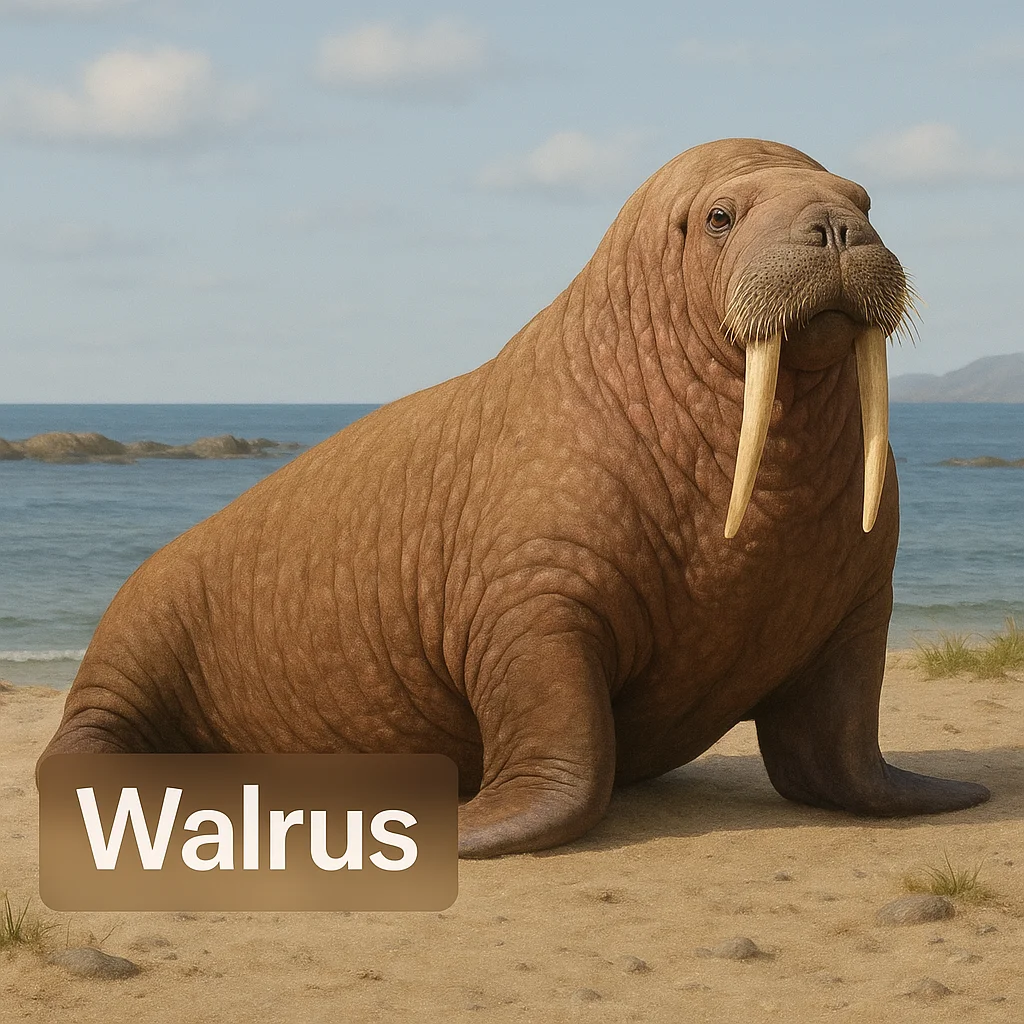
- Common name(s): Walrus
- Scientific name: Odobenus rosmarus
- Animal type: Mammal
- Typical adult size: Length 10–12 feet (3–3.6 meters), Weight 1,760–3,740 lbs (800–1,700 kg)
- Typical lifespan: 20–30 years in the wild
- Diet type: Carnivore, primarily feeds on mollusks, crabs, shrimp, worms
- Activity pattern: Mostly diurnal
- Social structure: Highly social, forms large groups on ice and land
- Speed / movement highlights: Semi-aquatic, capable of swimming up to 7 mph (11 km/h)
- Intelligence/learning: Moderate, capable of learning skills in captivity
- Primary habitats: Coastal regions, primarily Arctic areas
- Geographic range: Arctic Ocean and subarctic seas of the Northern Hemisphere
- Predators/threats: Polar bears, orcas, and human-related threats such as climate change
- Conservation status: Varies by region, generally classified as vulnerable
🔍 Identification & Appearance
Recognizable by their robust bodies and long tusks, walruses have a unique appearance suited for life in cold, marine environments. They exhibit a bulky silhouette with thick, wrinkled skin covered in sparse hair. Their skin ranges from gray to brown, often appearing reddish due to increased blood flow in the cold.
Walruses possess distinctive features that help differentiate them from similar species. Their tusks, which are elongated canine teeth, are used for defense, cutting through ice, and aiding in climbing out of water. Furthermore, walruses have a thick mustache of stiff white whiskers.
- Top ID Tips:
- Large, blubbery body with a flat, flipper-like tail
- Long, prominent tusks extending from upper jaw
- Flipper-like forelimbs used for swimming
- Wrinkled skin covered in sparse hair
- White, bristle-like mustache on snout
- Reddish tone to the skin in cold climates
- Found in groups on ice floes
- Occurs primarily in Arctic waters
- Deep, resonant vocalizations
- Distinguishable from seals by larger size and tusks
🧱 Body Structure & Physical Adaptations
The walrus's body is well-adapted for both aquatic and icy environments. Its robust build and thick blubber provide insulation against the cold temperatures. Their tusked jaws are adapted to assist in feeding on benthic invertebrates, primarily mollusks, by sucking them out of their shells.
With flipper-like forelimbs and hind flippers, walruses are agile swimmers. They also possess sensitive whiskers, or vibrissae, which detect prey on the ocean floor. Their sense of smell and hearing are highly developed, aiding in locating mates and detecting predators.
- Key Adaptations:
- Thick blubber layer for insulation
- Tusks for defense and ice-breaking
- Sensitive vibrissae for locating prey
- Powerful, flippered limbs for swimming
- Ability to slow heart rate underwater
- Blood-rich skin maintains warmth
- Large, retractable nostrils
- Well-developed hearing
- Wear-resistant, enamel-covered tusks
- Adaptations to handle icy, marine conditions
🌍 Range & Distribution
Walruses are distributed across the Arctic and subarctic regions, with two distinct subspecies: the Atlantic walrus (Odobenus rosmarus rosmarus) and the Pacific walrus (Odobenus rosmarus divergens). They inhabit the icy waters of the Northern Hemisphere and are typically found along coastal areas, ice floes, and shallow waters.
Their range is characterized by seasonal movements, mainly driven by changing ice conditions. During the warmer months, they may travel to higher latitudes where ice is present.
- Where You Might Find It:
- Arctic Ocean
- Coastal Siberia
- Greenland's coastal zones
- Northern Canada
- Bering Sea
- Chukchi Sea
- Labrador Sea
- Baffin Bay
- Ice-laden arctic and subarctic waters
🏞️ Habitat & Shelter
Walruses prefer the cold, icy environments of the Arctic, where they find refuge on ice floes and coastal regions. These habitats provide them with the ideal environment for resting, breeding, and accessing food sources.
Walruses rely on sea ice as a platform for molting, giving birth, and resting between feeding bouts. Seasonal changes in sea ice and environmental conditions can influence their distribution and behavior.
Understanding the walrus's habitat is crucial for ensuring their survival, as climate change and melting sea ice pose significant challenges to their natural living spaces.
🧭 Behavior & Ecology
Walruses are social animals that often gather in large, noisy herds on ice floes or beaches. Their daily routine typically includes alternating periods of feeding and resting, in addition to grooming and social interactions.
These animals communicate through a range of vocalizations, such as grunts and bellows, alongside visual displays. They play a key role in the Arctic ecosystem as consumers of benthic invertebrates and influence sediment turnover in their habitats.
- Behavior Highlights:
- Highly social, form large groups
- Diurnal activity pattern
- Vocal communications including grunts
- Use tusks for climbing onto ice
- Influence marine sediment turnover
- Rest on ice floes between feeding
- Maintain frequent contact with herd
- Respond to changing ice conditions
- Engage in tactile social interactions
- Crucial in marine food webs
👥 Social Life & Group Dynamics
Walruses are known for their gregarious nature, living in large groups known as herds. These herds can consist of several hundred individuals and are highly interactive.
Social bonds are reinforced through vocalizations and physical interactions, and groups may cooperate in defense against predators. Dominance hierarchies exist, often based on size and tusk length, influencing access to resources.
- Social Structure Notes:
- Form large, noisy herds
- Strong social bonds and interactions
- Cooperative defense against predators
- Territorial when resting on ice
- Dynamic dominance hierarchies
- Physical and vocal communication
- Calves cared for by groups
- Social living is crucial during breeding
- Males often form bachelor groups
- Females gather in nursery groups
🍽️ Diet, Prey & Predators
Walruses are carnivorous, mainly feeding on benthic invertebrates such as mollusks, using their sensitive whiskers to locate prey on the ocean floor. They have a strong preference for clams, which they suck from the seabed with a powerful vacuum-like action.
Natural predators of walruses include polar bears and orcas. To protect themselves, they congregate on ice and beaches, where adults form a protective barrier around calves. Although they occasionally scavenge, walruses do not typically rely on dead animals as a food source.
- Feeding Notes:
- Primary diet consists of mollusks
- Uses whiskers for detecting prey
- Employs suction feeding techniques
- Feeds on crabs, shrimp, and worms
- Consumes benthic invertebrates
- Predators include polar bears and orcas
- Rarely scavenges dead animals
- Protective behavior increases during feeding
- Diverse feeding tactics in different regions
- Seasonal changes influence prey availability
🦌 Hunting, Foraging & Movement
Walruses are adept swimmers, using their powerful flippers for propulsion in the water. While they have an average swimming speed of up to 7 mph (11 km/h), they do not typically engage in high-speed pursuits.
Foraging mostly occurs on the ocean floor, where walruses use their sensitive whiskers and tusks to locate and extract prey from the seabed. Their movements are often influenced by seasonal ice changes, leading to localized migrations within their range.
- Movement & Strategy:
- Swimmers with flipper propulsion
- Forage on ocean floor benthos
- Sensitive whiskers for prey detection
- Not high-speed predators
- Tusks aid in climbing ice
- Movements affected by ice conditions
- Local migrations within ranges
- Home range fidelity varies
- Navigation primarily by coastal landmarks
- Can slow heart rate to endure dives
🧠 Intelligence & Senses
Walruses exhibit moderate intelligence, with abilities to learn and adapt within their environments. In captivity, they have been trained to perform tasks, indicating a capacity for learning and memory.
Their sense of hearing and smell is highly developed, aiding in detecting predators and locating potential mates. Research on their cognitive abilities is limited, but they display complex social interactions and problem-solving within their groups.
- Notable Abilities:
- Moderate intelligence
- Trainable in captivity
- Sensitive hearing and smell
- Capable of social learning
- Problem-solving in natural settings
- Memory and recognition skills
- Limited research on cognitive abilities
- Complex social structuring
- Physical communication with tusks
🪺 Reproduction, Pregnancy & Parenting
Walruses are seasonal breeders, with courtship and mating typically occurring in early winter to spring. They exhibit a polygynous mating system, with dominant males often more successful in securing mates.
After a gestation period of approximately 15–16 months, females give birth to a single calf, which is relatively precocial at birth. Nursing lasts for about two years, during which time calves often remain close to their mothers, with extended family groups aiding in care.
- Reproduction Snapshot:
- Seasonal breeders, mating in winter
- Polygynous mating strategies
- Typically one calf per birth
- Gestation lasts 15–16 months
- Calves are precocial at birth
- Nursing period lasts around two years
- Mother-calf bonding is strong
- Extended family supports calf care
- Males compete for mating opportunities
- Birthing often occurs on ice floes
♀️♂️ Male vs Female Differences
Male and female walruses exhibit sexual dimorphism, mainly in size and tusk characteristics. Males are typically larger and have longer tusks than females, which they use for social display and combat with rival males.
Behaviorally, males are more territorial during the breeding season, engaging in displays and fighting to establish dominance. Females, meanwhile, focus on nurturing and protecting young.
- Sex Differences at a Glance:
- Males larger than females
- Male tusks are longer and thicker
- Males show more aggression in breeding season
- Females invest heavily in calf rearing
- Sexual displays primarily in males
- Dominance displays often male-driven
- Females may be lighter and more agile
- Males form bachelor groups outside of breeding
- Variable size dimorphism by population
🧬 Subspecies & Variation
The walrus has two recognized subspecies: the Atlantic walrus and the Pacific walrus. These subspecies demonstrate differences in size, distribution, and population dynamics.
The Pacific walrus is generally larger and found over a broader range, while the Atlantic walrus is relatively more restricted geographically. Differences in behavior and habitat preferences have been noted, although both subspecies exhibit similar ecological roles.
- Variation Notes:
- Atlantic walrus (O. r. rosmarus)
- Pacific walrus (O. r. divergens)
- Pacific subspecies typically larger
- Regional distribution varies by subspecies
- Behavioral differences in feeding areas
- Response to climate change varies
- Populations adapted to local conditions
- Research on variation is ongoing
- Different tusk shapes by subspecies
⚠️ Threats, Conservation & Human Interaction
Walrus populations face several threats, including climate change, habitat loss, and human disturbances. Melting sea ice poses a significant challenge as it impacts their resting, breeding, and foraging habitats.
Human activities such as shipping and resource exploration in the Arctic also pose risks. Conservation efforts focus on habitat protection and minimizing anthropogenic impacts.
- Responsible Notes:
- Vulnerable to climate change
- Melting ice affects habitats
- Susceptible to habitat disruption
- Conservation focuses on sea ice protection
- Impact of Arctic shipping routes
- Importance of minimizing disturbance
- Coordination between countries for conservation
- Informed management of human-wildlife interactions
- Monitoring changes in distribution and behavior
✨ Fun Facts & Unique Traits
- Walrus tusks never stop growing and can reach over 3 feet (1 meter) long.
- They have air sacs in their neck and upper thorax to aid buoyancy in water.
- The name "walrus" is thought to originate from a Scandinavian language term meaning "whale horse."
- Walruses enclose their food in their marginal teeth to suction prey from the ocean floor.
- They play an important ecological role by recycling nutrients back into their environments.
- In Alaska, walrus communities are often found near family-oriented villages.
- Their blubber provides insulation in frigid climates, maintaining core temperatures.
- Walruses can sleep in the water while partially submerged.
- Historically, indigenous peoples have utilized walruses for meat, skin, and tusk crafting.
- Walruses are sometimes depicted in folklore and mythology as guardian spirits.
📌 Summary
- Walruses are large, social marine mammals known for their long tusks.
- They inhabit the Arctic and subarctic regions, primarily on ice floes.
- Walruses are carnivores, feeding mainly on benthic invertebrates like clams.
- Natural enemies include polar bears and orcas, with human-related threats linked to habitat disruption.
- These animals form large, social herds with dynamic group dynamics.
- Reproduction involves a long gestation with a focus on maternal care.
- Adaptations include thick blubber, tusks for defense and maneuvering, and sensitive whiskers for detecting prey.
- Two main subspecies exist: the Atlantic and Pacific walrus, differing in size and region.
- Conservation challenges include climate change and habitat interference.
- Walruses are ecologically important for nutrient cycling in marine ecosystems.