🦁 Sperm Whale
🧾 Quick Facts
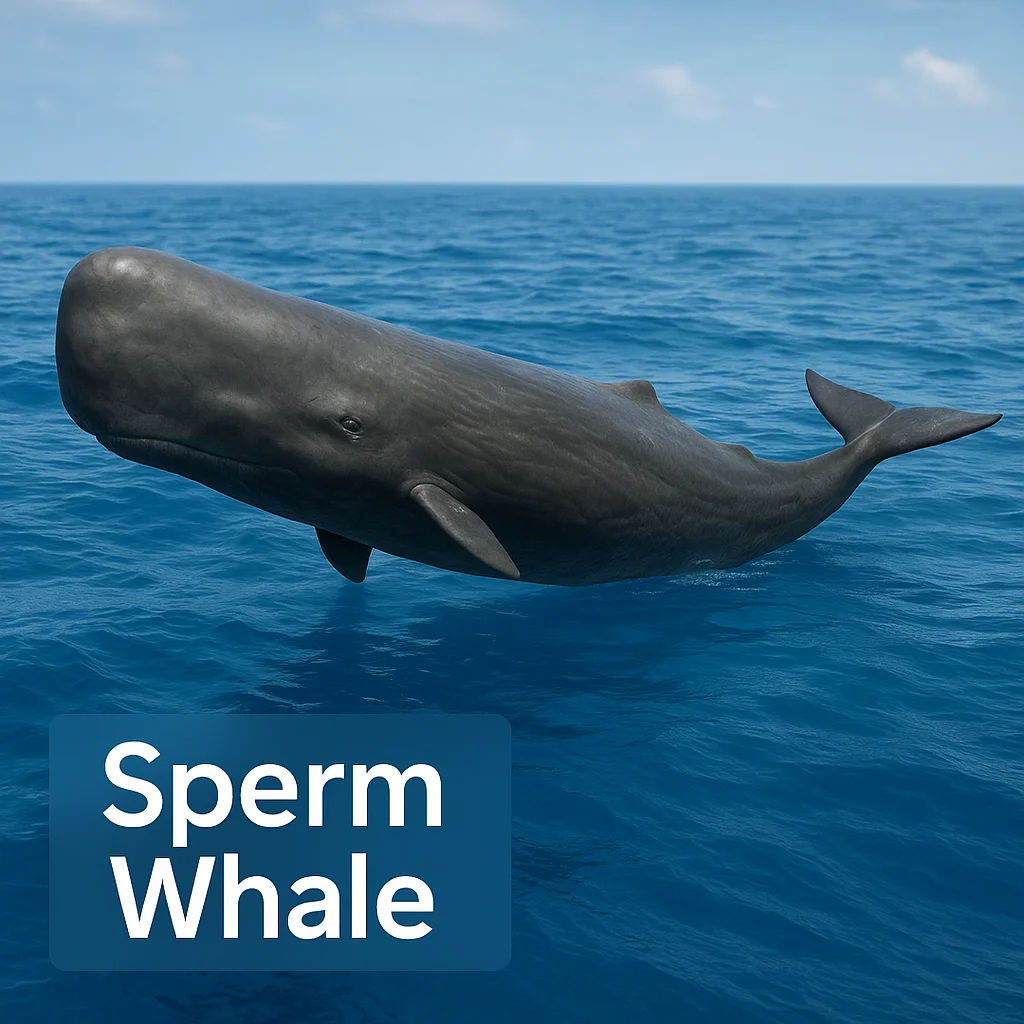
The sperm whale (often listed as Physeter macrocephalus) is the largest of the toothed whales and an awe-inspiring giant of the deep ocean. Known for its massive head and deep diving capabilities, this marine mammal captivates the imagination and is a subject of interest for both scientists and enthusiasts alike.
- Common name(s): Sperm Whale
- Scientific name: Physeter macrocephalus
- Animal type: Mammal
- Typical adult size: 50 to 67 feet in length, up to 45 tons in weight
- Typical lifespan: 60 to 70 years
- Diet type: Carnivore, primarily squid and fish
- Activity pattern: Primarily nocturnal, though varies by foraging habits
- Social structure: Matrilineal groups known as pods
- Speed / movement highlights: Swims up to 20 mph
- Intelligence/learning: High intelligence, capable of complex communication
- Primary habitats: Open ocean
- Geographic range: Globally, in tropical to polar waters
- Predators/threats: Orcas, human-related threats like whaling
- Conservation status: Vulnerable
🔍 Identification & Appearance
The sperm whale is unmistakable with its colossal square head, which makes up about a third of its body length. The skin is typically wrinkled and dark gray, with lighter areas around the mouth and belly. Unlike many whales, sperm whales have no dorsal fin but possess a small hump and a series of ridges on their back. Adult males are significantly larger than females, and calves have a smoother skin texture.
- Top ID Tips:
- Massive square-shaped head and distinctly wrinkled skin
- Dark gray coloration with lighter patches
- Lack of dorsal fin, presence of a small hump
- Large, conical teeth on the lower jaw
- One blowhole, located asymmetrically on the left side
- Characteristically low and bushy blow
- Ridge-like "knuckles" trailing from hump
- Surface behavior: known for tail fluking and logging at the surface
- Occasionally mistaken for other odontocetes, but size and head shape are distinctive
🧱 Body Structure & Physical Adaptations
Built for the deep, sperm whales have robust bodies and ample blubber providing buoyancy and insulation. Their lower jaw houses large conical teeth, well-suited for grasping slippery squid. The small pectoral fins and powerful tail flukes enable remarkable swimming speed and diving depth. Advanced echolocation capabilities adapt them to hunting in the pitch-black ocean depths.
- Key Adaptations:
- Large spermaceti organ aids in buoyancy regulation and echolocation
- Teeth suited for capturing prey in low light
- Thick blubber for thermal insulation in cold waters
- Powerful flukes for efficient swimming and deep dives
- High vascularized lungs aiding in oxygen storage
- Efficient kidneys for processing high salt intake
- Complex vocalization abilities for communication and navigation
🌍 Range & Distribution
Sperm whales inhabit deep waters across the globe, from equatorial zones to the edges of the polar regions. They favor submarine canyons and offshore waters rich in squid. This species is usually found at depths of over 3,000 feet but can venture into coastal areas for feeding.
- Where You Might Find It:
- Open ocean, far from shorelines
- In proximity to deep-sea canyons
- North Atlantic and Gulf Stream regions
- Pacific ocean trenches and sea mounts
- Indo-Pacific deep sea areas
- Mostly absent in Arctic ice-packed zones
- Occasional sightings near island chains
🏞️ Habitat & Shelter
Sperm whales thrive in oceanic habitats where they dive to great depths to forage for prey. They seldom approach land but will occasionally be found in areas with steep continental shelf drops or submarine canyons. This deep-diving mammal’s habitat preference emphasizes structures where prey aggregates, providing rich foraging grounds.
🧭 Behavior & Ecology
Sperm whales operate mostly during the night, using sophisticated echolocation to track down prey in the dark. They communicate with a series of clicks, known as codas, which can be specific to family units or regions. As keystone predators, their foraging maintains the balance of marine ecosystems by controlling squid populations. Other notable behaviors include logging (resting at the surface) and social interactions within pods.
- Behavior Highlights:
- Deep diving to over 3,280 feet for feeding
- Logging behavior for resting
- Echolocation used for communication and foraging
- Pod structures important for cooperative dynamics
- Vocal communicative clicks for social interaction
👥 Social Life & Group Dynamics
Sperm whales are known for their complex social structures based on matrilineal connections. Females and young form stable units called pods, often assisted by alloparenting. Males tend to roam more widely and solitary individuals or temporary male alliances called bachelor groups can be found. Social cooperation includes mutual assistance during hunting and collective calf rearing and protection from predators.
- Social Structure Notes:
- Matrilineal pods with strong family bonds
- Female-led groups with cooperative childcare
- Solitary behavior in mature males
- Bachelor groups in non-breeding season
- Social communication via clicks and codas
🍽️ Diet, Prey & Predators
Sperm whales predominantly consume squid, including the elusive giant squid, supplemented by various fish species. Their feeding strategy often involves deep, extended dives, enabling access to prey found in the mesopelagic and bathypelagic zones. Despite their large size, they face predation mainly from orca pods.
- Feeding Notes:
- Deep-sea squid is a primary dietary element
- Occasional fish and bottom-dwelling organisms
- Dive strategy tailored to prey distribution
- Nautical predator echolocation for prey detection
- Minimal predators, mainly targeted by orcas
🦌 Hunting, Foraging & Movement
With an extraordinary ability to dive over 7,200 feet, sperm whales spend a lot of their time in pursuit of elusive deep-sea prey. Their swimming and diving endurance allow for significant depth stays, while echolocation aids in precise prey localization even in complete darkness. Movements can be seasonally driven, seeking regions with high prey density.
- Movement & Strategy:
- Renowned deep diver with vertical capacity
- Echolocation facilitates hunting in darkness
- Long-range movement below and across ocean basins
- Seasonal movements reflect prey aggregations
🧠 Intelligence & Senses
Renowned for their intelligence, sperm whales exhibit advanced social behaviors and learning abilities. Their brain remains the largest of any creature known, facilitating complex cognition thought to involve social decision-making, collaboration, and communication. Their acoustic senses are paramount for navigation and foraging in the ocean's depths.
- Notable Abilities:
- Complex vocal communications (codas)
- Advanced echolocation for profound navigation
- Social intelligence for group coordination
- Recognized for problem-solving skills
🪺 Reproduction, Pregnancy & Parenting
Sperm whales have a polygynous mating system where mature males may compete for access to multiple females. Calving seasons in temperate and tropical waters result in single births after approximately 14 to 16 months of gestation. The young are typically nursed for up to three years, with females playing a communal role in calf rearing.
- Reproduction Snapshot:
- Long gestation period (14 to 16 months)
- Typically single calf births
- Extended nurturing periods (2 to 3 years)
- Alloparenting practices common in pods
♀️♂️ Male vs Female Differences
The sexual dimorphism in sperm whales is pronounced, with males being significantly larger and more robust than females. Behavioral roles also differ, as males often roam and venture further into colder waters while females stay in warmer waters to rear young. These distinctions support different ecological strategies within the species.
- Sex Differences at a Glance:
- Males considerably larger than females
- Male-dominant solitary or bachelor groups
- Female-led pod structures for stability
- Roaming predators (males), constant regions (females)
🧬 Subspecies & Variation
While typically recognized under a singular species designation, regional variation in size and behavior is noted. These variations often result from specific environmental conditions, like prey availability and water temperature. The subspecies concept is less emphasized, but local adaptations exist to match habitat needs.
- Variation Notes:
- Regional morphological size differences
- Behavioral adaptations to prey patterns
- Localized environmental adaptations
⚠️ Threats, Conservation & Human Interaction
Despite current protections, sperm whales continue to face threats from human activity, including entanglement in fishing gear, pollution, and climate change ecosystems shifts. Conservation efforts focus on habitat preservation, reducing ship strikes, and anti-poaching laws. Understanding their global ecological role encourages responsible viewing practices to support their conservation.
- Responsible Notes:
- Avoidance of ship strike regions and noise pollution
- Importance of anti-poaching regulations
- Engagement in sustainable fishing practices
- Minimizing chemical pollution in marine environments
✨ Fun Facts & Unique Traits
- Sperm whales possess the largest brain of any known animal.
- These whales are capable of holding their breath for up to 90 minutes.
- Their dives are among the deepest recorded for any mammal.
- Their echolocation clicks are among the loudest sounds produced by any animal.
- Sperm whale pods can have highly complex social structures.
- Their name derives from "spermaceti," a waxy substance once misidentified as sperm.
📌 Summary
- Identification: large heads, dark gray color, and unique clicks.
- Habitat: open ocean and deep waters.
- Distribution: global presence in both tropical and polar regions.
- Diet: primarily squid and fish.
- Predators: mainly orcas, though minimal other threats due to size.
- Social life: matrilineal pods with strong social bonds.
- Reproduction: extended gestation and calf rearing periods.
- Key adaptations: echolocation and immense diving capabilities.
- Unique traits include complex social structure and deep diving skills.