🦁 Sea Otter
🧾 Quick Facts
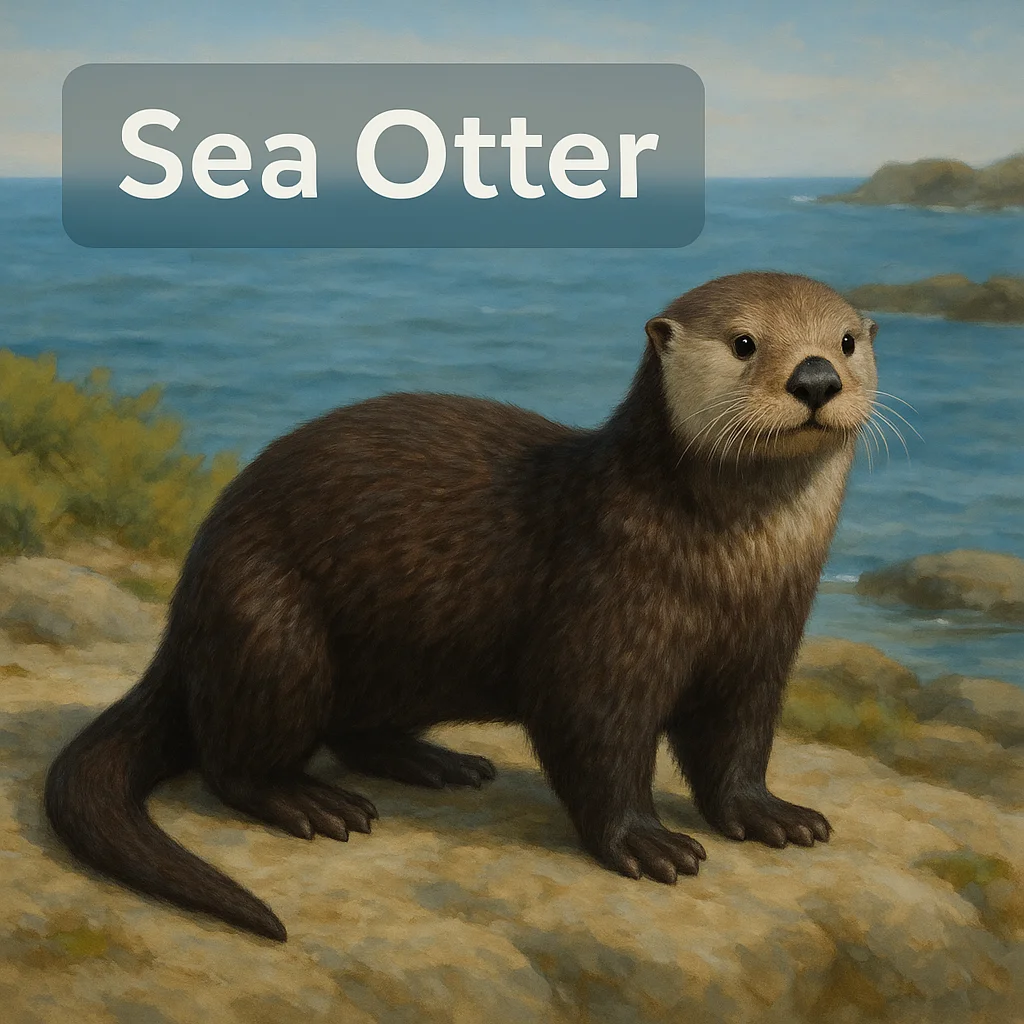
The sea otter is a charismatic marine mammal known for its playful behavior and critical role in marine ecosystems. Commonly observed floating on its back, the sea otter has fascinated scientists and wildlife enthusiasts alike with its unique adaptations to life in the ocean.
- Common name(s): Sea Otter
- Scientific name: Enhydra lutris
- Animal type: Mammal
- Typical adult size: 4 to 5 feet in length, weighing 50 to 100 pounds
- Typical lifespan: 15 to 20 years in the wild; can be longer in captivity
- Diet type: Carnivore; includes sea urchins, clams, crabs, fish, and other marine organisms
- Activity pattern: Primarily diurnal, with active foraging during the day
- Social structure: Usually solitary but may form rafts (groups) of several otters
- Speed/movement highlights: Swimmers, can reach speeds up to 5 mph
- Intelligence/learning: Known for tool use, such as using rocks to break open shells
- Primary habitats: Coastal waters, especially kelp forests
- Geographic range: North Pacific Ocean coasts, from Russia to California
- Predators/threats: Sharks, orcas, and human-related threats like pollution
- Conservation status: Endangered in some regions, varies by population
🔍 Identification & Appearance
Sea otters can be easily recognized by their sleek, streamlined bodies covered in dense, water-repellent fur. They have a rounded face, prominent whiskers, and small, rounded ears. Their hind limbs are webbed, aiding in their adept swimming abilities. Sea otters vary in color from dark brown to a lighter, silvery brown, with the face often appearing lighter.
- Compact body with a thick layer of fur
- Rounded face with long whiskers
- Forepaws with retractable claws
- Long tail, used for steering while swimming
- Dense fur provides insulation in cold waters
- Distinctive swimming with head held above water
- May use rocks as tools, a notable behavior
- Easily confused with seals but differ by otters' distinctive swimming style and body shape
- Paws and fur may appear lighter during summer
- Use of facial expressions for communication
🧱 Body Structure & Physical Adaptations
The sea otter's body is perfectly adapted for a life spent mostly at sea. Its insulation comes from its thick fur rather than blubber, like other marine mammals. Their forelimbs are strong and dexterous, allowing them to manipulate objects and grasp prey efficiently. Their teeth are designed for crushing shells, a crucial adaptation for their diet of hard-shelled marine animals.
- Streamlined body for efficient swimming
- Retains heat through dense, water-resistant fur
- Sharp teeth designed for crushing shellfish
- Robust forelimbs for holding tools and prey
- Sensitive whiskers help detect prey underwater
- Strong, webbed hind limbs for propulsion
- Good vision above and below water
- Zygomatic arch allows strong bite force
- Vestibular system aids in balance in water
- Highly adjustable grip due to flexible wrists
🌍 Range & Distribution
Sea otters inhabit the coastal regions of the North Pacific Ocean. Their range includes the coastal waters of Russia, Alaska, British Columbia, Washington, and California. They are typically found in nearshore environments, preferring rocky coastlines and kelp forests, which provide abundant foraging opportunities and protection from predators.
- Pacific coastal waters of Russia to California
- Prefer shallow coastal regions
- Often found in kelp forests
- May be seen in estuaries and rocky shores
- Rarely venture more than a couple of miles from shore
- Distribution is patchy due to habitat specificity
- Seasonal movements are minimal
- Alaska hosts significant populations
- Southern sea otters inhabit California coasts
🏞️ Habitat & Shelter
Sea otters are marine animals that require specific habitats like kelp forests for survival. These forests provide shelter and abundant foraging grounds. Sea otters use kelp strands to anchor themselves when sleeping or resting to prevent drifting. Shelter and habitat are vital as they influence their foraging success and protection from predators.
- Prefer underwater structures like kelp forests
- Use floating kelp as rafts to rest and sleep
- Shorelines with rocky features are ideal
- Weather changes may influence shelter choice
- Tides impact feeding and resting behavior
- Stable environment critical for raising pups
- Pollution can severely impact available habitats
- Habitat knowledge is crucial for conservation
🧭 Behavior & Ecology
Sea otters are known for being highly active, curious, and playful creatures. Their daily routine includes extensive grooming to maintain the insulating quality of their fur. They are also known for using vocalizations, body language, and tools, such as rocks, while foraging. As keystone predators, their feeding habits help regulate the populations of their prey, which in turn maintains the health of kelp forests.
- Extensive grooming keeps fur insulating
- Use vocal calls to communicate
- Playful and inquisitive species
- Famous for using tools during feeding
- Structure of their rafts may vary dynamically
- Important predator of sea urchins
- Rafting behavior provides safety and warmth
- Role as ecosystem engineers in kelp forests
- Scavenging behavior contributes to cleaning ecosystems
👥 Social Life & Group Dynamics
While sea otters are mainly solitary, they exhibit occasional social behavior. Groups of sea otters, known as rafts, can form, especially during resting. These rafts can number from just a few individuals to several dozen. Sea otters lack strong social hierarchies but will engage in cooperative behaviors mostly surrounding foraging and pup care.
- Form rafts primarily for comfort and safety
- Male and female rafts can differ in structure
- Cooperative behavior seen in pup rearing
- Limited territorial aggression
- Interactions are largely centered around feeding
- Rafts provide warmth and protection
- No rigid social structuring like packs
- Raft dynamics can change based on environmental conditions
🍽️ Diet, Prey & Predators
Sea otters are carnivorous, with diets that include a variety of marine organisms. Sea urchins, crabs, and mollusks are particularly important, and otters are well-known for their ability to crush shells with their powerful jaws or tools like rocks. In turn, they face natural predators such as sharks and orcas, though human impacts represent significant modern threats.
- Sea urchins are a staple in the diet
- Also consume crabs, mollusks, and small fish
- Method of consumption involves crushing and using tools
- Pups more vulnerable to predation
- Orcas and sharks are primary natural threats
- Human-induced threats include oil spills and entanglement
- Forages in shallow coastal waters
- Does not engage in long-distance hunting
🦌 Hunting, Foraging & Movement
Sea otters are adept swimmers, relying on their strong webbed hind feet for propulsion. They forage in nearshore areas, using their senses to locate prey. Their ability to dive up to 300 feet allows them access to a wide range of underwater habitats. Foraging typically involves the use of tools and is often a solitary activity.
- Efficient swimmers aided by webbed feet
- Capable of deep dives for prey
- Tool use during foraging is common
- Rely heavily on tactile and visual cues
- Often seen floating on back during feeding
- Nocturnal foraging can occur in high-traffic areas
- Movements largely confined to shallow coastal waters
- Raft movement based on currents and food availability
🧠 Intelligence & Senses
Sea otters are highly intelligent, demonstrating the ability to use tools to access food, a trait seen in few animal species. They possess excellent senses of smell and touch, which they use extensively during foraging. Their communication is complex, involving a range of vocalizations and body language.
- Tool use demonstrates problem-solving skills
- Complex vocal and non-verbal communication
- Strong memory aids in food location
- Acute sense of smell guides foraging
- Tactile sensitivity helps detect prey
- Good eyesight for both light and dark conditions
- Learning is influenced by environment and experience
- Social intelligence displayed through group interactions
🪺 Reproduction, Pregnancy & Parenting
Sea otters breed throughout the year, though peaks may occur depending on location. They tend to exhibit polygynous mating systems, with males often defending territories that encompass multiple females. Pups are born fully furred and are cared for intensively by their mothers for several months, with mothers teaching pups crucial skills such as hunting and grooming.
- Year-round breeding, peaking in spring or summer
- Gestation lasts around six months
- Typically one pup per pregnancy
- Pups are dependent on mothers for survival
- Mother-offspring bond is strong and nurturing
- Females provide most care; alloparenting is rare
- Pups begin learning to swim and groom shortly after birth
- Paternal involvement is absent post-mating
♀️♂️ Male vs Female Differences
Male and female sea otters show some differences, primarily in size, with males generally larger. Behavioral roles also differ, as males often engage in territorial defense, while females focus on raising young. However, sexual dimorphism is not highly pronounced in terms of coloration or other physical traits.
- Males are typically larger and heavier
- Females are more involved in pup-rearing
- Males more aggressive in defending territories
- No significant differences in fur coloring
- Both participate equally in foraging activities
- Male skulls slightly more robust, ideal for crunching shells
- Females may be more selective in choosing territory due to pup needs
- Mating behavior varies but is mainly driven by male activity
🧬 Subspecies & Variation
There are three recognized subspecies of the sea otter: the Northern sea otter, the Southern sea otter, and the Russian sea otter. Variations among them are primarily in body size and geographic range. While all subspecies depend on coastal waters, habitat conditions can lead to differences in behavior and diet.
- Northern sea otters are larger, found from Alaska to Washington
- Southern sea otters reside along central California coasts
- Russian sea otters are found in the western North Pacific
- Each subspecies adapted to local environmental conditions
- Debates exist over classification of subspecies due to genetic similarities
- Variations may include behavioral adaptations to local threats
- Coloration can subtly differ depending on habitat conditions
- Subspecies classification can impact conservation strategies
⚠️ Threats, Conservation & Human Interaction
The sea otter faces numerous threats both natural and human-induced. Habitat degradation, oil spills, and fishing gear entanglement are critical issues. Conservation efforts are underway to protect and restore sea otter populations, focusing on habitat conservation and pollution control as key strategies. Ethical considerations stress the importance of coexisting without disturbing natural behaviors or habitats.
- Human activities pose significant threats
- Conservation efforts focus on habitat protection
- Pollution, especially oil spills, severely impact populations
- Efforts made to diminish bycatch in coastal fishing
- Public education on cohabitation remains essential
- Zoos and aquariums provide roles in rehabilitation and awareness
- Legal protections vary by region, highlighting need for awareness
- Collaboration with local communities crucial for conservation success
✨ Fun Facts & Unique Traits
- Sea otters have the densest fur in the animal kingdom
- They play a role similar to forest elephants and bison as ecosystem engineers
- Their use of tools is a sign of advanced intelligence
- Sea otters can use their chest as a dining table or a lounge
- Pups cannot dive for several months and rely on their mothers
- Sea otters hold hands while sleeping to stay together
- They often vocalize using chirps, growls, and whines
- Sea otters have a favorite rock they keep in a pouch under their arms
- An adult sea otter can eat up to 25% of its body weight in food each day
- Kelp forests thrive by sea otters controlling sea urchin populations
📌 Summary
- Sea otters are marine mammals found in the North Pacific
- Easily recognized by their dense fur and playful behavior
- Primary habitats include coastal kelp forests where they forage
- They eat various marine organisms, using tools for hunting
- Face threats from natural predators and human activities
- Important ecological role in maintaining kelp forest health
- Exhibit solitary behavior but form rafts for safety and warmth
- Highly intelligent, showing problem-solving and tool use
- Females primarily care for young, with males defending territories
- Conservation status varies; efforts focus on habitat protection
- No strong sexual dimorphism, though males are slightly larger
- Subspecies variation exists; distinctions crucial for conservation