🦁 Orca (Killer Whale)
🧾 Quick Facts
The Orca, also known as the Killer Whale, is one of the ocean's most fascinating and intelligent predators. They are known for their striking black-and-white coloration, complex social structures, and diverse hunting techniques. Here is a quick overview of this majestic animal:
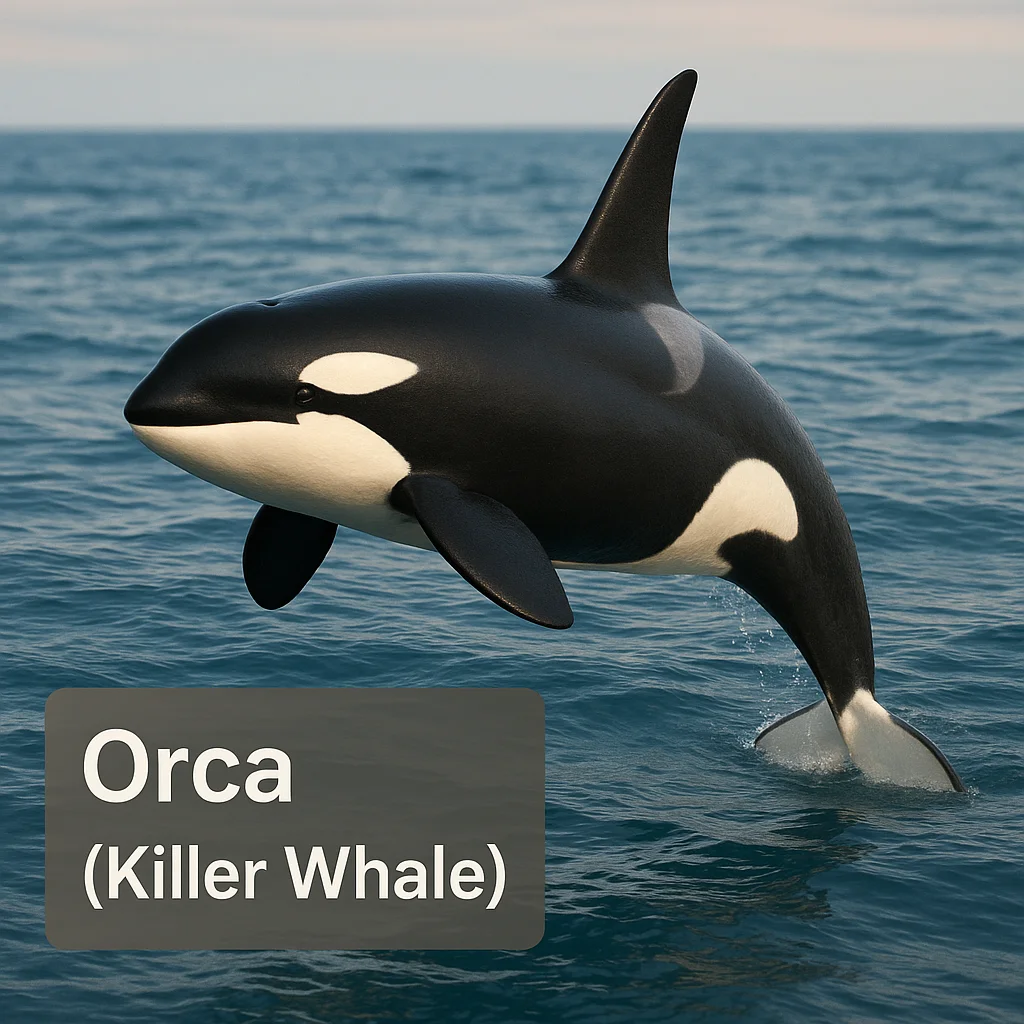
- Common name(s): Orca, Killer Whale
- Scientific name: Orcinus orca
- Animal type: Mammal
- Typical adult size: 20-26 feet (6-8 meters) in length, weighing up to 6 tons (5,443 kg)
- Typical lifespan: 30-50 years in the wild; may live up to 70+ years in some populations
- Diet type: Carnivore; feeds on fish, marine mammals, and cephalopods
- Activity pattern: Diurnal, with activity spread throughout the day and night
- Social structure: Live in stable family groups called pods
- Speed / movement highlights: Can swim up to 34.5 mph (56 km/h)
- Intelligence/learning: Highly intelligent with advanced problem-solving and communication skills
- Primary habitats: Oceanic and coastal waters; prefer cooler regions but are found worldwide
- Geographic range: Found in every ocean, from polar to tropical regions
- Predators/threats: Few natural predators; human threats include pollution, ship strikes, and fishing nets
- Conservation status: Varies by region; some populations are endangered
🔍 Identification & Appearance
Orcas are easily recognizable thanks to their striking black-and-white coloring and robust, torpedo-shaped bodies. Here’s how to identify them:
- Medium to large dorsal fin, which can be over 6 feet (1.8 meters) tall in males
- Distinct black back and white belly; white patches near eyes and down sides
- Stocky, rounded body with a prominent beak-like snout
- Saddle patch of grayish white behind dorsal fin
- When seen clearly, each individual can be identified by unique fin and saddle shape
- Top ID Tips
- Look for dorsal fin shape and size, with males having taller fins
- Note unique body markings: no two orcas have exactly the same pattern
- Females and young are smaller with a curved dorsal fin
- Observe social behavior: traveling in pods is common
- Spot them from afar: often seen surfacing in groups
- Listen for vocalizations: they often breach with distinctive sounds
- White eye patch and saddle patch are hallmark features
- More streamlined body and narrower pectoral fins in younger animals
🧱 Body Structure & Physical Adaptations
Orcas possess a range of physical adaptations that make them top-level predators in the marine environment:
- Streamlined, hydrodynamic build optimized for high-speed swimming
- Robust jaws with 40 to 56 interlocking teeth for grasping slippery prey
- Strong, paddle-shaped pectoral fins for steering
- Highly developed auditory system for echolocation and communication
- Thick blubber layer for insulation in cold waters
- Key Adaptations
- High aspect ratio dorsal fin for stability in water
- Acute hearing adapted for underwater frequencies
- Teeth designed for tearing and holding prey, not chewing
- Adds buoyancy and protection from cold with significant blubber
- Incredible sonar capabilities for hunting
- Flexible social structure aids in cooperative hunting
- Black and white coloration provides camouflage
- Pectoral fins double as stabilizers while submerged
- They navigate using environmental cues and echolocation
🌍 Range & Distribution
Orcas are one of the most widely distributed mammals, inhabiting every ocean on the planet. Their adaptability allows them to thrive from the icy waters near polar regions to the warm, temperate sea areas.
- Where You Might Find It
- Pacific Northwest coast of North America
- Norwegian fjords and waters around Iceland
- Sub-Antarctic waters
- Nearshore waters off New Zealand
- Southern Ocean around Antarctic
- Cerulean depths of the Gulf of Mexico
- South African coasts
- Regions of the British Isles
- North Sea environs
🏞️ Habitat & Shelter
Orcas prefer a variety of marine habitats but show a particular affinity for the open ocean and coastal areas. Their ability to navigate diverse marine environments underscores their adaptability and range.
- Prefer cooler waters but are adaptable
- Highly migratory, seeking prey and conditions
- Varied habitat ranging from deep oceans to coastal bays
- Often seen roving near the ice edges in colder regions
- Rare use of specific shelters, not residing in confined structures
- Urban coastlines surprise sighting sites
🧭 Behavior & Ecology
Orcas are renowned for their complex behaviors and interactions with their environment and other species. Their cooperative hunting strategies and strong social bonds highlight their intelligence and adaptability:
- Behavior Highlights
- Cooperative and sophisticated hunting techniques
- Pod-based living, matriarchal leader figure
- In-depth vocalization; signals and songs
- Aerial spyhopping to survey surface and surroundings
- Complex social play and inter-pod interaction
- Human observation curiousness
- Breaches and tail slaps as communicative displays
- Bubbling hunting formation effectively adaptive
- Preys on a diverse range of animals, including large marine mammals
- Land-based seal hunting witnessed with unique approaches
👥 Social Life & Group Dynamics
Orcas lead complex and socially structured lives, mostly residing in pods where dominance hierarchies and alliances form:
- Social Structure Notes
- Live in maternal headlined family pods
- Packs range from a few individuals to more than 40 members
- High cooperation in hunting and prey capture
- Female-led structure, often with shared nurturing
- Distinct family calls for vocal identity
- Cross-pod socializing and bonding
- Majority active associations lasting decades
- Aggression mostly directed at food disputes or navigation
- Behavior studied extensively for social complexity
🍽️ Diet, Prey & Predators
Orcas are versatile predators with a diverse diet adapting to their surrounding ecological niches:
- Feeding Notes
- Diet includes fish, squid, sea birds, marine mammals
- Cooperative hunting known, including herding
- Prey capture techniques agile and environment-dependent
- High adaptability in hunting between regions
- Threat from larger shark species low to nonexistent
- Fast-reactive hunting makes variety accessible
- Specializations on certain prey prominent in some groups
🦌 Hunting, Foraging & Movement
Orcas demonstrate advanced tactics in hunting and foraging, tailored to their environment and prey:
- Movement & Strategy
- Primary movement style: swimming
- Uses echolocation to hunt and navigate
- Excels in rapid pursuit of swift prey
- Speed tops at 34.5 mph during chase
- Fatal blows delivered by body rams
- Seasonal shifts in movement linked to prey migration
- Cruising habits central to varied cope with waters
🧠 Intelligence & Senses
Orcas are celebrated for their intelligence, rivaling that of primates with amazing adaptability and communications:
- Notable Abilities
- Sophisticated problem-solving and learning behavior
- Complex vocalizations, songs, and dialects
- Effective use of sonar for prey location
- Unique, characteristic vocal sounds Pod-based
- Sociability-transitioning for environmental adaptation
- Intragroup coordination vital to survival
- They exhibit advanced memory recall skills
🪺 Reproduction, Pregnancy & Parenting
Orca reproduction and parenting display complexity and cooperation, with intricate social bonding:
- Reproduction Snapshot
- Mates mostly during spring and summer
- Gestation lasts 15-18 months
- Birth usually of one calf at a time
- The mother, mostly, takes the lead in childcare
- Calves nurse up to two years before gradual weaning
- Female breeding typically ceases near age 40
- Inter-subpod partnerships common
♀️♂️ Male vs Female Differences
Despite their identical black and white coloring, male and female orcas display some key differences:
- Sex Differences at a Glance
- Females are generally smaller than males
- Males have taller and more erect dorsal fins
- Females often outlive their male counterparts
- Differences in vocalization linked with sex
- Roles in parenting typically female-focused
🧬 Subspecies & Variation
There are several ecotypes of killer whales, varying by diet and morphology. Some subspecies classification is debated:
- Variation Notes
- Resident, transient, and offshore ecotypes in the Pacific
- Resident forms mostly feed on fish
- Transients typically prey on marine mammals
- Morphological and behavioral differences present across groups
- Behavioral nurture prominent by locality of territory
⚠️ Threats, Conservation & Human Interaction
While orcas have few natural predators, human activities have introduced significant challenges:
- Responsible Notes
- Biggest threat from pollution and chemical waste
- Ship traffic disrupts their acoustic environment
- Bycatch in fisheries an ongoing danger
- Captivity controversy sparks ongoing debates
- Protective regulations vary globally
- Ecosystem impacts seen from declining prey availability
- Efforts needed in proper ocean conservation practices
- Hydrocarbon and contaminants a latent threat
✨ Fun Facts & Unique Traits
- Orcas have the second-largest brain of any marine mammal
- They are a part of the dolphin family, not whales
- Known to create waves to wash prey off ice floes
- Orcas can live in both salt and fresh water
- Exhibit pods of tight family structures
- They can swim up to 100 miles (161 km) in a single day
- Their communication is a rich tapestry of clicks and calls
- Can work with other pods in superpods
📌 Summary
- Orcas are top predators found in all the world's oceans
- Easily identified by their striking black-and-white coloration
- Live in complex social structures known as pods
- Engage in cooperative hunting, enabling a diverse diet
- Exhibit fascinating vocalizations and echolocation skills
- Males larger than females, with pronounced dorsal fins
- Face conservation challenges from human activities
- Highly intelligent, comparable to primate behavior
- Serve crucial roles in their ecosystems as apex predators
- Rich mythologies and folklore emphasize their iconic status