🦁 Manatee
🧾 Quick Facts
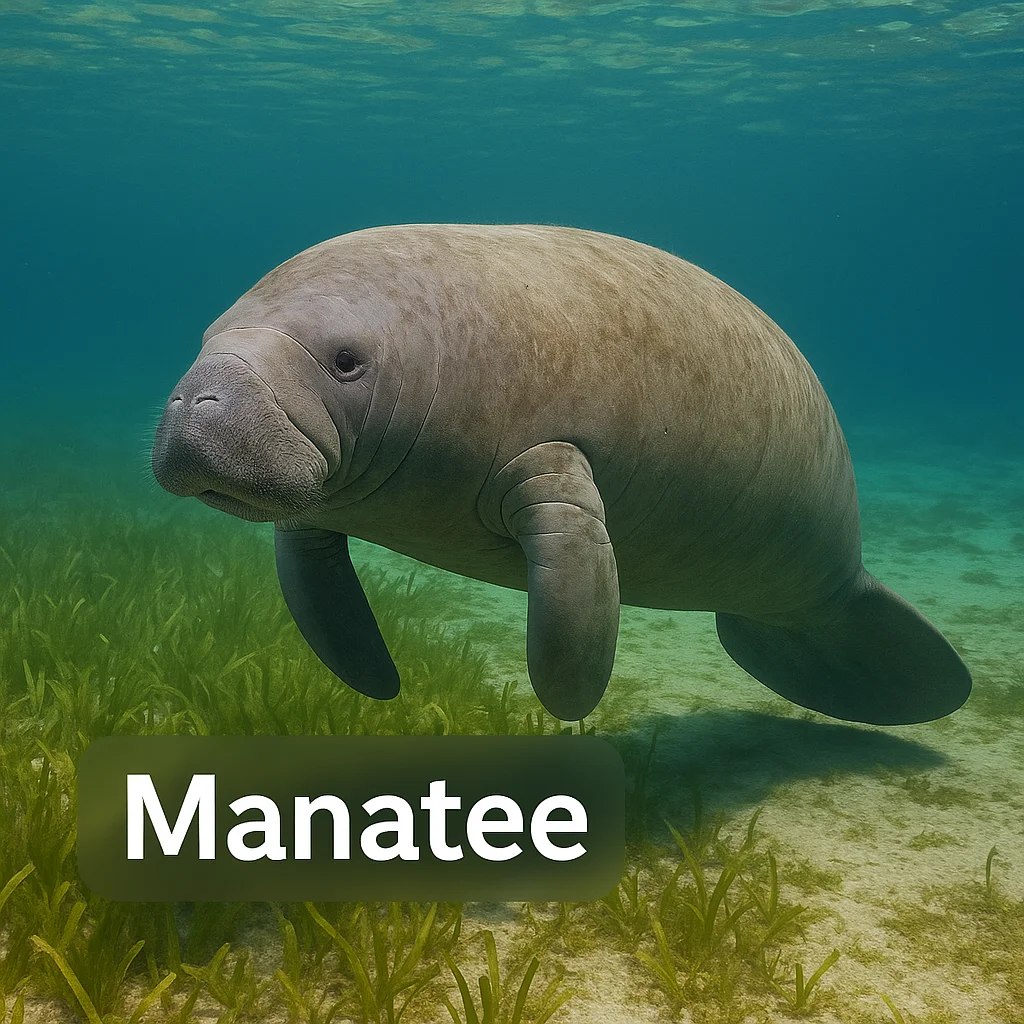
The manatee, also known as the "sea cow," is a large, fully aquatic, mostly herbivorous marine mammal. These gentle giants glide through the waters of the Caribbean Sea, Gulf of Mexico, Amazon Basin, and West Africa.
- Common name(s): Manatee, Sea Cow
- Scientific name: Trichechus (various species)
- Animal type: Mammal
- Typical adult size: 8-13 feet in length; 800-1,200 pounds
- Typical lifespan: 40-60 years
- Diet type: Herbivore; primarily seagrasses and freshwater vegetation
- Activity pattern: Mostly diurnal
- Social structure: Solitary or small, loose groups
- Speed / movement highlights: Swim at 3-5 mph, bursts up to 20 mph
- Intelligence/learning: Recognize areas and individuals; learn new routes
- Primary habitats: Warm coastal waters, rivers, and estuaries
- Geographic range: Caribbean Sea, Gulf of Mexico, Amazon Basin, West Africa
- Predators/threats: Few natural predators; human-impact threats include boat strikes, habitat disruption
- Conservation status: Varies by region; some populations are threatened
🔍 Identification & Appearance
Manatees have a distinctively rounded body designed for buoyancy and movement in aquatic environments. Their skin is thick and wrinkled, typically gray or brownish. They have paddle-shaped tails and flippers, which are covered in small bristles.
- Body shape and silhouette: Torpedo-like, streamlined body
- Key colors/patterns: Uniform gray, sometimes with algae or barnacles
- Distinctive features: Paddle-shaped tail, whiskered snout, stubby flippers
- Tracks, scat, or other field signs: Leave trails in muddy or grassy areas
- Common look-alikes: Dugongs; differ by snout shape and geographic distribution
- Rounded, streamlined body for aquatic life
- Algae and barnacles can grow on their skin
- Distinguished by their paddle-like tail
- Flippers used for steering and holding food
- Large size with no dorsal fin
- Long, flexible snout for grazing sea grass
- Whiskers for tactile exploration
- No visible ears; small auditory openings
- Solitary path drifters, often mistaken for floating logs
🧱 Body Structure & Physical Adaptations
Manatees have a large, round body with a slight taper at the back, ending in a large, flat tail. Their skeleton is heavy, with dense bones that counteract buoyancy, making it easier to stay submerged. They have more than 12 molars adapted for grinding vegetation.
- Build and proportions: Robust and sturdy with a large tail
- Teeth adaptations: Replacement "marching molars" for grinding plants
- Flippers: Perfect for steering and slow movement
- Sensory strengths: Sensitive to vibrations and have keen hearing
- Dense bones for countering buoyancy
- Paddle-like flippers with flexible joints
- Constantly replace teeth to manage wear
- Slow metabolism reducing oxygen needs
- Eyes equipped with self-cleaning membranes
- Sniffing abilities to detect food and other manatees
- Long lungs that assist in buoyancy control
- Blubber layer for warmth and energy storage
- Flexible lips to grasp vegetation
🌍 Range & Distribution
Manatees are found in warm coastal waters of the Atlantic, primarily along the coasts of Florida and the Caribbean, as well as in the Amazon Basin and West Africa.
- Northern limits: Florida, southeastern North America
- Southern limits: Northern South America
- Habitats: Coastal waters, rivers, and estuaries
- Amazonian manatees are found in the Amazon River
- West African manatees range along the west coast of Africa
- Typically resident, but may migrate in response to temperature changes
- Water temperature critical for presence
- Coastlines of the Caribbean Sea and Gulf of Mexico
- Amazon River and its tributaries
- West African coastal zones
- Tide-dependent areas in tropical coasts
- Often in rivers and estuaries
- Inland waterways during warm months
- Limited to warmer waters year-round
- Migrate to warm springs in colder months
- Prefer shallow waters up to 6 feet deep
🏞️ Habitat & Shelter
Manatees favor warm coastal environments, usually found in rivers, estuaries, and coastal areas with ample aquatic vegetation. They occasionally move into freshwater habitats. Shelter in deeper channels is sought during colder spells to avoid cold stress.
- Rivers, bays, and shallow coastal waters are preferred environments
- Occasionally move to freshwater springs
- Seek warm water sources in winter
- Sensitive to water temperature changes
Understanding their habitat helps in conservation planning and management, given how climate and development threaten their environment.
🧭 Behavior & Ecology
Manatees are slow-moving mammals. They graze throughout the day, consuming up to 10-15% of their body weight in vegetation. Communication involves gentle vocalizations, important for mother-calf connections in murky waters. Manatees play a role as ecosystem 'gardeners,' maintaining vegetation balance.
- Mainly graze on seagrass and freshwater plants
- Spend 6-8 hours feeding daily
- Rest for about half the day submerged
- Communicate with squeaks, chirps, and whistles
- Help maintain aquatic vegetation biodiversity
👥 Social Life & Group Dynamics
Manatees are generally solitary but may engage in small group gatherings. They form pairs or tiny groups for feeding or mating but don't maintain a stable group structure. Occasionally, they collaborate during migration, and mother-calf bonds are particularly strong.
- Briefly gather during feeding or migrations
- Mother and calf relationships are strong for about two years
- Loose aggregations at feeding sites
- Bond-oriented rather than social hierarchy
- Minimal aggression; generally, avoid conflict
- Occasional gentle contact for tactile communication
- Coincide around warm water sources in winter
- Communicate mimicry and understanding between them
🍽️ Diet, Prey & Predators
As herbivores, manatees feed on over 60 different freshwater and marine plants. Their main defense is their size and the underwater environment. While natural predation is low, their biggest threats come from human activities, such as boat collisions and habitat loss.
- Largely feed on seagrasses, algae, and freshwater plants
- Capability to eat terrestrial plants in flooded areas
- No natural predators of significant threat
- Migrating or resting near warm waters reduces exposure
- Vulnerable to collisions with watercraft
🦌 Hunting, Foraging & Movement
Manatees are leisurely swimmers, usually moving at 3-5 mph. They exhibit long feeding periods during daylight hours. Navigating shallow waters allows easy access to seagrass beds and vegetation lining rivers and lakes. They educate one another about food locations through tactile exploration.
- Slow swimmers, mainly forage in shallow waters
- Rely on memory to navigate between habitats
- Feed during daylight, rest at night
- Powerful tail propels them in water
- Adapted to grazing along the bottom
- Store fat to sustain energy during lower food availability
🧠 Intelligence & Senses
Manatees display a fair degree of problem-solving abilities. They quickly learn pathways and locations, crucial in areas with limited food sources or warm water sites. Their tactile receptors detect movement and pressure changes in water, while whiskers function as sensory tools.
- Excellent memory for learning complex routes
- Utilize whiskers for tactile exploration
- Sensitive to sound, often avoiding loud noises
- Memory plays a role in identifying warm refuges
- Problem-solving skills in finding food efficiently
🪺 Reproduction, Pregnancy & Parenting
Manatees generally breed every two years with a gestation period of about 11-13 months. Newborns are weaned by their mothers, relying entirely on them for the first year. There is no defined breeding season but occurs year-round in warmer months.
- Breeding occurs year-round, more when warm
- Gestation lasts about 13 months
- Typically one calf; twin births rare
- Caring mothers nurse calves over a couple of years
- Calves reliant on learning from their mothers
- No specific male involvement beyond mating
- Gradual weaning onto plants within the first year
♀️♂️ Male vs Female Differences
Manatees exhibit minimal sexual dimorphism, with females typically larger due to reproductive needs. Male and female behaviors are largely similar, with differences primarily in reproductive duties.
- Females generally larger due to reproductive roles
- Males do not engage in calf-rearing
- Similar coloration and anatomy outside of sexual organs
- Both sexes solitary, aside from mating periods
🧬 Subspecies & Variation
There are three main species of manatees: the West Indian Manatee, the Amazonian Manatee, and the West African Manatee. Differences are mainly geographical with subtle variances in size and coloration.
- West Indian (Trichechus manatus) is split between Florida and the Caribbean
- Amazonian (Trichechus inunguis) smaller and found in freshwater
- West African (Trichechus senegalensis) found along Africa's west coast
- Slight variation in size and skin texture across regions
- Genetic studies indicate regional adaptations and distinctions
⚠️ Threats, Conservation & Human Interaction
Manatees face several human-induced threats, including habitat destruction, boat collisions, and pollution. Conservation efforts focus on habitat preservation and protection measures, such as reducing boat speeds in manatee zones. Public awareness campaigns emphasize cohabitation benefits.
- Boat strikes are a significant risk due to low speed
- Habitat loss from coastal development
- Pollution affects water quality and vegetation health
- Protected areas and speed regulations in place for conservation
- Importance of maintaining clean water for food security
✨ Fun Facts & Unique Traits
- Manatees' bones are solid and heavy, unlike most other mammals, which helps them stay submerged
- Can hold their breath for up to 20 minutes when resting
- Known as "sirenia," linking them mythologically to mermaids
- The closest living relatives are elephants and hyraxes
- Have a small brain but with a large cerebellum, aiding in coordination
- Use their lips much like hands to manipulate food
- Frequently subject of folklore across their native regions
- Have existed relatively unchanged for over 50 million years
📌 Summary
- Identification: Large, gray aquatic mammals with paddle-shaped tails
- Habitat: Warm coastal waters and inland rivers
- Distribution: Caribbean, Gulf of Mexico, Amazon, West Africa
- Diet: Herbivore, consumes marine and freshwater plants
- Predators: Few natural predators; human-related threats remain significant
- Social life: Solitary or form small, flexible groups
- Reproduction: Year-round breeding, one calf with extended care
- Key adaptations: Dense bones, tactile whiskers, specialized molars
- Distinctive traits: Closely related to elephants, known for gentle demeanor