🦁 Harbor Seal
🧾 Quick Facts
The harbor seal, scientifically known as Phoca vitulina, is a common species of seal found along temperate and Arctic marine coastlines of the Northern Hemisphere. As one of the most widely distributed pinnipeds, it inhabits a variety of coastal habitats and is known for its adaptability and generalist diet.
- Common name(s): Harbor Seal, Common Seal
- Scientific name: Phoca vitulina
- Animal type: Mammal
- Typical adult size: 1.2 to 1.9 meters (4 to 6.3 feet) in length; 55 to 170 kilograms (121 to 375 pounds)
- Typical lifespan: 20 to 35 years in the wild
- Diet type: Carnivore; primarily fish, shellfish, and crustaceans
- Activity pattern: Mostly diurnal with some nocturnal foraging
- Social structure: Typically solitary but forms groups during breeding and resting
- Speed / movement highlights: Agile swimmer but clumsy on land
- Intelligence/learning: Known for problem-solving and curiosity
- Primary habitats: Coastal waters, estuaries, beaches, and rocky shores
- Geographic range: Northern Hemisphere, North Atlantic, and North Pacific coasts
- Predators/threats: Sharks, killer whales, coyotes; human activities and habitat disturbance
- Conservation status: Varies by region; some populations protected, others stable
🔍 Identification & Appearance
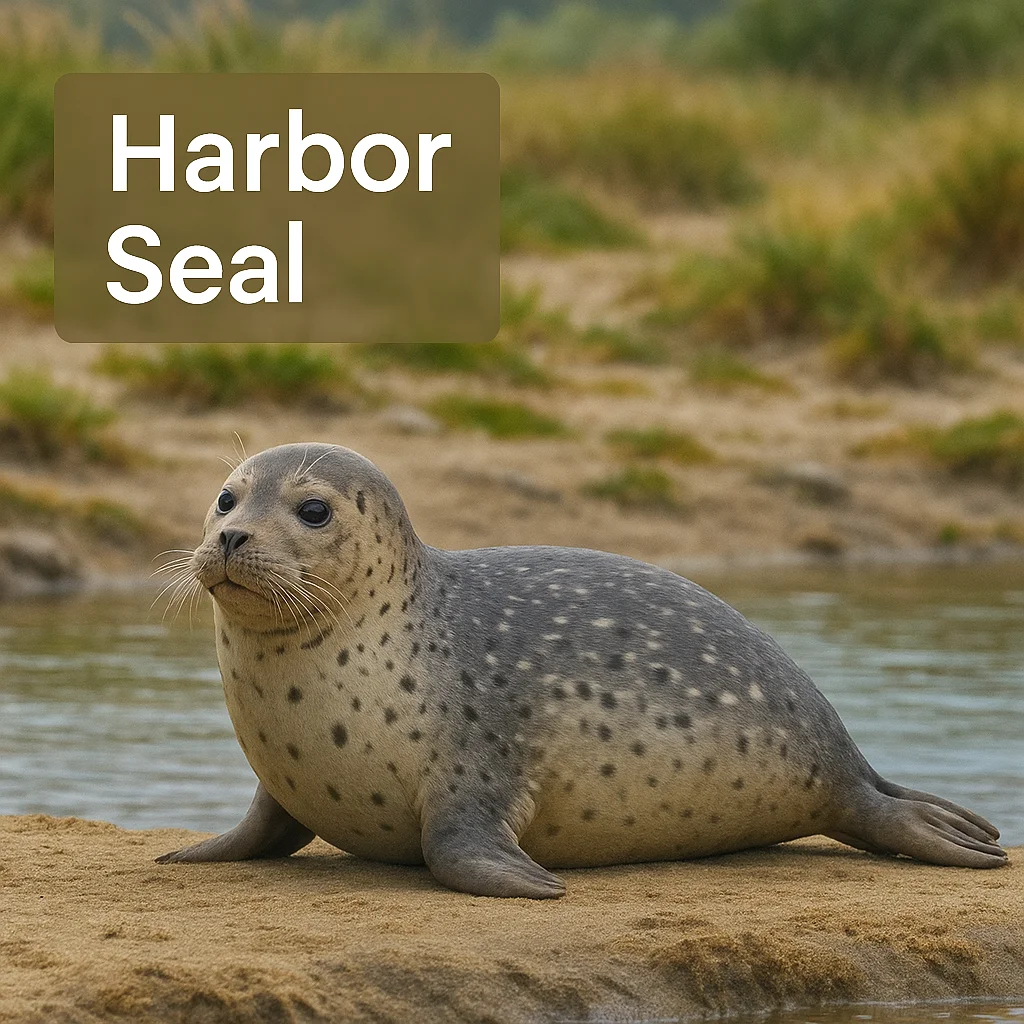
Harbor seals are easily recognizable by their rounded, streamlined bodies and distinctive V-shaped nostrils. Their coat is typically gray with varying patterns of spots and rings that can change with age. Younger seals may have a lighter, silkier coat, while adults boast a more mottled appearance.
- Body shape: Streamlined with a slight taper at both ends
- Color patterns: Grey or brown with spots and rings
- Distinctive features: V-shaped nostrils, large dark eyes
- Tracks: Often leave a belly-shaped trail on soft ground when hauling out
- Common look-alikes: Gray seals, which are larger and have a longer snout
- Top ID Tips: Fat, rounded body; pattern of spots; V-shaped nostrils
🧱 Body Structure & Physical Adaptations
Harbor seals possess several adaptations for their aquatic lifestyle. Their bodies, optimized for swimming, are equipped with strong, short limbs called flippers. They have sharp, pointed teeth suited for gripping slippery prey. The seal's thick blubber layer provides insulation in cold waters, and its sensitive whiskers help detect prey vibrations.
- Stocky build with a tapering end
- Pointed teeth for grasping slippery fish
- Flippers optimized for propulsion and steering
- Excellent underwater hearing and vision
- Thick blubber for insulation
- Key Adaptations: Streamlined body, sensitive whiskers, sharp teeth
🌍 Range & Distribution
Harbor seals are extensively distributed throughout the coastal areas of the Northern Hemisphere. They can be found from temperate regions to Arctic coastlines, primarily along the North Atlantic and North Pacific Oceans. This species often inhabits cold to temperate waters but can also be found in estuarine and freshwater environments.
- North Atlantic coasts
- North Pacific coasts
- Arctic coastal regions
- Occasional in freshwater lakes and rivers
- Where You Might Find It: Estuaries, beaches, rocky shorelines
🏞️ Habitat & Shelter
Harbor seals favor diverse coastal habitats, allowing them to adapt to a wide range of environments. They utilize rocky shorelines, sandy beaches, and estuaries, often resting on haul-out sites during low tide. Habitat selection can vary seasonally and is crucial for understanding seal behavior, especially in relation to breeding and foraging.
🧭 Behavior & Ecology
Harbor seals exhibit intriguing behavioral patterns, including daily rest cycles, frequent grooming, and some territoriality over haul-out sites. Communication is achieved through vocalizations and body language, such as flipper slapping. Ecologically, as both predator and prey, these seals play vital roles in marine food webs.
- Frequent grooming and resting on haul-outs
- Vocal communication and physical displays
- Predator and prey in the marine ecosystem
- Body language to communicate dominance
- Behavior Highlights: Vocalizations, resting behavior, prey-predator roles
👥 Social Life & Group Dynamics
While predominantly solitary, harbor seals become social during breeding and molting periods. During these times, they form loose aggregations on beaches or sandbanks. Cooperation is minimal, although mothers care for their pups extensively until weaning.
- Solitary most of the year
- Forms groups during breeding
- Minimal cooperation
- Female care for pups
- Social Structure Notes: Solitary with seasonal social gatherings
🍽️ Diet, Prey & Predators
As opportunistic carnivores, harbor seals have a diet primarily comprised of fish and invertebrates. They employ varied hunting strategies ranging from solitary hunting to cooperative methods in some cases. Natural predators include sharks and killer whales. Seals rely on speed and agility to evade threats.
- Main diet: Fish, mollusks, crustaceans
- Occasional scavenging
- Predators: Sharks, killer whales
- Feeding Notes: Opportunistic forager, quick to adapt to available prey
🦌 Hunting, Foraging & Movement
Harbor seals excel in aquatic environments where their movements are characterized by graceful swimming using their powerful flippers. They hunt primarily below the water's surface and possess significant endurance, allowing them to cover extensive areas while foraging.
- Agile swimmer with high endurance
- Expert forager, adept at hunting fish
- Movement & Strategy: Primarily aquatic movement, using flippers for propulsion
🧠 Intelligence & Senses
The harbor seal displays notable problem-solving abilities and curiosity, particularly in interaction with the environment and humans. They have underwater adaptations like acute vision and hearing, which assist in navigation and foraging. Whiskers play a crucial role in detecting prey.
- Curious and exploratory behavior
- Excellent underwater vision
- Highly sensitive whiskers
- Intelligence & Senses: Problem-solving ability, sensory adaptations
🪺 Reproduction, Pregnancy & Parenting
Harbor seals have a defined breeding season influenced by geographic location. The mating system varies, and gestation lasts around 9 to 11 months, including delayed implantation. Females usually give birth to a single precocial pup, and maternal care is intensive for several weeks post-birth.
- Breeding season: Spring to early summer
- Mating: Varied strategies; often polygynous
- Single precocial pup at birth
- Reproduction Snapshot: Delayed implantation, extensive maternal care
♀️♂️ Male vs Female Differences
While males and females harbor seals appear similar, males tend to be slightly larger and more robust. Behavioral differences aren't profound, but males may exhibit more pronounced behaviors during the breeding season.
- Slight size difference: Males larger
- Subtle coloration variations
- Sex Differences at a Glance: Males larger, slight behavioral variances during breeding
🧬 Subspecies & Variation
The harbor seal exhibits variation across its range, with several recognized subspecies differing in size, coat pattern, and distribution. Subspecies classification can be complex, influenced by geographical barriers and local adaptations.
- Regional color variations
- Subspecies classification is debated
- Variation Notes: Local adaptations, debated subspecies classification
⚠️ Threats, Conservation & Human Interaction
Human activities pose significant threats to harbor seals, including habitat disturbance, pollution, and bycatch in fisheries. Conservation efforts vary by region, with some populations requiring protection due to declining numbers. Responsible coexistence involves minimizing disturbances and supporting conservation measures.
- Natural challenges: Predators (sharks, orcas)
- Human-related pressures: Pollution, habitat loss
- Responsible Notes: Support conservation, minimize disturbances
✨ Fun Facts & Unique Traits
- Used flipper movements to communicate
- Able to sleep both in water and on land
- Pups can swim shortly after birth
- Known to follow boats out of curiosity
- Unique V-shaped nostrils aid in species identification
📌 Summary
- Streamlined body with V-shaped nostrils
- Commonly found along temperate and Arctic coastlines
- Carnivorous diet: fish, mollusks, crustaceans
- Agile swimmer, adept at hunting and foraging
- Exhibit solitary but social during breeding
- Reproduction involves extensive maternal care
- Variability in subspecies and local adaptations
- Conservation concerns due to human impacts