🦁 Harbor Porpoise
🧾 Quick Facts
The Harbor Porpoise, known scientifically as Phocoena phocoena, is a small cetacean found in the coastal waters of the Northern Hemisphere. These porpoises are distinguished by their shy nature and relatively limited inland range, making them fascinating subjects for marine exploration.
- Common name(s): Harbor Porpoise
- Scientific name: Phocoena phocoena
- Animal type: Mammal
- Typical adult size: 4.9 to 6.6 feet (1.5 to 2 meters) in length
- Typical lifespan: 8 to 12 years, occasionally up to 20 years
- Diet type: Carnivore; consumes fish and cephalopods
- Activity pattern: Mostly diurnal
- Social structure: Generally solitary or in small groups
- Speed / movement highlights: Swims up to 22 mph (35 km/h)
- Intelligence/learning: Shows problem-solving skills and social learning
- Primary habitats: Coastal and estuarine waters
- Geographic range: Northern Hemisphere coastal waters
- Predators/threats: Orcas, sharks, entanglement in fishing gear
- Conservation status: Varies by region; generally of concern due to human impact
🔍 Identification & Appearance
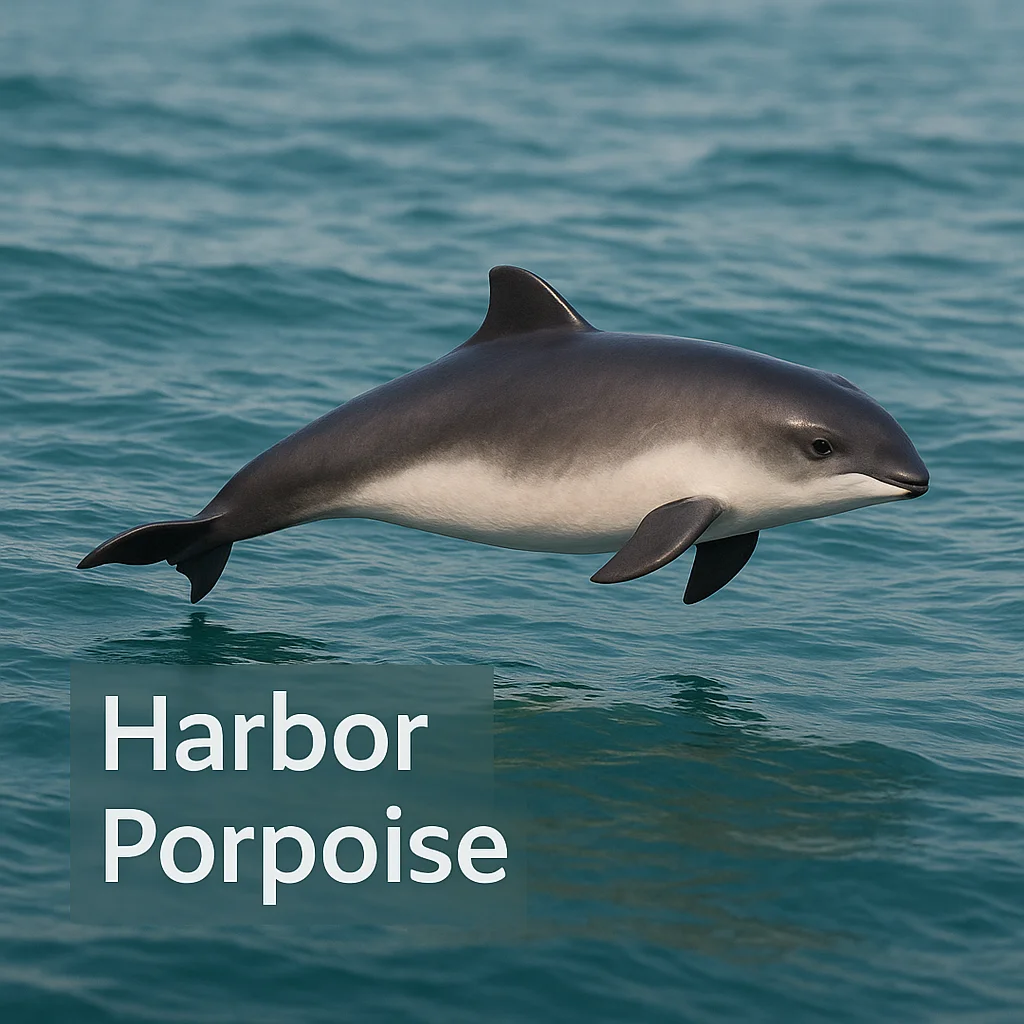
The Harbor Porpoise is characterized by its compact and robust body, allowing it to navigate coastal waters efficiently. The porpoise sports a dark gray to brownish hue on the dorsal side, with a lighter gray or white belly, offering effective camouflage in its maritime environment. It bears a small, rounded head without a pronounced beak, unlike dolphins. Its dorsal fin is triangular and centrally placed on the back.
- Body shape and silhouette: Rounded, compact body with a stubby appearance
- Key colors/patterns: Dark gray dorsal, fading to pale gray or white ventral side
- Distinctive features: Short, rounded nose and central triangular dorsal fin
- Tracks, scat, or other field signs: Not applicable to aquatic species
- Common look-alikes: Easily mistaken for dolphin species, but note lack of pronounced beak
🧱 Body Structure & Physical Adaptations
Harbor Porpoises feature a stocky build optimal for agile swimming in turbulent coastal waters. Their dentition is designed to grasp and hold slippery prey, with spade-shaped teeth ideal for a diet of fish like herring and mackerel. The fins and tail flukes provide stability and propulsion, crucial for quick maneuvers.
- Build and proportions: Robust body with relatively short limbs (fins)
- Teeth adaptation: Spade-shaped for gripping prey
- Fins/tail: Well-developed for rapid swimming and agile turns
- Sensory strengths: Acute hearing developed for echolocation
🌍 Range & Distribution
The Harbor Porpoise can be found in the temperate and subarctic coastal waters of the Northern Hemisphere. This species prefers shallow, near-shore environments for feeding and calving, frequently spotted in bays, estuaries, and occasionally rivers.
- Continents/regions: Coasts of Europe, North America, and parts of Asia
- Typical habitats: Bays, estuaries, coastal waters
- Elevation range: Sea level coastal habitats
- Seasonal movements: Generally resident, with localized seasonal shifts
🏞️ Habitat & Shelter
Harbor Porpoises thrive in colder coastal and estuarine environments, often found near shallow bays and river mouths. Their preference for colder waters means they are most active during spring and summer when prey is plentiful near the surface.
Understanding these habitat preferences helps in conserving areas critical for feeding and breeding, especially in regions impacted by human activities.
🧭 Behavior & Ecology
These porpoises lead a mostly solitary life or travel in small loose-knit groups. Daily activities include foraging for food, socialization, and resting. Communication involves clicking sounds used in echolocation, vital for navigation and locating prey. They play a crucial role in the marine ecosystem as prey for larger predators and contribute to controlling fish populations through predation.
- Daily routine: Forages during the day; evening rest periods
- Communication: Echolocation clicks for navigation and hunting
- Interactions: Minimal aggression; shares territory with other marine mammals
- Ecological role: Prey for larger marine predators; maintains fish population balance
👥 Social Life & Group Dynamics
Harbor Porpoises exhibit varying degrees of social behavior, generally forming small pods consisting of a few individuals. Pods might form temporarily for cooperative hunting or social interactions, but they do not form long-term familial groups. There’s little evidence of complex dominance hierarchies, as they resolve conflicts through avoidance rather than aggression.
- Social tendencies: Primarily solitary; small transient groups
- Group types: Small pods of 2-5 individuals
- Cooperation: Limited, primarily for social and occasional cooperative feeding
- Conflict resolution: Avoidance behavior rather than aggression
🍽️ Diet, Prey & Predators
The Harbor Porpoise has a diet focused on small schooling fish such as herring and mackerel, alongside cephalopods like squid. Hunting involves active pursuit and sometimes collaborative effort within small pods. Predators of the porpoise include orcas and some large sharks. To evade attacks, they rely on their agility and speed in water.
- Diet: Fish and cephalopods primarily during spring/summer
- Hunting strategy: Ambush and active pursuit within small schools
- Natural predators: Orcas, large sharks; humans via bycatch
- Defenses: Speedy swimming, staying in shallow waters to evade pursuit
🦌 Hunting, Foraging & Movement
Harbor Porpoises are adept swimmers, capable of rapid bursts of speed to catch prey. They use echolocation to navigate and locate food in the murky coastal waters. Typically, foraging activities increase during daylight when fish schools are more visible.
- Locomotion style: Active swimmer with rapid, agile movements
- Speed and endurance: Swims swiftly with short bursts of speed
- Foraging tactics: Daytime hunting, using echolocation to locate food
- Navigation: Uses coastal landmarks and sonar abilities to traverse known ranges
🧠 Intelligence & Senses
Harbor Porpoises possess noticeable cognitive abilities for problem-solving and social learning. They exhibit complex auditory processing for echolocation, which aids hunting and navigation. Their sensory adaptations are specifically tuned for marine life, with excellent hearing capabilities to capture echolocation signals.
- Problem-solving: Exhibits learning through environmental interaction
- Sensory strengths: Exceptional hearing for echolocation
- Learning: Capable of social learning from observing conspecifics
- Memory: Retains spatial information for navigation
🪺 Reproduction, Pregnancy & Parenting
Breeding in Harbor Porpoises occurs primarily in late spring to early autumn. They exhibit a promiscuous mating system with no long-term pair bonds. The gestation period lasts about 10 to 11 months, commonly resulting in the birth of a single calf. Calves are typically weaned after 8 to 12 months, during which time the mother is the primary caregiver.
- Breeding seasonality: Spring to early autumn
- Mating system: Promiscuous, no permanent pair bonds
- Gestation period: 10-11 months
- Parental care: Sole responsibility of females
♀️♂️ Male vs Female Differences
Male and female Harbor Porpoises exhibit subtle differences, primarily in size, with males generally being slightly smaller than females. Both sexes share similar coloration and fin structure. Behavioral roles do not vary significantly with gender, as both engage similarly in foraging and social interactions.
- Size differences: Males slightly smaller than females
- Coloration: No significant difference between genders
- Behavioral roles: Similar, with no distinct sexual division of labor
🧬 Subspecies & Variation
There are recognized subspecies of Harbor Porpoises, displaying minor differences primarily in size and slight variability in coloration. Subspecies classification is often debated, and variations mostly arise from adaptation to locally differing environmental conditions. These include the Baltic Sea Harbor Porpoise and North Sea populations.
- Subspecies recognition: Minor variances arise chiefly from size and range
- Local adaptations: Size and coloration may differ by regional habitat
- Classification status: Debated among marine mammal experts
⚠️ Threats, Conservation & Human Interaction
Harbor Porpoises face natural threats from predators such as orcas and sharks, but human activities pose significant challenges. These include habitat degradation, pollution, and accidental bycatch in fishing equipment. Efforts to minimize human impact focus on sustainable fishing practices and pollution reduction in coastal waters.
- Human-related pressures: Bycatch, pollution, habitat destruction
- Conservation efforts: Focused on habitat preservation and bycatch reduction techniques
- Coexistence tips: Encourage sustainable use of marine resources
✨ Fun Facts & Unique Traits
- Harbor Porpoises are one of the smallest cetaceans found in coastal regions.
- They use sophisticated echolocation to hunt in murky waters.
- The porpoise is known for its shy and elusive nature.
- They can hold their breath for up to 6 minutes while diving for prey.
- Sometimes called "puffing pigs" due to their loud breathing sounds when surfacing.
📌 Summary
- The Harbor Porpoise is a small marine mammal appearing grayish with a rounded body.
- Prefers cold coastal waters, often near depths where prey is plentiful.
- Mostly resides in coastal areas of the Northern Hemisphere.
- Feeds on small fish and cephalopods, using unique echolocation abilities.
- Threatened by natural predators and particularly by human marine activities like fishing.
- Exhibits limited social interactions, forming small groups temporarily.
- Reproduction involves a gestation period of 10-11 months, resulting in single calf births.
- Displays local variations in physical attributes influenced by regional environmental conditions.