🦁 Dugong
🧾 Quick Facts
The dugong (Dugong dugon) is a medium-sized marine mammal, often associated with mythical "mermaids" due to its gentle demeanor and unique appearance. As a member of the Sirenia order, it is closely related to manatees and is the only extant species of the Dugongidae family. Throughout the tropical and subtropical waters of the Indo-Pacific, dugongs play a crucial role in the ecosystem as seagrass consumers.
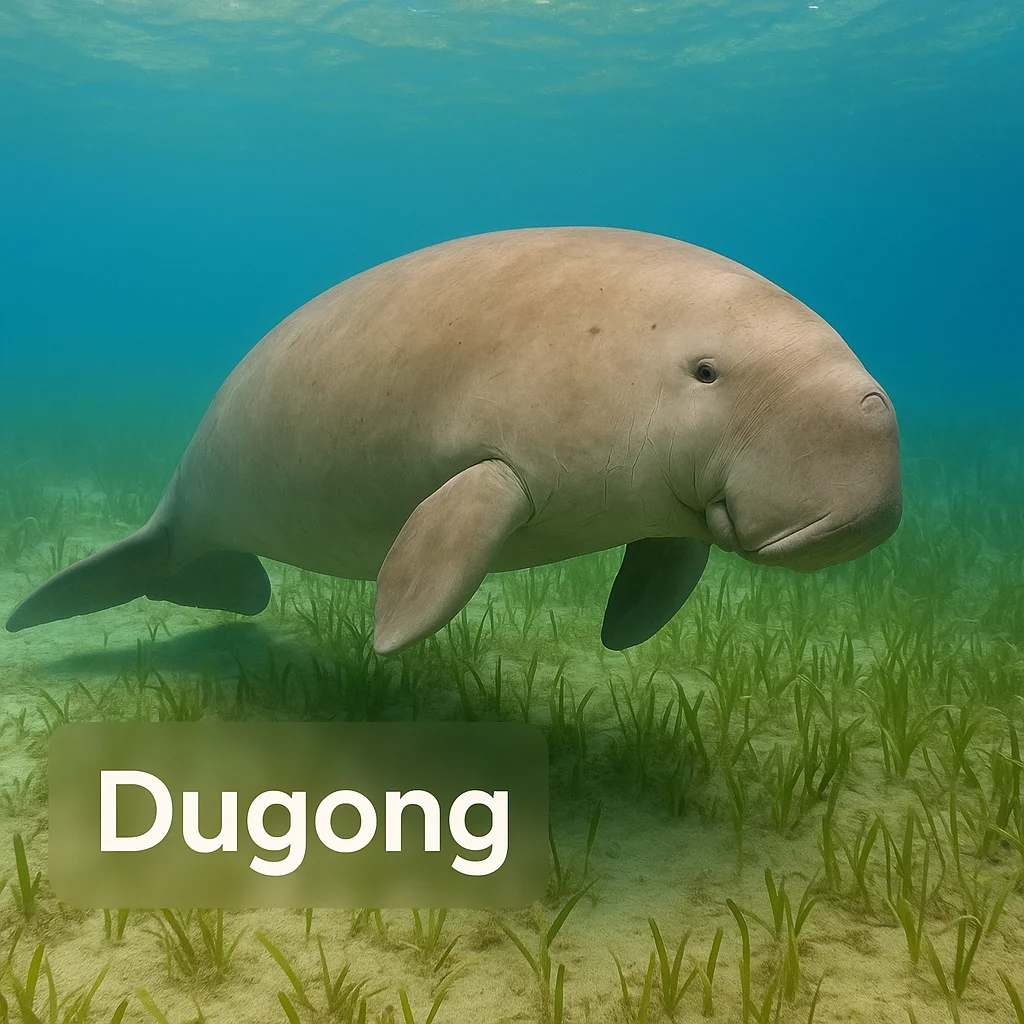
- Common name: Dugong
- Scientific name: Dugong dugon
- Animal type: Mammal
- Typical adult size: 2.4 to 3.3 meters (8-11 feet) in length; 250 to 900 kg (550-1980 lbs) in weight
- Typical lifespan: 50 to 70 years
- Diet type: Herbivore; primarily seagrass
- Activity pattern: Mostly diurnal, but can be active day and night
- Social structure: Generally solitary or in small groups
- Movement highlights: Swims at an average speed of 10 km/h (6 mph)
- Intelligence/learning: Exhibit learning and memory; use vocalizations for communication
- Primary habitats: Coastal marine waters, seagrass beds
- Geographic range: Indo-Pacific region, including East Africa, the Red Sea, Australia, and Southeast Asia
- Predators/threats: Sharks, crocodiles; human-related threats include habitat loss and bycatch
- Conservation status: Vulnerable
🔍 Identification & Appearance
The dugong's stout, fusiform body is complemented by a smooth, gray to brown skin that often appears scarred due to contact with sharp objects or predators. Its rounded head features a broad, strong upper lip that is crucial for grazing seagrass. The paddle-like flippers and fluked tail are reminiscent of a dolphin, but the dugong's flattened body distinguishes it among marine mammals.
- Fusiform body shape, adapted for efficient aquatic navigation
- Smooth, thick skin, typically gray to brown in color
- Paddle-shaped front flippers and a dolphin-like tail
- Small eyes positioned for a wide field of view under water
- Large, muscular upper lip distinctive for feeding
- Distinctive scars from encounters and natural wear
- Can be confused with manatees, but has a fluked tail, unlike their paddle-shaped tail
- Tracks and field signs include unique tail drag marks on sandy seafloors
🧱 Body Structure & Physical Adaptations
Dugongs possess a streamlined body adapted for marine life, with dense bones to counteract buoyancy when feeding on seagrass. Their upper lip is a specialized tool for uprooting seagrass, while their molars are adapted for grinding the fibrous material. Unlike their mammalian relatives, dugongs rely heavily on their moderate vision and acute hearing, as they lack external ear structures.
- Streamlined, flexible body for efficient swimming
- Dense skeletal structure aids buoyancy control
- Specialized, muscular upper lip for seagrass grazing
- Molars designed for grinding plant material
- Paddle-like flippers and tail for agile maneuvering
- Moderate vision with eyes protected by thick eyelids
- Acute auditory sense, important for communication
- Minimal sense of smell but capable of detecting changes in water pressure
🌍 Range & Distribution
Dugongs inhabit warm coastal waters of the Indo-Pacific region, favoring shallow areas rich in seagrass. They are primarily found in regions with extensive continental shelves, such as the Great Barrier Reef region in Australia. Dugongs are generally non-migratory, although they may travel long distances to find food or mate.
- Coastal waters of East Africa to Vanuatu
- Significant populations around Australia's northern shores
- Common in the Red Sea, Gulf of Bengal, and Strait of Johor
- Major population in the waters off the Philippines
- Favor locations with abundant seagrass meadows
- Observed at depths of up to 10 meters (33 feet)
- Subjects to seasonal movements based on seagrass availability
🏞️ Habitat & Shelter
Dugongs are predominantly found in shallow, sheltered marine environments, including bays, mangroves, and estuaries. They rest in shallow depths during the day, grazing in fertile areas with dense seagrass beds, their primary food source. Dugongs may venture into deeper waters but usually return to coastal areas where seagrass is most abundant.
Seasonal weather, such as monsoons, can influence their habitat preference, often driving them to more sheltered areas. Understanding these habitat needs is crucial for conservation, as habitat degradation poses a significant threat to dugong populations.
🧭 Behavior & Ecology
Dugongs display a rather sedentary lifestyle, spending much of their day grazing and resting on the ocean floor. Despite their size, they are agile swimmers. Communication is vital, as they use chirps, whistles, and barks to interact with others.
- Grazing primarily occurs during daylight hours
- Communicate through a series of vocalizations for interaction and mate attraction
- Engage in mutualistic relationships with seabirds like gulls, which remove parasites
- Play a keystone role in the marine ecosystem by maintaining healthy seagrass beds
- Rest in shallow waters, often lying on one side at the seafloor
- Exhibit territorial behaviors, though not stringent
👥 Social Life & Group Dynamics
While generally solitary, dugongs occasionally form temporary groups in areas with abundant food resources. Such groups, typically less than six individuals, are loosely structured with no strong hierarchy.
Mothers establish strong bonds with their calves, who remain close during their extended nursing period. Dugongs rarely engage in social grooming, relying on natural processes for hygiene and defense mechanisms.
- Primarily solitary but may gather in groups when feeding
- Groups are transient, forming by chance rather than bonds
- Mothers and calves have strong social bonds and close proximity
- No prominent social dominance or hierarchy noted
- Minimal physical interactions beyond maternal care
🍽️ Diet, Prey & Predators
Dugongs are herbivorous, exclusively feeding on seagrass, which they can identify by taste and smell. Their feeding promotes the growth and health of seagrass beds. Certain seagrass species are preferred, and dugongs may migrate to different areas in response to food shortages.
Natural predators include larger sharks and occasionally crocodiles. Dugongs respond with flight behaviors, relying on agility and speed to escape predators.
- Primarily consume seagrass species like Halophila and Halodule
- Feeding creates grazing trails on seafloors, indicating presence
- Feeding areas change with seagrass availability and condition
- Sharks and crocodiles are natural threats
- Flight responses are typical anti-predator behavior
🦌 Hunting, Foraging & Movement
Dugongs forage by uprooting seagrass beds using their specialized snouts, leaving behind visible feeding trails. They rely on strong pectoral muscles to navigate these undersea meadows. Typically, dugongs are slow swimmers, but they can accelerate when needed.
- Swimming speed typically 10 km/h (6 mph), but can burst up to 22 km/h (13.5 mph)
- Foraging primarily occurs during daylight in shallow waters
- Uproot seagrass using muscular lips and feeding motion
- Slow, graceful gliders in water, growing adept with spatial navigation
🧠 Intelligence & Senses
Dugongs exhibit learning capabilities and social communication skills. They rely heavily on auditory senses for navigation and interaction within their aquatic environment. Vision is moderate, adapted for underwater conditions.
- Complex social vocalizations suggest learning abilities
- Memory and recognition skills for repeated feeding grounds
- Acute hearing, vital for communication and environmental awareness
- Moderate vision, primarily used for close object recognition
🪺 Reproduction, Pregnancy & Parenting
Reproduction in dugongs does not follow strict seasonal trends, but environmental conditions can influence breeding. Dugongs engage in grooming and courtship displays, often involving physical presence and soothing vocalizations.
Females typically give birth to a single calf after a 12 to 14-month gestation period. Calves are born swimming and receive parental care for up to 18 months, primarily from the mother.
- Breeding varies but often influenced by environmental factors
- Engage in subtle courtship behaviors, including vocalizations
- Single calf per birth after a gestation of 12 to 14 months
- Calves rely heavily on maternal care for up to 18 months
♀️♂️ Male vs Female Differences
Dugongs exhibit minor sexual dimorphism. Males slightly larger, but both sexes demonstrate similar coloration and general appearance. Behavioral roles are similar, although males may be more territorial during mating periods.
- Males generally larger than females
- Both sexes have similar coloring and shape
- Males may occasionally demonstrate territorial displays
🧬 Subspecies & Variation
No recognized subspecies of the dugong exist, although populations exhibit local adaptations to specific habitats. Variations are mostly in size and behavior influenced by environmental factors rather than genetic differentiation.
- No distinct subspecies are recognized
- Local populations adapt behaviorally to habitat conditions
- Size varies slightly based on nutrient availability and habitat
⚠️ Threats, Conservation & Human Interaction
Dugongs face numerous threats from human activity, including habitat loss, fishing nets, boat collisions, and climate change impacts on seagrass beds. Conservation efforts focus on habitat protection, sustainable fishing, and awareness programs to mitigate human interference.
- Habitat degradation due to coastal development and pollution
- Bycatch in fishing operations and net entanglement
- Collisions with boats in shallow waters
- Climate change affecting seagrass bed health
✨ Fun Facts & Unique Traits
- The dugong's name derives from the Malay word "duyung," meaning "lady of the sea."
- Dugongs are one of the few marine mammals that exclusively graze on plants.
- Dugongs can hold their breath for up to six minutes while feeding.
- The species is closely related to manatees, both categorized under Sirenians.
- Dugongs have inspired cultural myths of mermaids and sea nymphs.
📌 Summary
- Dugongs are marine mammals known for their herbivorous diet of seagrass.
- They inhabit warm coastal waters in the Indo-Pacific region.
- Distinctive for their fusiform shape and smooth, grayish skin.
- Dugongs play a keystone role in maintaining seagrass bed health.
- Generally solitary, but may form small groups for feeding.
- Threatened by habitat loss and human-related activities.
- No recognized subspecies but show local adaptation.
- Conservation efforts are focused on habitat protection and awareness.