🦁 California Sea Lion
🧾 Quick Facts
The California Sea Lion, commonly found along the West Coast of the United States, is a highly social and intelligent marine mammal known for its playful nature and adaptability to various marine environments. This species is often seen barking on rocks near the shore or performing tricks in marine mammal shows.
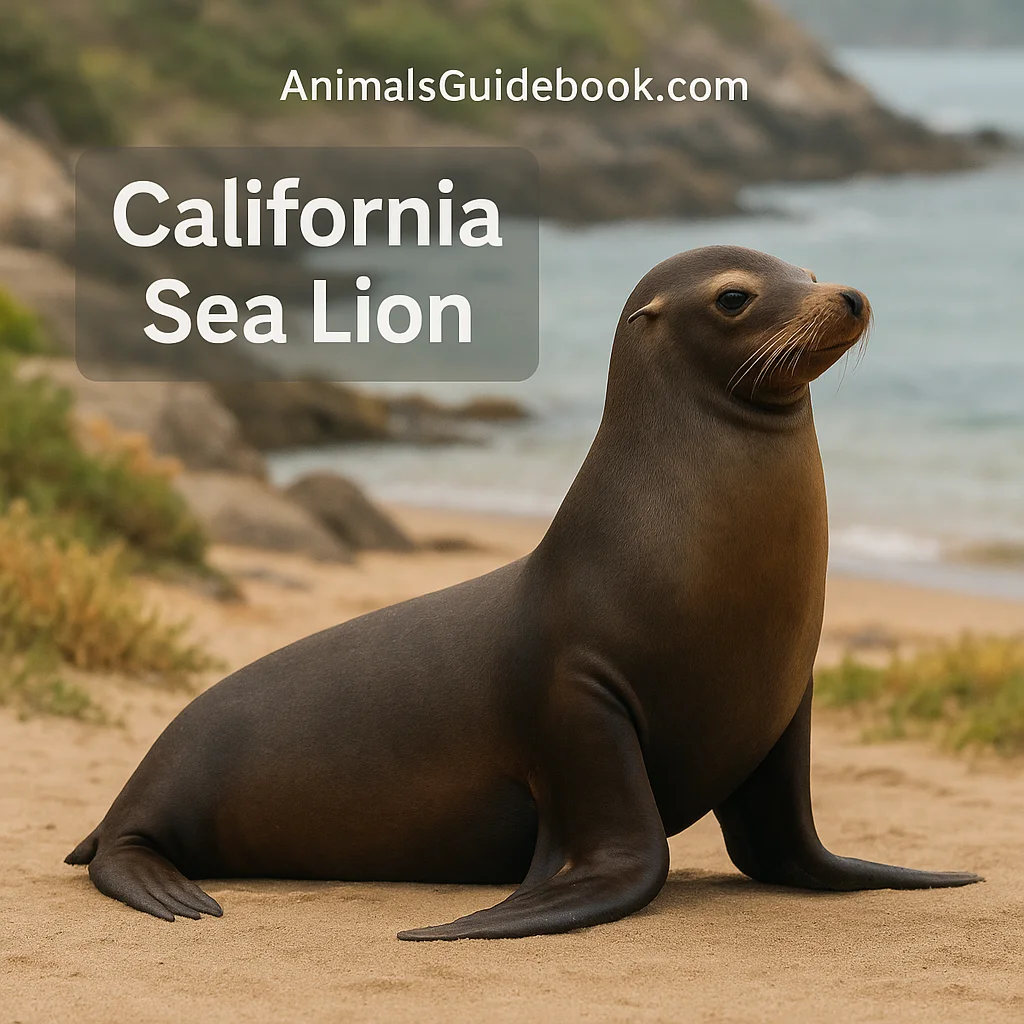
- Common name(s): California Sea Lion
- Scientific name: Zalophus californianus
- Animal type: Mammal
- Typical adult size: 6–8 feet (1.8–2.4 meters) in length; 220–880 pounds (100–400 kg)
- Typical lifespan: 15–25 years in the wild
- Diet type: Carnivore; primarily fish and squid
- Activity pattern: Diurnal
- Social structure: Highly social, forming groups called colonies
- Speed / movement highlights: Swims up to 25 mph (40 km/h)
- Intelligence/learning: Known for trainability and problem-solving skills
- Primary habitats: Coastal marine environments
- Geographic range: Pacific Ocean, from British Columbia to Baja California
- Predators/threats: Killer whales, sharks, and human activities
- Conservation status: Least Concern
🔍 Identification & Appearance
California Sea Lions have a sleek, streamlined body adapted for efficient swimming. Their coloration is generally a rich, dark brown that may appear lighter in juveniles or when dry. Their short, thick fur helps insulate against cold waters.
- Body shape and silhouette: Streamlined with external ear flaps
- Key colors/patterns: Dark brown, sometimes grayish when dry
- Distinctive features: Whiskers, dog-like face
- Tracks and signs: Clear slide marks along sandy beaches
- Common look-alikes: Can be mistaken for Steller Sea Lions; smaller size and louder bark differ
- Top ID Tips: Prominent external ears, barking noises, long front flippers
🧱 Body Structure & Physical Adaptations
The California Sea Lion's build is robust yet flexible, aiding its adeptness in both aquatic and terrestrial environments. It possesses long and powerful front flippers that allow agile swimming and quick maneuvers.
- Build: Sleek and elongated
- Teeth: Sharp teeth adapted for catching slippery prey
- Fins: Long front flippers for swimming, hind flippers for steering
- Sensory strengths: Excellent underwater vision and sound localization
- Key Adaptations: Whiskers for detecting prey in murky waters
🌍 Range & Distribution
The California Sea Lion is predominantly found along the western coasts of North America. Their range extends from the coastal areas of British Columbia, Canada, to Baja California in Mexico.
- Primary regions: Eastern Pacific Ocean
- Typical countries: United States, Mexico, Canada
- Common biomes: Coastal waters and rocky shorelines
- Seasonal movements: Some populations migrate during breeding seasons
- Where You Might Find It: Rookeries, stack rocks, harbor piers
🏞️ Habitat & Shelter
California Sea Lions prefer coastal environments, including sandy beaches and islands where they haul out to rest, breed, and socialize. They often seek sheltered coves or rocky outcrops for protection against the elements.
- Preferred habitats: Rocky coastlines, sheltered bays
- Shelter: Natural caves, driftwood piles, rocky crevices
- Weather adaptations: Use sea for cooling down in hot weather
- Behavior changes: Increased inland resting during rough seas
🧭 Behavior & Ecology
California Sea Lions are highly social and communicative creatures, often seen in large groups. They use a combination of vocalizations and body language to interact. Known for their playful nature, they are integral to marine ecosystems as predators of fish and invertebrates.
- Daily routine: Alternates between feeding in water and resting on land
- Vocalizations: Barking, grunting, and growling
- Interactions: Often seen with dolphins or seabirds during feeding
- Role in ecosystem: Important mid-level predator
- Behavior Highlights: Cooperative herding of fish, playful with objects
👥 Social Life & Group Dynamics
These sea lions are extremely social animals that congregate in large, noisy colonies. Males establish territories during the breeding season and exhibit dominance through vocalizations and physical displays.
- Social tendencies: Highly social
- Group types: Colonies during breeding, groups otherwise
- Typical size range: Up to several thousand during breeding
- Dominance and conflict: Males compete for territory and mates
- Social Structure Notes: Males are often busy maintaining territory
🍽️ Diet, Prey & Predators
California Sea Lions primarily feed on a variety of fish and squid, and they are known to consume up to 5% of their body weight per day. Their main predators include killer whales and large sharks.
- Diet staples: Fish like anchovies and mackerel
- Predators: Primarily killer whales and sharks
- Anti-predator defenses: Speed and agility in water
- Scavenging behavior: Occasionally follows fishing vessels
- Feeding Notes: Skilled hunters both alone and in groups
🦌 Hunting, Foraging & Movement
California Sea Lions are adept swimmers with a streamlined shape that allows them to move quickly and efficiently. They exhibit cooperative hunting strategies, sometimes working in groups to herd fish into dense schools for easier capture.
- Locomotion style: Strong swimmers
- Speed and endurance: Fast over short bursts; excellent endurance
- Foraging tactics: Cooperative herding, deep dives
- Movement & Strategy: Agile maneuvering in tight spots
🧠 Intelligence & Senses
Renowned for their intelligence, California Sea Lions display advanced problem-solving abilities and can be easily trained to perform complex tasks. They have acute senses that enable them to thrive in diverse marine environments.
- Problem-solving: High degree of trainability and skill
- Sensory use: Vibrosensitive whiskers to locate prey
- Memory: Exceptional short- and long-term memory skills
- Notable Abilities: Echo-based object detection and learning
🪺 Reproduction, Pregnancy & Parenting
The California Sea Lion's breeding season occurs during the summer months, primarily on offshore islands. Males establish breeding territories and mate with multiple females. Females give birth to a single pup after a gestation period of about 11 months and provide all parental care.
- Breeding season: Late spring to summer
- Mating system: Polygynous with dominant males
- Gestation period: About 11 months
- Newborn development: Pups are born precocial and able to swim
- Reproduction Snapshot: Maternal care, vocal pup recognition
♀️♂️ Male vs Female Differences
There are notable differences between male and female California Sea Lions, with males being significantly larger and heavier than females. Males also develop a distinctive crest on their heads as they mature, which is absent in females.
- Size differences: Males much larger than females
- Coloration: Males are often darker than females
- Behavioral role differences: Males defend territories
- Sex Differences at a Glance: Males have more pronounced physical features
🧬 Subspecies & Variation
The California Sea Lion is largely uniform across its range. However, there are some variations in size and coloration, likely due to environmental factors and local adaptations.
- Subspecies: Generally considered monotypic
- Local adaptations: Variations occur along different parts of their range
- Variation Notes: Minor differences in size and behavior
⚠️ Threats, Conservation & Human Interaction
While the California Sea Lion is not currently endangered, it faces threats from habitat degradation, pollution, and entanglement in fishing gear. Conservation efforts focus on reducing human impacts and protecting critical habitats.
- Environmental threats: Pollution, climate shifts
- Human-related pressures: Marine debris and bycatch
- Coexistence tips: Respect wildlife regulations, avoid disturbances
- Responsible Notes: Viewing from a distance and supporting marine protections
✨ Fun Facts & Unique Traits
- California Sea Lions can hold their breath for up to 20 minutes while diving.
- They are capable of diving to depths of 800 feet (240 meters).
- These sea lions emit distinct barking sounds that can be heard up to a mile away.
- They use their sensitive whiskers to detect fish in murky waters.
- Females can recognize their pups among hundreds using vocalizations.
📌 Summary
- Identification: Medium-sized marine mammals with dark brown fur.
- Habitat: Coastal marine areas with rocky shorelines and islands.
- Distribution: Pacific coasts from Canada to Mexico.
- Diet: Primarily fish and squid.
- Predators: Mainly killer whales and large sharks.
- Social life: Highly social with complex communication.
- Reproduction: Single pup born after a lengthy gestation period.
- Key adaptations: Streamlined body, sharp senses.
- Distinctive trait: Playful and intelligent behavior.