🦁 Beluga
🧾 Quick Facts
Belugas, often referred to as the "canaries of the sea," are fascinating marine mammals known for their distinct white coloration and vocalizations. These social creatures are predominantly found in Arctic and sub-Arctic waters.
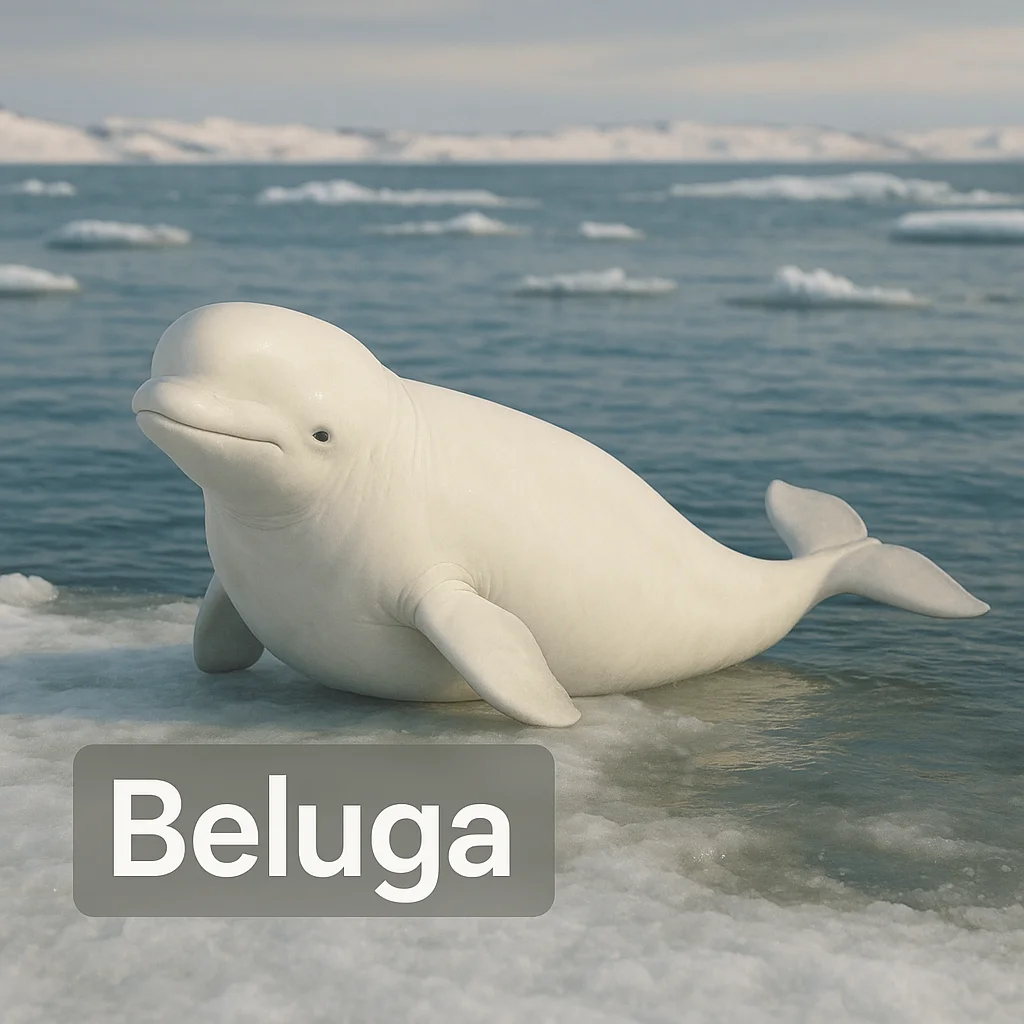
- Common name(s): Beluga, White Whale
- Scientific name: Delphinapterus leucas
- Animal type: Mammal
- Typical adult size: 3 to 5 meters (about 10 to 16 feet); 600 to 1,600 kg (1,300 to 3,500 pounds)
- Typical lifespan: 30 to 50 years
- Diet type: Carnivore; primarily fish, along with crustaceans and cephalopods
- Activity pattern: Diurnal
- Social structure: Lives in groups called pods, ranging from a few individuals to hundreds
- Speed / movement highlights: Known for agile swimming and slow deliberate movements
- Intelligence/learning: Highly intelligent with complex vocal communication
- Primary habitats: Arctic and sub-Arctic marine environments
- Geographic range: Arctic Ocean, along with coastal regions of Greenland, Canada, and Russia
- Predators/threats: Mainly orcas and polar bears; human-related pressures include shipping and oil drilling
- Conservation status: Near Threatened, varies by region
🔍 Identification & Appearance
Belugas are easily recognized by their white skin, which serves as camouflage in icy environments. They are distinctive for their lack of a dorsal fin, unlike other cetaceans, and for their bulbous forehead, known as a melon.
- Bulbous forehead (melon)
- No dorsal fin
- Distinct white coloration
- Rounded body with short flippers
- Relatively small size for a whale
- Flexible neck, allowing head movement
- Juveniles are gray, becoming white over time
- Short snout with a smiling appearance
- Easily confused with juvenile narwhals
🧱 Body Structure & Physical Adaptations
The beluga's body is robust and streamlined, facilitating smooth swimming in icy waters. Its thick blubber provides insulation against cold temperatures.
- Thick layer of blubber for insulation
- Flexibility for maneuvering in ice-filled waters
- Adapted teeth for seizing fish
- Benthic foraging specialized
- Keen sense of hearing, used for echolocation
- Vision adapted to murky waters
- Highly mobile neck due to unfused cervical vertebrae
- Lacking dorsal fin reduces heat loss
🌍 Range & Distribution
Belugas inhabit cold Arctic and sub-Arctic waters, ranging widely depending on ice coverage and the availability of prey.
- Found in Arctic Ocean and surrounding seas
- Coastal regions around Greenland and northern Canada
- Often seen near Russia's Arctic coastline
- Sometimes venturing further south during summer
- Known for ice-associated migratory patterns
🏞️ Habitat & Shelter
Belugas prefer icy marine environments. Their adaptability allows them to exploit coastal, riverine, and sea areas as required by seasonal changes.
- Arctic coastal areas
- Frequent river mouths in summer
- Under-ice waters during winter
- Important to follow ice movement for breathing holes
🧭 Behavior & Ecology
Belugas exhibit a variety of compelling behaviors, such as social interaction and vocal communication. They play a crucial ecological role in the Arctic marine food web.
- Highly social, living in pods
- Known as the "canaries of the sea" for their vocal nature
- Use echolocation for navigation and hunting
- Maintain breathing holes in ice cover
- Social interactions include play and mutual rubbing
👥 Social Life & Group Dynamics
Belugas have intricate social structures typically organized in pods. These group dynamics play a crucial role in their survival and day-to-day functioning.
- Form pods of varying sizes
- Groups can merge into larger gatherings
- Strong mother-calf bonds
- Engage in cooperative hunting
- Pods usually consist of females and young
🍽️ Diet, Prey & Predators
Belugas are carnivorous, with diets consisting of fish and invertebrates. Their feeding habits are influenced by seasonal availability and geographical distribution.
- Consume a variety of fish species
- Prey includes squid and shrimp
- Natural predators include orca and polar bears
- Occasionally engage in cooperative feeding
- Primarily scan environment using echolocation
🦌 Hunting, Foraging & Movement
Belugas display remarkable swimming capabilities and are known for their ability to navigate through complex ice environments. Their foraging ensures they adapt to seasonal changes in prey density.
- Agile swimmers but slow movers
- Adapt to ice movements for access to oxygen
- Foraging shifts seasonally
- Use echolocation as a primary navigation tool
- Capacity to travel vast Arctic distances
🧠 Intelligence & Senses
Belugas are considered highly intelligent with rich cognitive abilities. Their vocalizations and ability to learn signify sophisticated mental functions.
- Vocal skills for communication
- Utilize echolocation efficiently
- Show evidence of social learning
- Aware of environmental changes
- Limited research on tool use
🪺 Reproduction, Pregnancy & Parenting
Belugas have a distinctive reproductive cycle, and parental care is largely provided by the mother. Their breeding habits include calving during warmer months for calf survival.
- Breeding season varies by region
- Gestation lasts about 14 to 15 months
- Usually one calf per pregnancy
- Calves are nursed for a year or longer
- Maternal care essential for calf development
♀️♂️ Male vs Female Differences
While visual differences between male and female belugas are not prominently marked, slight size variations and behavior during the breeding season can be noted.
- Males tend to be slightly larger
- Females primarily responsible for calf rearing
- Males can be more vocal during mating
- Behavioral differences during mating rituals
- Males may display intrasexual competition
🧬 Subspecies & Variation
There is limited clarity regarding distinct subspecies within belugas, though regional adaptations to different environmental conditions are evident.
- Minor regional size variations
- Behavioral adaptations to local prey types
- Responses to different sea ice coverage patterns
- Debate on potential subspecies classification
⚠️ Threats, Conservation & Human Interaction
Belugas are faced with numerous challenges, many stemming from climate change and human activity. Maintaining their natural habitats is crucial for their continued existence.
- Threatened by climate-induced habitat changes
- Oil exploration disrupts living areas
- Shipping lanes pose collision risks
- Bycatch mortality in fishing operations
- Safe observations encouraged; no feeding
✨ Fun Facts & Unique Traits
- The beluga's white coloration develops in adulthood, aiding in ice camouflage.
- Belugas can mimic human speech sounds at times.
- They have a flexible neck, unlike other whales, due to unfused neck vertebrae.
- Belugas use their unique melon structure to direct echolocation sounds.
- They can swim backward, a trait not common among cetaceans.
- Known to spit water, possibly as a play behavior.
- Some belugas have been observed living over 60 years.
- They possess a thick layer of blubber, comprising up to 40% of their body weight.
📌 Summary
- Distinct for their white color and vocal nature.
- Prefers Arctic and sub-Arctic waters, adapting to ice conditions.
- Feeds on fish, with orcas as primary natural predators.
- Lives in social groups known as pods, exhibiting complex behaviors.
- Vocal and use echolocation for navigation and hunting.
- Strong maternal bonds, with extended calf care periods.
- Significant adaptations for survival in icy environments.
- Faces threats from climate change and human activities.