🦁 Quail
🧾 Quick Facts
Quails are small, ground-dwelling birds known for their distinctive calls and social behaviors. They are part of the pheasant family and can be found in various regions across the globe. Their adaptability makes them a common subject of interest for bird watchers and nature enthusiasts alike.
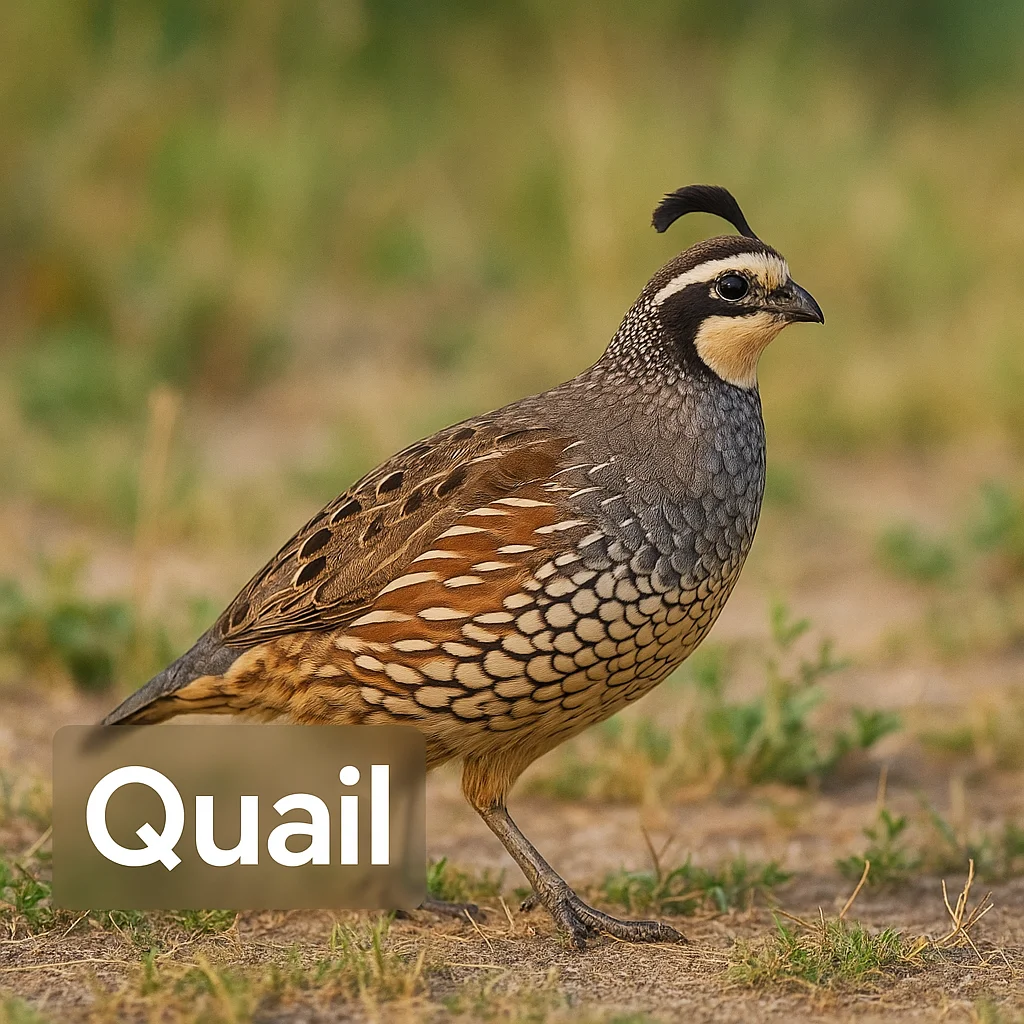
- Common name(s): Quail
- Scientific name: Coturnix (various species)
- Animal type: Bird
- Typical adult size: 15–30 cm in length; 100–250 grams in weight
- Typical lifespan: 2–5 years in the wild
- Diet type: Omnivore; seeds, insects, and vegetation
- Activity pattern: Diurnal
- Social structure: Group, often called a covey
- Speed / movement highlights: Quick runners; capable of short flight bursts
- Intelligence/learning: Known for adapting to varied environments
- Primary habitats: Grasslands, woodlands, and agricultural fields
- Geographic range: Found on every continent except Antarctica
- Predators/threats: Foxes, cats, hawks, human encroachment
- Conservation status: Varies by region; some species are of least concern
🔍 Identification & Appearance
Quails are typically small, plump birds with rounded bodies and short tails. Their plumage often includes a blend of brown, gray, and buff colors, aiding in camouflage in their natural habitats. Male quails can have brighter plumage compared to females.
- Body shape and silhouette: Rounded, compact body with a short tail
- Key colors/patterns: Earthy tones with various speckling patterns
- Distinctive features: Small head with a slight crest, short curved beak
- Tracks, scat, or other field signs: Small, three-toed footprints; droppings often seed-filled
- Common look-alikes: Partridges and grouse; distinguishable by size and habitat
- Top ID Tips
- Look for a short, stocky body
- Note the small head and slight crest
- Earthy tones and speckles are indicative
- Listen for their distinctive calls
- Typically seen in groups (coveys)
- Short, rapid wingbeats during flight
- Prefer ground-dwelling behavior
🧱 Body Structure & Physical Adaptations
Quails possess a body structure that supports their terrestrial lifestyle. They have strong legs for running and a small beak adapted for a varied diet. Their plumage provides excellent camouflage, while their wings allow for short bursts of flight to escape predators.
- Key Adaptations
- Compact, stocky build for ground dwelling
- Strong legs for quick sprints
- Short wings optimized for burst flight
- Camouflaging plumage for predator evasion
- Adaptable beak for varied diet
- Good hearing and sight for detecting threats
🌍 Range & Distribution
Quails are a widely distributed group found on almost every continent. They typically inhabit areas that offer a mix of open space and cover, such as grasslands and woodlands. The specific regions can vary greatly depending on the species.
- Where You Might Find It
- North America: Open fields and farmlands
- Europe: Forest edges and heaths
- Africa: Savannas and light woodlands
- Asia: Agricultural areas and scrublands
- Australia: Outback regions and open woodlands
- South America: Open fields and transitional forests
- Primarily lowland areas
- Generally non-migratory
🏞️ Habitat & Shelter
Quails are adaptable birds that favor habitats offering ample cover and feeding opportunities. They thrive in areas such as open grasslands, agricultural fields, and woodland edges. Their nests are usually shallow depressions on the ground, lined with vegetation to camouflage and protect their eggs.
Understand the habitat of quails to gain insight into their behavior, nesting, and feeding habits.
🧭 Behavior & Ecology
Quails are generally social birds, often found in coveys that help provide protection against predators. Their behavior includes foraging for seeds and insects during the day and using vocalizations to communicate with each other. They play a crucial role as prey for various predators and as seed dispersers.
- Behavior Highlights
- Diurnal activity, mainly ground feeding
- Use calls for communication and mating
- Play roles in seed dispersion
- Often found in social groups (coveys)
- Frequent dust-bathing for grooming
- Tend to freeze or fly short distances if alarmed
👥 Social Life & Group Dynamics
Quails tend to be social birds, forming groups known as coveys, especially outside the breeding season. These groups provide safety in numbers. During the breeding season, they may become more territorial. Dominance hierarchies within coveys are mild and not aggressively enforced.
- Social Structure Notes
- Typically form coveys for protection
- Display social feeding habits
- Potential for mild territorial behavior
- Cooperative breeding sometimes observed
- Minimal conflict within coveys
🍽️ Diet, Prey & Predators
Quails are omnivores, feeding on a diet rich in seeds, grains, and insects. This varied diet allows them to survive in different environments. Their natural predators include birds of prey, mammals, and reptiles. Quails use quick dashes, camouflage, and short bursts of flight to evade predators.
- Feeding Notes
- Prefers seeds and grains
- Insect consumption varies by season
- Forages during the day
- Uses quick movements to catch prey
- Has a broad diet favoring adaptation
- Avoids predators with camouflage
🦌 Hunting, Foraging & Movement
Quails are adept at ground foraging, often scratching at the soil to find seeds and insects. They are quick runners and capable of short flights to escape threats. Their movement patterns are generally confined to known territories where food and cover are abundant, minimizing the need for long-distance travel.
- Movement & Strategy
- Forages by scratching the ground
- Fast runners, minimal long flights
- Responsive to potential threats
- Tends to stick to familiar territories
- Utilizes group movement for safety
🧠 Intelligence & Senses
Quails are adept at navigating their environment, relying on acute senses of hearing and sight. They exhibit basic problem-solving abilities and can adapt behaviors to changing conditions. While not known for tool use, their social and navigational acumen is well-documented.
- Notable Abilities
- Good spatial awareness
- Utilizes vocalizations for communication
- Adapts quickly to new environments
- Alert to changes in habitat and threats
- Well-developed hearing for predator detection
🪺 Reproduction, Pregnancy & Parenting
Quails usually breed during the warmer months, engaging in specific courtship displays. The mating system is predominantly monogamous. Quail lay a clutch of 10-12 eggs, and chicks are precocial, meaning they are relatively mature and mobile shortly after hatching. Both parents often participate in caring for the young.
- Reproduction Snapshot
- Breeds in spring and summer
- Engages in courtship displays
- Monogamous pairing is common
- Clutch size ranges from 10-12 eggs
- Chicks are precocial
- Parenting is usually cooperative
♀️♂️ Male vs Female Differences
In quails, males are often more brightly colored than females, which aids in attracting mates. Females tend to have more subdued colors that provide better camouflage. Sexual dimorphism can be subtle, especially in species where both sexes participate in nesting and breeding duties.
- Sex Differences at a Glance
- Distinctive plumage coloration
- Males often have brighter markings
- Females better camouflaged for nesting
- Subtle size and weight differences
- Both sexes engage in brooding duties
🧬 Subspecies & Variation
Quails encompass several subspecies, with variations in size, color, and behavior depending on their geographical location. Some subspecies have adapted to specific environments, demonstrating unique plumage patterns or behaviors. Classification can sometimes be debated among ornithologists.
- Variation Notes
- Varies in size and color between subspecies
- Adaptation seen in desert and highland populations
- Plumage patterns can vary significantly
- Subspecies recognition can be debated
- Localized ecological adaptations evident
⚠️ Threats, Conservation & Human Interaction
Quails face threats from habitat destruction, hunting, and predation. Human encroachment and agricultural expansion have reduced available habitats. Conservation efforts vary, with some regions actively managing populations. Ethical considerations include minimizing habitat disruption and addressing hunting impacts.
- Responsible Notes
- Prone to habitat loss from agriculture
- Various levels of protection in place
- Urbanization presents ongoing threats
- Conservation programs are regional
- Awareness of hunting impacts needed
✨ Fun Facts & Unique Traits
- Quails have a unique call resembling "Bob-white!"
- They can lay over 200 eggs in a single breeding season
- Dust-bathing helps quails maintain feather health
- Quails' short flights are known as "flushing"
- Some species migrate short distances
- Quails are known for their strong family bonds
📌 Summary
- Quails are small, ground-dwelling birds
- Recognized by their plump bodies and short tails
- Found in grasslands, woodlands, and farmlands
- Omnivorous diet includes seeds and insects
- Form social groups called coveys
- Breeding involves cooperative parenting
- Cleverly adapted to their environments
- Multiple subspecies show diverse adaptations