🦁 Greater Sage-Grouse
🧾 Quick Facts
The Greater Sage-Grouse, often recognized for its unique courtship displays, populates the expansive sagebrush ecosystems of North America. As a notable species, its survival and behavior offer valuable insights into the health of its habitat.
- Common name(s): Greater Sage-Grouse
- Scientific name: Centrocercus urophasianus
- Animal type: Bird
- Typical adult size: 65–75 cm (25–30 inches) in length
- Typical lifespan: 3–6 years in the wild
- Diet type: Herbivore; primarily sagebrush leaves, buds, and insects
- Activity pattern: Primarily diurnal
- Social structure: Group (form leks during breeding season)
- Speed / movement highlights: Capable of short, burst flights
- Intelligence/learning: Moderate; displays complex mating rituals
- Primary habitats: Sagebrush plains
- Geographic range: Western United States and southern Canada
- Predators/threats: Coyotes, hawks, habitat loss, human development
- Conservation status: Near threatened
🔍 Identification & Appearance
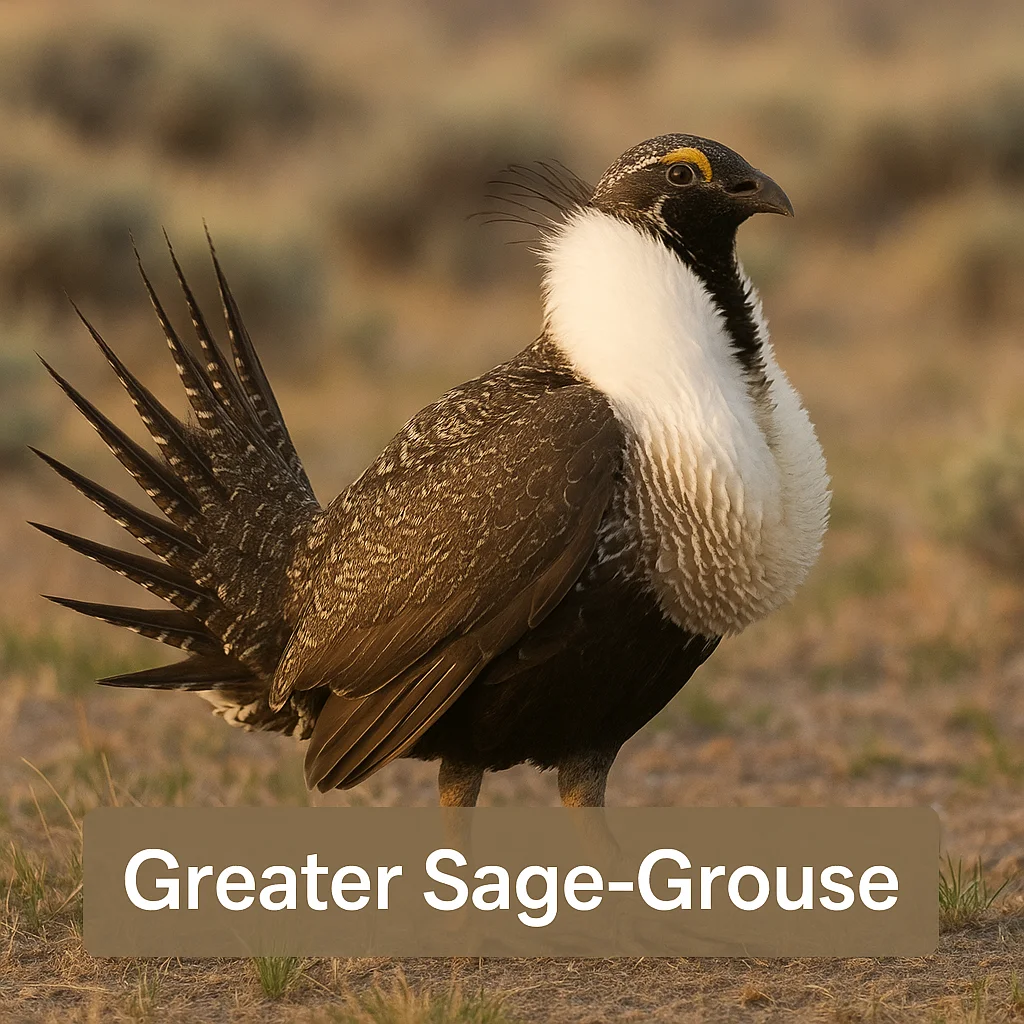
The Greater Sage-Grouse is a large, rounded bird with a chunky body and long legs. During mating season, males are especially striking, displaying their fan-like tail and inflatable chest sacs. Their plumage is mostly mottled gray, providing effective camouflage among the sagebrush.
- Body shape and silhouette: Stocky, with a prominent tail and long tail feathers
- Key colors/patterns: Mottled gray and brown; males have striking white breast patches in display
- Distinctive features: Inflatable chest sacs in males, long pointed tail feathers
- Tracks, scat, or other field signs: Large, rounded tracks with three toes
- Common look-alikes: Sharp-tailed Grouse; distinguish by habitat and display behavior
- Look for large, rounded body shape
- Note the unique courtship display: inflatable chest sacs
- Focus on the mottled gray and brown plumage
- Check for long, pointed tail feathers during flight
- Observe in sagebrush habitats
- Listen for distinctive "plops" during mating season
- Compare with Sharp-tailed Grouse by habitat preference
- Top ID Tips
🧱 Body Structure & Physical Adaptations
The Greater Sage-Grouse is uniquely adapted to its environment, with a body shape and features that suit its foraging and mating rituals. The large chest sacs are vital for attracting females during breeding seasons.
- Build and proportions: Stocky with long legs, suited for traversing sagebrush terrain
- Beak adaptation: Short and strong for foraging sagebrush leaves
- Wings: Rounded wings suitable for short burst flights
- Sensory strengths: Sharp vision for spotting predators; moderate hearing
- Inflatable chest sacs for mating displays
- Camouflage plumage for predator avoidance
- Short, rounded wings for maneuverable flight
- Legs adapted for walking and foraging
- Robust immune system to handle parasites
- Excellent balance for courtship dances
- Key Adaptations
🌍 Range & Distribution
Greater Sage-Grouse primarily inhabit the sagebrush-dominated landscapes of the western United States and southern Canada. They are mostly resident, but local movements occur in response to weather and food availability.
- Regions: Predominantly western North America
- Countries: USA, Canada
- Biome: Sagebrush ecosystems
- Elevation range: Typically found at elevations from 1,200 to 2,300 meters (4,000 to 7,500 feet)
- Migration: Largely non-migratory but may move seasonally for resources
- Wyoming's sagebrush plains
- Montana's open landscapes
- Northern Nevada's arid regions
- Southern Alberta's grasslands
- Central Idaho's high desert
- Where You Might Find It
🏞️ Habitat & Shelter
The Greater Sage-Grouse thrives in vast open sagebrush country, utilizing the vegetation for food, cover, and nesting. Seasonal weather changes prompt subtle shifts in habitat use, with birds seeking shelter during harsh conditions.
- Preferred habitats: Sagebrush plains, grasslands adjacent to sagebrush
- Microhabitats: Ground nests hidden beneath sagebrush
- Behavioral adaptations: Seek shade and cover in dense shrub areas during midday heat
- Importance of habitat: Essential for food and protection; critical for mating display leks
🧭 Behavior & Ecology
Greater Sage-Grouse exhibit fascinating ecological roles and behavior patterns, most notably their elaborate lekking during the breeding season. Their presence is indicative of a healthy sagebrush ecosystem.
- Daily routine: Active primarily in early morning and late afternoon
- Communication: Vocal "plops" and visual displays during courtship
- Interactions: Predation by coyotes and birds of prey; competition with other sagebrush inhabitants
- Role in the ecosystem: Serve as prey and disperse seeds
- Complex courtship displays males perform on leks
- Seasonal shifts in diet based on food availability
- Vocal communication during displays
- Defensive behavior via camouflage and staying still
- Utilizes seed dispersion during foraging
- Behavior Highlights
👥 Social Life & Group Dynamics
Sage-Grouse are known for their intriguing social structures, particularly during breeding season when males congregate on traditional display grounds known as leks. While generally solitary or in small groups outside of breeding, leks can be densely populated.
- Solitary vs social: Solitary or small groups when foraging; highly social during breeding
- Group types: Breeding leks can attract dozens of males
- Cooperation: No cooperative breeding; females select males based on display success
- Highly social during breeding season on leks
- Females choose mates based on display
- Used leks year after year
- Non-territorial outside mating season
- No parental cooperation post-mating
- Social Structure Notes
🍽️ Diet, Prey & Predators
The Greater Sage-Grouse primarily feeds on sagebrush year-round, supplemented by insects and other vegetation during warmer months. This specialized diet makes them vulnerable to habitat changes. They face predation mainly from avian predators and mammals.
- Primary diet: Sagebrush leaves; insects in summer
- Feeding strategy: Foraging walking through sagebrush landscapes
- Main predators: Coyotes, eagles, hawks
- Anti-predator defenses: Camouflage and standing still
- Sagebrush is a year-round dietary staple
- Insects add protein during summer
- Avoids open areas to reduce predation risk
- Young chicks consume more insects
- Feeding Notes
🦌 Hunting, Foraging & Movement
Though they are not hunters, Greater Sage-Grouse are efficient foragers, grazing the diverse plant life within their sagebrush home. Their movement is characterized by short flights and an agile ability to navigate dense brush.
- Locomotion style: Ground-dwelling with occasional short flights
- Speed and endurance: Capable of burst flight to escape predators
- Foraging times: Predominantly early morning and late afternoon
- Efficient ground forager among sagebrush
- Short, rapid flights between cover
- Active primarily during cooler parts of the day
- Movement & Strategy
🧠 Intelligence & Senses
The sensory and cognitive abilities of the Greater Sage-Grouse reflect their environmental needs and social complexity, particularly visible in their courtship rituals. While not tool users, they show significant behavioral cues responding to the environment.
- Problem-solving: Not noted for complex problem-solving
- Senses: Relies on vision for detecting predators and mates
- Remarkable courtship display choreography
- Excellent visual acuity for predator detection
- Sound cues integral to mating success
- Notable Abilities
🪺 Reproduction, Pregnancy & Parenting
The reproductive cycle of Greater Sage-Grouse involves elaborate courtship displays where males compete for females on leks. With female-led parental care, the birds have a unique seasonally-driven reproductive system.
- Breeding seasonality: Begins in early spring
- Mating system: Polygynous; females mate with dominant males
- Incubation period: Approximately 25–27 days
- Clutch size: Ranges from 6 to 10 eggs
- Females solely responsible for incubation and chick-rearing
- Males aggregate on leks for display
- Chicks are precocial and leave nest quickly
- Reproduction Snapshot
♀️♂️ Male vs Female Differences
In Greater Sage-Grouse, sexual dimorphism is especially pronounced in size, plumage, and behavior during the breeding season. Females are more camouflaged, while males display vivid characteristics during matings.
- Size: Males larger and heavier than females
- Coloration: Males have more distinct plumage with white chest sacs
- Behavioral role: Males engage in lekking displays
- Males perform striking courtship displays
- Females smaller with muted colors
- Males display inflated chest sacs
- Sex Differences at a Glance
🧬 Subspecies & Variation
While there are no widely recognized subspecies of Greater Sage-Grouse, variation can occur geographically, particularly influenced by habitat availability and changes. Overall, the genetic diversity is crucial for adaptability.
- Subspecies: Generally considered monotypic (no subspecies)
- Regional diversity influenced by habitat fragmentation
- Individuals adapt to local environmental conditions
- Genetic research is ongoing to clarify variations
- Variation Notes
⚠️ Threats, Conservation & Human Interaction
Greater Sage-Grouse face threats from habitat destruction and fragmentation largely due to human activities such as agriculture and urban development. Conservation efforts focus on habitat preservation and restoring population connectivity.
- Natural challenges: Predation, environmental changes
- Human impacts: Habitat loss, infrastructure development
- Coexistence tips: Supporting conservation efforts is crucial
- Conserve sagebrush habitats
- Monitor development impacting sagebrush regions
- Participation in habitat restoration projects is helpful
- Responsible Notes
✨ Fun Facts & Unique Traits
- Greater Sage-Grouse males can inflate their air sacs to produce distinctive popping noises.
- Mating displays are considered among the most complex in the bird world.
- Their reliance on sagebrush makes them an important indicator species for ecosystem health.
- The flight of the Sage-Grouse is low and awkward, hence not distance flyers.
- Only the males have the pronounced white breast feathers used in displays.
📌 Summary
- The Greater Sage-Grouse is known for distinctive courtship displays.
- Inhabits primarily sagebrush-dominated areas in North America.
- Primarily herbivorous, feeding on sagebrush with some insects.
- Faces predation from coyotes and birds of prey.
- Displays social lekking during breeding season.
- Females solely handle incubation and chick-rearing.
- Males have distinctive white chests during displays.
- Conservation focused on preserving sagebrush habitat.