🦜 Galah
🧾 Quick Facts
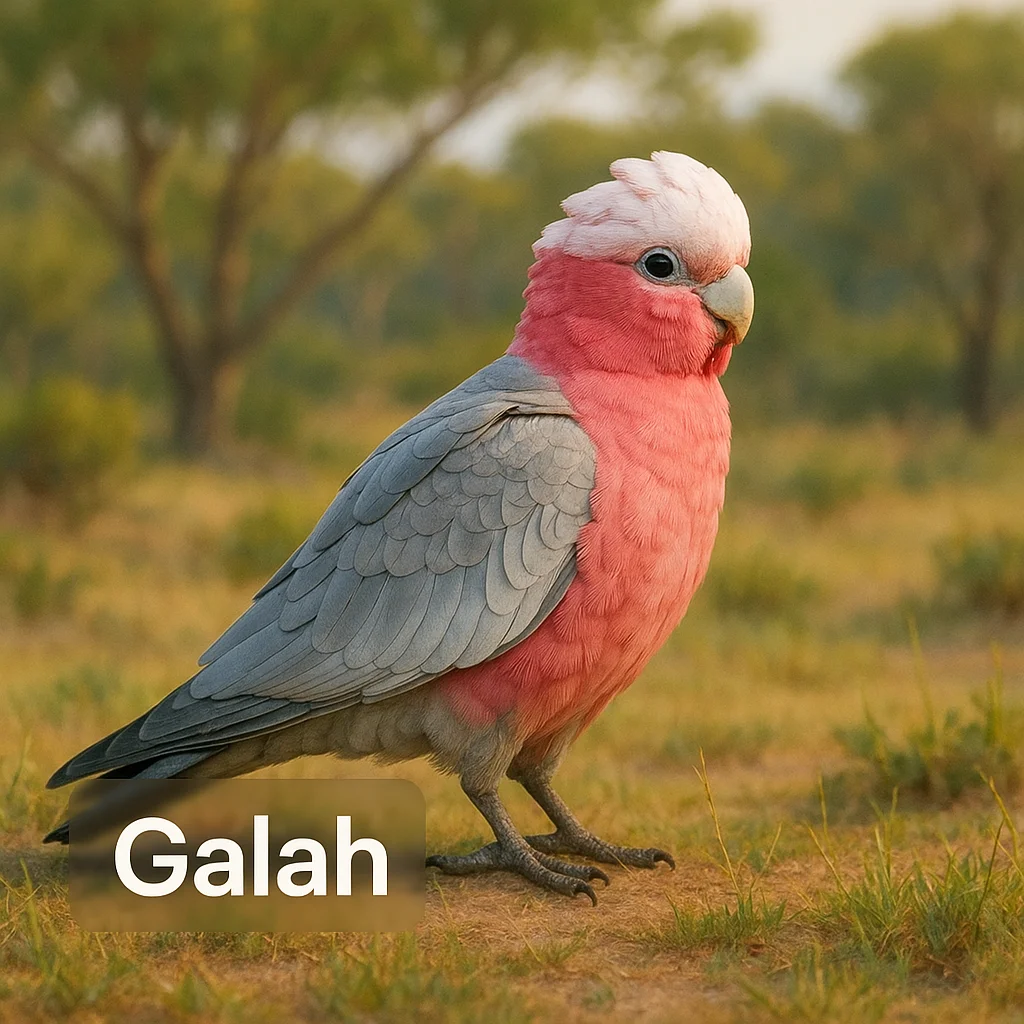
The Galah, often recognized by its vibrant pink and grey plumage, is a well-known bird native to Australia. Belonging to the parrot family, these colorful creatures are celebrated for their playful and social nature.
- Common name(s): Galah, Rose-breasted Cockatoo
- Scientific name: Eolophus roseicapilla
- Animal type: Bird
- Typical adult size: 35–38 cm (14-15 in) in length; 270–350 g (9.5-12.3 oz) in weight
- Typical lifespan: 40–50 years in captivity, 20–30 years in the wild
- Diet type: Herbivore; seeds, nuts, berries, fruits
- Activity pattern: Diurnal
- Social structure: Often found in pairs or small groups; sometimes large flocks
- Speed / movement highlights: Strong flier; capable of rapid and agile flights
- Intelligence/learning: Highly intelligent; known for mimicking vocally and exhibiting problem-solving abilities
- Primary habitats: Woodlands, grasslands, urban areas
- Geographic range: Widespread across Australia
- Predators/threats: Birds of prey; habitat loss due to human activity
- Conservation status: Least Concern
🔍 Identification & Appearance
The Galah is easily recognizable due to its striking color palette of pink and grey. It has a robust, stocky build typical of cockatoos. Its head, chest, and underparts are a vibrant pink, while its back, wings, and long tail feathers show a softer grey. The Galah also features a distinct white crest atop its head, which it raises when excited or threatened.
- Body shape and silhouette: Stocky with a rounded head and robust build
- Key colors/patterns: Pink on the chest and face; grey on wings and tail
- Distinctive features: White crest; pink and grey plumage
- Tracks: Often found in open grasslands where their feeding patterns can create distinct ground markings
- Common look-alikes: Other cockatoos; distinguishable by color and crest shape
- Top ID Tips
- Look for pink and grey coloration
- Note the white crest when raised
- Listen for their distinctive loud calls
- Gregarious behavior often seen in flocks
- Stocky beak for seed cracking
- Strong, swift flying patterns
🧱 Body Structure & Physical Adaptations
Galahs have a compact build with strong muscles that power their flight. Their beaks are sturdy and adapted for cracking hard seeds and nuts. Their feet are zygodactylous, meaning they have two forward-facing and two backward-facing toes, aiding in climbing and grasping food.
- Key Adaptations
- Strong, curved beak for seed consumption
- Zygodactylous feet for climbing and foraging
- Robust muscles enhance flight capabilities
- Well-developed syrinx for vocalizations
- Crest for communication and display
- Adaptable to diverse and changing environments
🌍 Range & Distribution
The Galah is endemic to Australia, found extensively across the mainland, thriving in a range of environments from arid interiors to coastal regions. It adapts to various habitats, including woodlands, grasslands, and even urban settings.
- Where You Might Find It
- Around the Australian inland
- Woodlands and forested areas
- Open grasslands
- Urban parks and gardens
- Coastal regions
🏞️ Habitat & Shelter
Galahs are proficient in many habitats. They prefer open country and can often be found in woodlands and grasslands. They utilize tree hollows for nesting and are not averse to settling in urban areas, capitalizing on food sources and nesting opportunities provided by human structures.
During different seasons, Galahs might alter their foraging and breeding spots based on food availability and weather conditions, showcasing their adaptability to environmental changes.
🧭 Behavior & Ecology
Galahs exhibit a lively and social demeanor, often seen in playful activities and acrobatic displays. Vocalizations are used extensively to communicate within flocks. They play an integral role in their ecosystem by aiding in seed dispersal and promoting vegetation growth through their feeding habits.
- Behavior Highlights
- Highly social, engaging in group interactions
- Vocal communication varies from squawks to mimicry
- Significant in seed dispersal and ecosystem health
- Notable play and grooming behaviors
- Sometimes aggressive towards other birds during feeding
👥 Social Life & Group Dynamics
Galahs are known for their gregarious nature, often forming large flocks that can number into the hundreds. This social structure provides safety in numbers against predators and enhances foraging efficiency. They engage in social grooming and play, reinforcing bonds within the group.
- Social Structure Notes
- Often seen in large, noisy flocks
- Strong pair bonds are typical
- Flocking provides protection from predators
- Playful interactions strengthen social ties
- Display hierarchy within flocks is subtle
🍽️ Diet, Prey & Predators
Galahs primarily eat seeds and grains, foraging on the ground or in trees. They sometimes consume fruits, berries, and nuts. Their feeding habits can influence local plant life positively by enhancing seed dispersal.
Main natural predators include birds of prey such as falcons and hawks. Galahs employ group defense strategies like mobbing and flying in tight formations to deter predators.
- Feeding Notes
- Ground foragers focusing on seeds and grains
- Diet includes fruits and berries, particularly when seeds are scarce
- Feed in large groups, enhancing vigilance
- Thick beak designed for breaking hard shells
- Extended feeding times during the early morning and late afternoon
🦌 Hunting, Foraging & Movement
Galahs are agile fliers and move with great precision. Their flight is swift and direct, aiding in quick escapes from predators. They are adept at both ground foraging and tree climbing, using their beaks and zygodactylous feet efficiently.
- Movement & Strategy
- Strong, steady fliers with direct paths
- Easily cover large distances when migrating between habitats
- Skilled ground foragers
- Adept at tree climbing for additional food sources
- Migrate locally in response to climatic conditions
🧠 Intelligence & Senses
Galahs are highly intelligent with excellent learning and memory capabilities. They can mimic human speech and other sounds, which indicates advanced cognitive processing. Their vision and hearing are sharp, aiding in rapid detection of predators and resource gathering.
- Notable Abilities
- Advanced problem-solving skills
- Capable of mimicking a variety of sounds
- Quick learning through interaction
- Networking with other Galahs to find resources
- Integration into urban environments showcases adaptability
🪺 Reproduction, Pregnancy & Parenting
Pair bonds among Galahs are typically strong and long-lasting. They nest in tree hollows and sometimes man-made structures, laying 2–5 eggs per clutch. Both parents share the task of incubating the eggs and feeding the chicks upon hatching.
- Reproduction Snapshot
- Nest in tree hollows or cavities
- Lay 2–5 eggs per breeding cycle
- Both parents participate in chick-rearing
- Incubation lasts around 25 days
- Fledging occurs around 49–56 days after hatching
♀️♂️ Male vs Female Differences
Sexual dimorphism in Galahs is subtle compared to other species. Males and females look largely similar, though females may slightly differ in eye coloration, often having a reddish hue while males typically have darker brown eyes. Behavioral differences during breeding are minimal, with both sexes actively participating in nesting activities.
- Sex Differences at a Glance
- Females may have redder eyes compared to males
- Size and coloration are very similar between sexes
- Both are equally involved in parenting
- Shared behaviors during courtship and feeding
🧬 Subspecies & Variation
The Galah is often separated into three broad subspecies, differing slightly in size and coloration, primarily based on their geographic distribution across Australia. These variations are generally minor, with the most distinct differences noticed in the crest and belly hues.
- Variation Notes
- Subspecies exhibit minor size and color differences
- Geographic distribution influences subtle coloration
- Crest coloring may differ slightly between subspecies
- Adapted to a wide range of environmental conditions
⚠️ Threats, Conservation & Human Interaction
The Galah faces threats primarily from habitat loss due to land clearing and agricultural expansion. Despite this, they have adapted well to urban environments, where they are often seen in gardens and parks. Conservation efforts focus on preserving large, old trees vital for nesting.
While Galahs are sometimes kept as pets due to their bright plumage and engaging nature, ethical considerations should be made regarding their social needs and the commitment required for long-term care.
- Responsible Notes
- Adapt well to human-altered landscapes
- Conservation efforts emphasize habitat preservation
- Often seen as both beneficial and pests in agriculture
- Avoid keeping them as pets unless prepared for long-term care
- Encourage planting of native flora to support ecosystem health
✨ Fun Facts & Unique Traits
- Galahs are renowned for their acrobatic flight displays
- They are one of the most widespread cockatoo species in Australia
- Galahs often engage in playful and social behaviors similar to humans
- Their vibrant plumage and calls make them a delight to birdwatchers
- Known to form long-lasting monogamous pair bonds
- Able to thrive in both rural and urban environments
- Play an essential role in controlling weed populations through their feeding habits
📌 Summary
- Distinctive pink and grey plumage makes identification easy
- Adaptive to a variety of habitats across Australia
- Known for their playful, social behaviors
- Primarily herbivorous, focusing on seeds and grains
- Main predators are birds of prey
- Strong social structures within flocks
- Reproduction involves both parents in care
- Bonds often form lifelong pairs
- Minor sexual differences; females may have redder eyes
- Thrives in human-altered landscapes