🦁 Emu
🧾 Quick Facts
The emu is one of the most iconic birds native to Australia, known for its impressive size and speed. As a flightless bird, the emu has evolved unique adaptations that make it a fascinating species to study and observe.
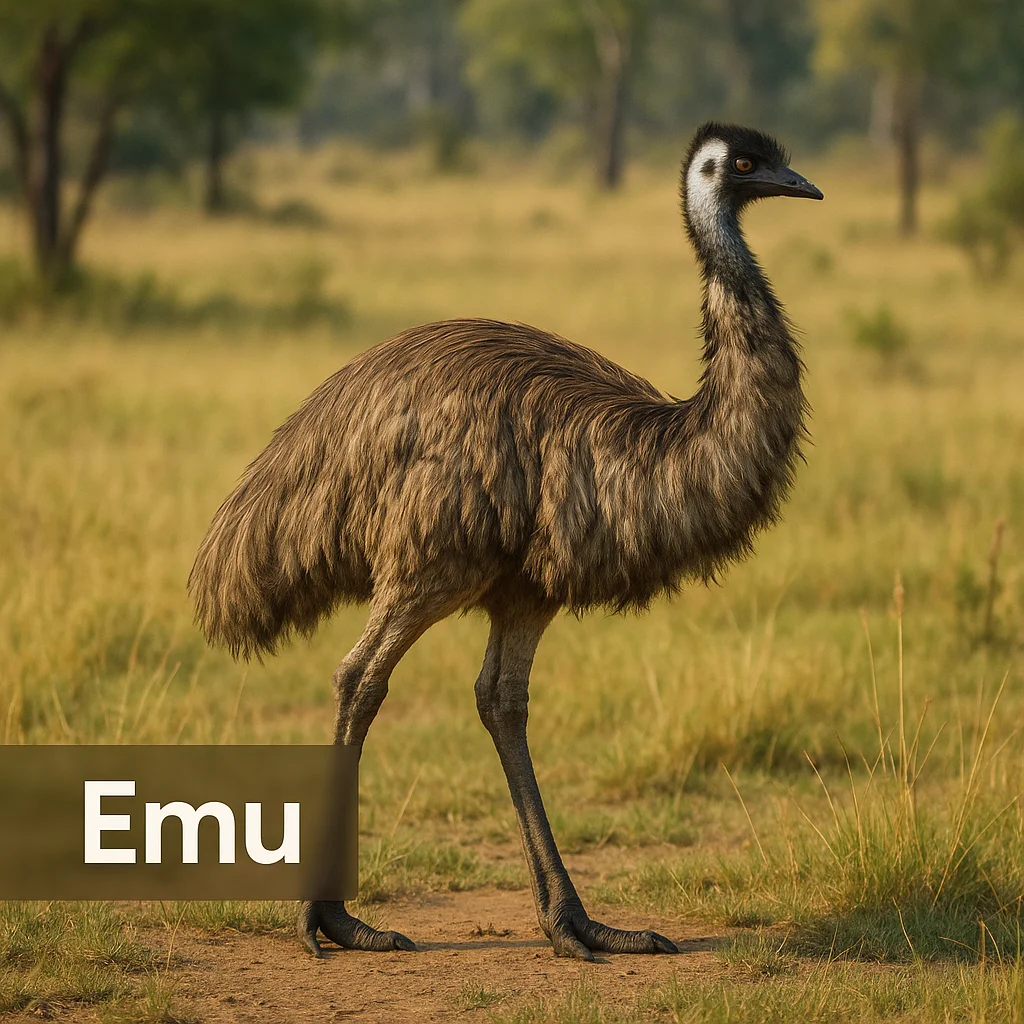
- Common name(s): Emu
- Scientific name: Dromaius novaehollandiae
- Animal type: Bird
- Typical adult size: 1.5 to 1.9 meters (4.9 to 6.2 feet) tall
- Typical lifespan: 10 to 20 years in the wild
- Diet type: Omnivore; eats plants, seeds, fruits, and insects
- Activity pattern: Diurnal
- Social structure: Generally solitary but forms groups during certain seasons
- Speed / movement highlights: Capable of running up to 50 km/h (31 mph)
- Primary habitats: Grasslands, savannas, and open forests
- Geographic range: Endemic to mainland Australia
- Predators/threats: Dingoes, eagles, and human-induced habitat loss
- Conservation status: Least Concern
🔍 Identification & Appearance
The emu is easily recognizable by its large stature, long neck, and shaggy, brownish-gray plumage. It has three-toed feet and small wings that are not functional for flight. Emus often have a striking blueish tint on their neck skin.
- Body shape and silhouette: Tall, with a long neck and large body
- Key colors/patterns: Brown and gray color scheme with black accents
- Distinctive features: Long legs and neck, powerful legs, and small wings
- Tracks, scat: Tracks show three broad toes; scat is large and fibrous
- Common look-alikes: Similar in size to ostriches but different in plumage and geography
- Top ID Tips
- Look for the large, flightless bird with a long neck.
- Note the shaggy brown-gray feathers and blue skin on the neck.
- Spot the three broad toes in tracks.
- Observe their fast running ability.
- Listen for their deep, booming calls.
- Distinctive from ostriches by feather patterns and range.
🧱 Body Structure & Physical Adaptations
The emu has a robust and stocky body, supported by powerful legs that facilitate its swift running capability. Its beak is relatively short and adapted for an omnivorous diet. Although it has wings, they are small and not used for flight but may play a role in temperature regulation.
- Build and proportions: Stocky build with long legs and neck
- Beak/jaw adaptations: Short, broad beak suited for varied diet
- Claws/hooves/wings: Strong claws for defense; vestigial wings
- Sensory strengths: Good eyesight and hearing for detecting predators
- Key Adaptations
- Powerful legs for swift running.
- Three-toed feet for stability and speed.
- Feathers adapted for temperature regulation.
- Short beak for consuming a variety of foods.
- Good vision to spot threats from afar.
🌍 Range & Distribution
The emu is native to Australia and inhabits a wide range of environments across the continent. They thrive in various biomes, from grasslands and dry savannas to open woodlands.
- Continents/regions: Australia
- Typical countries/biomes: Found across mainland Australia except for dense forests and arid deserts
- Elevation range: Generally lower elevations in open landscapes
- Seasonal movements: Some nomadic movements depending on food availability
- Where You Might Find It
- Mainland Australia
- Grasslands and savannas
- Open forests
- Semi-arid regions
- Coastal scrublands
🏞️ Habitat & Shelter
Emus prefer open landscapes that provide ample space for running and foraging. They take advantage of grasslands and savannas, where they can find a variety of food sources.
- Preferred habitats: Grasslands, savannas, and open forests provide the ideal environment
- Microhabitats and shelter: Utilize overhangs for shade; little need for dense covering
- Weather/seasonal behavior changes: Movement towards water sources during dry spells
- Importance of habitat: Understanding habitat aids in conservation and behavior study
🧭 Behavior & Ecology
Emus are generally solitary but may form breeding pairs or small groups during specific seasons. Their daily routine involves foraging for food and water, with periods of rest during the hottest part of the day.
- Daily routine: Foraging in the morning and evening; rest during midday
- Communication: Produce booming calls for communication
- Interactions with other species: Compete for food with other grazers
- Role in the ecosystem: Seed dispersers and ecological engineers
- Behavior Highlights
- Solitary most of the year.
- Forms pairs or small groups during breeding season.
- Forages for a wide variety of food sources.
- Produces deep, resonant voice calls.
- Important seed dispersers in their habitats.
👥 Social Life & Group Dynamics
While emus are generally solitary, during the breeding season they are known to pair up or form small groups. They show little aggression towards each other and often share resources when they do gather in numbers.
- Solitary vs social tendencies: Typically solitary; social during breeding season
- Group types and size: Pairs or small groups can form seasonally
- Cooperation: Share foraging space peacefully
- Dominance hierarchies: Minimal conflict and no strict hierarchies
- Social Structure Notes
- Frequent solitary lifestyle.
- Seasonal group formations.
- Limited aggression towards each other.
- Pairs form for breeding season.
- Social behavior centers around food and mating.
🍽️ Diet, Prey & Predators
Emus have an omnivorous diet, feeding on a variety of plants and small animals depending on availability. Their diet shifts seasonally as different foods become available. They must be wary of predators such as dingoes and large birds.
- Diet across seasons: Involves seeds, fruits, flowers, insects
- Omnivorous diet: Adapted to a broad diet range, including tough plant matter
- Main predators: Dingoes, feral dogs, wedge-tailed eagles
- Defense mechanisms: Fast running and camouflage with surroundings
- Feeding Notes
- Consumes both plant and minor animal food sources.
- Adapts diet with seasonal variation.
- Fruit consumption helps in seed dispersal.
- Relies on sight to find food.
- Camouflage helps evade predators.
🦌 Hunting, Foraging & Movement
With a reputation for speed, emus can outrun many threats. They have keen senses to aid in foraging and detecting danger. As birds that cannot fly, they rely on running and swift maneuvering to navigate their environment.
- Locomotion style: Running swiftly across open terrain
- Speed and endurance: Can sprint over 50 km/h and maintain long-distance runs
- Foraging tactics: Broad selection, using both sight and opportunity
- Spatial behavior: Nomadic trends observed, but primarily local movement for resources
- Movement & Strategy
- Running is the primary means of travel.
- Prefers open terrain for efficient movement.
- Exhibits seasonal movement for resource access.
- Agile in avoiding predators.
- Efficient foragers across varied environments.
🧠 Intelligence & Senses
Emus possess a level of curiosity and adaptability that enables them to survive various environmental changes. Although research on their intelligence is limited, they demonstrate problem-solving abilities during foraging.
- Problem-solving: Shows adaptability in feeding strategies
- Learning: Can learn from past experiences (e.g., identifying safe plants)
- Sensory utilization: Eyesight and hearing are critical for survival
- Notable Abilities
- Adaptive feeding strategies.
- Good eyesight detects movement from a distance.
- Demonstrate simple problem-solving in feeding.
- Alert to auditory cues from a wide range.
- Limited but tenable memory for recognizing terrain.
🪺 Reproduction, Pregnancy & Parenting
The breeding season for emus occurs during the Australian winter. Males are responsible for nurturing the eggs, incubating them for about eight weeks. Chicks are precocial and can follow their father soon after hatching.
- Breeding season: Begins in May and August in their native range (Australian winter)
- Mating system: Generally monogamous during the breeding season
- Incubation period: Approximately 56 days
- Clutch size range: 5 to 15 eggs per season
- Parenting roles: Male incubates and cares for chicks post-hatching
- Reproduction Snapshot
- Breeding occurs in cooler months.
- Males incubate eggs for several weeks.
- Chicks are precocial, active soon after hatching.
- Parental care is mainly by the male.
- Nesting involves minimal materials.
♀️♂️ Male vs Female Differences
Male and female emus are similar in appearance, with size variations generally being minimal. Both sexes share similar feather coloration, making them difficult to differentiate visually without closer observation.
- Size/weight differences: Slight size differences may occur, but similar overall
- Coloration: No significant differences; both have similar plumage
- Behavioral roles: Males are unique in their role as incubators
- Sex Differences at a Glance
- Visually similar in appearance.
- Minimal size and weight differences.
- Males are the primary caregivers post-egg laying.
- Behavioral role varies mainly in breeding context.
- Both genders contribute vocal sounds.
🧬 Subspecies & Variation
The emu has a few recognized subspecies primarily defined by their geographical distribution, though differences are subtle. These variations are not substantial enough to affect general identification.
- Known subspecies: Mainly defined by range, minor plumage changes
- Local adaptations: Adaptable to a wide range, slight plumage variance by region
- Variation Notes
- Minor variations exist between subspecies.
- Subspecies are primarily region-based.
- Plumage may vary slightly among subspecies.
- Geographical isolation leads to subtle differences.
- Classification is stable, yet variances are minor.
⚠️ Threats, Conservation & Human Interaction
Emus face natural challenges from native predators, and human activities such as land use changes also pose significant threats. However, the species remains adaptable and persists across diverse Australian habitats.
- Natural challenges: Predation from dingoes and large birds
- Human pressures: Habitat encroachment and agricultural barriers
- Coexistence tips: Preserve natural landscapes; promote wildlife corridors
- Responsible Notes
- Avoid disruption in natural habitats.
- Encourage conservation in agricultural transition zones.
- Pursue wildlife corridor projects for safer movement.
- Support sustainable land use practices.
- Engage in educational outreach on emu ecology.
✨ Fun Facts & Unique Traits
- Emus are the second largest bird in the world by height.
- Unique among birds, emus have small vestigial wings.
- Their booming calls can be heard over considerable distances.
- Young emus have striped downy feathers for camouflage.
- Fossil records show emus have existed in Australia for millions of years.
- Despite their size, they can travel vast distances in search of food.
- Emus have strong claws that can be used defensively.
- Their diet helps in controlling insect populations naturally.
📌 Summary
- Recognized by their tall stature with a long neck and shaggy plumage.
- Native to Australia, inhabiting grasslands, savannas, and open forests.
- Consumes a variety of plants and small animals as an omnivore.
- Main predators include dingoes and wedge-tailed eagles.
- Generally solitary but forms pairs or groups for breeding.
- Males are primary caregivers during incubation and chick-rearing.
- Adapted for fast running to achieve speeds up to 50 km/h.
- Emus are key seed dispersers and contribute to ecosystem health.
- Face threats from habitat loss and predation but remain in stable populations.
- Emus are iconic, reflecting Australia's unique wildlife.