🦁 Brown Kiwi
🧾 Quick Facts
The Brown Kiwi, a cherished symbol of New Zealand, is a nocturnal, flightless bird known for its distinct features and fascinating behaviors. Despite being grouped under a single common name, it comprises different species that inhabit varied environments across New Zealand. Below are essential facts about the Brown Kiwi.
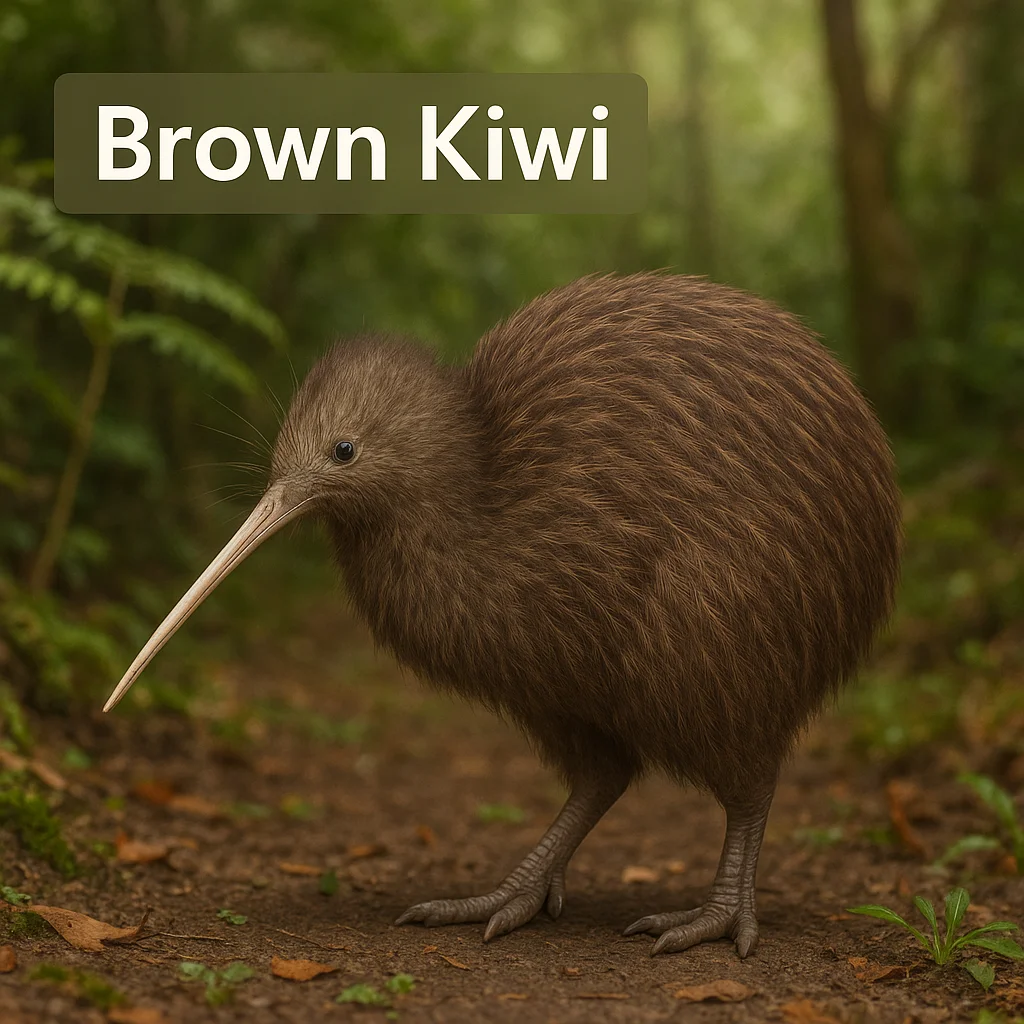
- Common name(s): Brown Kiwi, North Island Brown Kiwi, South Island Brown Kiwi
- Scientific name: Often listed as Apteryx mantelli (North Island) and Apteryx australis (South Island)
- Animal type: Bird
- Typical adult size: 45–55 cm (17.7–21.6 in), 2–3.3 kg (4.4–7.2 lbs)
- Typical lifespan: 10–20 years in the wild, up to 40 years in captivity
- Diet type: Omnivore; primarily insects, worms, seeds, fruits
- Activity pattern: Nocturnal
- Social structure: Typically solitary or monogamous pairs
- Speed / movement highlights: Slow walkers; limited mobility due to flightlessness
- Intelligence/learning: Good at problem-solving, strong memory, uses olfactory cues
- Primary habitats: Forests, grasslands
- Geographic range: Endemic to New Zealand
- Predators/threats: Stoats, feral cats, dogs, habitat destruction
- Conservation status: Varies by region from vulnerable to critically endangered
🔍 Identification & Appearance
The Brown Kiwi is a unique bird with a round, buff-colored body and shaggy, hair-like feathers. It has a long, slender bill and strong legs with large claws. Unlike many birds, its body shape is compact and ground-dwelling rather than streamlined for flight.
- Body shape and silhouette: Round, compact body with a long beak
- Key colors/patterns: Buff-colored, shaggy feathers; no significant seasonal changes
- Distinctive features: Long, sensitive bill; strong legs and claws
- Tracks, scat, or other field signs: Small holes dug with its beak in search of food
- Common look-alikes: Other kiwi species; distinguishable by size, bill length
- Top ID Tips:
- Rounded, bulky body with shaggy feathers
- Distinctive long beak, used for probing
- Strong, thick legs with noticeable claws
- Brownish coloration blends with forest floor
- No visible wings or tail feathers
- Active at night; often heard before seen due to vocalizations
- Digging behavior leaves small holes in soil
🧱 Body Structure & Physical Adaptations
Brown Kiwis have physical features adapted for a ground-dwelling lifestyle. Their strong legs and large claws are essential for foraging and self-defense, while the long beak is crucial for probing the soil for invertebrates.
- Build and proportions: Stocky with short legs and no visible tail
- Teeth/beak/jaw adaptations: Long beak sensitive to touch, suitable for probing
- Claws/hooves/wings/fins: Claws adapted for digging and territorial defense
- Sensory strengths: Excellent sense of smell, relatively poor eyesight
- Key Adaptations:
- Highly developed sense of smell for detecting prey
- Long, probing beak for reaching underground insects
- Short, sturdy legs for traversing dense underbrush
- Feathers offer camouflage on forest floors
- Nocturnal behavior to avoid predators
- Strong territorial behavior addressing habitat challenges
🌍 Range & Distribution
The Brown Kiwi is endemic to New Zealand, with different species inhabiting the North and South Islands. They do not migrate and are mostly found in varying elevations from coastal regions to mountain forests.
- Regions: New Zealand; distinct populations in North and South Islands
- Typical biomes: Forests, grasslands, varying elevation habitats
- Seasonal movements: Mostly resident, minimal seasonal movement
- Where You Might Find It:
- Dense forests on the North Island
- Grasslands in accessible region of the South Island
- Conservation areas and national parks
- Typically low-light, high-humidity environments
- Areas with softer soil for probing and foraging
🏞️ Habitat & Shelter
The Brown Kiwi prefers dense forests and scrublands where it can find ample cover and food sources. Shelters are typically formed in burrows or dense vegetation, where they can remain hidden from predators. A good understanding of their habitat preferences is crucial for conservation efforts to protect their population.
During wetter seasons, they might venture out more, while in drier conditions, they are likely more restricted to areas with rich soil for easier probing.
🧭 Behavior & Ecology
Brown Kiwis are primarily nocturnal and territorial. They engage in vocalizations to establish territory and occasionally engage in displays to deter threats or assert dominance. They play a significant role in their ecosystem by contributing to seed dispersal and maintaining insect populations through their foraging habits.
- Behavior Highlights:
- Vocal night calls for territory marking
- Prefer dense cover and minimal disturbance
- Strong site fidelity; return to favored foraging spots
- Natural pest control through invertebrate consumption
- Resilient to fluctuating food availability
- Interaction with other kiwi species in overlapping territories
👥 Social Life & Group Dynamics
Brown Kiwis are predominantly solitary but form strong monogamous pair bonds. These pairs share territory and collaborate in territorial defense and reproduction. Social interactions are primarily centered around mating pairs, with limited social hierarchy development beyond pair bonds.
- Social Structure Notes:
- Primary unit: Monogamous pair
- Occasional vocal communication with neighbors
- Joint territory defense with mate
- Lower aggression outside of mating season
- Reduced interaction with other species beyond predatory avoidance
🍽️ Diet, Prey & Predators
The omnivorous diet of the Brown Kiwi consists mainly of invertebrates, fruit, and seeds. They forage at night, using their keen sense of smell to detect prey underground. Main natural predators include stoats, feral cats, and dogs, which pose significant threats to their survival.
- Feeding Notes:
- Key diet: Invertebrates, particularly earthworms and beetles
- Occasional fruit and seed consumption
- Probing technique used in soil to locate prey
- Main predators: Stoats, feral cats, dogs
- Camouflage and stealth used as anti-predator defense
🦌 Hunting, Foraging & Movement
Brown Kiwis are slow-moving, relying on stealth and their senses to locate food. They primarily forage at night, moving slowly and deliberately to avoid detection by predators.
- Locomotion style: Ground walker, no flight
- Speed and endurance: Slow, deliberate movement
- Foraging tactics: Nocturnal probing in forest soil
- Home range: Stable territories, reliance on memory
- Movement & Strategy:
- Nighttime foraging minimizes predation
- Careful navigation through dense underbrush
- Fidelity to local foraging sites and paths
- Use of vocalizations to maintain territorial boundaries
🧠 Intelligence & Senses
Brown Kiwis possess strong problem-solving abilities and a good memory, particularly in navigation and foraging. They rely on their sense of smell more than vision, which is less critical in their mostly night-bound life.
- Problem-solving and memory: Excellent spatial navigation and recall
- Senses: Strong olfactory abilities for detecting prey
- Research status: Limited, but behavior suggests high cognitive function
- Notable Abilities:
- Keen sense of smell supports foraging
- Ability to memorize large areas and revisited locations
- Detecting subtle olfactory cues
- Adapting to seasonal food variation through learned behavior
🪺 Reproduction, Pregnancy & Parenting
Brown Kiwis have a defined breeding season, with courtship initiated by vocal exchanges. They are monogamous, with the male and female both involved in incubation. The incubation period is notably lengthy, with few large eggs laid per clutch.
- Breeding seasonality: Typically spring and summer
- Mating system: Monogamous, stable pairs
- Incubation period: 70–80 days
- Litter/clutch size: Usually 1-2 eggs, large relative to body size
- Parental roles: Shared incubation, with some male predominance
- Reproduction Snapshot:
- Vocal courtship rituals common
- Shared responsibilities increase hatchling survival
- Incubation handled primarily by the male
- Eggs take up significant body resources and energy
♀️♂️ Male vs Female Differences
In Brown Kiwis, subtle sexual dimorphism is noted, mainly in size, with females typically larger than males. Both sexes perform similar behaviors, though females lay the eggs, requiring greater resources.
- Size differences: Females tend to be larger
- Role differences in reproduction: Egg-laying, incubating duties skewed
- Behavioral roles: Generally similar, territoriality shared
- Sex Differences at a Glance:
- Females larger and heavier
- Males contribute more to incubation
- Greater nutritional needs for females during egg production
- Roles converge in territory defense
🧬 Subspecies & Variation
The Brown Kiwi encompasses several recognized subspecies, notably the North Island Brown Kiwi and the South Island Brown Kiwi. These subspecies vary in size, coloration, and distribution but share many core behaviors and ecological roles.
- Subspecies: North Island Brown Kiwi and South Island Brown Kiwi
- Large size variation between island groups
- Geographic distribution impacts threat exposure
- Overall similar adaptive strategies across subspecies
- Variation Notes:
- Subspecies specific to island locations
- Coloration minorly varied among subspecies
- Distinctive habitats create diverse adaptive behaviors
- Potential for confusion between closely located subspecies
⚠️ Threats, Conservation & Human Interaction
The Brown Kiwi faces several threats, including habitat destruction, introduced predators, and human-related disturbances. Conservation efforts focus on predator control and habitat protection. Human interaction should be mindful, ensuring any contact does not lead to habitat disruption or increased predation risks.
- Challenges: Habitat loss, predation by introduced species
- Conservation efforts: Predator management, habitat restoration
- Human interaction: Requires careful management to avoid distress
- Captivity: Moderate success in captive breeding programs
- Responsible Notes:
- Conservation areas fundamental to survival
- Human activity moderation to reduce habitat disturbance
- Success in localized predator control vital
- Advocacy for preservation critical at community levels
✨ Fun Facts & Unique Traits
- Kiwis possess one of the largest egg-to-body size ratios among birds.
- Their feathers resemble mammalian hair more than typical bird plumage.
- The Kiwi is a flightless bird with no keel on its sternum.
- They have almost 30 different calls used in communication.
- Much of New Zealand's nocturnal insect population thrives due to kiwi foraging.
- Despite flightlessness, kiwis are built for speed and agility while foraging.
- Each species of kiwi has a unique call pattern and frequency.
- Kiwis are named after the sound they make, "kee-wee."
📌 Summary
- Identification: Brown, round body, long beak, strong legs
- Habitat: Dense forests and grasslands in New Zealand
- Distribution: Endemic to New Zealand, distinctive subspecies by island
- Diet: Omnivorous; insects, worms, seeds
- Predators: Stoats, cats, dogs; habitat conservation efforts ongoing
- Social life: Mainly solitary or pairs; strong territorial behavior
- Reproduction: Monogamous, large eggs, shared incubation
- Key adaptations: Strong sense of smell, intricate night vision, enduring vocalizations
- Distinctiveness: Flightless, highly adapted to forest life