🦁 Wildebeest
🧾 Quick Facts
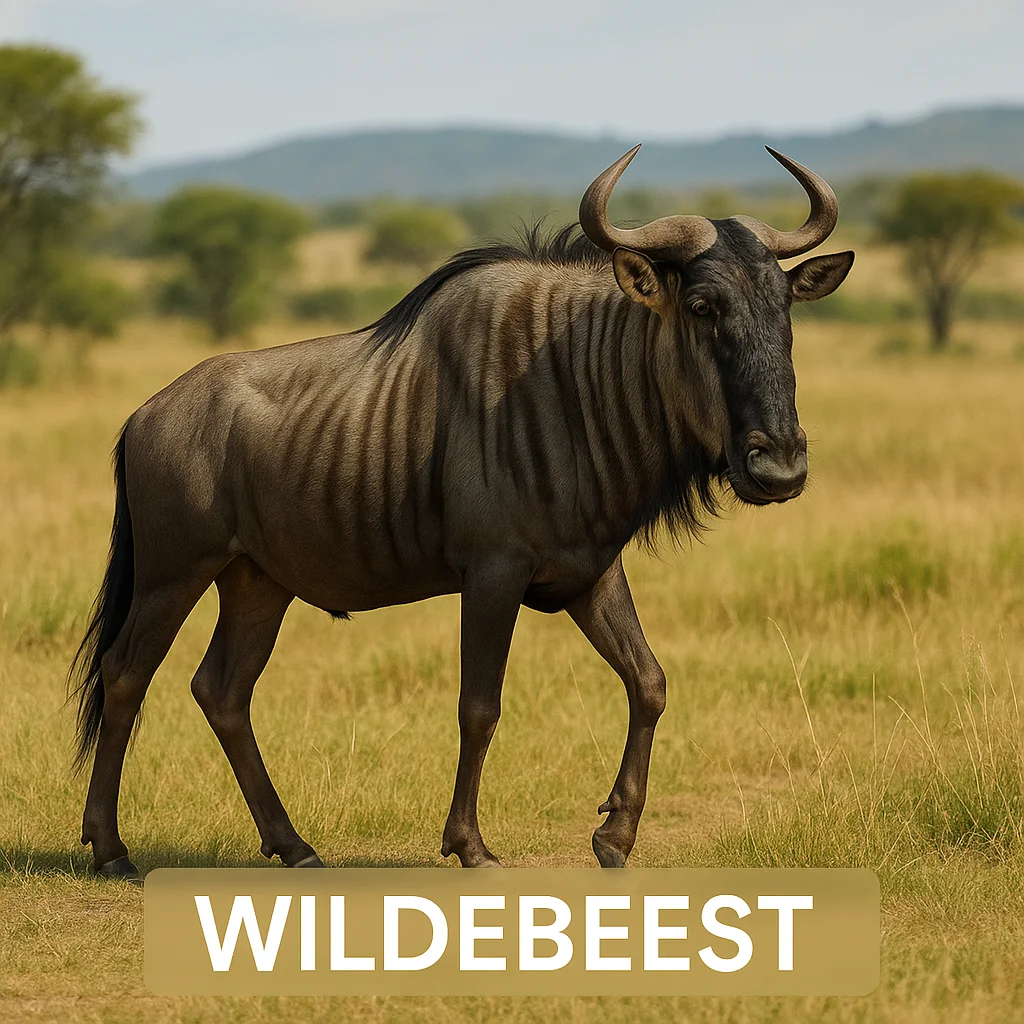
The wildebeest, also known as gnus, are large antelopes of the genus Connochaetes. They are particularly known for their annual migrations across the African savannas, a spectacle that attracts many wildlife enthusiasts.
- Common names: Wildebeest, Gnu
- Scientific names: Connochaetes taurinus (blue wildebeest), Connochaetes gnou (black wildebeest)
- Animal type: Mammal
- Typical adult size: 1.2 to 1.5 meters at the shoulder, weighing 150 to 250 kg
- Typical lifespan: 10 to 20 years in the wild
- Diet type: Herbivore, primarily grasses
- Activity pattern: Diurnal
- Social structure: Herds
- Speed / movement highlights: Can run up to 80 km/h
- Intelligence/learning: Capable of learning migration routes
- Primary habitats: Grasslands and savannas
- Geographic range: Southern and Eastern Africa
- Predators/threats: Lions, hyenas, habitat loss
- Conservation status: Varies by region; generally least concern
🔍 Identification & Appearance
Wildebeests are formidable-looking antelopes with robust bodies, muscular front parts, and thinner hindquarters. They have large heads with distinctive faces, a beard, and a mane that darkens with age.
- Body shape: Robust with a sloping back
- Colors/patterns: Blue wildebeests are grayish, black wildebeests are dark brown
- Distinctive features: Curved horns and tufted tails
- Field signs: Cloven hoof prints, large dropping piles
- Look-alikes: Buffalo; wildebeests have lighter, more slender builds
- Top ID Tips:
- Look for the curved horns
- Note the beard and mane
- Observe the characteristic silhouette
- Check the body color for species identification
- Watch for movement in herds
- Listen for distinctive snorts
- Examine tracks for round, cloven prints
🧱 Body Structure & Physical Adaptations
The wildebeest's body structure is optimized for endurance and long-distance travel, key to surviving in the vast savanna ecosystem.
- Build: Stocky with powerful shoulders, slim hindquarters
- Teeth: Flat molars ideal for grinding grasses
- Hooves: Adapted for stability and speed on open plains
- Sensory strengths: Keen eyesight and smell for detecting predators
- Key Adaptations:
- Designed for long migrations
- Strong run and sustained speed
- Efficient grazers
- Highly socially coordinated
- Good nocturnal vision
- Sharp hearing abilities
- Capable of sensing distant dangers
🌍 Range & Distribution
Wildebeests mainly inhabit the plains and open woodlands of Southern and Eastern Africa. They traverse across countries like Kenya, Tanzania, and South Africa.
- Where You Might Find It:
- Serengeti in Tanzania
- Masai Mara in Kenya
- Okavango Delta in Botswana
- Grasslands of South Africa
- Savannas of Zimbabwe
- Woodlands of Namibia
- Migratory routes in the Mara-Serengeti ecosystem
- Open plains with abundant grasses
🏞️ Habitat & Shelter
Wildebeests prefer open savannas and grasslands, where they find their primary food source: grass. These environments allow them to spot predators from afar. Shelter is often minimal, using the open landscape and herd behavior for safety.
During seasonal changes, their behavior shifts; for instance, in rain, they may disperse, and in the dry season, crowd around watering holes. Understanding their habitat is crucial for grasping their migration and survival strategies.
🧭 Behavior & Ecology
Wildebeests have complex social structures and engage in daily routines that involve grazing, resting, and social interactions. They communicate through a range of vocalizations and use their senses effectively to avoid predators.
- Behavior Highlights:
- Migrate in massive numbers
- Graze in groups for protection
- Engage in mock fights
- Use snorts and grunts for communication
- Rely on communal vigilance against predators
- Follow rainfall for fresh pastures
- Form hierarchies within herds
👥 Social Life & Group Dynamics
Wildebeests are highly social animals, forming herds that can number in the thousands. During migrations, these herds mass together for increased protection.
Within a herd, there are complex social bonds and a clear dominance hierarchy, which helps in maintaining order during the crowded migrations. Wildebeests will often form temporary alliances with zebras and other grazing animals for mutual benefits like increased predator detection.
- Social Structure Notes:
- Herds of mixed species
- Females and calves lead migration routes
- Males may form bachelor groups
- Cooperative calf-raising in groups
- Dominance established through displays
- Tight clustering during predator threats
🍽️ Diet, Prey & Predators
Wildebeests are strict grazers, preferring short grasses. Their diet changes with the seasons, as they migrate following the rains and the growth of new grass.
The natural predators of wildebeests include lions, hyenas, and crocodiles. To defend themselves, wildebeests rely on speed and group vigilance, often stamping and snorting to alert others to danger.
- Feeding Notes:
- Prefer tender, short grasses
- Depend on rain-fed grasses
- Particularly selective grazers
- Ingest large volumes quickly
- Occasionally consume shrubbery
- Alert to predators while feeding
- Consume available water sources readily
🦌 Hunting, Foraging & Movement
As grazers, wildebeests cover vast distances in search of food. Their movement is characterized by remarkable endurance, and they navigate using intuitive cues and memory.
Their migratory behavior is a strategy to optimize food availability and is one of the most dramatic wildlife events, as herds cross rivers, sometimes facing crocodiles.
- Movement & Strategy:
- Seasonal migrations
- Strong swimmers
- Swift runners to evade predators
- Maintain high speeds over long distances
- Exhibit coordinated movement in herds
- Respond instinctively to weather signals
- Frequent stops for grazing during travels
🧠 Intelligence & Senses
Wildebeests demonstrate effective decision-making in migration and predator awareness. Their sensory abilities, including hearing and vision, are well-adapted to the open plains, allowing them to detect distant threats.
While not known for tool use, wildebeests display intelligence in their social interactions and navigation skills.
- Notable Abilities:
- Highly perceptive senses
- Learn migration patterns from elders
- Acute spatial awareness in herds
- Sharp memory for grazing locations
- First to react to warning calls
- Efficient herd communication
🪺 Reproduction, Pregnancy & Parenting
During the mating season, males will compete for access to females through displays and vocalizations. Wildebeests exhibit a polygynous system, where dominant males mate with multiple females.
Gestation lasts approximately eight months, resulting in the birth of a single calf that is precocial, able to stand and run shortly after birth. Female wildebeests take primary responsibility for nursing, while the herd helps protect the young.
- Reproduction Snapshot:
- Mating season coincides with rainy seasons
- Females synchronize birth timing
- Single offspring per birth
- Calves mature rapidly
- Alloparental care in herd
- Calves remain with mothers for weaning
- Social bonding through grooming
♀️♂️ Male vs Female Differences
Sexual dimorphism is apparent in wildebeests, with males generally larger and more robust than females. Both sexes possess horns, but male horns are typically thicker and more curved for fighting rivals.
Behaviorally, males are often more territorial and engage in more frequent aggressive displays compared to females, who focus more on nurturing roles in the herd.
- Sex Differences at a Glance:
- Males larger and bulkier
- Male horns thicker and curved
- Females form critical part of migration leadership
- Males engage in territorial battles
- Females carry nurturing responsibilities
- Calves follow maternal lead
🧬 Subspecies & Variation
Two primary species of wildebeest reflect adaptations to different environments. The blue wildebeest is found in the open savannas, while the rarer black wildebeest adapts to the highland environments.
Variations may occur in coat color and horn shape influenced by environmental factors and geographic distribution.
- Variation Notes:
- Blue wildebeest in lowland plains
- Black wildebeest in hilly grasslands
- Seasonal coat color changes
- Regional horn shape differences
- Geographically distinct populations
- Adaptations aiding in migration
⚠️ Threats, Conservation & Human Interaction
Wildebeests face several natural and human-induced threats. Habitat loss due to agriculture and urban expansion, climate changes affecting migration patterns, and hunting pressures are significant conservation concerns.
Efforts to establish and maintain protected areas are crucial in ensuring the safety of migratory routes. Responsible tourism practices can help support conservation while ensuring coexistence with local human communities.
- Responsible Notes:
- Support wildlife reserves
- Follow responsible tourism guidelines
- Avoid disrupting migration paths
- Encourage sustainable land use practices
- Promote education about wildebeest ecology
- Participate in conservation initiatives
✨ Fun Facts & Unique Traits
- Known for their annual mass migration — one of nature's great spectacles
- Named "wildebeest," meaning "wild beast" in Dutch due to their appearance
- Play a critical role in the ecosystem as grazers
- Wildebeest calves can run alongside the herd within minutes of birth
- Migrate synchronously with zebras
- Utilize various vocal calls for communication
- Wildebeests have unique stamps and snorts to signal danger
- Historical migrations shaped African landscapes over centuries
📌 Summary
- Wildebeests are large African antelopes known for their mass migrations
- They inhabit the open grasslands of Southern and Eastern Africa
- Diet consists mainly of grasses, requiring vast seasonal movements
- Natural predators include lions, hyenas, and crocodiles
- Highly social, forming large, structured herds
- Reproduce seasonally with synchronized birthing among females
- Adapted for endurance with powerful bodies and strong senses
- Conservation efforts focus on habitat protection and sustainable tourism