🦁 Wild Boar
🧾 Quick Facts
The Wild Boar, with its distinct appearance and adaptable nature, is a fascinating member of the animal kingdom. As a key player in many ecosystems, it exhibits various behaviors and adaptations that have allowed it to thrive across diverse habitats.
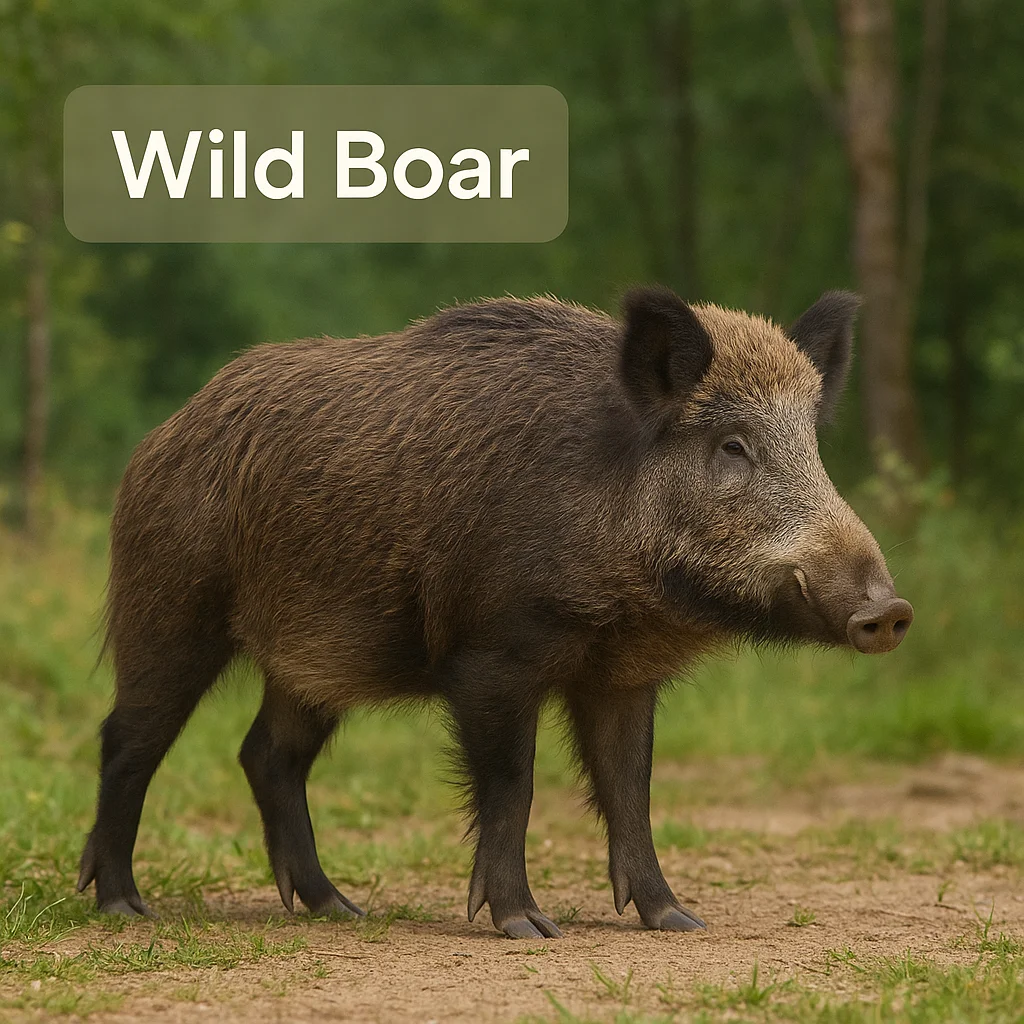
- Common name(s): Wild Boar, Wild Hog
- Scientific name: Sus scrofa
- Animal type: Mammal
- Typical adult size: 90–200 cm (35–79 inches) length, 50–150 kg (110–330 pounds) weight
- Typical lifespan: 4–8 years in the wild, up to 20 years in captivity
- Diet type: Omnivore; includes roots, fruits, small mammals, and insects
- Activity pattern: Mostly nocturnal, some diurnal tendencies in undisturbed areas
- Social structure: Usually lives in small family groups called "sounders"
- Speed / movement highlights: Can run at speeds up to 40 km/h (25 mph)
- Intelligence/learning: Highly adaptable and intelligent; capable of learning quickly
- Primary habitats: Forests, grasslands, and wetlands
- Geographic range: Europe, Asia, North Africa, and introduced in the Americas and Australia
- Predators/threats: Wolves, large cats, humans, habitat loss
- Conservation status: Least Concern, though status varies by region
🔍 Identification & Appearance
Wild Boars are easily recognizable by their robust body, short legs, and coarse, bristly coat. Their coloration varies from dark brown to black, sometimes with a brindled or spotted effect. Young boars, called piglets, have striped coats for better camouflage.
Distinctive features include their long, straight snouts, small, erect ears, and sharp tusks. The tusks, more pronounced in males, are a notable feature used in defense and foraging.
Their tracks are cloven and similar to those of domestic pigs, while their dung or scat is often visible in areas they frequent.
- Top ID Tips:
- Look for a stout, compact body with a downward-arching back.
- Note the dark, bristly coat that can vary in shade and pattern.
- Observe the long snout – a key foraging tool.
- Spot the sharp tusks that are more developed in males.
- Listen for characteristic grunts and other vocalizations.
- Look for signs of rooting in the ground in search of food.
- Beware of similar-looking domestic pigs; Wild Boars have leaner builds.
🧱 Body Structure & Physical Adaptations
The Wild Boar has a stocky build, with relatively short, powerful legs that aid in running and maneuveuring through dense underbrush. Its snout is long and flexible, optimized for digging and rooting in the ground to uncover food.
Their teeth include prominent tusks, particularly in males, that grow continuously throughout their lives. These tusks are used not only for digging but also for fighting and defense.
Their coat, while bristly and coarse, provides valuable protection against the elements and minor injuries. Their senses, especially smell and hearing, are highly developed, compensating for relatively weaker vision.
- Key Adaptations:
- Robust body to support a life of foraging and survival in varied environments.
- Powerful snouts designed for digging and unearthing roots and insects.
- Tusks that serve as formidable weapons and digging tools.
- Highly sensitive sense of smell for locating food and detecting predators.
- Strong, agile legs for quick bursts of speed and nimble turns.
- Brusque-sensitive skin to partly ward off insect bites and environmental scratches.
🌍 Range & Distribution
Wild Boars are highly adaptable and inhabit a wide geographical range. They are native to large parts of Europe, Asia, and North Africa. Additionally, they have been introduced to the Americas and Australia, where they can become invasive.
Typically residing in temperate and tropical forests, they also adapt to grasslands, swamps, and agricultural areas. Some populations migrate to find water and food, but many are resident.
- Where You Might Find It:
- Woodlands across Europe and Asia
- Wetlands in temperate regions
- Deciduous and coniferous forests
- Agricultural areas near wild lands
- Invasive populations in North American forests
- Grasslands in non-native ranges
🏞️ Habitat & Shelter
Wild Boars prefer dense woodlands and forest environments where they can find ample food and cover. Forest edges, swamps, and agricultural fields are also typical habitats. The boars create nests or bedding areas out of vegetation, where their family units rest during the day.
Seasonally, they may adjust their range depending on food availability, shifting from temperate forests to more sheltered areas during heavy snowfall or extremely cold periods. In warmer climates, they seek out wetlands or drenched soils to cool down.
Understanding boar habitats aids in comprehending their feeding patterns, migration, and social behavior.
🧭 Behavior & Ecology
Wild Boars are predominantly nocturnal but may display diurnal activity in environments with minimal human presence. Their daily routine includes foraging for food, wallowing in mud to protect their skin, and resting in shaded areas.
Communication consists of various nudges, grunts, and vocalizations, including squeaks and squeals. Scent marking and rooting patterns help indicate their presence and territorial behavior.
They play a major ecological role as earth-turners, influencing plant growth, and their omnivorous diet contributes to seed dispersal. They have an impact as both prey and predators across food webs.
- Behavior Highlights:
- Primarily active at night to avoid predation.
- Complex communication through sounds and tactile signals.
- Significant earth disturbance increasing ecosystem dynamics.
- Participates in mutualistic relationships through seed dispersal.
- Employs wallowing in mud as a cooling mechanism and insect repellent.
- Alters landscapes through extensive rooting and digging.
👥 Social Life & Group Dynamics
Wild Boars exhibit complex social structures often centered around small family units called "sounders," which typically consist of females and their offspring. Solitary males join these groups during the breeding season, but usually live alone or in bachelor groups otherwise.
The hierarchy within groups is usually linear and based on age and size, with dominant sows leading. Conflict within groups is rare but is resolved through mild displays of aggression or vocal interaction.
- Social Structure Notes:
- Females form sounders with social bonds.
- Adult males more solitary, except during mating.
- Clear hierarchies in female-led groups.
- Cooperative care within sounders, especially in raising young.
- Displays of aggression usually symbolic or brief.
🍽️ Diet, Prey & Predators
As omnivores, Wild Boars have a varied diet: roots, fruits, insects, small mammals, and occasionally eggs from bird nests. Seasonal foods include nuts like acorns and chestnuts, along with agricultural crops when available.
Natural predators vary by region and include large carnivores like wolves and big cats. Human hunting poses a significant threat in parts of their range. Boars rely on their sharp tusks and considerable speed for defense.
- Feeding Notes:
- Opportunistic feeders adjusting to seasonal abundance.
- Forage by digging with snouts to unearth underground foods.
- Targets and consumes invertebrates and small animals.
- Competes with livestock in agricultural regions.
- Defense involves aggressive charges and vocalizations.
- Supplements diet with herbs and browse during scarcity.
🦌 Hunting, Foraging & Movement
Wild Boars are primarily foragers, using their excellent senses and snouts to find food. With a preferred running style, boars can navigate dense brush and forest floors swiftly and efficiently.
They are capable of sustained movement but tend to forage within established home ranges, rotating areas to allow recovery and regrowth of vegetation. No significant migratory movements are noted, though some seasonal range shifts occur in response to extreme weather.
- Movement & Strategy:
- High endurance in varied terrain.
- Uses short sprints to avoid detection and danger.
- Foraging involves systematic rooting patterns.
- Home range determined by resource availability.
- Responsive to environmental changes, adjusting activity levels.
🧠 Intelligence & Senses
Wild Boars possess a high level of adaptability and problem-solving skills, evidenced by their ability to thrive in diverse environments. They exhibit impressive memory and learning abilities, particularly when foraging and avoiding predators.
Among their sensory strengths, olfaction is exemplary, used not only for finding food but also to detect potential threats. While eyesight is relatively poor, their acute hearing compensates significantly.
- Notable Abilities:
- Adaptable forage strategists and problem solvers.
- Developed social learning among group members.
- Memory used effectively for navigation and food location.
- Olfactory senses help in both hunting and predator avoidance.
- Responsive auditory system for communication and alertness.
🪺 Reproduction, Pregnancy & Parenting
The breeding season of Wild Boars typically occurs in late autumn and winter, though it can vary by region. Boars are polygynous, with males vying for access to receptive females through displays and vocalizations.
Pregnancy lasts about 115 days, resulting in a litter of 4 to 6 piglets, though larger litters can occur. Wild Boar piglets are born precocial and grow quickly, nursing for several months.
The females primarily handle parental duties, with alloparenting, or shared care, often observed within family groups.
- Reproduction Snapshot:
- Polygynous mating system observed.
- Gestation period lasts approximately 3.5 months.
- Litter size generally between 4-6 piglets.
- Piglets are precocial and striped at birth.
- Maternal care with group support in rearing young.
♀️♂️ Male vs Female Differences
Wild Boars exhibit sexual dimorphism. Males, known as boars, are typically larger with more prominent tusks used during the rutting season. Females, or sows, are generally smaller and have shorter tusks.
Behavior varies slightly, with males displaying solitary tendencies outside the mating season, while females maintain close-knit groups. During the breeding season, males may exhibit increased aggression and roam larger areas to find mates.
- Sex Differences at a Glance:
- Males larger and heavier than females.
- Males have longer, more curved tusks.
- Sows maintain closer social bonds year-round.
- Slight behavioral shifts during the breeding period.
🧬 Subspecies & Variation
There are several subspecies of Wild Boar, with size, coat color, and tusk development varying accordingly. Differences are often adaptations to local environments, such as body sizes optimized for temperature extremes or specific food availability.
For instance, the smaller Eurasian Wild Boars are adapted to forested areas with cooler climates, while larger semi-desert variants are found in arid conditions.
- Variation Notes:
- Subspecies affected by geographical and climatic conditions.
- Size variations often due to resource availability.
- Coat coloration affected by environmental camouflage needs.
- Tusk size and shape can reflect dietary habits.
⚠️ Threats, Conservation & Human Interaction
Wild Boars face various natural and human-induced threats, including habitat loss and hunting pressures. In non-native regions, they can become invasive, leading to conflicts with agriculture and native ecosystems.
Conservation efforts focus on controlling population sizes and preventing excessive damage, mainly in areas where they are non-native. While they play essential roles in their ecosystems, coexistence requires careful management.
- Responsible Notes:
- Responsible hunting can help manage boar populations.
- Management strategies necessary in non-native habitats.
- Potential for agricultural damage needs mitigation.
- Protected in regions where native population numbers are declining.
✨ Fun Facts & Unique Traits
- Wild Boars are capable swimmers and can cross rivers and lakes.
- Their rooting behavior can improve soil health and promote new plant growth.
- Young boars (piglets) have distinctive striped patterns for camouflage.
- Boars have a reputation for their keen sense of smell, sometimes used in truffle hunting.
- Known for their resilience, they can thrive in various habitats, from forests to swamps.
- Wild Boars communicate using a wide range of vocal sounds, including grunts, squeals, and snorts.
📌 Summary
- Wild Boars are robust mammals known for their adaptability and significant impact on ecosystems.
- Recognizable by their bristly coats, long snouts, and sharp tusks.
- Native to Europe, Asia, and North Africa, with invasive populations worldwide.
- Omnivorous diet includes roots, fruits, and small mammals.
- Predators include large carnivores and human hunters.
- Live in female-led groups termed "sounders" with complex social structures.
- Breeding results in litters of precocial piglets, with supportive maternal care.
- Key adaptations include strong olfactory senses and versatile foraging abilities.
- Capable of altering their environment, influencing both plant life and soil through rooting.