🦁 White Rhinoceros
🧾 Quick Facts
The White Rhinoceros, often revered for its impressive size and distinctive features, is one of the largest land mammals. Typically associated with grasslands and savannas in Africa, this animal plays a crucial role in its ecosystem, both as a grazer and as an iconic species influencing conservation efforts.
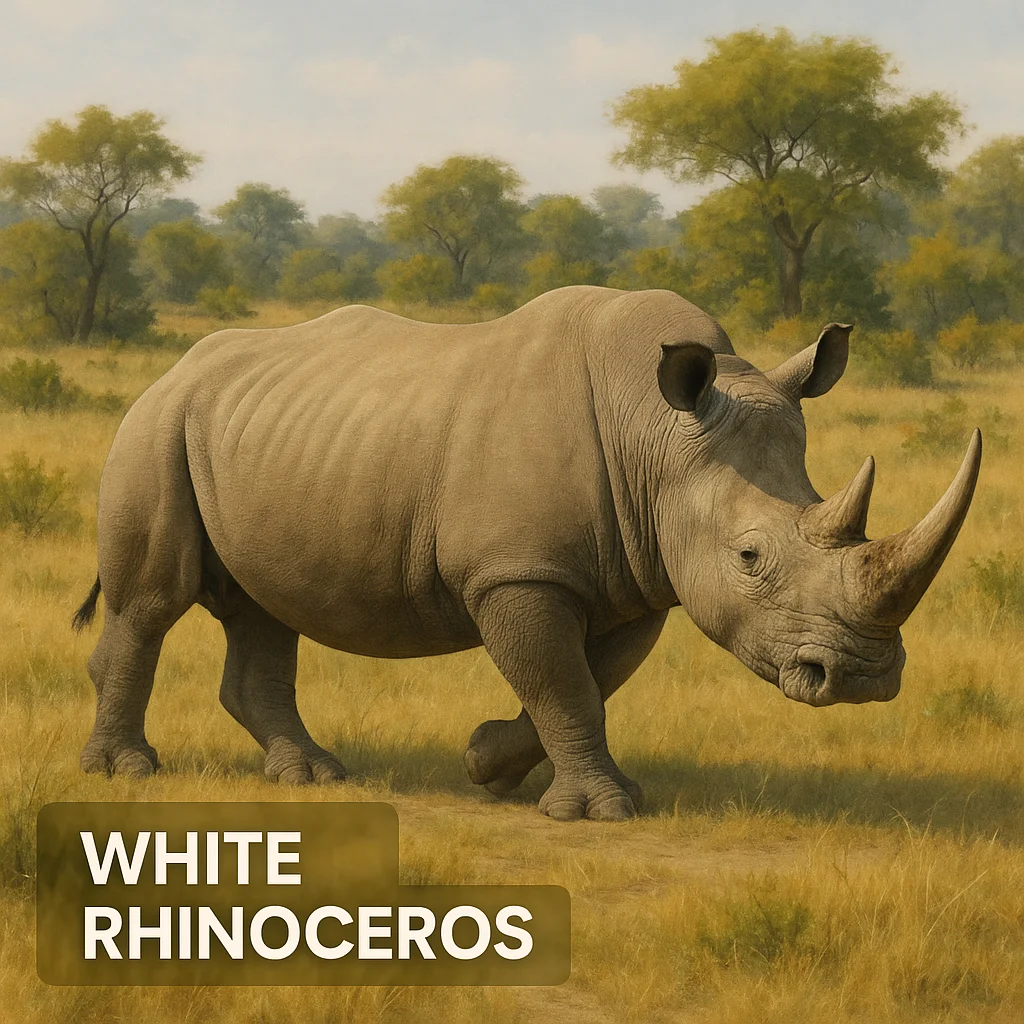
- Common name(s): White Rhinoceros, Square-lipped Rhinoceros
- Scientific name: Ceratotherium simum
- Animal type: Mammal
- Typical adult size: 3.5 to 4 meters in length, 1.7 to 2 meters in height, 1,400 to 3,600 kg in weight
- Typical lifespan: 30 to 40 years in the wild, up to 50 years in captivity
- Diet type: Herbivore; primarily grasses
- Activity pattern: Diurnal, with peaks in the early morning and late afternoon
- Social structure: Group; forms small herds
- Speed / movement highlights: Can run up to 40 km/h
- Intelligence/learning: Known for strong memory and social bonds
- Primary habitats: Grasslands and savannas
- Geographic range: Southern Africa
- Predators/threats: Humans (poaching), habitat loss
- Conservation status: Near Threatened, with some populations endangered
🔍 Identification & Appearance
The White Rhinoceros is easily recognized by its enormous size and large head. It has a broad chest and a characteristic hump on its back. Its skin is thick and grayish, although its name might suggest a different color, it actually refers to its wide mouth adapted for grazing.
An adult White Rhinoceros typically features two horns made of keratin, with the front horn being longer. Its square lips distinguish it from other rhino species, aiding its grass-eating habits. The animal’s ears are large and funnel-shaped, rotating to detect sounds.
- Top ID Tips:
- Large size and prominent hump on the back
- Grayish skin, thick and folds in appearance
- Two horns with the front one longer
- Square-shaped lips suited for grazing
- Long, funnel-shaped ears that can swivel
- Large, round body shape
- Wide mouth compared to other rhino species
- Broad chest and massive shoulders
- Commonly sighted in herds on open grasslands
- Tracks show a three-toed footprint
🧱 Body Structure & Physical Adaptations
The White Rhinoceros showcases significant physical adaptations that suit its life in open habitats. Its bulky build, supported by pillar-like legs, allows powerful movements while grazing. The wide, flat mouth helps it clip grass efficiently. It possesses broad hooves that distribute its weight over soft ground.
Its horns aren't just for defense but are used in social interactions as well. The thick skin acts as armor against predators and insects. Sensory adaptations include acute hearing and a strong sense of smell; however, its eyesight is relatively poor.
- Key Adaptations:
- Large, muscular build supports grazing lifestyle
- Pillar-like legs for firm support
- Broad, flat mouth adapted for grazing
- Thick skin provides protection
- Large, functional horns for defense and communication
- Rotating ears for detecting sounds
- Strong sense of smell
- Broad hooves distributing weight
- Relatively poor vision compared to other senses
🌍 Range & Distribution
The White Rhinoceros predominately inhabits the grasslands and savannas of southern Africa. Countries such as South Africa, Namibia, Zimbabwe, and Kenya feature notable populations. Its distribution reflects its preference for open plains where it can graze efficiently.
While not migratory, some regional movements occur due to seasonal changes affecting water and food availability.
- Where You Might Find It:
- South Africa
- Namibia
- Zimbabwe
- Kenya
- Botswana
- Zambia
- Grassland biomes
- Open savannas
- Areas with abundant water sources
🏞️ Habitat & Shelter
White Rhinoceroses favor habitats where grass is plentiful and water sources are reliable, usually in savannas and open woodland. Within these ecosystems, waterholes are crucial, as rhinos are dependent on water for drinking and wallowing. Wallowing in mud serves as a key mechanism for thermoregulation and parasite control.
In response to seasonal changes, they may roam to find areas with sufficient water and nourish their grazing needs. Knowledge of their habitat preference helps in devising conservation strategies and understanding their ecological impact as mega-grazers that shape vegetation composition.
🧭 Behavior & Ecology
The White Rhinoceros leads a fairly sedentary lifestyle, spending a significant part of its day grazing. It is territorial, with males maintaining defined areas marked by dung piles. Social behavior includes forming groups called crashes, often seen resting under trees during midday heat.
Communication occurs through various vocalizations, scent marking, and body language. As a mega-herbivore, it influences the ecosystem by maintaining grassland ecology, stimulating new growth, and affecting species composition.
- Behavior Highlights:
- Grazes during early morning or late afternoon
- Forms small social groups called crashes
- Wallows in mud for thermoregulation
- Territorial males mark areas with dung
- Communicates through grunts and snorts
- Sometimes mutualistic with birds like oxpeckers
- Plays a role in seed dispersal of some plant species
- Influences grassland structure as a mega-grazer
- Alternates between feeding and resting
👥 Social Life & Group Dynamics
While primarily solitary, White Rhinoceroses can exhibit social tendencies, particularly in sub-adults and females with young. Groups, known as crashes, often consist of females and their offspring. However, adult males are usually solitary when not mating.
Interactions among individuals can include play, grooming, and conflict resolution through mock charges and displays rather than physical altercations.
- Social Structure Notes:
- Forms small groups or crashes
- Females and young often group together
- Adult males are typically solitary
- Sub-adult males may form bachelor groups
- Social structure varies during mating season
- Nonverbal cues used to resolve conflicts
- Playful behavior observed in younger rhinos
- Scent marking to establish dominance
- Mutual grooming as a social bonding tool
🍽️ Diet, Prey & Predators
The White Rhinoceros is a pure grazer, with a diet consisting almost exclusively of different types of grasses. Its squared lip is adapted to clip grass cleanly as it walks, resembling a lawnmower in its efficiency.
Their main natural predators are humans, primarily due to poaching threats. Although lions and hyenas can be a threat to young or sick animals, well-nourished adults are generally safe due to their size and formidable horns.
- Feeding Notes:
- Primarily feeds on short grasses
- Uses square lip to clip grasses
- Can adjust diet based on grass availability
- Drinks daily but can tolerate sparse rainfall
- May feed during cooler parts of the day
- Main threats are human-related
- Young protected by mother
- Utilizes wallows to cool down and avoid parasites
- Occasionally browses on shrubs when grass is scarce
🦌 Hunting, Foraging & Movement
As a grazer, the White Rhinoceros has adapted to cover considerable distances in search of adequate grazing grounds. They primarily walk, but can run at speeds of up to 40 km/h when threatened.
Their daily routine includes long periods of grazing interspersed with resting and wallowing. They follow the availability of resources, adjusting their ranging behavior in response to seasonal changes in food and water.
- Movement & Strategy:
- Primarily a grazer of grasslands
- Walks significant distances for feeding
- Can run short distances at high speed
- Water-dependent but can endure dry periods
- Forages in early and late day
- Follows seasonal vegetation changes
- Movement influenced by water availability
- Defensive running in face of threats
- Home range size varies with resource availability
🧠 Intelligence & Senses
The White Rhinoceros, while not known for problem-solving, exhibits strong social intelligence and memory. They can remember rhino-associated sounds and commonly return to long-used paths and territory boundaries.
Strong senses, particularly olfactory and auditory, support navigation and social interactions. Visual acuity is less developed, contributing to their reliance on scent and hearing.
- Notable Abilities:
- Excellent memory for locations and routes
- Strong social intelligence within groups
- Highly developed sense of smell
- Able to detect sounds over long distances
- Limited reliance on eyesight
- Able to recognize individual humans and other animals
- Responsive to vocal signals from others
- Remember watering holes and feeding grounds
🪺 Reproduction, Pregnancy & Parenting
White Rhinoceroses breed throughout the year, with no strict breeding season. Courtship includes vocalizations and horn displays. The mating system is polygynous, with dominant males mating with multiple females.
The gestation period is approximately 16 months, and females typically give birth to a single calf. Newborns are relatively well-developed but reliant on the mother for protection and nourishment for up to three years.
- Reproduction Snapshot:
- Polygynous mating behavior
- Gestation lasts about 16 months
- Usually, one calf per birth
- Calves stay with mothers for up to 3 years
- Females control calf-rearing
- Males compete for mating opportunities
- No fixed breeding season
- Displays involve horn-flashing and vocalizations
- Calves are born precocial
♀️♂️ Male vs Female Differences
Male and female White Rhinoceroses are similar in appearance, but there are some notable differences. Males tend to be larger and heavier than females. Behaviorally, males establish more defined territories and are more solitary than females, who often remain with offspring or in female groups.
- Sex Differences at a Glance:
- Males larger than females
- Males have broader horns
- Females often seen with calves
- Males are more territorial
- Females more social with other females
- Males occasionally form bachelor groups
- Size difference detectable in mature adults
- Both sexes can be similarly colored
🧬 Subspecies & Variation
The White Rhinoceros is often divided into two subspecies: the Southern White Rhinoceros (Ceratotherium simum simum) and the Northern White Rhinoceros (Ceratotherium simum cottoni). The Southern subspecies is more populous and widespread, predominantly found in South Africa. Conversely, the Northern subspecies is critically endangered and near-extinct, with most remaining individuals living under human care.
- Variation Notes:
- Southern subspecies more numerous
- Northern subspecies critically endangered
- Differences in range and population size
- Possible size and weight distinctions
- Conservation strategies vary by subspecies
⚠️ Threats, Conservation & Human Interaction
The White Rhinoceros faces significant threats, primarily from poaching driven by the lucrative market for rhino horns. Habitat loss and human conflict also pose challenges. Conservation efforts include strict protection laws, anti-poaching patrols, and international cooperation on captive breeding programs.
Coexistence initiatives focus on educating local communities about the ecological importance of rhinos and promoting sustainable tourism practices. While zoos and reserves play a vital role in their conservation, it is critical that ethical practices are followed to ensure their welfare.
- Responsible Notes:
- Major threat: poaching
- Conservation priority in Southern Africa
- Strict protection enforced in reserves
- Habitat protection crucial for survival
- Communities engaged in conservation efforts
- Anti-poaching measures practiced widely
- Breeding programs in controlled environments
- Rhino tourism supports conservation funding
- Education programs battle demand for rhino horn
✨ Fun Facts & Unique Traits
- White Rhinoceroses play a vital role in African folklore and mythology.
- Their square mouth is perfectly adapted for grazing extensive areas of grassland.
- Despite their size, they can run surprisingly fast, reaching speeds up to 40 km/h.
- Rhinos are known for having ancient evolutionary roots, dating back millions of years.
- Their thick skin can reach up to 5 cm in some areas, providing excellent defense.
- They can produce a wide range of vocal sounds, including snorts, roars, and grunts.
- White Rhinoceros contribute to biodiversity by promoting plant growth through their grazing habits.
- The term "white" in their name is believed to derive from a misinterpretation of the word "wijde" meaning wide, referring to their mouth.
- While weighing over a ton, they rely significantly on their senses of smell and hearing.
📌 Summary
- The White Rhinoceros, or Ceratotherium simum, is one of the largest land mammals.
- Typically identifiable by its large size, square lips, and two horns.
- Inhabits grasslands and savannas primarily in southern Africa.
- Herbivorous diet, grazing mostly on grasses.
- Main threat from poaching driven by demand for horn.
- Social animals forming small groups; calves stay with mothers.
- Reproduces throughout the year; known for a polygynous mating system.
- Key adaptations include large size, grazing efficiency, and strong senses.
- Influences grassland ecology as a mega-grazer and key conservation species.