🦁 Pronghorn
🧾 Quick Facts
The pronghorn, often regarded as one of North America's most unique animals, is distinguished by its incredible speed and endurance, making it a fascinating subject for wildlife enthusiasts. Here's a broad overview of this remarkable species:
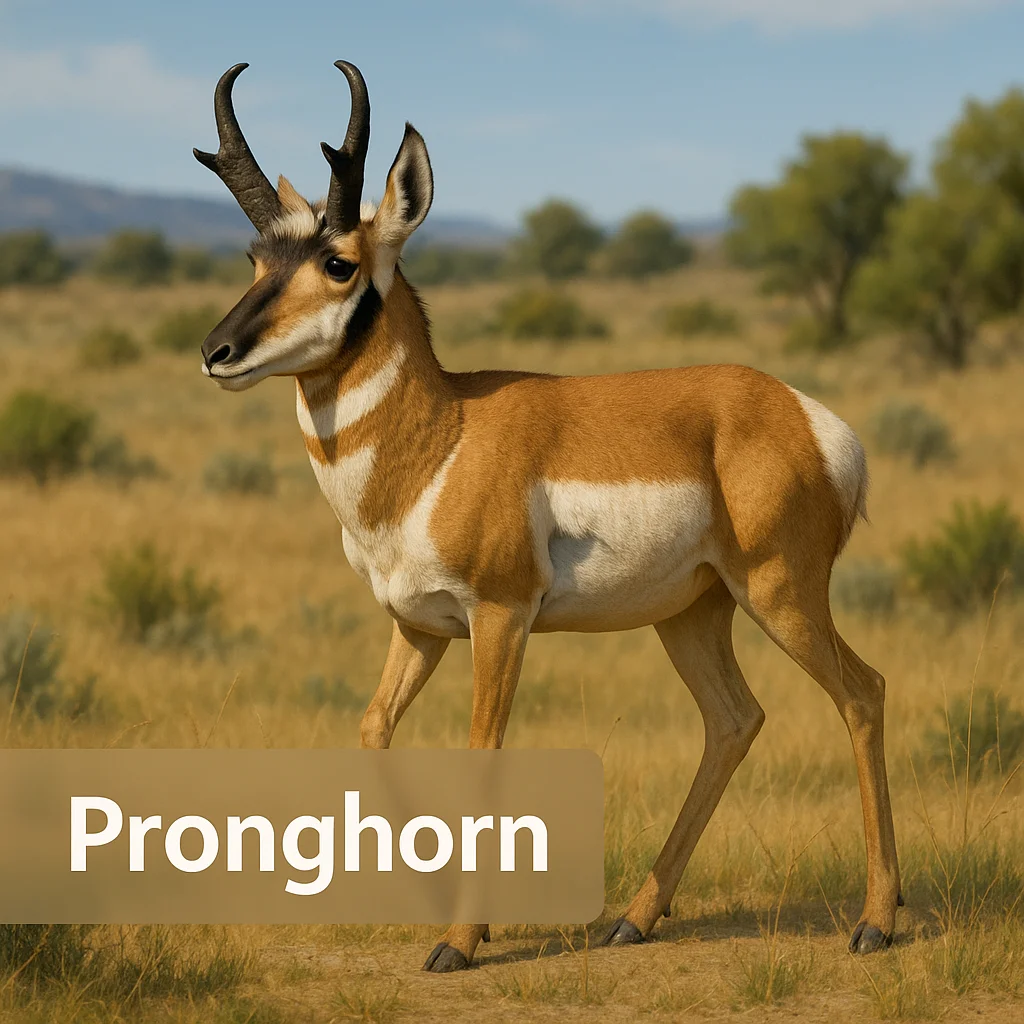
- Common name(s): Pronghorn
- Scientific name: Antilocapra americana
- Animal type: Mammal
- Typical adult size: 1.3 to 1.5 meters (4.3 to 5 feet) in length, 40 to 65 kg (88 to 143 pounds) in weight
- Typical lifespan: 7 to 10 years in the wild
- Diet type: Herbivore, primarily grazing on grasses and browsing on shrubs
- Activity pattern: Diurnal
- Social structure: Typically found in herds
- Speed / movement highlights: Can run up to 88.5 km/h (55 mph), making it the fastest land mammal in North America
- Intelligence/learning: Keen problem-solving abilities and social intelligence
- Primary habitats: Grasslands, deserts, and open prairies
- Geographic range: Western and central North America
- Predators/threats: Coyotes, wolves, and mountain lions; human pressures include habitat fragmentation
- Conservation status: Least Concern, but populations vary by region
🔍 Identification & Appearance
The pronghorn is notable for its sleek, agile build. Its body is slender and supported by strong, thin legs designed for rapid movement. The coat features a mix of tan, white, and darker brown patches, which may vary with age and season.
- Body shape and silhouette: Slender with long legs and a graceful gait
- Key colors/patterns: Tan and white with dark markings around the face and neck
- Distinctive features: Unique pronged horns, white rump patch, and black mask across the face
- Tracks, scat, or other field signs: Tracks are heart-shaped and relatively small
- Common look-alikes: Often confused with deer but can be differentiated by their distinctive horn structure
🧱 Body Structure & Physical Adaptations
Pronghorns are well-adapted to their environments with several key physical features. Their lightweight bodies and specialized organs make them supreme runners in the animal kingdom.
- Build and proportions: Strong, lean build with long limbs
- Teeth: Adapted for a herbivorous diet, ideal for grinding grasses
- Hooves: Split hooves provide stability on various terrains
- Sensory strengths: Exceptional vision and keen hearing
- Key Adaptations:
- Lungs and heart are adapted for efficient oxygen distribution
- Large eyes aid in spotting predators
- Unique horn structure aids in social displays
- Lung capacity supports high-altitude existence
- Specialized skin allows for rapid heat dissipation
🌍 Range & Distribution
Pronghorns inhabit a broad range of environments across North America but primarily thrive in open lands where their speed and agility can be utilized for survival.
- Primary location: Western and central North America
- Elevation range: Commonly found at elevations ranging from sea level to 1,800 meters (5,900 feet)
- Reside largely within the Great Plains, desert, and sagebrush regions
- Migration: Some populations undertake seasonal migrations to seek better grazing or more temperate climates
- Where You Might Find It:
- Open grasslands of Wyoming
- Deserts of Nevada
- Prairies of Montana
- Sagebrush habitats of Idaho
- Lower elevations of Colorado
🏞️ Habitat & Shelter
Pronghorns prefer expansive, open terrains that provide unobstructed views of their surroundings, utilizing their speed to evade predators. Shelter is often minimal, with pronghorns relying on sparse vegetation for cover.
In more extreme weather, such as winter, pronghorns may seek out sheltered areas behind hillocks or within low-lying brush to protect themselves from the wind.
Understanding their habitat preferences helps in appreciating their survival strategies and the challenges they face with habitat fragmentation.
🧭 Behavior & Ecology
Pronghorns exhibit a suite of behaviors driven primarily by the need for survival and reproduction. They are largely active during the day, utilizing keen eyesight and speed to navigate their environments.
- Maintain vigilance through constant scanning for predators
- Utilize vocalizations and body language for communication
- Participate in seasonal migrations depending on food availability
- Play a crucial role as primary consumers in their ecosystems
- Behavior Highlights:
- Forming loose, migratory groups
- Communicating through distinctive snorts and body postures
- Males engage in displays of strength during rut
- Adaptable responses to environmental stressors
- Frequent movement as a survival strategy
👥 Social Life & Group Dynamics
The social structure of pronghorns is intriguing. They exhibit varied group behaviors based on environmental conditions and reproductive cycles. Typically, they are found in mixed herds, especially during non-breeding seasons.
- Males establish territories during the breeding season
- Females often group in larger herds for safety
- Except for breeding males, pronghorns exhibit relatively peaceful interactions
- Social bonds often form within gender-specific groups
- Social Structure Notes:
- Herds can vary greatly in size
- Males may form bachelor groups outside the breeding season
- Hierarchy is evident during mating season
- Cooperative vigilance against predators
- Mother-offspring bonds are strong and enduring
🍽️ Diet, Prey & Predators
As herbivores, pronghorns thrive on a diet primarily composed of grasses and forbs. They adjust their diet based on availability, sometimes browsing on shrubs and cacti in harsher habitats.
- Primarily graze on grasses during warmer months
- Supplement diet with shrubs like sagebrush in winter
- Are preyed upon by a variety of predators including coyotes and golden eagles
- Employ speed as their primary defense mechanism against threats
- Feeding Notes:
- Flexible diet adapts to seasonal changes
- Tendency to prefer nutrient-rich areas
- Water consumption is low, gaining moisture from vegetation
- Capable grazers providing important seed dispersal
- Feeding behavior changes during droughts
🦌 Hunting, Foraging & Movement
Pronghorns are unmatched in terms of speed and endurance among North American mammals. Their foraging relies on both browsing and grazing, adapting based on the habitat.
- Running style optimized for long distance and quick sprints
- Use speed to escape predators rather than relying on agility
- Diurnal foragers, often grazing during the cooler parts of the day
- Migrate seasonally to optimize access to resources
- Movement & Strategy:
- High stamina supports prolonged movement
- Energy-efficient gait minimizes fatigue
- Trail use to navigate large distances
- Spatial awareness critical for avoiding obstacles
- Migrations driven by resource availability
🧠 Intelligence & Senses
Pronghorns are equipped with a range of senses that enhance their survival prospects. Their intelligence is reflected in their ability to learn and adapt to new challenges.
- Notable for exceptional vision, capable of spotting movement over great distances
- Hearing is acute, providing early warnings of approaching danger
- Risk management through calculated decision-making in escape strategies
- Able to remember terrain and migratory paths
- Notable Abilities:
- Vision comparable to an 8x binocular viewer
- Effective use of memory for migration routes
- Keen auditory processing minimizes surprise attacks
- Can distinguish predator calls from routine noise
- Adaptability in dynamic environments
🪺 Reproduction, Pregnancy & Parenting
Reproductive behaviors and strategies are crucial to pronghorn survival, particularly in habitats with varying resource availability.
- Breeding season occurs in late summer to early fall
- Males display and defend territories to attract females
- Gestation lasts approximately 245 days
- Usually give birth to twins, although singles and triplets may occur
- Reproduction Snapshot:
- Polygynous mating system
- Females select males based on territory quality
- Newborns are precocial, quickly able to stand and follow
- Mothers provide initial nurturing and protection
- Offspring begin grazing after roughly a week
♀️♂️ Male vs Female Differences
Sex differences in pronghorns are subtle but notable, especially during the breeding season when males display their dominance and territoriality.
- Males are generally larger with distinctively shaped horns
- Males exhibit more territorial behaviors during breeding
- Females may form larger groups for nurturing and protection
- Horn development in females is present but less pronounced
- Sex Differences at a Glance:
- Males larger and more robust
- Presence of distinct prong on male horns
- Females more involved in post-birth care
- Behavioral differences more pronounced during rut
- Subtle color variations may be observed
🧬 Subspecies & Variation
While all pronghorns belong to the same species, regional variations exist, often driven by habitat-specific adaptations and resource availability.
- Known subspecies include the Baja, Sonoran, and Mexican pronghorn
- Differing coat thickness related to climate
- Variations in size due to geographic isolation
- Subspecies classifications are sometimes debated among scientists
- Variation Notes:
- Baja pronghorn with lighter coat adaptations
- Sonoran pronghorn adapted to extreme desert conditions
- Interbreeding can obscure subspecies boundaries
- Geographical barriers influence gene flow
- Varying horn dimensions across populations
⚠️ Threats, Conservation & Human Interaction
Pronghorns face several natural and anthropogenic challenges. Conservation efforts focus on habitat preservation and minimizing human-wildlife conflict.
- Threats include habitat loss due to agriculture and urbanization
- Climate change affecting resource availability
- Predation pressure from natural enemies like wolves
- Road networks can disrupt migratory patterns
- Responsible Notes:
- Conservation programs aim to maintain open corridors
- Respect wildlife-friendly fencing practices
- Efforts in educating public about pronghorn ecology
- Habitat restoration is crucial for survival
- Promoting coexistence through mindful land use
✨ Fun Facts & Unique Traits
- Pronghorns are sometimes called "American antelope," although they are not true antelopes.
- Despite their speed, pronghorns are not particularly agile when changing directions quickly.
- Their eyes are among the largest relative to body size of any North American land mammal.
- The pronghorn's horn sheath is shed and re-grown each year.
- Pronghorns have a keen sense of curiosity but are difficult to approach due to their wariness.
📌 Summary
- Pronghorns are swift animals native to North America, recognized for their speed and endurance.
- They inhabit varied landscapes, including grasslands, deserts, and prairies.
- Diet consists mainly of grasses and sagebrush, with adaptations for arid environments.
- Key predators include coyotes and eagles, although human activity is a primary concern for their survival.
- Exhibit strong social structures, forming herds and engaging in complex interactions.
- Unique reproductive tactics involve territory defense and selective mating by females.
- Notable adaptations include excellent vision, specialized respiratory systems, and seasonal migrations.
- Their remarkable speed and migratory habits make them a unique component of the ecosystem.