🦁 Plains Zebra
🧾 Quick Facts
Plains zebras are one of Africa's iconic species, known for their striking black-and-white stripes. These social mammals roam the vast savannas and grasslands of the continent, often seen in large herds.
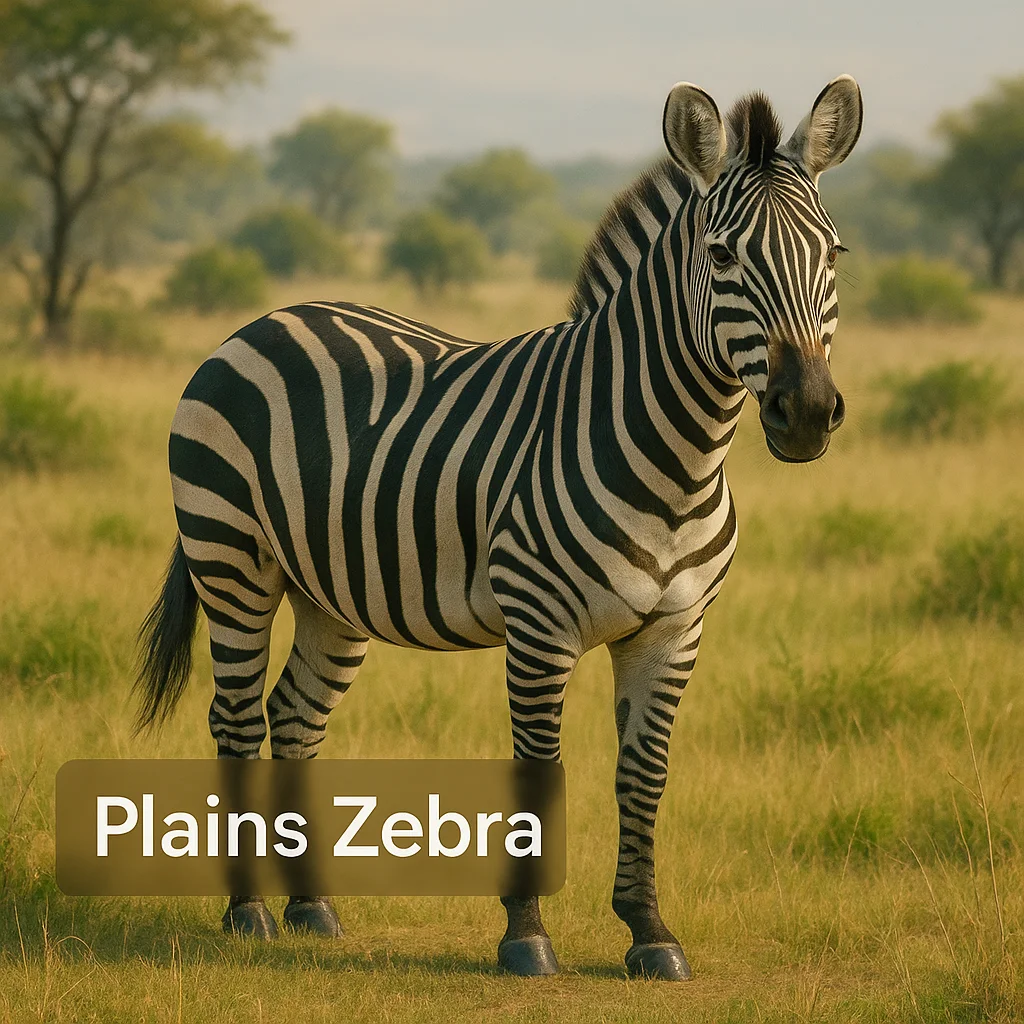
- Common name(s): Plains zebra, Common zebra
- Scientific name: Equus quagga
- Animal type: Mammal
- Typical adult size: 2.3 to 2.5 meters in length, 1.2 to 1.4 meters tall at the shoulder, 175 to 385 kilograms in weight
- Typical lifespan: 20 to 30 years in the wild, up to 40 years in captivity
- Diet type: Herbivore, primarily grazers consuming grasses
- Activity pattern: Diurnal
- Social structure: Group living, often in herds of varying sizes
- Speed / movement highlights: Capable of running at speeds up to 65 km/h
- Intelligence/learning: Known for complex social behaviors and learning ability within the herd
- Primary habitats: Savannas, grasslands, woodlands
- Geographic range: Sub-Saharan Africa
- Predators/threats: Lions, hyenas, leopards, and human pressures like habitat loss
- Conservation status: Near threatened due to habitat fragmentation and hunting
🔍 Identification & Appearance
Plains zebras can be recognized by their barrel-shaped bodies, erect manes, and unique black-and-white striped coats. Each individual has a distinct stripe pattern, which can be used to identify them. Their hooves are hard and capable of withstanding the hard terrain of the savanna.
- Body shape: Stocky with a short neck and rounded body
- Colors/patterns: Distinctive black-and-white vertical striping, varies individually
- Distinctive features: Upright manes, bushy tails with a tuft
- Field signs: Tracks are characterized by heart-shaped hoof prints
- Common look-alikes: Grevy's zebra, differentiated by narrower stripes and a white belly
- Top ID Tips: Look for black stripes on a white body, full body view including legs and tail, distinctive individual patterns
🧱 Body Structure & Physical Adaptations
Adapted to a life on the move across African grasslands, the plains zebra has a robust skeletal structure and muscular legs designed for endurance and speed. Their incisors and molars are perfect for grazing grasses, and their acute hearing and sight are vital for detecting predators.
- Build and proportions: Stocky and muscular, built for speed and stamina
- Teeth: Flat-topped, suited for grinding grasses
- Hooves: Tough and strong, adapted for long marches over hard ground
- Sensory strengths: Strong eyesight especially in open sunlight, good night vision
- Key Adaptations: Stripes may aid in thermo-regulation and protection from biting flies
🌍 Range & Distribution
Plains zebras are predominantly found across the expansive savannas and grasslands of sub-Saharan Africa. Their range includes countries like Kenya, Tanzania, Botswana, Zimbabwe, and South Africa. They are mostly resident species with some local seasonal migrations based on rainfall and vegetation growth.
- Where You Might Find It: Open savannas, grassy plains, woodlands, other open habitats
- Regions: East and southern Africa
- Countries: Kenya, Tanzania, Botswana, Zimbabwe, South Africa
- Biomes: Grasslands and savannas
- Climate Zones: Prefer temperate and tropical zones
🏞️ Habitat & Shelter
Plains zebras prefer open habitats where they can quickly detect predators, commonly found in savannas and open woodlands. During harsh weather conditions, zebras use proximity to riverbanks and forests for shelter. Their presence in specific habitats is closely tied to the availability of grasses.
Knowledge about their habitat preferences helps in understanding their migratory patterns and behavior, essential for conservation efforts as they frequently share these areas with human agricultural interests.
🧭 Behavior & Ecology
Plains zebras are social animals that exhibit complex behaviors and interactions within their herds. They engage in mutual grooming, which strengthens social bonds. Zebras communicate using a variety of vocalizations like barks and brays, as well as non-vocal cues such as ear and tail movements.
They play a vital ecological role as grazers, helping to maintain the grassland habitats, which in turn supports a multitude of other species.
- Behavior Highlights: Social grooming, vocal communications, herd formation
- Role: Key grazing species, crucial for grassland ecosystems
- Interactions: Often form mixed herds with wildebeest and antelope
👥 Social Life & Group Dynamics
Typically found in herds, plains zebras exhibit a social structure that includes stable family groups and transient herds. Family groups consist of a single stallion, several mares, and their young. Stallions are responsible for the defense of the group, while familial bonds are strengthened through grooming rituals.
Group dynamics allow zebras to defend against predators and facilitate successful migration across the African plains.
- Social Structure Notes: Herds, bachelor groups, family bonds
- Cooperation: Mutual care and protection within herds
- Dominance: Lead stallions defend group, resolve conflicts internally
🍽️ Diet, Prey & Predators
As herbivores, plains zebras have a diet consisting primarily of grasses, but they will occasionally consume leaves, bark, and shrubs during scarce periods. Their natural predators include lions, leopards, and hyenas, and they employ grouping and vigilance as primary defenses against such threats.
- Feeding Notes: Primarily grazers, varied grasses
- Key Predators: Lions, hyenas, leopards
- Anti-Predator Defenses: Fleeing, group vigilance
🦌 Hunting, Foraging & Movement
Plains zebras are known for their remarkable endurance and speed in movement. Their locomotion style involves fast gallops, useful both for evading predators and during migration. Zebras typically forage during the day, in short grazing bouts, remaining close to water sources in dry periods.
- Movement & Strategy: Endurance for migration, speed to evade threats
- Navigation: Seasonal migrations follow rainfall and forage availability
🧠 Intelligence & Senses
Plains zebras have developed heightened senses that support their survival on the wild plains. Their sharp eyesight is complemented by an acute sense of hearing, both vital for detecting predators. Zebras also exhibit strong social intelligence, seen in their complex social interactions and vocal communication.
- Notable Abilities: Strong social intelligence, acute sense of hearing
- Senses: Excellent eyesight, effective in open areas
🪺 Reproduction, Pregnancy & Parenting
Breeding for plains zebras can occur at any time of the year, although there may be peaks during the rainy season. They tend to have a polygynous mating system, with a single stallion mating with multiple mares. Mares have a gestation period of approximately 12 to 13 months, usually giving birth to a single foal that is precocial and able to stand and walk shortly after birth. Mares are primarily responsible for nurturing young zebras.
- Reproduction Snapshot: Year-round breeding, longest mating with dominant stallion
- Gestation period: 12 to 13 months, typically one foal
♀️♂️ Male vs Female Differences
Though male and female plains zebras appear similar, males (stallions) are often slightly larger and more heavily built compared to females (mares). Behaviorally, males exhibit more aggressive, territorial behavior, particularly during the breeding season.
- Sex Differences at a Glance: Males larger, more territorial
- Role Differences: Males defend territory/herd
🧬 Subspecies & Variation
The plains zebra includes several recognized subspecies, with variation mostly noted in stripe patterns and the extent of distribution. These subspecies include the Burchell's zebra, Grant's zebra, and others. Differences can be subtle, such as stripe thickness and range overlaps. Classification of subspecies can be debated.
- Variation Notes: Stripe variation among subspecies, debated classifications
⚠️ Threats, Conservation & Human Interaction
Though traditionally abundant, plains zebras face substantial pressures due to habitat loss from agricultural expansion and human settlement. They are also victims of poaching for their skins. Conservation efforts focus on habitat preservation and reducing human-wildlife conflicts. While often seen in zoos and reserves, maintaining their natural behavior in the wild is crucial for their conservation.
- Responsible Notes: Encourage habitat conservation, avoid illegal wildlife trade
- Human interactions: Conflicts over grazing land, monitored interaction to ensure ethical persistence
✨ Fun Facts & Unique Traits
- No two zebras have the same stripe pattern – they're unique like human fingerprints.
- Their stripes may help regulate body temperature and deter biting insects.
- Despite running in large herds, foals recognize their mothers by specific calls and looks.
- Plains zebras can bark, bray, and snort to communicate their mood and warn against predators.
- The social structure of zebras helps them look out for predators, using teamwork.
- Zebras have excellent hearing and night vision, essential for avoiding predators.
- The Great Migration often includes these zebras in massive herds moving across East Africa annually.
📌 Summary
- Identification: Black-and-white stripes, each unique, barrel-shaped body
- Habitat: Prefers open savannas, grasslands, found mainly in sub-Saharan Africa
- Distribution: Broad, covering parts of Kenya, Tanzania, Botswana, Zimbabwe
- Diet: Grazes predominantly on grasses
- Predators: Lions, hyenas, leopards; human impacts—habitat loss
- Social Life: Live in herds, complex social structure, mutual care systems
- Reproduction: Polygynous, usually one foal per gestation lasting over a year
- Key Adaptations: Striped patterns potentially aid in pest control, thermoregulation
- Unique Traits: Known for expansive migrations, intricate vocal communications