🦁 Okapi
🧾 Quick Facts
The Okapi, often dubbed the "forest giraffe," is a rare and intriguing mammal found in the dense rainforests of central Africa. Despite having zebra-like stripes, this elusive animal is actually a relative of the giraffe.
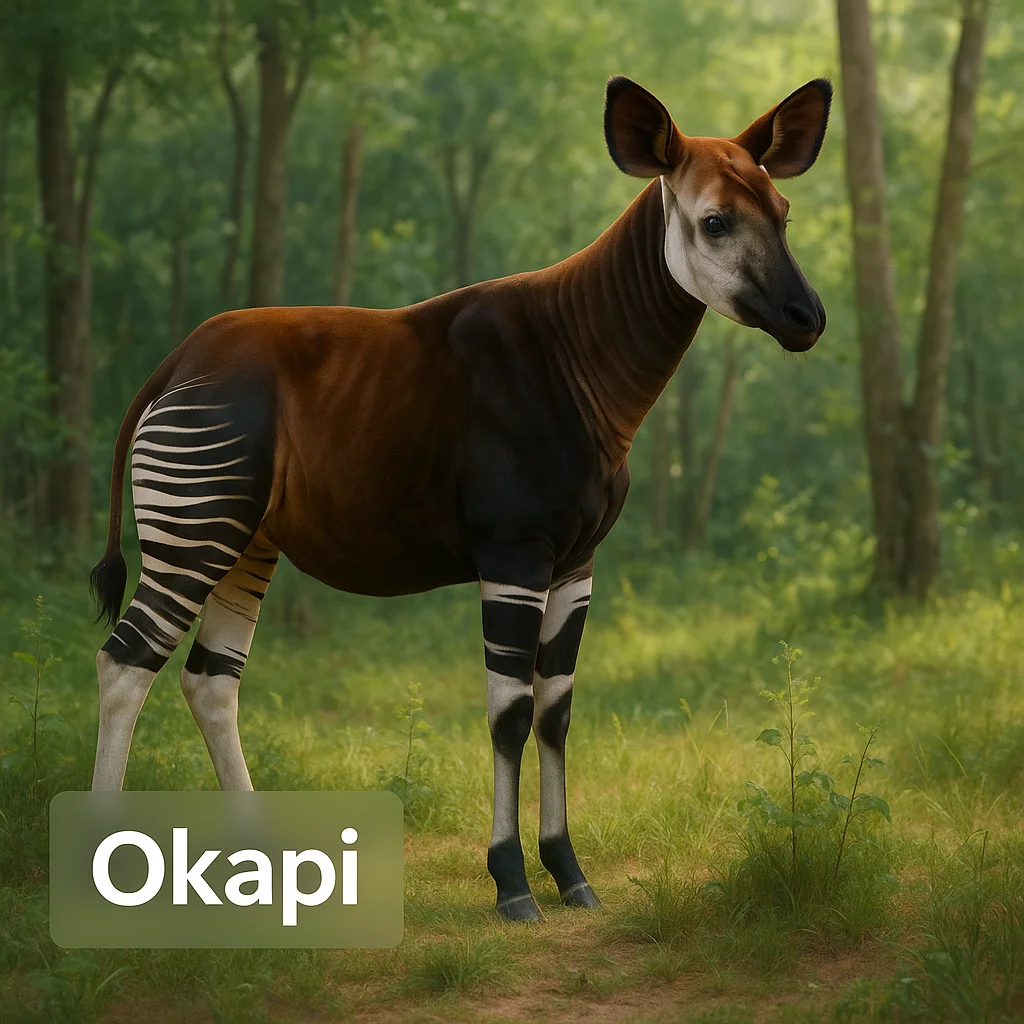
- Common name(s): Okapi
- Scientific name: Okapia johnstoni
- Animal type: Mammal
- Typical adult size: 4.9–6.6 feet (1.5–2 meters) in height, 440–770 pounds (200–350 kg)
- Typical lifespan: 15-30 years (wild and captive)
- Diet type: Herbivore; consists of leaves, fruits, and fungi
- Activity pattern: Mostly diurnal
- Social structure: Solitary
- Speed / movement highlights: Capable of maintaining a quiet, stealthy stride to avoid predators
- Intelligence/learning: Considered intelligent due to adaptability to forest life
- Primary habitats: Dense rainforests
- Geographic range: Central Africa, predominantly the Democratic Republic of Congo
- Predators/threats: Leopards, human-related habitat destruction
- Conservation status: Endangered
🔍 Identification & Appearance
Recognizing an Okapi is an unforgettable experience, thanks to its unique appearance that blends traits of both giraffes and zebras. Its body is stocky yet elegant, with a deep chest and a sloping back. The legs are adorned with striking horizontal white stripes against a black background, reminiscent of a zebra.
- Robust body with a deep chest and sloping back
- Rich, dark brown coat with an oily sheen
- Zebra-like stripes on legs and hindquarters
- Large ears that provide excellent hearing
- Long neck, shorter than a giraffe, aiding foliage feeding
- Head features a long, flexible, dark tongue
- Tapered, muscular legs suitable for moving through dense vegetation
- Tail has a tuft of long hair at the end
- Individuals may have slight variations in stripe patterns
- Hoof prints resemble cloven tracks
🧱 Body Structure & Physical Adaptations
The Okapi's body structure is finely tuned for life in the rainforests. Its stocky build and muscular limbs allow it to navigate the forest floor efficiently. The skin produces a natural oily substance that acts as a waterproof barrier, and its long, sticky tongue is perfect for grasping leaves.
- Stocky build to maneuver through underbrush
- Flexible tongue for grasping leaves and cleaning ears
- Large ears for acute hearing capabilities
- Hooves adapted for soft, muddy terrain
- Vision adapted for low light levels in dense forests
- Flat molars to grind vegetation
- Short neck compared to giraffes but still aids foraging
- Robust coat adapted for humid climates
- Efficient in conserving water and minerals
🌍 Range & Distribution
The Okapi is endemic to the Democratic Republic of Congo, dwelling primarily in the Ituri Forest. This area provides the dense cover and plentiful foliage that the species requires. They do not typically migrate but may move seasonally within their range to find food.
- Central Africa main residence
- Predominantly the Democratic Republic of Congo
- Inhabits the Ituri, Aruwimi, and Wamba regions
- Presence reported in some adjacent regions
- Most abundant in protected forest zones
- Resistant terrains include lowland rainforest areas
- Adapted to mid-elevation and dense vegetation areas
- Does not migrate; mostly resident species
🏞️ Habitat & Shelter
The Okapi thrives in dense rainforests, particularly areas with abundant foliage and a canopy for protection. They prefer environments where they can easily hide from predators and have access to a rich variety of plants.
Seasonal behaviors in these forests depend on rain patterns, influencing the availability of specific plant foods. Understanding their habitat is crucial as it allows researchers to assess how environmental factors affect their survival and breeding.
🧭 Behavior & Ecology
Okapis are solitary creatures, leading tranquil lives hidden in thick vegetation. Despite their calm demeanor, they display alertness by rotating their large ears to detect threats. Communication is mainly through scent marking and some vocalizations to signify territory or alert to danger.
- Primarily solitary, avoids long-term group living
- Scent-mark areas to denote territories
- Minimal vocal communication; primarily between mother and calf
- Active during daylight, especially dawn and dusk
- Spends much time feeding and patrolling territory
- Plays a vital role in forest ecology as a seed disperser
- Adjusts behavior according to human presence and natural threats
- Rarely seen, uses camouflage and stealth to avoid predators
- Vital ecological role as seed dispersers and plant community promoters
👥 Social Life & Group Dynamics
Though primarily solitary, Okapis occasionally form casual, non-permanent groups, especially female and calf pairs. Mothers provide care and protection to offspring, creating temporary bonds until the calf matures.
- Solitary by nature, minimal interaction with others
- Temporary mother-calf bond is significant
- No strict hierarchy; little conflict due to solitary lifestyle
- Minimal cooperation except parental investment
- Territory overlap more common in females
- Sibling interaction rare and usually fleeting
- Dispersal of young happens post-maturation
🍽️ Diet, Prey & Predators
Okapis are herbivorous, thriving on a diet rich in foliage, fruits, and fungi. Their selective feeding influences the vegetation dynamics of their ecosystem. Natural predators include leopards, which hunt using their stealth.
- Diet consists mainly of leaves and fruits
- Mainly browse on tree leaves rather than grass
- Long, prehensile tongue aids in selecting food
- Consume clay for mineral supplementation
- While predators include leopards and humans, survival strategies involve stealth and camouflage
- Scavenging rare; rely almost exclusively on fresh vegetation
🦌 Hunting, Foraging & Movement
The Okapi moves with a slow, deliberate gait that helps it stay stealthy in dense forests, essential for avoiding detection by predators. They forage with great care, often standing still for long periods to blend in with their surroundings.
- Forages by day, mainly early morning and late afternoon
- Employs slow and quiet movements to avoid predators
- Home range is large but often explored at leisure
- Displays incredible agility despite its size
- Prefers shaded areas of the forest for movement
- Possesses no migratory habits
🧠 Intelligence & Senses
Okapis exhibit a keen sense of hearing and olfaction, allowing them to sense danger quickly. Their intelligence shines through their ability to navigate complex forest environments and remember locations where food is abundant.
- Strong memory aids in navigation within dense forests
- Sensitive to sounds due to large ear size
- Displays adaptability in tree-dense environments
- Senses used extensively for mate selection and predator avoidance
- Status and territorial recognition rely on scent detection
🪺 Reproduction, Pregnancy & Parenting
Breeding occurs year-round, with courtship involving vocal calls and scent markings. The gestation period for Okapis is around 14.5 months, leading to the birth of a single calf.
Calves are born relatively mature (precocial) and can stand shortly after birth. Mothers solely nurture their young until independence.
- Non-seasonal breeders; capable of reproducing year-round
- Polygynous mating system predominates
- Gestation lasts approximately 440–450 days
- Calves begin foraging within weeks of birth
- Females invest heavily in calf rearing; males contribute via territorial protection
♀️♂️ Male vs Female Differences
Okapi males and females are similar in appearance; however, males typically possess ossicones, which are small, skin-covered horn-like protuberances on the head. Otherwise, sexual dimorphism is limited due to their solitary nature.
- Males have ossicones while females lack these prominences
- Size variations are minimal between genders
- Roles in reproduction mainly differ; females actively raise offspring
- Both genders are involved in territorial marking, primarily through scent
- Both employ similar stealth strategies
🧬 Subspecies & Variation
The Okapi is often considered a monotypic species, meaning it does not have any subspecies. Any variations usually result from environmental adaptations or individual genetic differences without affecting overall morphological or behavioral traits.
- No officially recognized subspecies
- Minor genetic variations known
- Environmental adaptations in local populations noted
- General consensus favors single species classification
⚠️ Threats, Conservation & Human Interaction
The Okapi faces numerous threats, including habitat destruction due to logging and agriculture. Moreover, illegal hunting and poaching contribute to their declining numbers. Conservation efforts focus on habitat protection and anti-poaching measures.
- Endangered status calls for urgent conservation
- Efforts support protected forest areas
- Coexistence requires careful management of human activities in forest areas
- Threats include habitat loss and illegal hunting
- Engagement with local communities is crucial for enforcement
✨ Fun Facts & Unique Traits
- Despite zebra-like stripes, it is closer to giraffes
- Its tongue is long enough to clean its eyes
- Only discovered by Western science in 1901
- Each individual's stripe pattern is unique
- The species name honors Sir Harry Johnston
- Okapis were historically unrecognized by local communities as existing animals
📌 Summary
- Stocky, giraffe-like body with zebra-like stripes
- Found in the dense forests of the Democratic Republic of Congo
- Herbivores, relying heavily on tree leaves and fruits
- Solitary by nature, mothers care for calves
- Non-seasonal breeders with extended gestation
- Exhibit unique visual and olfactory adaptations
- Face significant conservation challenges due to habitat loss
- A remarkable ecological role as seed dispersers