🦁 Lowland Tapir
🧾 Quick Facts
The Lowland Tapir, an intriguing creature of South America's lush terrains, is noted for its unique features and ecological importance. Often elusive and remarkable, these mammals fascinate wildlife enthusiasts and researchers alike.
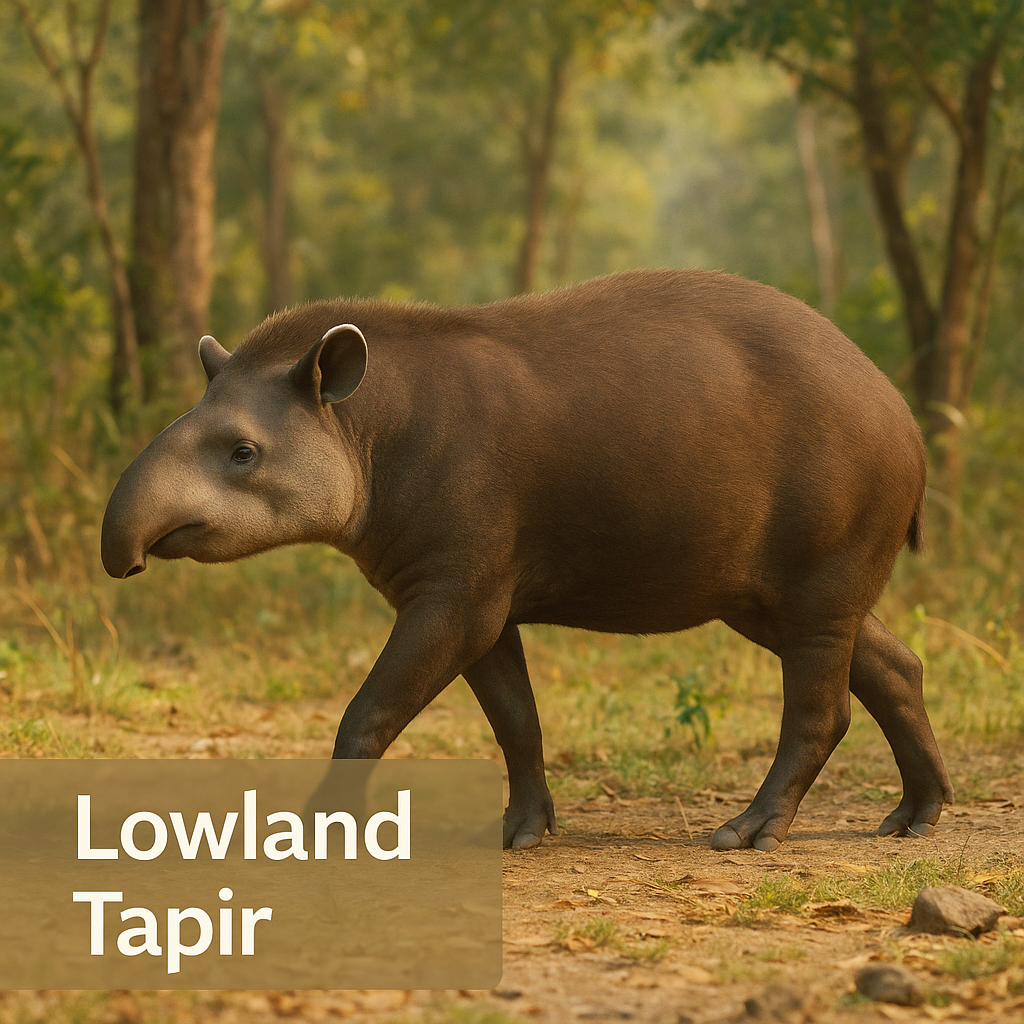
- Common name(s): Lowland Tapir, Brazilian Tapir
- Scientific name: Tapirus terrestris
- Animal type: Mammal
- Typical adult size: 180-240 cm in length, 90-110 cm in height, weighing 150-300 kg
- Typical lifespan: 25-30 years in the wild, potentially longer in captivity
- Diet type: Herbivore; feeds on fruits, leaves, branches, and aquatic plants
- Activity pattern: Primarily nocturnal
- Social structure: Solitary, except for mothers with young
- Speed / movement highlights: Capable of short bursts of speed; adept swimmer
- Intelligence/learning: Known for adaptability and problem-solving
- Primary habitats: Forests, grasslands, and wetlands
- Geographic range: Predominantly South America, east of the Andes
- Predators/threats: Jaguars, pumas, human impacts (habitat loss, hunting)
- Conservation status: Vulnerable, varies by region
🔍 Identification & Appearance
The Lowland Tapir can be easily recognized by its distinctive shape and features. With a rounded, stout body and a noticeably short trunk, it stands out among the forest dwellers. Its coarse, bristly fur is typically a dark brown to gray, which helps it blend into the underbrush. Younger tapirs often have stripes and spots for camouflage.
Telling the Lowland Tapir apart from similar species, such as other tapirs, can be done by observing its larger size and the absence of a white-tipped ear or crest, which are present in other tapir types.
- Short trunk used for grabbing foliage and fruits
- Thick, dark brown fur
- Young have distinctive stripes and spots for camouflage
- Large, rounded body with relatively short legs
- Short tail often hidden within its fur
- Distinctive, non-prehensile nose trunk
- Four toes on front feet and three on the back
- Elongated face and large, expressive eyes
🧱 Body Structure & Physical Adaptations
The Lowland Tapir's robust physique is an adaptation suited for its dense habitat. Its stout build with sturdy limbs allows it to navigate difficult terrains, while its unique trunk-like upper lip aids in feeding. The tapir’s molars are well-developed to process tough vegetation.
- Sturdy limbs for traversing dense forest floors
- Adapted molars for grinding leaves and fibrous plants
- Nose trunk aids in reaching high or distant food sources
- Thick skin offers some protection from predators
- Proportioned body aids in swimming
- Acute sense of smell for locating food and identifying threats
- Moderate hearing, shuns loud disturbances
🌍 Range & Distribution
The Lowland Tapir is native to various parts of South America, prominently found across the Amazon Basin and surrounding rainforests east of the Andes. This range extends from Venezuela to northern Argentina, crossing diverse countries and numerous ecosystems.
The Lowland Tapir generally stays under 2000 meters in elevation, preferring the humid and temperate climate zones of tropical forests and wetlands where its primary food sources thrive.
- Mostly found in the Amazon Basin
- Range includes parts of Brazil, Venezuela, Argentina, and Colombia
- Thrives in tropical and subtropical lowland forests
- Also occupies moist grasslands and Amazonian marshwater
- Typically inhabits regions below 2000 meters
🏞️ Habitat & Shelter
Lowland Tapirs favor environments with abundant water sources, such as flooded forests and riparian zones. They require dense vegetation for cover and access to a diverse supply of foliage for feeding. During dry spells, tapirs may travel to find water, displaying great adaptability to changing ecosystems.
Understanding the tapir's habitat is crucial since these conditions influence behaviors like breeding, feeding, and movement patterns. Protection of these habitats is essential for their sustainability and survival.
🧭 Behavior & Ecology
Lowland Tapirs are primarily nocturnal, retreating to shaded areas during daytime to avoid predators and conserve energy. Grooming is pivotal, often involving rubbing against rocks or trees. They maintain territories through scent marking and have been known to flee into water when threatened.
As essential seed dispersers, tapirs play a major role in their ecosystems, promoting plant biodiversity. They also interact indirectly with top predators like jaguars, influencing population dynamics in their habitats.
- Territorial, using scent marking to define home ranges
- Solitary, except during mating or raising young
- Vocalizations include whistles and clicks
- Reacts to threats with swimming or fleeing into dense cover
- Vital seed disperser, affecting vegetation composition
👥 Social Life & Group Dynamics
Generally solitary, lowland tapirs occasionally interact during mating or while mothers care for their young. These relationships are temporary, with no stable groups beyond mother-offspring pairs. Mating encounters lack complexity and are brief.
In terms of conflict, tapirs avoid physical confrontation, opting for avoidance. Any perceived control in habitats stems from knowledge and scent rather than physical dominance.
- Primarily solitary animals
- Mothers care for calves until they are semi-independent
- Limited social structures, mostly non-territorial
- No complex hierarchies or group dynamics
- Encounters with others are random and often short-lived
🍽️ Diet, Prey & Predators
The Lowland Tapir's diet is remarkably varied, relying on fruits, leaves, and aquatic vegetation. Seasonally, it adjusts its diet based on availability, showcasing flexibility in response to its habitat.
Predators include big cats like jaguars and pumas. To evade threats, tapirs utilize water as an escape route and rely on their hearing and smell to detect danger early.
- Eats a wide variety of vegetation
- Seasonal dietary adjustments based on food availability
- Natural dangers consist mainly of jaguars and pumas
- Utilizes dense underbrush and water for safety
- Calves are more vulnerable; adults are generally secure in habitats
🦌 Hunting, Foraging & Movement
As herbivores, lowland tapirs foraging in nocturnal hours, exploiting both land and water sources. Their ambulation in dense forests highlights short yet flexible escapes while feeding.
Swimming is an integral aspect of tapir mobility, aiding in both predator evasion and foraging efficiency in aquatic plants.
- Nocturnal foragers, covering ground and aquatic plant areas
- Adept swimmers, often use waterways for movement
- Not precise runners but can rapidly move in short bursts
- Non-territorial, cover extensive areas in regular foraging trips
🧠 Intelligence & Senses
Lowland Tapirs demonstrate a pragmatic intelligence level, as seen in their sensitivity to environmental changes. They effectively use their keen olfactory sense for foraging and predator awareness.
Understanding external threats, tapirs avoid danger through smell and sound detection, rather than relying on bluffing or confrontation.
- Keen sense of smell for detecting predators and navigating
- Strong memory of local resources and danger zones
- Problem-solving evident in foraging strategies
- Adaptations in behavior according to learned experiences
🪺 Reproduction, Pregnancy & Parenting
Breeding typically occurs year-round with peaks influenced by preferred food availability. Tapirs tend to be polyandrous, with casual partnerships lacking elaborate courtship rituals. After a gestation period of around 13 months, a single calf is born.
Mothers take active nurturing roles alone, safeguarding in dense terrain for a slow, steady yearlong child-rearing period.
- Gestation lasts approximately 13 months
- Single calf born per reproductive event
- Calves gain independence slowly, staying with mothers for up to a year
- Reproduction is relatively consistent year-round
- Breeding is influenced by food resource availability
♀️♂️ Male vs Female Differences
Differences between male and female lowland tapirs are subtle, primarily distinguished by size and reproductive behavior. Males are slightly more robust but have similar coloration and features to females.
This limited sexual dimorphism indicates that physical appearance differences are minimal compared to other species. Territoriality and dominance are not evident in either gender.
- Males generally larger, heavier than females
- No pronounced differences in coloration or body structure
- Behavioral roles are identical apart from parenting
- Both participate similarly in foraging and basic survival
🧬 Subspecies & Variation
There is limited distinct subspecies within the Lowland Tapir, although regional variations in size or coloration may occur. Typically attributed to environmental adaptations, these differences are not often recognized as formal subspecies.
Potentially seen in varying sizes in subtropical versus tropical sponsors; understanding these distinctions requires careful, ongoing research.
- Debate on distinct subspecies classification
- Some size variation across geographic regions
- No official subspecies, hues may slightly vary
- Localized adaptations due to specific climate/terrain
⚠️ Threats, Conservation & Human Interaction
Lowland Tapir populations face numerous threats; primarily habitat destruction, as well as illegal hunting. Conservation efforts focus on combating these issues, emphasizing habitat preservation as vital.
Interaction with humans generally arises in non-hostile forms, such as research or ecotourism. However, close human interaction can be detrimental unless managed with respect for the species’ natural behavior.
- Conservation efforts prioritize habitat protection
- Human encroachment and hunting pose significant pressures
- Coexistence depends on minimizing habitat conflict
- Engagement in ecotourism can spread tapir awareness
✨ Fun Facts & Unique Traits
- Lowland Tapirs have been around since the Eocene, making them living fossils
- Their swim and dive abilities rival those of aquatic mammals
- They play a key role in seed dispersal, aiding forest regeneration
- Called the "gardeners of the forest" owing to their ecological role
- Despite their shy nature, tapirs are crucial for biodiversity
- Their fossils reveal they have changed little over millions of years
📌 Summary
- Identification: Stout body, dark fur, distinctive short trunk
- Habitat: Prefers lowland forests, wetlands with water access
- Distribution: Primarily found in South America's tropics
- Diet: Herbivore; consumes a diverse vegetation range
- Predators: Jaguars and pumas are main threats
- Social Life: Mainly solitary, aside from maternal bonds
- Reproduction: Single calf, mother cares for nearly a year
- Adaptations: Excellent swimmer and seed disperser
- Unique Traits: Long evolutionary history as ecological gardeners