🦁 Greater Kudu
🧾 Quick Facts
The Greater Kudu, widely recognized for its majestic spiraled horns and striking appearance, is a significant species within the African savannah ecosystems. As a larger antelope, its graceful yet powerful build embodies both beauty and agility.
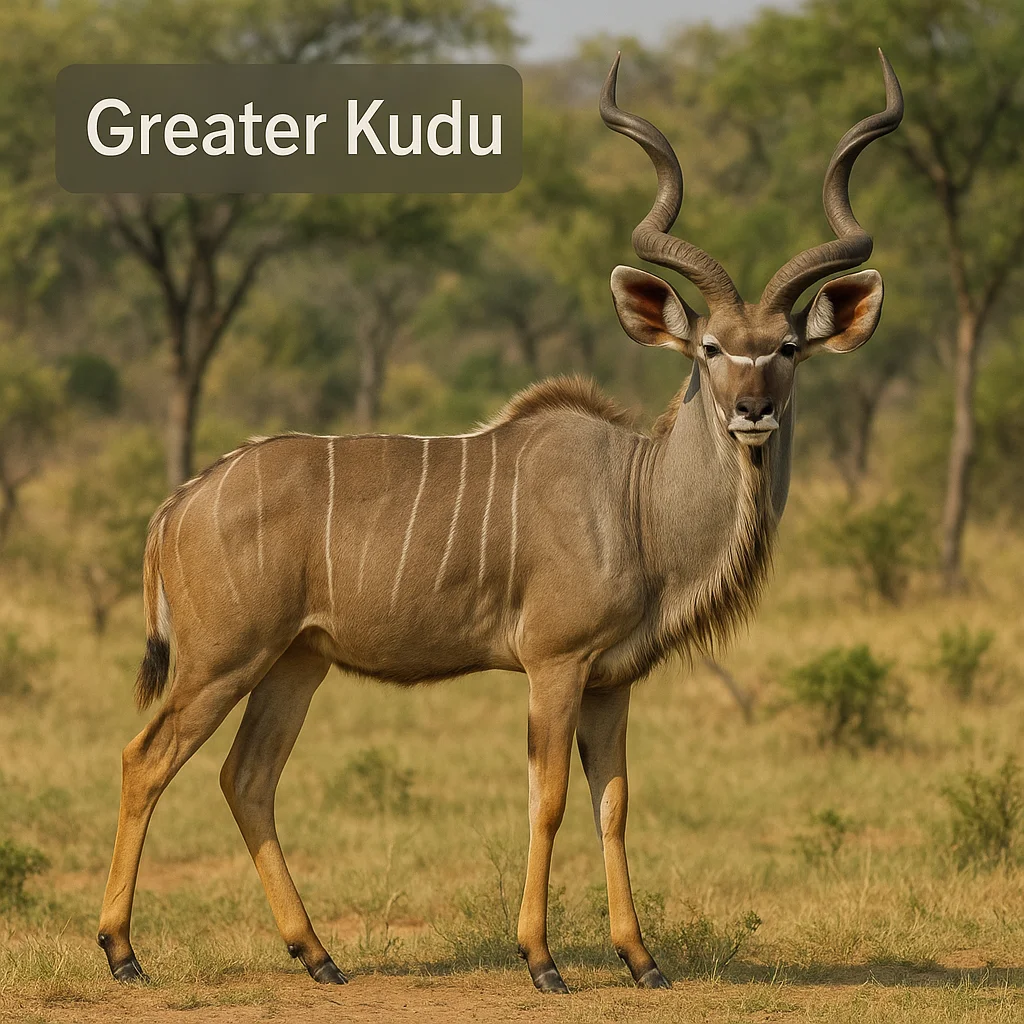
- Common name(s): Greater Kudu
- Scientific name: Tragelaphus strepsiceros
- Animal type: Mammal (antelope)
- Typical adult size: 1.3–1.5 meters at shoulder; males 190–270 kg, females 120–210 kg
- Typical lifespan: 7–8 years in the wild; up to 20 years in captivity
- Diet type: Herbivore; leaves, grasses, fruits, and shoots
- Activity pattern: Crepuscular; most active during early morning and late afternoon
- Social structure: Loose groups; females in herds, males often solitary or in bachelor groups
- Speed / movement highlights: Can run up to 60 km/h; excellent jumpers
- Intelligence/learning: Known for keen sense of awareness in avoiding predators
- Primary habitats: Savannas, woodlands, and lowland bush areas
- Geographic range: Sub-Saharan Africa, particularly southern and eastern regions
- Predators/threats: Lions, leopards, wild dogs, and human hunting
- Conservation status: Least Concern, but habitat destruction poses risks
🔍 Identification & Appearance
Recognizing the Greater Kudu involves focusing on its distinctive physical features and natural markings. Males are known for their majestic spiral horns, which can extend up to 1.8 meters long. Their coat is a sleek blue-gray to tawny, adorned with 6–10 vertical white stripes running down the flanks. In contrast, females lack the horns and are slightly smaller.
Both sexes have a pronounced fringe of white hair along their throats and large ears that enhance their auditory senses. Their tracks are pointed and elongated, typical of antelope species.
- Vivid white stripes across the sides
- Males have long, spiraled horns
- Females lack horns
- Large, expressive ears
- Sleek, muscular build
- Fringe of white hair on the throat
- Distinct white band between the eyes
- Tawny to blue-gray coat
🧱 Body Structure & Physical Adaptations
The Greater Kudu showcases a body structure finely tuned to its environment. Its long legs and robust muscles facilitate rapid bursts of speed and agile jumps to evade predators. The horns, used primarily by males during mating displays and skirmishes, grow in a striking spiral pattern.
Their dentition is adapted to a browsing diet, with flat-topped molars designed for grinding fibrous plant material. They possess acute hearing, aided by large, rotatable ears, while their vision and smell are also highly developed to detect predators.
- Slender and powerful body build
- Spiral horns for social and defensive purposes
- Teeth adapted for chewing toughest plant matter
- Highly efficient diet digestion
- Excellent hearing due to large, sensitive ears
- Strong legs suited to jumping and running
- Keen eyesight and sense of smell
🌍 Range & Distribution
The Greater Kudu's range broadly covers the eastern and southern regions of Africa. From the woodlands of South Africa to the bushlands of Tanzania, these antelope thrive in diverse terrains that offer a mix of vegetation for browsing. Though typically found at lower elevations, kudu are adaptable and can sometimes be located in mountainous areas bordering their normal habitats.
- Southern Africa: Botswana, Namibia, Zimbabwe, South Africa
- East Africa: Kenya, Tanzania
- Preferentially woodlands and savannas
- Possible in transitional bushlands
- Inhabits both protected and non-protected areas
🏞️ Habitat & Shelter
Greater Kudus are predominantly found in savannas and woodlands where they can effortlessly forage amid varying undergrowths. They rely on dense bushlands and thickets for concealment, using these areas for resting and evading predators. Seasonal variations like the wet and dry seasons influence their migratory movements within their range, often in search of sustainable food supplies.
Understanding habitat preferences is integral to gauging kudu movement, predator avoidance tactics, and dietary needs within their ecological niche.
🧭 Behavior & Ecology
The Greater Kudu leads a reserved lifestyle, mostly avoiding the midday heat by resting in shaded areas. They groom themselves and each other to maintain social bonds within herds. Communication is primarily non-verbal, involving body movements and occasionally vocal tones.
As essential browsers, they impact vegetation patterns and act as a prey species for larger carnivores, playing a critical role in their ecosystems.
- Rest in sheltered areas during the heat
- Grooming strengthens social interactions
- Browsers affecting local vegetation
- Quiet and cautious in detecting threats
- Contributes to the food chain as prey
- Non-verbal communication with body signals
👥 Social Life & Group Dynamics
The social structure of Greater Kudus is primarily determined by sex and age. Females and their young typically form herds that serve as protection against predators. Males usually prefer solitary lives or form small bachelor groups. The hierarchy in such groups, when they do occur, is fluid with periodic skirmishes to establish dominance especially during the breeding season when competing for mates.
- Females often in larger herds
- Males prefer solitude or bachelor groups
- Seasonal male-male competition
- Mothers with calves form strong bonds
- Dominance shifts with breeding cycles
🍽️ Diet, Prey & Predators
As herbivores, Greater Kudus primarily consume a diet rich in leaves, shoots, and sometimes fruits, adjusting their intake based on seasonal availability. During dry periods, they browse acacias and shrubs for moisture-rich intake. Their chief predators include lions, leopards, and occasionally spotted hyenas, requiring them to be constantly alert and utilize their habitat effectively to avoid detection.
- Seasonal diet adaptations
- Leafy and shrub-rich diet
- Lions and leopards as main predators
- Alertness and concealment are key defenses
- Careful foraging to maximize nutrient intake
- Herbivory influences local plant species
🦌 Hunting, Foraging & Movement
Greater Kudus are adept foragers and excellent leapers, moving gracefully across their terrain. They often forage during dawn and dusk, taking advantage of lower temperatures and reduced predator activity. Their coloration provides camouflage amidst the bush, and they often stand still to avoid detection when predators are near.
- Forages during cooler twilight hours
- Adept at navigating varied terrain
- Camouflage helps avoid predators
- Utilizes bush as both food and shelter
- Efficient coordination and balance
- Seasonal movement dictated by forage availability
🧠 Intelligence & Senses
While not typically regarded as highly intelligent, Greater Kudus demonstrate instinctive and tactical awareness when avoiding threats. Their sensory capabilities, particularly their hearing, enable them to detect danger from a significant distance. Despite limited specific studies on problem-solving, their survival success hints at an adaptive behavior that involves a keen sense of their environment.
- Acute sense of hearing
- Highly adaptive to environmental changes
- Instinctive in avoiding predators
- Limited specific studies on problem-solving
- Utilize terrain for safety
- Behavioral adaptability to different threats
🪺 Reproduction, Pregnancy & Parenting
Breeding occurs year-round but peaks towards the end of the rainy season. The mating system is polygynous, with males often competing for females through displays of horn sprawling. The gestation period lasts approximately 8 months, yielding typically one calf that is nursed and hidden in dense cover initially. Mothers are the primary caregivers, although calves can form nursery groups under supervision.
- Polygynous mating system
- 8-month gestation period
- Usually one calf per birth
- Females mate seasonally after rain
- Mothers conceal calves initially
- Nursery groups offer protection
♀️♂️ Male vs Female Differences
The most notable difference between male and female Greater Kudu is the presence of long, spiraled horns in males. Males are also generally larger and exhibit more robust muscular development compared to females, who tend to be more adept in forming herd dynamics for calf protection.
- Males have spiraled horns, females do not
- Males are generally heavier and larger
- Females more social, form protective herds
- Behavioral roles differ in mating displays
- Both sexes have similar coloration
🧬 Subspecies & Variation
There are recognized subspecies of the Greater Kudu, primarily differentiated by geographic and phenotypic variations like horn length and stripe patterns. These differences result from local adaptations to specific ecological niches. Subspecies classification can sometimes be debated, requiring further genetic studies for clarification.
- Southern vs eastern kudu subspecies
- Variability in horn length and corkscrew pattern
- Stripe number and width can vary
- Ecological niche adaptations
- Subspecies classification debated
⚠️ Threats, Conservation & Human Interaction
While the Greater Kudu is currently listed as Least Concern by conservation authorities, it faces multiple threats ranging from habitat loss due to agricultural expansion to hunting pressures. Although targeted by poaching in some regions, conservation programs strive to ensure sustainable population levels. Public awareness and legal protections are vital to its long-term stability.
- Habitat loss due to agriculture
- Illegal hunting pressure
- Protected in wildlife sanctuaries
- Human-wildlife conflict management needed
- Conservation status varies regionally
✨ Fun Facts & Unique Traits
- A male's horns start spiraling after 6–12 months and fully form around six years.
- Excellent at jumping over obstacles up to 2 meters high.
- Known for a quiet yet distinct bark that signals alarm.
- Can survive long periods without direct water sources, deriving moisture from food.
- Form "nursery herds" for protective communal calf care.
- Grooming plays a crucial role in social bonding within female groups.
📌 Summary
- Recognizable for their spiral-horned males and striking stripes
- Inhabit East and Southern African savannas and woodlands
- Diet primarily consists of leaves, with ecological roles as browsers
- Predators include lions and leopards
- Social structures vary, with female herds and solitary males
- Breeding peaks post-rainy season, with single calf births
- Key adaptations include keen senses and adept mobility
- Significant for maintaining their habitat's ecological balance