🦁 Black Rhinoceros
🧾 Quick Facts
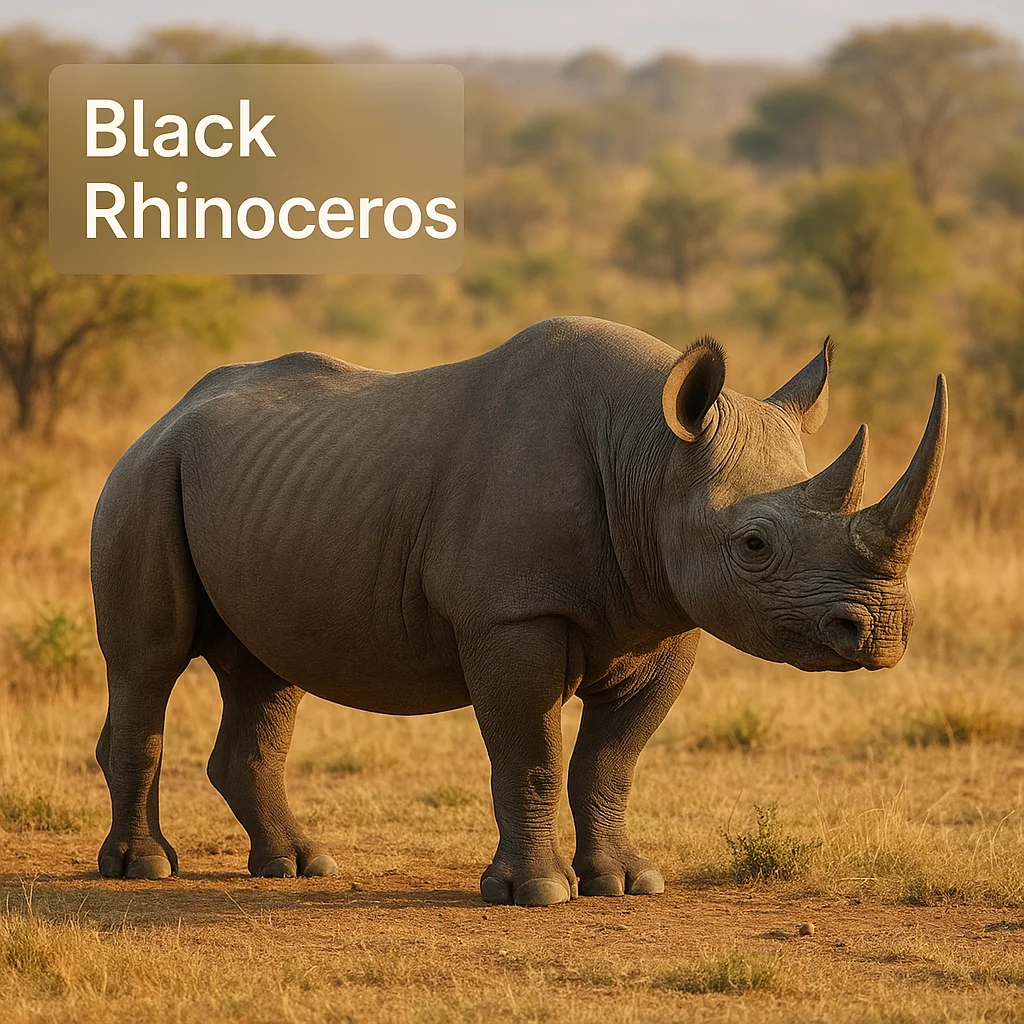
The Black Rhinoceros, known for its iconic horn, is a large, herbivorous mammal often found in Africa's savannas and bushlands. Despite its name, its color varies and is not necessarily black.
- Common name(s): Black Rhinoceros
- Scientific name: Diceros bicornis
- Animal type: Mammal
- Typical adult size: 3 to 3.75 meters in length, weighing 800 to 1,400 kg
- Typical lifespan: 35 to 50 years in the wild
- Diet type: Herbivore; eats leaves, branches, shoots, and fruits
- Activity pattern: Mostly crepuscular and nocturnal
- Social structure: Solitary, except for mothers with calves
- Speed / movement highlights: Can run up to 55 km/h
- Intelligence/learning: Known for good memory and problem-solving abilities
- Primary habitats: Savanna, bushland, woodlands
- Geographic range: Eastern and Southern Africa
- Predators/threats: Mainly humans; natural predators include lions and hyenas for young calves
- Conservation status: Critically Endangered
🔍 Identification & Appearance
Black Rhinoceroses are recognized by their prehensile upper lip, which helps them feed. Their body is large and powerful, with thick grayish to brown skin that can appear darker due to mud wallows. They have two horns, the front one being more prominent.
- Silhouette: Stocky build with a pronounced humped back
- Colors/patterns: Gray to brown, varies with mud coverings
- Distinctive features: Two horns, prehensile upper lip, thick skin folds
- Field signs: Footprints with three toes, dung piles marking territory
- Common look-alikes: White rhinoceros, which has a square lip
- Look for a hook-shaped lip
- Front horn longer than the second
- Thick skin folds on the body
- Smaller size compared to white rhinoceros
- Body posture is more upright
- Ears constantly moving to detect sounds
- Top ID Tips:
🧱 Body Structure & Physical Adaptations
The Black Rhinoceros is built for strength rather than speed. Its limbs are sturdy, suited for supporting its heavy body, and its horns are used for defense and foraging. Its senses are adapted for its lifestyle, possessing an acute sense of smell and hearing.
- Build: Stocky and robust
- Teeth: Molars adapted for grinding vegetation
- Hooves: Three-toed for stability on varied terrain
- Sensory strengths: Excellent smell and hearing; poor eyesight
- Prehensile lip for grasping foliage
- Thick skin protects against thorns
- Specialized molars for a herbivorous diet
- Powerful neck muscles to support horn strikes
- Capable of running short distances quickly
- Ears rotate to pick up sounds from different directions
- Key Adaptations:
🌍 Range & Distribution
The Black Rhinoceros is primarily found in parts of Eastern and Southern Africa, inhabiting countries such as Kenya, Tanzania, Namibia, and Zimbabwe. They occupy a range of habitats from savannas to bushlands.
- Where You Might Find It:
- National parks in Kenya and Tanzania
- Namibian desert edges
- Southern African bushveld
- Zambezi basin areas
- Mixed arid savannas
- Sparse shrubland near waterholes
- Seasonally dry regions
- Low to medium altitudes
🏞️ Habitat & Shelter
The Black Rhinoceros thrives in a variety of habitats including savannas, bushlands, and wooded areas. It seeks shelter under trees or in mud wallows, which also help regulate body temperature and deter parasites.
Understanding its habitat is crucial as it impacts its behavior, such as movement patterns and feeding. During dry seasons, these rhinos stay near water sources, while in wetter periods, they can roam more freely.
🧭 Behavior & Ecology
Black Rhinoceroses are mostly solitary. Their daily activities involve foraging during dawn and dusk, often using their sharp sense of smell to locate food. They mark territories using dung piles and by spraying urine.
- Resting in the shade during the day
- Use vocalizations and body gestures for communication
- May charge when threatened
- Act as significant grazers, controlling vegetation
- Scent marking for territory boundary setting
- Occasional waterhole visits
- Compete with other herbivores for food
- Strong territorial instincts
- Mud wallowing for skin health
- Agility surprising for size
- Social bonds primarily between mothers and calves
- Occasional confrontation with other rhinos
- Behavior Highlights:
👥 Social Life & Group Dynamics
Black Rhinoceroses are largely solitary, maintaining individual territories. However, mothers are highly protective of calves and will aggressively defend them against threats. Social interactions are mostly limited to mating or occasional encounters at water sources.
- Solitary but tolerant of overlap at waterholes
- Maternal bonds last up to three years
- No traditional herd structures
- Cows with calves form temporary associations
- Conflict resolved by threats instead of physical combat
- Occasional social interactions with other species
- Female territory smaller than males
- Males may be more aggressive
- Flexible social structure with environmental changes
- Calves stay with mothers until weaned
- Nocturnal activities promote solitary lifestyle
- Social Structure Notes:
🍽️ Diet, Prey & Predators
As herbivores, Black Rhinoceroses consume a wide variety of plant materials including leaves, twigs, and fruits. Their diet shifts with seasonal changes, aligning with the availability of vegetation. They have few natural predators; young rhinos can be vulnerable to lions and hyenas.
- Consumes over 50 plant species
- Typically feeds in early morning or late afternoon
- Uses prehensile lip to grasp twigs
- Can browse high due to body posture
- Thorny bushes and succulent plants are dietary staples
- Roots and tubers in dry season
- Uses non-verbal threats for predator deterrence
- Height helps with foliage access
- Diverse plant diet ensures nutrition
- Diet prevents over-browsing
- Nocturnal feeding reduces heat stress
- Seasonal adaptability essential for survival
- Feeding Notes:
🦌 Hunting, Foraging & Movement
The Black Rhinoceros is primarily a browser, foraging for food during cooler parts of the day. They travel considerable distances to find resources, following habitual paths. Although not migratory, they have a well-defined home range that they know well.
- Primarily browsing with limited grazing
- Adapted to moving over rough terrain
- Favors ambush terrain for rest
- Browses using prehensile lip
- Moves quietly with slow, deliberate steps
- Potentially runs swiftly when threatened
- Home range sizes can vary widely
- Prefers dense underbrush for concealment
- Adjusts browsing height naturally
- Can navigate rocky terrain
- Path following promotes resource consistency
- Partial home range overlap with others
- Movement & Strategy:
🧠 Intelligence & Senses
Black Rhinoceroses are intelligent creatures with excellent memory, especially in relation to their home territories. They rely heavily on their acute sense of smell and hearing for navigation and spotting dangers, compensating for their poor eyesight.
- Peers closely to inspect unknown objects
- Scent trails aid in territory recognition
- Advanced auditory faculties detect predators
- Memory helps avoid past dangers
- Instinctual learning evident in foraging
- Exceptional scent detection
- Strong orientation skills
- Discriminates friends from foes by smell
- Reactiveness to auditory cues
- Memory assists in finding water sources
- Notable Abilities:
🪺 Reproduction, Pregnancy & Parenting
Black Rhinoceroses breed throughout the year but show some peaks dependent on environmental conditions. They are polygynous, with males seeking out receptive females. The gestation period lasts about 15 to 16 months, followed by the birth of a single calf, which is precocial.
- Mating involves prolonged courtship
- Gestation period: 15-16 months
- Females give birth to one calf every 2-3 years
- Calves are able to move shortly after birth
- Mother is the primary caregiver
- Alloparenting minimal but possible in close groups
- Weaning occurs after about two years
- Extended parental care
- Variable birth peaks during favorable conditions
- Males compete for mating rights
- Youth learn foraging and social cues from mother
- Reproduction Snapshot:
♀️♂️ Male vs Female Differences
While similar in appearance, male Black Rhinoceroses are generally larger and more aggressive than females. Both genders possess horns; however, males may have slightly thicker ones due to breaking and encounters.
- Males larger by some hundred kilograms
- Females more often seen with calves
- Horn size varies significantly by individual
- Behaviorally cautious female demeanor
- Male territories are larger
- Males more combat-oriented physiology
- Female nurturing instincts stronger
- Behavioral variance in threat response
- Minor morphological differences in horn architecture
- Sex Differences at a Glance:
🧬 Subspecies & Variation
The Black Rhinoceros has several subspecies, with notable differences primarily in their geographical locations, size, and slight variations in body shape:
- Eastern Black Rhinoceros (Diceros bicornis michaeli)
- South Western Black Rhinoceros (Diceros bicornis bicornis)
- Southern Central Black Rhinoceros (Diceros bicornis minor)
- Adaptive differences largely in horn size, body weight based on habitat
- Subspecies differ in size/public domain
- Population-specific coloring
- Adaptations to arid vs moist environments
- Subspecies status is scientific subject to debate
- Variation Notes:
⚠️ Threats, Conservation & Human Interaction
The primary threat to the Black Rhinoceros arises from human activities, especially poaching for horns. Conservation efforts are ongoing through protected reserves, strict anti-poaching laws, and translocation programs. Human-wildlife conflicts and habitat loss are continuous challenges.
- Habitat destruction decreases foraging opportunities
- Climate change impacts food availability
- Reserves and sanctuaries are critical to survival
- Eco-tourism offers financial incentives for protection
- Avoid disturbing them in the wild
- Support conservation programs
- Acknowledge the plight due to illegal poaching
- Understand the delicate balance in rhino conservation
- Responsible Notes:
✨ Fun Facts & Unique Traits
- The Black Rhinoceros can sleep standing up.
- Despite its name, it is not actually black.
- Rhinos communicate using a variety of sounds, including grunts, snorts, and hums.
- They have a mutualistic relationship with tickbirds, which help remove parasites from their skin.
- Known to follow established paths in their territory.
- The front horn can grow up to 140 cm long.
- They play a vital role in shaping ecosystems by preventing bush encroachment.
- Rhinos can run surprisingly fast, capable of reaching speeds up to 55 km/h.
📌 Summary
- Identified by their two horns and hooked upper lip.
- Found in Eastern and Southern Africa.
- Inhabit savannas, bushlands, and woodlands.
- Exclusively herbivorous, eating a variety of plant materials.
- Critically Endangered due to poaching and habitat loss.
- Solitary, except during breeding and parenting periods.
- Calves stay with the mother for up to a few years.
- Possess great memory abilities related to survival.
- Essential for ecosystem balance by controlling vegetation growth.
- Notable for their speed and the depth of communication sounds.