🦁 Asian Elephant
🧾 Quick Facts
The Asian Elephant, often depicted as a symbol of wisdom and strength in various cultures, is a fascinating species with unique adaptations and notable social structures. Found primarily in South and Southeast Asia, these elephants play a crucial ecological and cultural role in their habitats.
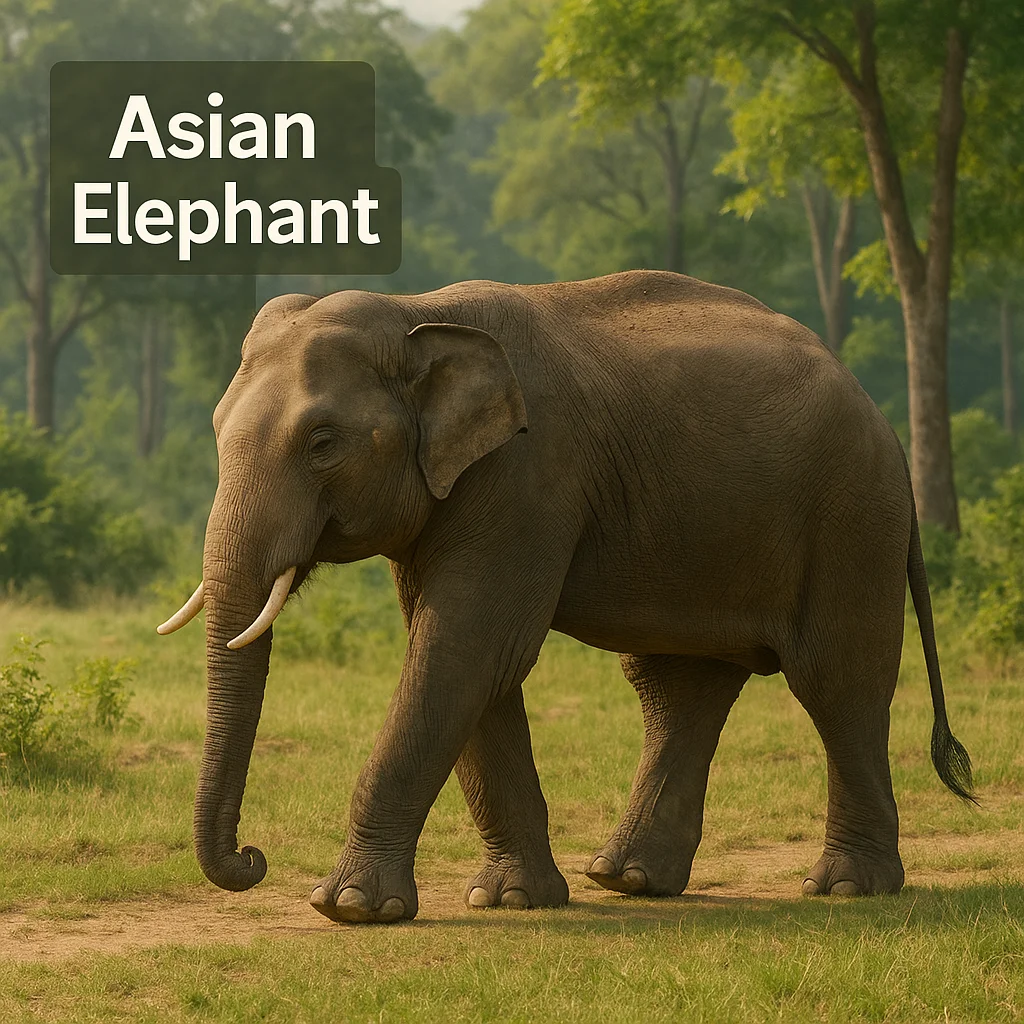
- Common name(s): Asian Elephant, Asiatic Elephant
- Scientific name: Often listed as Elephas maximus
- Animal type: Mammal
- Typical adult size: Height 2-3.5 meters, weight 2,700-5,400 kg
- Typical lifespan: Wild: 60-70 years; Captivity: up to 80 years
- Diet type: Herbivore; consumes grasses, leaves, fruits
- Activity pattern: Mostly diurnal, active during cool parts of the day
- Social structure: Highly social; matriarchal herds
- Speed / movement highlights: Walks slowly; can run at 25 km/h in short bursts
- Intelligence/learning: High intelligence; capable of problem-solving and using tools
- Primary habitats: Forests, grasslands, wetlands
- Geographic range: South Asia, Southeast Asia
- Predators/threats: Few natural predators; human pressures include habitat loss and poaching
- Conservation status: Endangered
🔍 Identification & Appearance
Recognizing the Asian Elephant involves noting its distinctive profile, which includes a more domed forehead, smaller ears, and a generally smaller overall size compared to its African relatives. This species often exhibits grayish skin with patches of depigmentation around its ears and trunk. Unlike African elephants, only some male Asian elephants have prominent tusks, while females usually lack them. Their trunk, a versatile tool, can perform delicate maneuvers. Large footprints and considerable dung are reliable field signs.
- Top ID Tips
- Smaller, rounded ears compared to African elephants
- More prominent forehead with a twin bulge
- Gray skin with patchy pinkish depigmentation
- Trunk used skillfully for various activities
- Males may have tusks; females typically do not
- Large, round footprints with visible toes
- Significant pile of dung
- Swinging movement of head while walking
- Slower walking and more graceful movement
🧱 Body Structure & Physical Adaptations
The Asian Elephant's body is robust, yet more compact compared to African elephants. Its thick legs support a considerable body mass, essential for its migratory lifestyle. The trunk, comprising over 40,000 muscles, is crucial for feeding, bathing, and social interaction. Tusks, present primarily in males, are used for digging roots and marking territory. Their large ears play a reduced role in thermoregulation compared to African elephants, due to their smaller size. These elephants boast acute hearing and a keen sense of smell, essential for communication and foraging.
- Key Adaptations
- Flexible and powerful trunk for manipulation and interaction
- Tusks in males used for foraging and social display
- Thick, supportive legs for traveling long distances
- Keen hearing for detecting distant sounds
- Sharp sense of smell to locate food and identify group members
- Smaller ears, less effective for heat dissipation compared to African species
- Strong, peg-like molars for grinding plant material
- Rough skin with pores for maintaining temperature
🌍 Range & Distribution
The natural range of the Asian Elephant extends across South and Southeast Asia, including countries like India, Thailand, Sri Lanka, and parts of Indonesia. These elephants typically inhabit areas with access to water, such as tropical and subtropical forests, grasslands, and riverine areas. They are known to inhabit regions at various elevations, from sea level to mountainous regions. Although primarily resident, elephants may travel considerable distances seasonally in search of food and water.
- Where You Might Find It
- India's dense forests and grasslands
- Wetlands and riverine areas in Sri Lanka
- Mountainous regions in northern Thailand
- Lowland regions in Laos and Cambodia
- Protected reserves like India's Kaziranga National Park
- Evergreen and deciduous forests of Malaysia
- Grasslands interspersed with water systems
- Tropical regions with high biodiversity
- Seasonal migrations along ancient paths
🏞️ Habitat & Shelter
Asian Elephants adapt to diverse habitats, including tropical forests, grasslands, and wetlands. They prefer areas with abundant food and proximity to water sources, which are essential for drinking, bathing, and their social activities. During dry seasons, they may move to riverine forests to find water and dense foliage for shade. Elephants significantly alter their habitats by toppling trees and uprooting vegetation, promoting rich biodiversity and creating environments suitable for other species. Understanding their habitat is vital for conservation, as habitat loss poses a major threat to their survival.
🧭 Behavior & Ecology
Asian Elephants exhibit complex behaviors and play key roles in their ecosystems. Their daily routines include grazing, traveling, and engaging in social dynamics within their herds. Known for their intricate vocalizations and low-frequency rumbles, these elephants can communicate over long distances. They also interact through body language, play, and scents. Elephants perform pivotal roles as seed dispersers and ecosystem engineers, facilitating habitat diversity. They have symbiotic relationships with other species, benefitting from mutualistic interactions.
- Behavior Highlights
- Highly social, with strong family bonds
- Communicate using deep rumbles and body language
- Playful interaction among juveniles
- Seed dispersal through dung
- Ecosystem engineering by altering vegetation
- Bathing and mud-wallowing for thermoregulation
- Migration to seasonal feeding grounds
- Hierarchy maintained through matriarch leadership
- Documented cases of grief over lost companions
- Mutual aid exhibited during herd movement
👥 Social Life & Group Dynamics
Asian Elephants typically live in matriarchal herds comprising females and their young. These herds are led by the oldest and most experienced female, who guides them in finding food and water, and making critical survival decisions. Males usually leave the herd upon reaching adolescence and may lead solitary lives or form loose bachelor groups. Cooperation is integral, with members helping to rear young and protect against threats. Social bonds are maintained through grooming, vocalizations, and coordinated activities.
- Social Structure Notes
- Matriarchal herds led by elder females
- Females stay with natal herd for life
- Males form bachelor groups or remain solitary
- Herds provide collective care to offspring
- Collaborative decision-making in herds
- Strong filial bonds and social hierarchy
- Ritualistic greeting ceremonies
- Coordinated movement during travel
- Protection from predators through unity
🍽️ Diet, Prey & Predators
As herbivores, Asian Elephants have a diverse diet comprising grasses, leaves, bark, and fruits. They spend a significant portion of their day foraging to meet their large dietary needs. During the rainy season, they have access to lush vegetation, while dry seasons may limit food availability. In terms of natural predators, Asian Elephants face minimal threats due to their size, with calves being more vulnerable. However, human-related pressures such as habitat destruction and poaching present significant threats.
- Feeding Notes
- Consume 150 kg+ of vegetation daily
- Prefer fresh grasses and assorted vegetation
- Seasonal variation influences diet composition
- Use trunks to pluck leaves and fruits
- Peel and strip bark with tusks for nutrients
- Calves learn dietary preferences from adults
- May travel distances for more abundant food
- Juveniles explore dietary habits through play
🦌 Hunting, Foraging & Movement
Asian Elephants are efficient foragers, covering vast distances in their search for food. They rely on their trunks to gather food and their tusks to access nutrient-rich resources. These elephants typically move in well-trodden paths, known as elephant trails, that connect feeding, watering, and resting areas. They are adapted for endurance rather than speed, moving at a slow and steady pace. Their exceptional memory aids in navigating their extensive home ranges.
- Movement & Strategy
- Daily travels follow known elephant trails
- Slow and methodical movement
- Utilize memory of landscape to locate resources
- Gather food using dexterous trunk
- Adapted for endurance through several kilometers
- Preferred feeding times are early mornings and late afternoons
- Shift habitats seasonally for food and water
- Family herd coordination in movement
- Minimal competition due to size advantage
🧠 Intelligence & Senses
Renowned for their high intelligence, Asian Elephants exhibit problem-solving abilities, social learning, and tool use. Their cognitive capabilities are evident in their sophisticated communication and interaction within herds. Equipped with sharp senses, they detect predators through smell and sound, and such abilities are critical for survival. Their emotional intelligence, demonstrated in mourning behavior and complex social dynamics, highlights their deep sense of empathy.
- Notable Abilities
- Excellent memory for navigation and social bonds
- Problem-solving skills evident in tool use
- Complex vocal communication in low-frequency sounds
- Emotionally expressive and socially aware
- Acute sense of smell for environmental cues
- Capability to learn through observation and interaction
🪺 Reproduction, Pregnancy & Parenting
Asian Elephants have an extended reproductive cycle with long gestation periods and significant investment in offspring care. Breeding can occur throughout the year, with peaks during rainy seasons. Mating is generally polygynous, with dominant males seeking estrous females. The gestation period lasts about 22 months, and newborns are precocial, able to stand and move within hours of birth. Parenting involves significant maternal care, with aunts and other herd females contributing.
- Reproduction Snapshot
- Breeding possible year-round, peaking in wet seasons
- Gestation lasts around 22 months
- Birth results in single, precocial calf
- Mothers provide milk and protection
- Allomothering common among herd females
- Calf weans by 3-4 years old
- Sexual maturity reached around 12-15 years
♀️♂️ Male vs Female Differences
Male Asian Elephants are generally larger and have more pronounced tusks than females. These tusks provide an advantage in social dominance and foraging. Females, being tuskless or having smaller tusks, focus on nurturing roles within herds. Behavioral roles also differ, with males often becoming more solitary or joining bachelor groups, while females maintain cohesive family units, playing a significant role in social dynamics and decision-making.
- Sex Differences at a Glance
- Males larger and heavier than females
- Prominent tusks primarily in males
- Males may lead solitary or bachelor lives
- Females central to herd social structure
- Maternal roles dominate female behavior
- Behavior during mating more competitive in males
🧬 Subspecies & Variation
The Asian Elephant has several recognized subspecies, including the Sri Lankan (E. m. maximus), Indian (E. m. indicus), and Sumatran (E. m. sumatranus) elephants. Differences among these include size variation, skin texture, and tusk development. The Sumatran Elephant is the smallest subspecies, adapted to dense forest environments, while the Sri Lankan Elephant is notably large. Taxonomical classification remains debated, with conservation strategies considering regional ecological requirements.
- Variation Notes
- Sri Lankan elephants are generally larger
- Sumatran elephants adapted for forest living
- Shape and size of ears vary subtly among subspecies
- Skin texture differences, with some more wrinkled
- Presence and size of tusks differ regionally
- Habitat adaptations visible in behavior and diet
⚠️ Threats, Conservation & Human Interaction
Asian Elephants face numerous threats from habitat destruction, human-wildlife conflict, and poaching for ivory and body parts. Conservation efforts focus on habitat protection, anti-poaching legislation, and human-elephant coexistence. Captive elephants contribute to cultural traditions, though ethical concerns arise regarding their care. Efforts aim to balance tradition with animal welfare, emphasizing elephant-friendly tourism and managed reserves that prioritize natural behaviors and health.
- Responsible Notes
- Habitat protection crucial for their survival
- Poaching for ivory banned internationally
- Human-wildlife conflict mitigated by education
- Elephant corridors help reduce road kills
- Community involvement in conservation beneficial
- Ethical tourism supports conservation goals
- Anti-poaching laws require strict enforcement
✨ Fun Facts & Unique Traits
- Asian Elephants can grasp objects with their trunk like a human hand
- Capable of complex vocal communication, including up to 50 different sounds
- Use mud and dust to protect skin from sun and parasites
- Each herd member is recognized by unique vocal signatures
- Elephants can detect distant sounds through their feet
- Contribute significantly to forest regeneration through seed dispersal
- Occasionally use tools, such as branches, to scratch themselves
- One of few animals that recognize themselves in mirrors
📌 Summary
- Asian Elephants are identifiable by their size, domed forehead, and smaller ears
- Found across South and Southeast Asia, inhabiting diverse ecosystems
- Primarily herbivorous, feeding on grasses, leaves, and fruits
- Human activity presents more significant threats than natural predators
- Matriarchal social structure, with strong family bonds
- Long gestation period, with significant maternal investment
- Adaptations include a versatile trunk and acute senses
- Renowned for their intelligence and emotional complexity