🦁 Stag Beetle
🧾 Quick Facts
The stag beetle is a fascinating group of beetles globally recognized for their impressive mandibles and distinctive appearance. Belonging to the family Lucanidae, these beetles are often associated with wooded areas, where they play essential roles in the ecosystem.
- Common name(s): Stag Beetle
- Scientific name: Lucanidae (family)
- Animal type: Invertebrate
- Typical adult size: 2.5 to 12 cm in length
- Typical lifespan: 3 to 7 years (mostly in larval stage)
- Diet type: Herbivore, primarily feeds on tree sap and rotting fruit
- Activity pattern: Nocturnal
- Social structure: Solitary
- Speed / movement highlights: Slow flyers and walkers
- Intelligence/learning: Limited, primarily instinctual behavior
- Primary habitats: Forests, woodlands, rural areas
- Geographic range: Europe, Asia, North America, South America
- Predators/threats: Birds, mammals, human habitat destruction
- Conservation status: Varies by region, some species threatened
🔍 Identification & Appearance
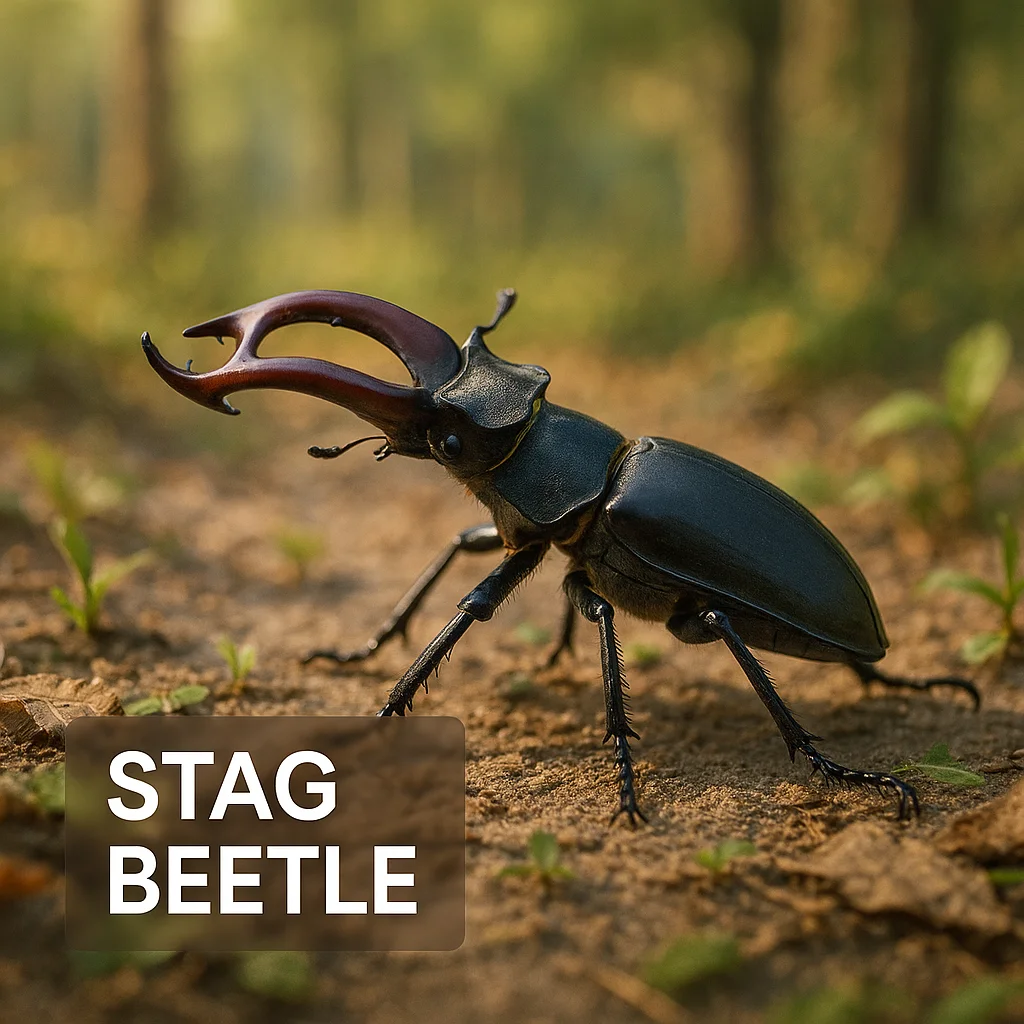
Stag beetles are recognizable by their robust body, large mandibles, and shiny exoskeleton. The most notable feature is the large, antler-like mandibles present prominently in males, used for fighting and mating displays. Females typically have smaller mandibles. Coloration is often deep brown to black, with some variations showing red hues. These beetles have a tough, segmented body with a small head in relation to their thorax and abdomen.
- Top ID Tips:
- Look for large antler-like mandibles in males.
- Note the shiny, hard exoskeleton.
- Body color ranges from deep brown to glossy black.
- Females have smaller, less conspicuous mandibles.
- The beetle's body is segmented into three main parts: head, thorax, and abdomen.
- Broad wings fold neatly underneath hard elytra (wing cases).
- Observe their slow, lumbering flight.
- Commonly found on decaying wood or near tree sap.
🧱 Body Structure & Physical Adaptations
Stag beetles possess a robust build with a tough exoskeleton providing protection and support. Their large mandibles, particularly prominent in males, are used for combat and display rather than feeding. The mandibles are designed to clasp and lever opponents in contests for mates. The beetles have three pairs of legs, each ending in a claw, adapted for gripping rough surfaces. Their sensory organs include large compound eyes and antennae, crucial for detecting environmental cues.
- Key Adaptations:
- Thick exoskeleton for protection.
- Large mandibles for fighting and mating displays.
- Claws on legs for climbing trees and gripping surfaces.
- Compound eyes provide a wide field of vision.
- Antennae sensitive to chemical signals.
- Strong wings under elytra for occasional flight.
- Larvae possess strong jaws for chewing through wood.
- Body shape enables maneuvering through narrow crevices.
🌍 Range & Distribution
Stag beetles are widely distributed across temperate regions, inhabiting various landscapes. In Europe, they are frequently found in woods, gardens, and even urban areas. Other regions like Asia and the Americas also host these beetles, although their presence varies according to local climates and habitat availability.
- Where You Might Find It:
- Western and Southern Europe, especially in well-wooded areas.
- In Asia, from Japan to India, where forests are prevalent.
- North America's eastern regions, with woodland habitats.
- Parts of South America, in temperate zones with wooded areas.
- Typically in habitats with decaying trees or forest debris.
- Rural areas with hedgerows and tree lines.
- Gardens that provide suitable deadwood.
- Rarely in completely urban or agricultural regions without trees.
🏞️ Habitat & Shelter
Stag beetles prefer forest environments where they have ample access to decaying wood, which is crucial for both adult feeding and larval development. They are drawn to woodlands, gardens, and hedgerows, often taking shelter in logs, stumps, and under loose bark. Seasonal changes can affect their activity, with eggs being laid during warmer months and larval development happening in the moist wood during colder seasons.
🧭 Behavior & Ecology
Stag beetles are primarily nocturnal, spending a significant portion of their life cycle hidden within wood. Males engage in fights over mates using their mandibles in displays that resemble stag duels, hence their name. Communication is limited, relying on chemical signals for mating. Stag beetles partake in nutrient cycling within their ecosystem by breaking down decaying wood, contributing to soil health and forest ecology.
- Behavior Highlights:
- Nocturnal activity, with peak activity in warm evenings.
- Males often compete aggressively using their mandibles.
- Lack complex social structures, mainly solitary.
- Play a significant role in decomposing dead wood.
- Attracted to light sources at night.
- Rely on pheromones for locating mates.
- Females select mates based on mandible size.
- Lifespan primarily spent in larval form within wood.
👥 Social Life & Group Dynamics
Stag beetles are solitary insects, mostly encountering one another during the mating season. While engaging in little to no group activities, males are territorial and may stake claim to a particular area rich in resources. The lack of social cooperation among stag beetles illustrates their solitary nature, with any semblance of social interaction being largely limited to competitive displays and mating.
- Social Structure Notes:
- Solitary creatures, except during breeding.
- Males exhibit territorial behaviors.
- Limited interaction outside of mating displays.
- No established social hierarchies.
- Mate competition among males can be intense.
- Males occasionally seen gathering around tree sap source.
- Females are less visible beyond mating period.
🍽️ Diet, Prey & Predators
The main diet of stag beetles consists of tree sap and decaying fruits, with larvae extensively consuming rotting wood and organic matter. Their consumption of decaying material assists in nutrient recycling. Stag beetles face predation from birds, mammals, and other larger insects. To defend themselves, they use their strong exoskeleton and may resort to mimicking dangerous insects as a deterrent.
- Feeding Notes:
- Adults feed on moisture and sugars of tree sap and fruit.
- Larvae consume decaying wood as their primary source of nutrition.
- Threats from bird species, especially woodpeckers.
- Mammals such as hedgehogs may prey on them.
- Utilizes thanatosis or "playing dead" as defense.
- Color patterns and hard shell as predator deterrence.
🦌 Hunting, Foraging & Movement
More foragers than hunters, adult stag beetles move primarily to consume tree sap and fermenting fruits. Their flight is slow and not sustained over long distances, generally made in search of food or mates. The larvae, in contrast, remain stationary, consuming materials where they develop. Adults may display territorial behavior around valuable food sources like tree sap sites.
- Movement & Strategy:
- Forages rather than hunts, focused on tree sap and rot.
- Flight used mainly for mate location and food search.
- Larvae remain stationary within decaying wood.
- Slow, cumbersome movement on ground.
- Degenerated wings adapted more for climbing than flying.
🧠 Intelligence & Senses
Stag beetles rely primarily on their well-developed senses rather than intelligence comparable to mammals. They detect chemical signals in the environment using their antennae, key for mate location. Vision and smell are crucial for nocturnal navigation. Their instincts drive behavior, particularly during competition and mating.
- Notable Abilities:
- Antennae adept at detecting pheromones.
- Compound eyes suited to low-light conditions.
- Specific mating and territorial calls or signals.
- Use sense of smell to locate sap oozes.
- Strong instinctual responses in competitive displays.
🪺 Reproduction, Pregnancy & Parenting
The breeding and reproduction of stag beetles typically occur in late spring and early summer. During courtship, males display their mandibles to impress females, who lay eggs in decaying wood post-mating. The larvae may spend several years developing within their wooden nursery, with no further parental investment beyond the egg stage. Little is known about specific gestation times, which can vary by region and species.
- Reproduction Snapshot:
- Mating often occurs during warm nights.
- Males use mandibles as courtship displays.
- Eggs laid in soft, decaying wood post-mating.
- Larval stage lasts 1 to 5 years, depending on species.
- Little to no parental care after eggs are laid.
- Females may be selective of wood quality for laying eggs.
♀️♂️ Male vs Female Differences
The most striking difference between male and female stag beetles is the size of the mandibles, with males showcasing much larger and more prominent "stagger" structures used in competition. Females are generally smaller and more robust, which aids in their egg-laying role. These differences are primarily physical, with behavioral roles converging during mating seasons.
- Sex Differences at a Glance:
- Males possess larger and more pronounced mandibles.
- Females have smaller heads proportionate to body size.
- Mandible size has no impact on feeding.
- Males engage in competitive displays.
- Females focus on reproduction and laying eggs.
🧬 Subspecies & Variation
Stag beetles encompass a diverse range of species within the Lucanidae family. While the classification of subspecies is subject to ongoing research, variations in size, mandible shape, and coloration have been observed. Local adaptations may occur in response to specific ecological demands, such as climate or available food sources.
- Variation Notes:
- Variations exist in mandible size and shape regionally.
- Color variations can range from reddish-brown to pitch-black.
- Geographical isolation leads to speciation.
- Adaptations to unique ecological niches noted.
⚠️ Threats, Conservation & Human Interaction
Stag beetles face several natural threats and human-induced pressures. Habitat loss due to deforestation and urbanization poses significant risks. Conservation efforts focus on maintaining and restoring habitat environments conducive to their life cycle, particularly preserving decaying wood in managed forests. Human appreciation for their ecological role is increasing, though pressures such as collection for trade also exist.
- Responsible Notes:
- Preservation of woodland habitats is vital.
- Promote decaying wood management in gardens/habitats.
- Limit pesticide use that can harm larvae in wood.
- Encourage public education on stag beetle ecology.
- Ensure legal protection in countries where populations decline.
✨ Fun Facts & Unique Traits
- Stag beetles are named for their large mandibles resembling deer antlers.
- Larval development periods can be longer than any beetle's adult life.
- Males may be up to twice the size of females due to their mandibles.
- Play an essential role in forest ecology as decomposers.
- Some cultures view stag beetles as symbols of strength and power.
- They are featured in folklore and myths as magical creatures.
📌 Summary
- Stag beetles are invertebrates of the family Lucanidae, known for antler-like mandibles.
- They inhabit woodlands and gardens, relying on decaying wood for life cycles.
- An important part of the ecosystems, they help decompose organic material.
- Their range includes Europe, Asia, and the Americas.
- Stag beetles face natural threats and require habitat preservation for conservation.
- Larvae spend years developing in wood, with limited parental investment post egg-laying.
- Lack complex social interactions, mostly solitary except during the mating season.
- Distinguished by size differences in mandibles between genders.
- Conservation efforts focus on protecting natural habitats and increasing public awareness.