🦁 Praying Mantis
🧾 Quick Facts
Praying mantises are fascinating insects known for their unique appearance and predatory behavior. These invertebrates play a significant role in controlling pest populations in gardens and agricultural areas worldwide.
- Common name(s): Praying Mantis
- Scientific name: Varies by species, often Mantodea
- Animal type: Invertebrate
- Typical adult size: 1 to 6 inches (2.5 to 15 cm) in length
- Typical lifespan: 6 months to 1 year (varies in wild vs. captivity)
- Diet type: Carnivore; feeds on smaller insects and occasionally small vertebrates
- Activity pattern: Mostly diurnal, sometimes active at twilight
- Social structure: Solitary hunters
- Speed / movement highlights: Slow, deliberate movements; rapid when striking prey
- Intelligence/learning: Known for rapid learning and hunting efficiency
- Primary habitats: Grasslands, gardens, forests, and tropical regions
- Geographic range: Found on every continent except Antarctica
- Predators/threats: Birds, bats, spiders, and larger insects; habitat loss due to human activities
- Conservation status: Generally stable, but varies by region
🔍 Identification & Appearance
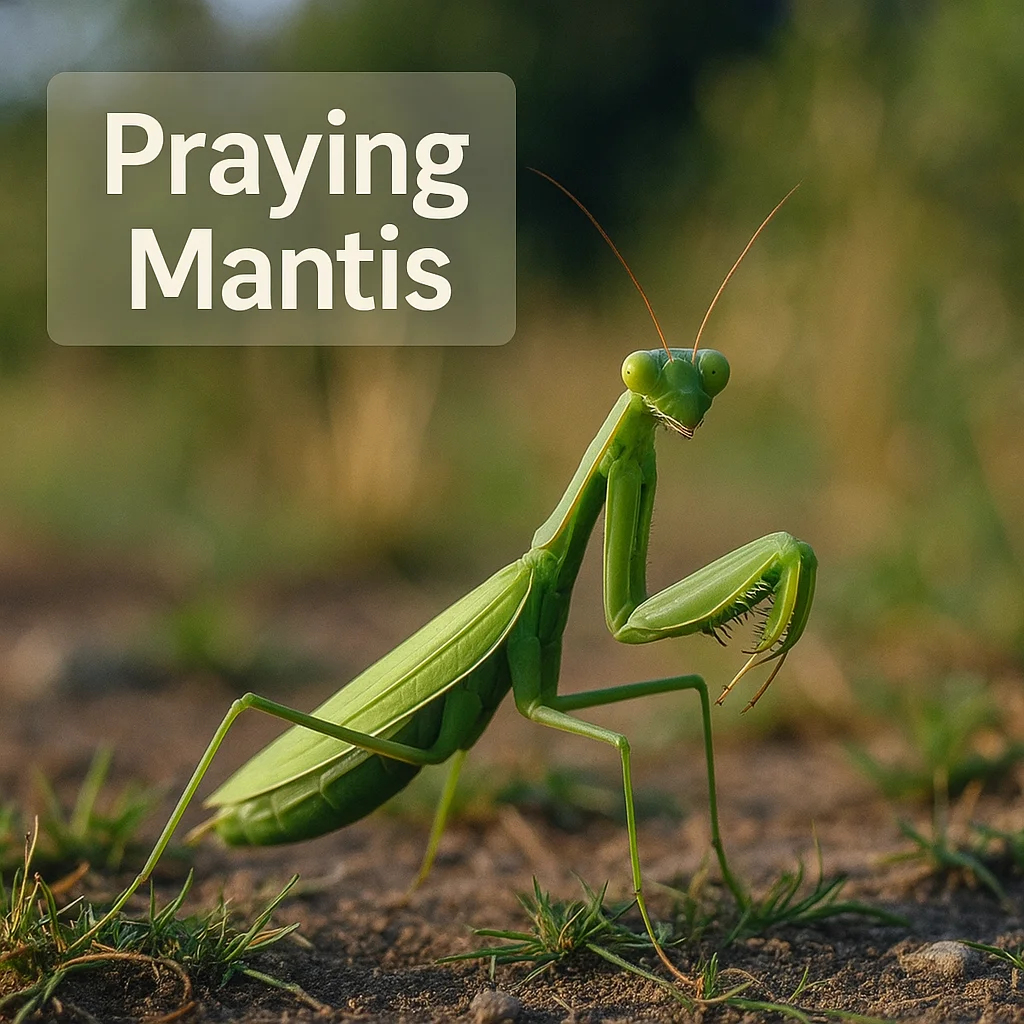
The praying mantis is recognizable by its elongated body and characteristic "praying" posture, which involves folding its forelimbs as if in prayer. They typically have a slender body, triangular head, prominent eyes, and long legs.
- Body shape and silhouette: Long and narrow with a prominent thorax
- Key colors/patterns: Green or brown, sometimes with adaptive camouflage
- Distinctive features: Large, compound eyes; raptorial forelegs for capturing prey
- Tracks, scat, or other field signs: No distinctive tracks; rarely leave signs
- Common look-alikes: Stick insects; distinguished by posture and hunting behavior
- Top ID Tips
- Look for the triangular head and large eyes
- Notable "praying" forelimbs
- Color often matches surrounding foliage
- Moves with a distinctive, swaying gait
- Forelimbs equipped with spines for grasping prey
- Winged adults often have a membranous hind wing with a leathery forewing
🧱 Body Structure & Physical Adaptations
The praying mantis has a sleek and efficient build, perfect for a predatory lifestyle. Its body is streamlined, enabling it to blend seamlessly with foliage while hunting. The predatory adaptations of the mantis are quite advanced.
- Build and proportions: Slender with proportionately large raptorial forelegs
- Teeth/beak/jaw adaptations: Mandibles are sharp and capable of piercing insects
- Claws/wings: Adapted for grasping prey and short flights; wings are used for display and gliding
- Sensory strengths: Acute eyesight; capable of detecting movement up to 60 feet away
- Key Adaptations
- Raptorial legs for capturing prey
- Highly flexible neck for 180-degree head rotation
- Large, well-developed compound eyes
- Cryptic coloration for camouflage
- Lightweight exoskeleton allows for stealthy movements
- Sexual dimorphism, with larger females
🌍 Range & Distribution
The praying mantis is distributed across many regions, thriving in areas that provide adequate prey and vegetation for camouflage. They are most frequently found in warmer climates but some species adapt to temperate zones.
- Occurs across North and South America, Africa, Europe, Asia, and Australia
- Common in tropical and subtropical regions
- Regenerated forest edges, meadows, and grasslands
- Can occupy gardens and farmlands where prey is abundant
- Typically found at elevations up to 1,500 meters (5,000 feet)
🏞️ Habitat & Shelter
Praying mantises prefer habitats that offer plenty of cover alongside ample prey opportunities. They shelter in trees, bushes, and tall grasses, adopting stillness to avoid predators while ambushing prey.
- Thrives in grasslands and open woodlands
- Adapts to gardens and agricultural fields with dense foliage
- Seasonal weather affects visibility but not substantially behavior
- Relies on its natural habitat for hunting and defense
🧭 Behavior & Ecology
Praying mantises exhibit a blend of patience and aggressiveness. They strike with precision and maintain a solitary lifestyle, except during breeding.
- Predominantly solitary except during breeding season
- Territorial but not aggressively defensive
- Utilizes cryptic behavior to ambush prey
- Important in controlling insect populations, contributing to ecosystem balance
- Behavior Highlights
- Incredible patience in hunting
- Camouflage strategies for surprise attacks
- Non-aggressive interactions unless mating
- Flexibility in prey selection based on availability
- Nocturnal hunting in some species
- Displays specific behavior during threat displays
👥 Social Life & Group Dynamics
The praying mantis is largely solitary, demonstrating minimal social interaction except during mating. After mating, the female may exhibit aggressive behavior towards the male, a notable feature in some species.
- Solitary by nature, only social for reproduction
- Mating involves complex displays and careful approach
- Occasional aggression post-mating among certain species
- No group formations or social hierarchies
- Social Structure Notes
- Primarily solitary except for mating
- Engages in careful courtship rituals
- Post-mating cannibalism observed
- Distinct lack of social structure amongst mantises
🍽️ Diet, Prey & Predators
Praying mantises are opportunistic carnivores, predominantly preying on other insects. They leverage their strong forelegs to catch prey, utilizing camouflage as a primary hunting strategy.
- Preys on flies, beetles, grasshoppers, and occasionally small vertebrates
- Commonly uses ambush tactics for hunting
- Falls prey to birds, reptiles, and larger arachnids
- Employs sudden strikes to capture prey efficiently
- Feeding Notes
- Generalist and opportunistic predator
- Efficient at controlling pest populations
- Uses patience when waiting for prey
- Capability to prey on larger insects
- Effective in reducing insect pest numbers in gardens
🦌 Hunting, Foraging & Movement
The mantis employs stealth and strategic positioning to capture prey. Its movement is calculated and slow to avoid detection, with swift bursts to capture prey when in range.
- Ambusher with a reliance on remaining hidden
- Rapid strikes to secure prey with raptorial limbs
- Movement calculated to mimic wind-blown foliage
- Primarily relies on eyesight for hunting
- Movement & Strategy
- Highly efficient in ambush hunting
- Master of using camouflage in movement
- Utilizes terrain and vegetation for stalking
- Short-distance flights to reposition
🧠 Intelligence & Senses
Praying mantises are renowned for their remarkable vision and reflexes. They display learning capabilities, especially in optimizing hunting strategies through experience.
- Exhibits problem-solving skills in prey capture
- Uses sight heavily in detecting and targeting prey
- Adaptive learning behavior noted in hunting tactics
- Research into social intelligence is limited
- Notable Abilities
- Exceptional visual acuity
- Adaptive prey capture tactics
- Quick learning from hunting experiences
- Precise spatial awareness when hunting
🪺 Reproduction, Pregnancy & Parenting
The breeding process of the praying mantis involves intricate courtship. Females appear larger and more robust, often posing risks to males after mating.
- Varied breeding seasons depending on region
- Complex courtship displays and signals
- Females produce ootheca, a protective case for eggs
- Children are precocial, requiring little direct care from parents
- Reproduction Snapshot
- Seasonally influenced mating
- Produces multiple egg cases in favorable conditions
- Post-natal care is largely absent
- Mating can be dangerous due to female aggression
♀️♂️ Male vs Female Differences
Sexual dimorphism is evident in praying mantises, with females often being significantly larger and heavier than males. Males, while smaller, are more agile to avoid cannibalism post-mating.
- Size: Females larger and more robust
- Coloration might occasionally differ, aiding in camouflage
- Males generally more agile and cautious post-mating
- Sex Differences at a Glance
- Females are larger with more robust bodies
- Males often risk predation by females post-copulation
- Distinct behaviors during the mating ritual
🧬 Subspecies & Variation
The praying mantis group is highly diverse, with numerous species exhibiting a variety of adaptations to their local environments. Some species are brilliantly colored, while others are masters of mimicry.
- Major variations in size and coloration based on environment
- Mimicry in some species helps to avoid predators
- Subspecies classification can be contentious
- Variation Notes
- Highly localized adaptations
- Species-specific coloration matched to habitat
- Debate over classifying certain subspecies
⚠️ Threats, Conservation & Human Interaction
While generally stable, praying mantis populations face threats from habitat destruction and pesticide use. They play a crucial role in maintaining garden and agricultural health by naturally controlling pest populations.
- Susceptible to pesticide application
- Valued for pest control in agricultural settings
- Habitats are sometimes disturbed by human expansion
- Responsible Notes
- Avoid pesticide use in gardens to protect mantises
- Recognize their beneficial role in biodiversity
- Encourage natural mantis habitats
✨ Fun Facts & Unique Traits
- Some species can rotate their heads nearly 180 degrees
- The name "mantis" comes from Greek, meaning prophet or fortune teller
- Mantis' striking motion is faster than the human eye can see
- Utilizes mimicry to avoid predators
- Capable of capturing and eating small mammals or reptiles
- Regarded with cultural respect in some countries
📌 Summary
- Praying mantises are identifiable by their praying posture and large, compound eyes
- Predominantly found in warmer regions worldwide
- Efficient and patient predators
- Solitary yet engaging in complex mating rituals
- Rely heavily on camouflage for hunting and defense
- Plays a key ecological role as a predator
- Exhibit notable sexual dimorphism
- Comprised of varied species with region-specific adaptations