🦁 Nautilus
🧾 Quick Facts
The nautilus is a fascinating marine creature, known for its distinctive spiral shell and ancient lineage. This group of cephalopods has survived for millions of years, navigating the oceans with ease. Despite their primitive appearance, nautiluses exhibit complex behaviors and adaptations that make them efficient dwellers of the deep sea.
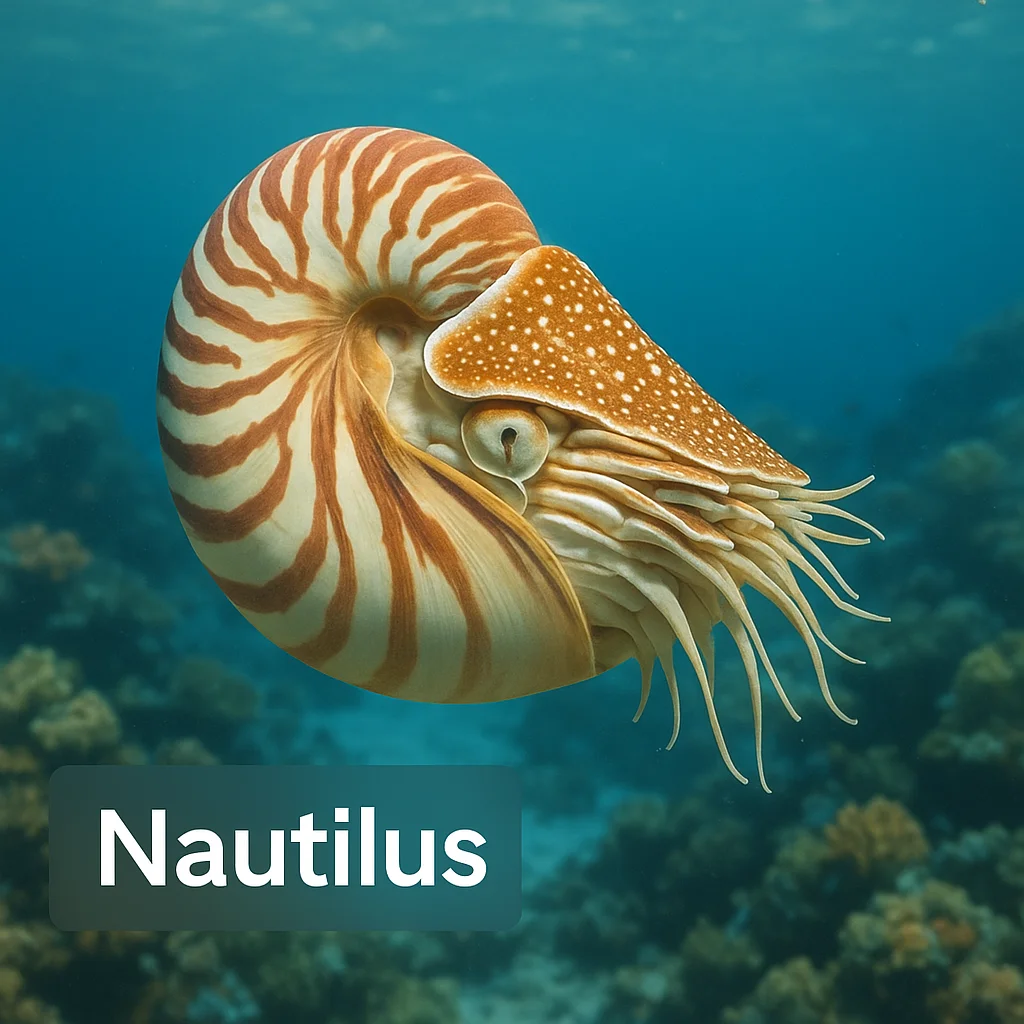
- Common name(s): Nautilus
- Scientific name: Varies (e.g., Nautilus pompilius, Allonautilus scrobiculatus)
- Animal type: Invertebrate
- Typical adult size: 15-20 cm (shell diameter), weight varies around 1 kg
- Typical lifespan: 15-20 years
- Diet type: Carnivore; feeds on fish, crustaceans, and detritus
- Activity pattern: Primarily nocturnal
- Social structure: Generally solitary
- Speed / movement highlights: Slow swimmers with jet propulsion
- Intelligence/learning: Basic learning ability, uses sensory adaptations for survival
- Primary habitats: Tropical and subtropical ocean waters
- Geographic range: Indo-Pacific Ocean, particularly around coral reef islands
- Predators/threats: Sharks, large fish, human exploitation
- Conservation status: Threatened, varies by region
🔍 Identification & Appearance
Nautiluses are easily recognized by their smooth, spiral shells with chambered sections filled with gas for buoyancy. These creatures have a soft body with numerous tentacles emerging from the shell's opening. Their coloration often includes white or cream with dark brown or reddish stripes.
- Spiral, chambered shell structure
- White or cream shell with brown/red stripes
- Tentacles around the mouth, lacking suckers
- Shell opening is protected by a leathery hood
- Soft body resides within the shell
- Resembles ancient ammonites, but with visible tentacles
- Commonly mistaken for other mollusks due to shell appearance
- Lacks the ink sac found in other cephalopods
- Eye structure lacks a lens, unlike octopuses and squid
🧱 Body Structure & Physical Adaptations
The nautilus's body is uniquely adapted for life in the ocean's depths. Its chambered shell provides buoyancy, while jet propulsion from expelling water helps in movement. The nautilus's tentacles are sensitive, aiding in detecting prey in low-light conditions.
- Chambered shell for buoyancy control
- Jet propulsion by expelling water for navigation
- Tentacles equipped with chemosensory abilities
- Simple eye structure without a lens
- Protective hood over the shell opening
- Uses a siphuncle to adjust buoyancy within shell chambers
- Beak-like jaws for cracking prey
- Resilient shell allows survival at great depths
- Complex nerve cord for subtle movements
🌍 Range & Distribution
Nautiluses are found in tropical and subtropical oceans within the Indo-Pacific region. These creatures typically inhabit deep waters often around coral reefs and submerged slopes, mostly avoiding the turbulence of surface waters.
- Indo-Pacific Ocean regions
- Common around barrier reefs and coral islands
- Prefers depths between 100-600 meters
- Inhabit areas near Vanuatu and Fiji
- Populations found near the Philippines
- Resident in waters off New Guinea
- Exists around the Solomon Islands
- Generally avoids open ocean environments
🏞️ Habitat & Shelter
Nautiluses favor steep reef slopes and sheltered coral environments where they can navigate easily and find food. Their environment plays a crucial role, as they often remain in the dark, cooler depths during the day and ascend to shallower waters at night for feeding. Understanding their habitat is essential for appreciating their ecological role and survival strategies.
🧭 Behavior & Ecology
Daily routines of nautiluses include rising from deep waters to shallows at night for feeding and returning at dawn. These solitary creatures rely on a unique set of movements and environmental interactions for survival, serving as both predator and prey in the marine ecosystem. Their slow, deliberate movements reflect their simple yet effective ecological niche.
- Nocturnal migrations for feeding
- Relatively solitary except during breeding
- Jet-propelled swimming technique
- Mainly ambush predators
- Ecosystem role as both predator and prey
- Interaction with reef-dwelling species
- Contribute to detritus-cleaning in coral environments
- Limited intra-species communication
- Shelter within shell offers protection from predators
👥 Social Life & Group Dynamics
Nautiluses are largely solitary except during reproduction. Little is understood about their social interactions beyond breeding times, where brief aggregations occur. Their isolated nature supports survival in sparse ocean environments.
- Primarily solitary lifestyle
- No permanent group structures
- Aggregation during breeding
- No known cooperative behaviors
- Minimal conflict resolution observed
- Lack of social hierarchies
- No known roles beyond reproduction
- Brief interactions during mating season
🍽️ Diet, Prey & Predators
Nautiluses are opportunistic feeders with a diet consisting mostly of fish, crustaceans, and detrital material. These creatures utilize their tentacles to catch prey. Natural predators include sharks and other large marine animals. Escape tactics rely on the nautilus's hardy shell and ability to withdraw completely inside.
- Feeds on fish, crustaceans, detritus
- Tentacles designed for grasping prey
- Primary predators: sharks, large fish
- Uses sudden jet propulsion for quick escapes
- ID threats by sensory tentacles
- Natural role in cleaning sea floor debris
🦌 Hunting, Foraging & Movement
The movement of nautiluses is powered by expelling water, an efficient mechanism for traversing their deep ocean habitats. Hunting is often a passive affair, using stealth to approach prey. Their navigation is likely guided by a combination of memory and sensory perception, moving slowly yet purposefully.
- Slow, deliberate jet-propelled movement
- Ambush predation strategy
- Diurnal vertical migration for feeding
- Spatial use of reef habitats for hunting
- Home range navigation throughout adult life
- Simple avoidance techniques against predators
🧠 Intelligence & Senses
Nautiluses do not exhibit the high intelligence of other cephalopods but have evolved senses suited to their environment. Their tentacles are highly sensitive, allowing them to detect chemical changes in the water. Despite lacking lenses, their eyes can gather a lot of light, aiding in low-light visibility.
- Chemosensory tentacles for prey detection
- Non-lens eyes effective in low-light
- Limited evidence of problem-solving abilities
- Adapted visual cues for sensing movement
- Relies on memory for navigating home ranges
- Basic learning skills observed in some studies
🪺 Reproduction, Pregnancy & Parenting
Nautiluses exhibit straightforward reproductive behaviors, with seasonal aggregations for mating. Little is known about the specifics of their mating systems, but females lay egg cases on various underwater substrates. Parental care is absent, relying on the environment to support developing young.
- Breeding typically occurs in the warmer months
- Unclear mating system due to sparsity of studies
- Egg incubation period can extend several months
- Eggs develop externally on sea floor
- Young are precocial, fully independent at birth
- Lack of postpartum parental involvement
♀️♂️ Male vs Female Differences
Male and female nautiluses show subtle differences primarily in size and reproductive organs. There are no significant color differentiation or behavioral roles observed within the species.
- Males may be smaller than females
- Subtle differences in tentacle size
- No significant differentiation in coloration
- Similar behavior patterns across sexes
- Reproductive role differences, but not visually marked
🧬 Subspecies & Variation
Variation within the nautilus group primarily pertains to shell shape and size, with some regional differences observed. Scientific classification of subspecies remains debated, though distinct geographic populations exhibit subtle traits.
- Subtle shell shape variations among populations
- Size differences linked to geographic locations
- Limited consensus on subspecies classification
- Regional adaptation to local marine conditions
- No significant color variation
⚠️ Threats, Conservation & Human Interaction
Nautiluses face threats from overfishing and habitat degradation, as their shells are sought after for decorative purposes. Conservation measures require careful management of marine resources. These creatures are also studied in aquariums, where maintaining natural-like environments can present challenges.
- Overharvested due to shell collection
- Habitat loss due to coral reef decay
- Bycatch in deep-sea fishing operations
- Climate change impacting ocean conditions
- Protection efforts in marine reserves
- Ethical concerns in ornamental exploitation
✨ Fun Facts & Unique Traits
- Nautiluses are often called "living fossils," unchanged for 500 million years
- They adjust their buoyancy by controlling gas in their shell chambers
- Have between 90 and 100 tentacles, unlike squid or octopuses
- Despite primitive eyes, they navigate effectively using their shell's architecture
- Nautiluses can withdraw completely into their shells for protection
- Their beak can crack open the shells of crabs and other hard-shelled prey
- They lack the chromatophores that allow squid and octopus to change color rapidly
- Nautiluses have survived past several mass extinction events
📌 Summary
- Nautiluses are easily identified by their spiral, chambered shells
- Resides in Indo-Pacific coral reefs, preferring deep waters
- Feeds on small marine creatures and detritus, with natural predators including sharks
- Primarily solitary, occasionally aggregating for breeding
- Simple reproductive habits involving laying of eggs on seafloor
- Use jet propulsion to navigate the ocean depths
- No significant sexual dimorphism, with subtle size variations
- Face conservation threats from overfishing and environmental changes
- Survive as a functional link in marine ecosystems, connecting multiple trophic levels