🦁 Lobster
🧾 Quick Facts
Lobsters are fascinating marine creatures known for their distinct appearance and role in marine ecosystems. Often found in oceans worldwide, these invertebrates are celebrated not only for their unique biology but also for their culinary appeal.
- Common name(s): Lobster
- Scientific name: Various, including Homarus americanus and Panulirus argus
- Animal type: Invertebrate
- Typical adult size: 8 to 24 inches (approximately 20 to 60 cm), though varies by species
- Typical lifespan: 3 to 50 years, depending on species and environment
- Diet type: Carnivore, feeding on fish, mollusks, and other invertebrates
- Activity pattern: Nocturnal
- Social structure: Solitary
- Speed / movement highlights: Slow-moving on the ocean floor; can swim backward quickly if threatened
- Intelligence/learning: Capable of learning and adapting behavior based on experience
- Primary habitats: Coastal waters and ocean floors
- Geographic range: Found in both the Atlantic and Pacific Oceans
- Predators/threats: Predation by fish, octopuses, and humans; habitat disturbance
- Conservation status: Varies by region; some populations are stable while others are overfished
🔍 Identification & Appearance
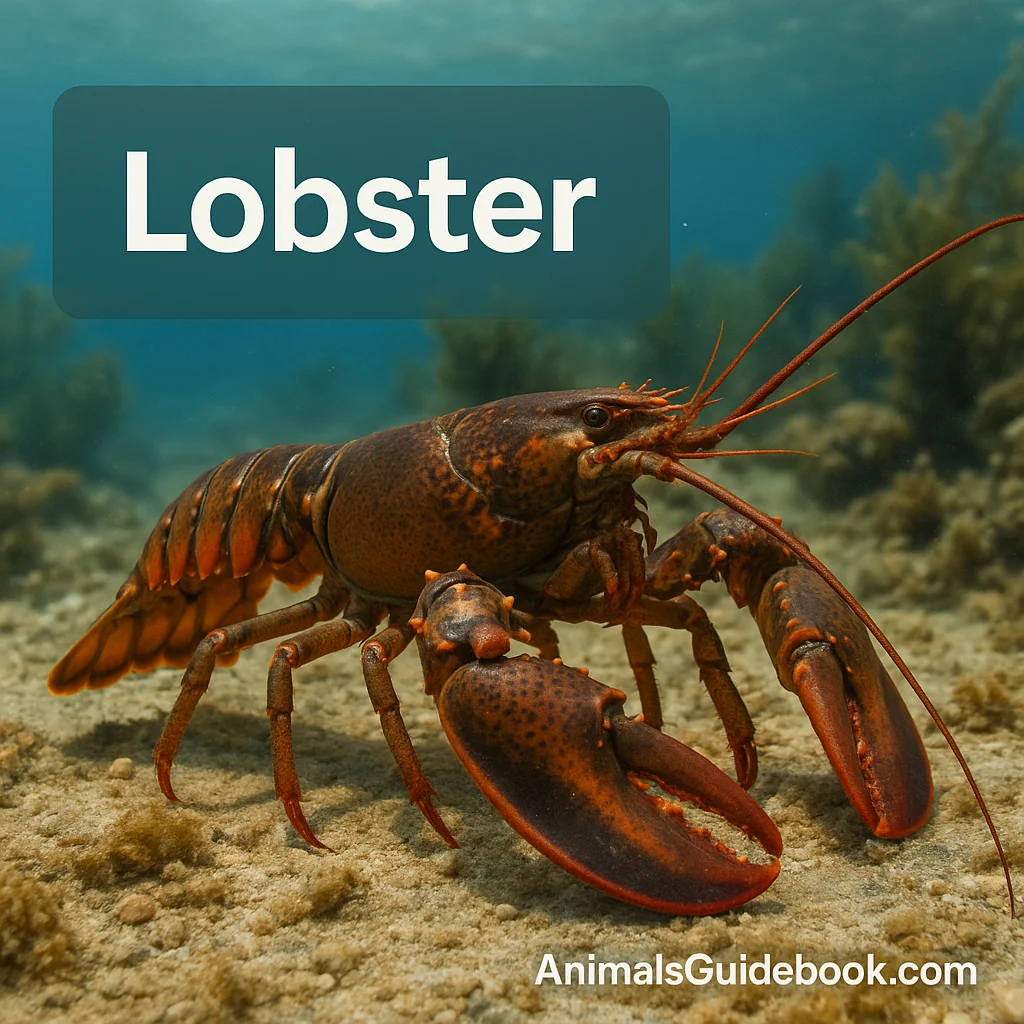
Lobsters can be recognized by their elongated bodies, segmented tails, and large claws. Their hard exoskeletons, often dark greenish-blue or brown, can change color during the cooking process. Lobsters possess long antennae for sensory navigation, and their claws are specialized for different tasks.
- Body shape: Elongated with segmented tail
- Key colors: Usually dark blue-green or brown; turns bright red when cooked
- Distinctive features: Large, asymmetrical claws
- Tracks: Typically not visible due to aquatic habitat
- Common look-alikes: Rock lobsters (no large claws)
- Top ID Tips:
- Look for large claws
- Note elongated, segmented tail
- Observe color changes when cooked
- Check for long antennae
- Observe slow movement on ocean floor
- Distinguish from rock lobsters by claw size
🧱 Body Structure & Physical Adaptations
Lobsters are built for life on the ocean floor. Their tough exoskeleton provides protection, while their claws are adapted for both crushing and cutting. Lobsters have excellent sensory organs, including antennae for detecting food and danger. Their jaws are designed to consume various prey, and they can regenerate lost limbs over time.
- Key Adaptations:
- Hard exoskeleton for protection
- Asymmetrical claws for diverse functions
- Ability to regenerate limbs
- Strong antennae for sensory detection
- Adaptation to scavenging on ocean floor
- Powerful, segmented tail for swift backward swimming
🌍 Range & Distribution
Lobsters are found in various marine environments across the world. They inhabit coastal waters, thriving on rocky, sandy, or muddy ocean floors. Their distribution includes regions such as the North Atlantic, where species like the American lobster are predominant.
- Where You Might Find It:
- North Atlantic Ocean
- Caribbean Sea
- Coastal reefs and rocky shores
- Sandy and muddy ocean floors
- Temperate to tropical waters
🏞️ Habitat & Shelter
Lobsters can be found in various marine habitats, preferring areas with cover such as rocks, reefs, or burrowed sand. They inhabit depths ranging from the intertidal zone to several hundred meters, depending on species and environmental conditions. Seasonal changes and tides can influence their activity levels, making sheltered habitats crucial for survival and reproduction.
🧭 Behavior & Ecology
As nocturnal creatures, lobsters primarily seek food and engage in activities during the night. Communication may involve chemical signals and body movements, particularly during breeding or territorial disputes. Lobsters play a critical role as both predator and scavenger within their ecosystems, regulating populations of smaller marine organisms.
- Behavior Highlights:
- Nocturnal feeding and activity
- Chemical communication via antennae
- Territorial display behaviors
- Predatory and scavenging roles
- Regulation of smaller marine organisms populations
- Influence on marine biodiversity
👥 Social Life & Group Dynamics
Lobsters are solitary animals, primarily dwelling alone unless during mating periods. While they typically avoid aggressive encounters, they may display territorial behavior to maintain feeding grounds. Lobsters do not form social groups or engage in cooperative activities.
- Social Structure Notes:
- Generally solitary
- Encounter others during mating
- Territorial but avoid unnecessary conflict
- Absence of pack or herd dynamics
- No cooperative hunting or defense strategies
🍽️ Diet, Prey & Predators
Lobsters are carnivorous, feeding on fish, mollusks, crustaceans, worms, and occasionally plant material. They use their claws to capture prey and open shells. Their primary predators include fish, octopuses, and humans. When threatened, lobsters will rapidly swim backward to escape.
- Feeding Notes:
- Carnivorous diet
- Uses claws for predation and defense
- Prey includes fish, mollusks, crustaceans
- Able to scavenge for leftover meals
- Escapes predators with swift backward swimming
🦌 Hunting, Foraging & Movement
Lobsters are adept at scavenging and foraging on the ocean floor. They move slowly when searching for food but can execute rapid, backward swimming using their powerful tails when necessary. Active primarily at night, lobsters employ ambush tactics, waiting for prey to come near.
- Movement & Strategy:
- Primarily slow movement on the ocean floor
- Proficient in scavenging habits
- Employs ambush tactics
- Uses strong tail for rapid backward movement
- Nocturnal foraging periods
🧠 Intelligence & Senses
Lobsters possess inherent problem-solving abilities crucial for navigating complex marine environments. Their strong sense of smell and taste through their antennae helps them locate food. Lobsters learn from their environment, using previous experiences to adapt their behavior when encountering new situations.
- Notable Abilities:
- Problem-solving skills
- Strong sense of smell
- Able to learn from experience
- Utilizes antennae for navigation
- Adapts behavior based on environmental cues
🪺 Reproduction, Pregnancy & Parenting
Lobster mating involves complex behaviors, with courtship rituals often taking place in the shelter of burrows or crevices. Females may carry eggs on their abdomen for several months until they hatch. Parental care is mainly limited to the female safeguarding the eggs until they hatch.
- Reproduction Snapshot:
- Complex mating rituals
- Breeding may occur after molting
- Females carry fertilized eggs for 9-12 months
- Eggs hatch into larval stage
- Females protect eggs by keeping them under the tail
♀️♂️ Male vs Female Differences
Sexual dimorphism in lobsters is relatively subtle, with males tending to possess slightly larger claws and more pronounced body structure. In breeding, males may engage in more territorial behaviors than females.
- Sex Differences at a Glance:
- Males often have larger claws
- Subtle size/weight differences
- Males may demonstrate more territoriality
- Limited behavioral dimorphism
🧬 Subspecies & Variation
Lobsters exhibit considerable variation across their range, with species adaptations reflecting their environments. For example, the spiny lobsters of the tropics lack the large claws of their cold-water relatives. There is ongoing debate among scientists about the validity of some subspecies classifications.
- Variation Notes:
- Spiny lobsters lack large claws
- Coloration and size can vary by region
- Adaptations to cold vs warm water habitats
- Subspecies classifications are occasionally disputed
⚠️ Threats, Conservation & Human Interaction
Lobsters face pressures from overfishing, habitat loss, and climate change's implications on oceanic conditions. To ensure sustainable populations, regulations and management practices are essential. Human interactions often include commercial fishing and culinary use; responsible sourcing can help maintain healthy ecosystems.
- Responsible Notes:
- Impact of overfishing
- Susceptibility to habitat alterations
- Efforts toward sustainable fishing practices
- Importance of habitat protection
- Conservation driven by both natural and human concerns
✨ Fun Facts & Unique Traits
- Some lobster species can live up to 50 years
- Capable of regenerating lost limbs
- Change color when cooked due to pigments
- Lobsters have blue blood due to copper-based hemocyanin
- Powerful tail snap used for escape movements
- Different claw shapes for specific functions - crushing or cutting
📌 Summary
- Lobsters are marine invertebrates with distinctive large claws
- Primarily nocturnal and solitary
- Found in various habitats including coastal and oceanic regions
- Omnivorous diet focusing on fish and invertebrates
- Predators include larger fish, octopuses, and humans
- Breeding involves complex courtship and egg protection by females
- Key adaptations include a hard exoskeleton and sensory antennae
- Important to consider sustainability in human interactions
- Lobsters contribute significantly to marine ecology as predators and scavengers