🦀 King Crab
🧾 Quick Facts
The term "King Crab" refers to a group of large crabs known for their impressive size and culinary value. Often found in cold marine environments, these crabs are a fascinating subject of study and a vital part of marine ecosystems.
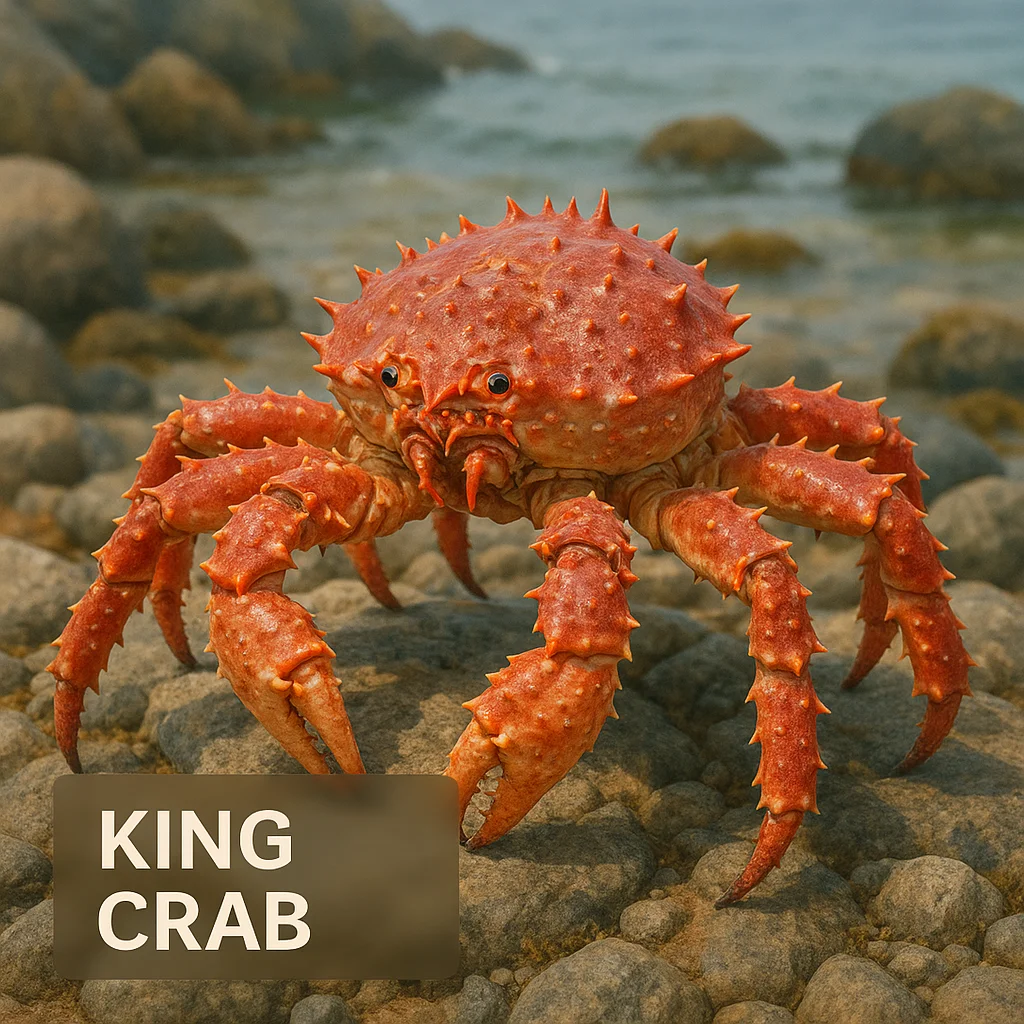
- Common name(s): King Crab
- Scientific name: Often listed as Paralithodes species
- Animal type: Invertebrate
- Typical adult size: Up to 6 feet across (including legs)
- Typical lifespan: 20–30 years in the wild
- Diet type: Carnivore; feeds on mollusks, other crustaceans, and decaying plant and animal matter
- Activity pattern: Mostly nocturnal
- Social structure: Typically solitary
- Speed / movement highlights: Moves slowly, often creeping over the ocean floor
- Intelligence/learning: Displays basic sensory learning
- Primary habitats: Cold oceanic waters
- Geographic range: Northern Pacific Ocean, particularly off the coasts of Alaska and Russia
- Predators/threats: Larger fish, octopuses, human fishing
- Conservation status: Varies by region
🔍 Identification & Appearance
King Crabs are recognized by their massive size and robust bodies. They have a distinctive crab shape with a broad, rounded carapace and long, spiny legs that can appear intimidating upon first sight. Their shells are typically a mottled red or orange, aiding camouflage among coral and rocky underwater surfaces.
- 💡 Broad, domed carapace
- 🦑 Long, spiny legs, often over 3 feet each
- 🪸 Mottled red/orange coloration
- 🐚 Large pincers used for defense and feeding
- 🔎 Tough exoskeleton aiding in predator defense
- 🦀 Eye stalks for an improved range of vision despite lower acuity
- 🧽 Spines along legs and back for added protection
- ⛴️ Often confused with snow crabs; distinguishable by thicker legs
- 🌊 Cold-water habitat preference hints at presence
- 👣 Leaves distinct wide tracks along sandy or muddy sea beds
🧱 Body Structure & Physical Adaptations
King Crabs possess a sturdy build with proportionally large legs and pincers designed for their cold, underwater lifestyle. They have evolved various adaptations that aid their survival and efficiency as predators in their maritime niche.
- 🦾 Strong, long limbs for reaching prey and locomotion
- 🦷 Hard pincers for breaking shells of prey
- 👂 Primitive hearing but keen smell through antennae
- 👀 Eye stalks allow a wide field of vision despite murky water
- 🦴 Heavy exoskeleton for protection against predators
- 🌫️ Limited visibility; relies on tactile senses more than sight
- ⚙️ Robust leg joints to navigate rocky sea floors
- 🔒 Protective shell adaptations reduce predation risk
- 🌀 Streamlined body for slow, energy-efficient movement
🌍 Range & Distribution
King Crabs primarily inhabit cold marine environments in the Northern Hemisphere. Their range extends across various oceanic regions, thriving in icy waters where other species cannot.
- 🌍 Northern Pacific Ocean
- 🗺️ Coastal waters of Alaska
- 🎣 Bering Sea hotspots
- 🇷🇺 Russian Far East coast
- 🌌 Deep-sea environments down to 300 meters
- 🌊 Oceanic shelves and slopes
- ❄️ Arctic influenced marine zones
- 🚢 Often caught in southern, colder currents
- ➡️ Limited to specific cold-water climates
🏞️ Habitat & Shelter
King Crabs prefer cold oceanic habitats, often found along the continental shelf and upper slope regions of the sea. These environments provide them the necessary shelter and food resources required for their survival.
They often shelter under rocks or in crevices, camouflaged by their rough, textured shells. Seasonal migrations may occur to access food or spawn in different areas, although they tend to remain in similar cold habitats throughout their life cycle.
🧭 Behavior & Ecology
King Crabs exhibit intriguing behaviors and fulfill important roles in their ecosystems. They are predominantly nocturnal, scavenging the ocean floor for food under the cover of darkness. Their interaction with other species and environment significantly affects local biodiversity and food chains.
- 🌒 Primarily active at night
- 🌿 Acts as both predator and scavenger
- 🍽️ Omnivorous tendencies in diverse ecosystem roles
- 🫂 Minimal aggression unless threatened
- 🔕 Uses subtle pheromones for intraspecies communication
- 🎭 Camouflage plays key ecological function
- 🐢 Important prey for larger marine species
- 🪙 Contributes to marine nutrient recycling
- ⚔️ Limited territorial disputes
👥 Social Life & Group Dynamics
King Crabs are generally solitary creatures with a minimalistic social structure. They are not known for forming groups or colonies, although temporary aggregations may occur during certain seasons, such as mating periods.
- 🔄 Solitary except for brief mating interactions
- 👥 No established hierarchies or dominance displays
- 🛡️ Disinterest in forming social bonds
- 🦠 Loose groups during feeding frenzies
- ⚠️ Generally non-aggressive except during mating
- 🚸 No cooperative behaviors common in family units
🍽️ Diet, Prey & Predators
The King Crab is primarily a carnivorous scavenger, feeding on various marine organisms and detritus found along the seabed. Its diet includes mollusks, smaller crustaceans, and organic debris which it efficiently processes with its strong pincers.
Predators include various larger oceanic fish, octopuses, and humans who extensively fish them for their economic value. King Crabs adopt various anti-predator strategies including a tough exoskeleton and minimal soft body exposure.
- 🦐 Preys on mussels, snails, and squids
- 🌿 Eats decaying plant matter when meat is scarce
- 🐟 Has natural enemies such as cod and halibut
- 🕵️ Blending into underwater habitats to avoid larger predators
- 🦑 Escapes threats by retreating into tight spaces
- 🔔 Limited known scavenging due to resource picky nature
- 🧩 Active foragers despite slow movement
🦌 Hunting, Foraging & Movement
King Crabs move methodically across the ocean floor using their long legs to navigate the challenging, uneven marine landscape. They forage primarily during the night, employing a slow but effective approach to hunting and gathering food resources.
- 🦟 Slow crawler; not adapted for rapid shifts
- 🍴 Predatory behavior includes ambush tactics on slower prey
- 🌜 Nocturnal feeders; active during reduced predation
- 🔍 Uses tactility for navigation over vision
- 🪝 Little observed migration; more residency-centric
- 🧭 Efficient travel to locate optimal feeding grounds
🧠 Intelligence & Senses
While King Crabs do not rank among the most intelligent marine animals, they exhibit a range of sensory capabilities suitable for their environment. Their strength lies in their acute sense of smell and tactile senses, compensating for poor vision.
- 👃 Strong smell sense for detecting prey
- 👓 Limited visual acuity, especially in deep water
- 🔊 Uses vibration detection more than auditory cues
- 🗺️ Navigational abilities suited for rocky sea floors
- 🔍 Minimal problem-solving skills
- ✋ Highly active tactile senses
- 🔑 Little evidence of learning beyond instinctive habits
- 🧠 Functions well within its ecological niche
🪺 Reproduction, Pregnancy & Parenting
Reproductive cycles for King Crabs are synchronized to optimize survival, with one or two brief mating seasons characterized by modest courtship and pairing behaviors. Mating involves a transfer of sperm packets from males to females, and females carry fertilized eggs under their abdomen until they hatch.
- 🌸 Seasonal reproduction; patterns can vary by region
- 🔗 Primarily promiscuous mating system
- 👶 Incubation of eggs varies but generally spans months
- 🐣 Females can hold thousands of eggs at once
- 🐾 Juveniles are planktonic larvae until maturation
- 🛡️ Maternal protection largely passive post-fertilization
- ⚖️ Little evidence of parental care beyond egg guarding
♀️♂️ Male vs Female Differences
In King Crabs, males are generally larger than females, with more pronounced chelae (claw) size differences which can aid in mating competition. However, distinctions may be subtle outside of physical measurements.
- 📏 Males grow larger overall
- ♂️ Larger, more developed claws in males
- ♀️ Females bear eggs visible during mating seasons
- 🪓 Subtle behavioral variances but primarily in reproductive roles
- ⚖️ Few visual cues distinguish genders without close observation
🧬 Subspecies & Variation
There are several species and subspecies grouped under the King Crab category, each adapted to specific environmental niches. Variations mostly involve size and habitat preference rather than drastic morphological differences.
- 🦀 Red King Crab (Paralithodes camtschaticus) most recognized
- 🌡️ Adaptations to colder climates more common
- ❄️ Limited species-specific range disparities
- ⚠️ Debate over taxonomic classifications noted
- ⚙️ Variations in limb robustness due to habitat specifics
⚠️ Threats, Conservation & Human Interaction
King Crabs face numerous threats from both natural predators and human actions, including habitat loss and overfishing. Human interaction extends into commercial and recreational fishing, greatly impacting their populations and demanding sustainable management practices.
- 🏗️ Affected by marine habitat modifications
- 🏴☠️ Overfishing leading to local population declines
- ♻️ Climate change affecting cold-water environments
- 🧑✈️ Conservation efforts vary globally
- 🦺 Engaging local fishing communities is crucial
✨ Fun Facts & Unique Traits
- 🦀 King Crabs are not true crabs but related to hermit crabs.
- 🌊 They can molt to grow, shedding their exoskeleton as needed.
- 📏 One of the largest arthropods, relative to their terrestrial cousins.
- 🐡 They can walk in all directions, a unique trait among crustaceans.
- 🌐 They have limited range due to cold habitat preference.
- 🦴 Occasionally used in research for insights into marine ecology.
- ⚖️ Their weight can influence buoyancy, affecting their oceanic location.
📌 Summary
- Distinctive for their large size and spiny legs
- Found in northern cold oceanic waters
- Carnivorous diet with a taste for mollusks
- Mainly solitary and nocturnal in behavior
- Significant economic and ecological contributors
- Males are generally larger than females
- Vulnerable to overfishing and habitat alterations
- Not true crabs but closely related to hermit crabs
- Adapted to deep, cold marine environments
- Efforts needed for sustainable fishery management