🦁 Horseshoe Crab
🧾 Quick Facts
The horseshoe crab is a fascinating marine arthropod known for its prehistoric appearance and ecological importance. Despite its name, it is more closely related to spiders than to true crabs, and it plays a vital role in coastal ecosystems.
- Common name(s): Horseshoe Crab
- Scientific name: Varies (Limulus polyphemus often listed)
- Animal type: Invertebrate
- Typical adult size: 24 to 60 cm in length, including the tail
- Typical lifespan: 20 to 40 years
- Diet type: Omnivore; feeds on worms, clams, algae
- Activity pattern: Nocturnal
- Social structure: Typically solitary, but groups for breeding
- Speed / movement highlights: Slow-moving, walks along the sea floor
- Intelligence/learning: Simple nervous system; limited learning ability
- Primary habitats: Coastal waters, estuaries
- Geographic range: Along the coasts of the Atlantic Ocean and Gulf of Mexico
- Predators/threats: Sharks, sea turtles, and human activities
- Conservation status: Varies by region; generally declining
🔍 Identification & Appearance
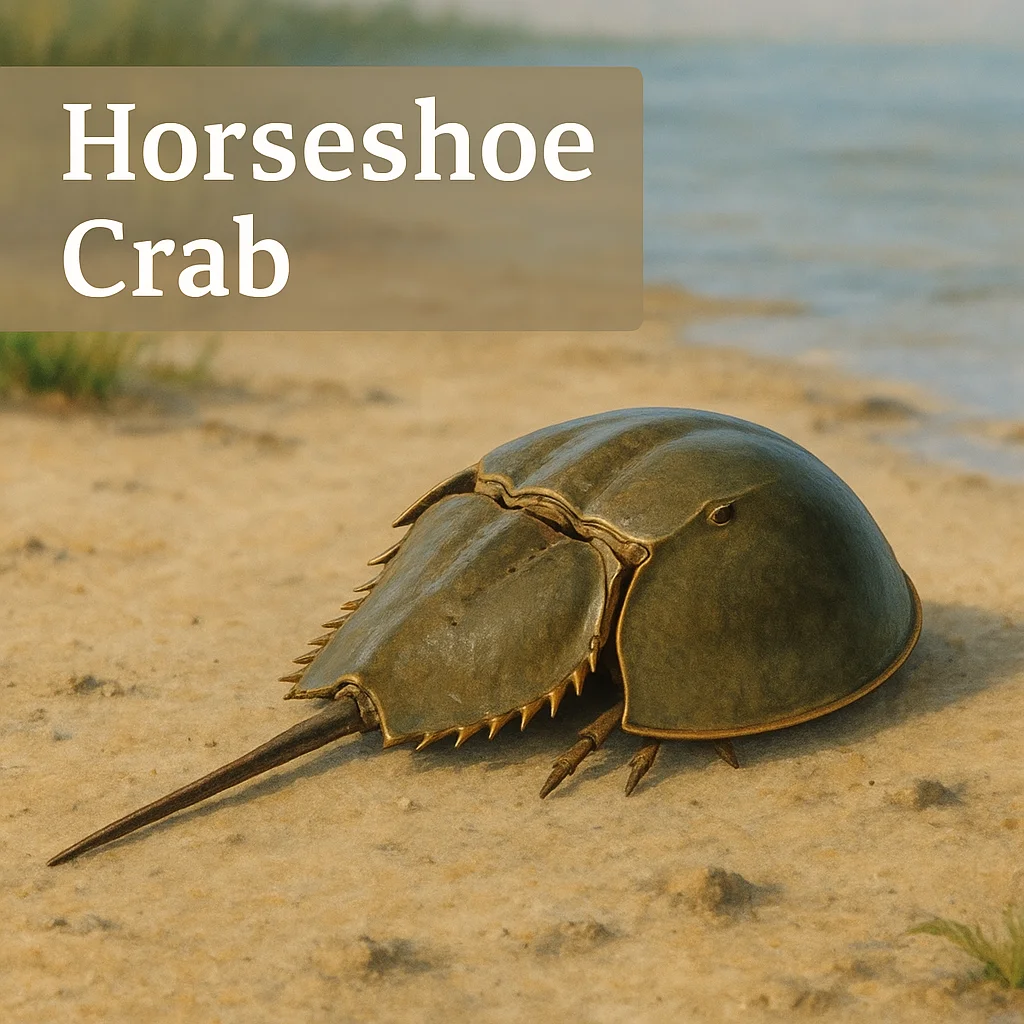
Horseshoe crabs are easily recognizable by their dome-shaped, hard shell and long, spiky tail, which is not used as a weapon but rather to right themselves if flipped over. Their color ranges from greenish-blue to brown. They have a unique design featuring ten legs and a series of eyes located on and around their shell.
- Recognizable dome-shaped shell
- Long, spiky tail (telson)
- Greenish-blue to brown coloration
- Ten legs hidden under their shell
- Numerous eyes located on the shell
- Body divided into prosoma and opisthosoma
- Commonly mistaken for true crabs
- Spiny appearance, but not aggressive
- Visible gill flaps called book gills
🧱 Body Structure & Physical Adaptations
The horseshoe crab's tough exoskeleton provides physical protection, while its book gills allow for both aquatic respiration and limited terrestrial survival. Its legs are specialized for walking along the seabed and for digging in the sand.
- Hard exoskeleton for protection
- Long, tail spine for self-righting
- Book gills for aquatic respiration
- Limbs adapted for seabed movement
- Simple mouth with gnathobases for grinding food
- Sensory hairs on appendages
- Compound lateral eyes for movement detection
- Ability to tolerate low oxygen levels
- Broad front for ploughing through sand
🌍 Range & Distribution
Horseshoe crabs are primarily found in the shallow coastal waters and estuaries of the Atlantic Ocean and the Gulf of Mexico. They thrive in warm waters and are often associated with sandy or muddy bottoms.
- North America: Atlantic Coast
- Gulf of Mexico shores
- Prefers warm, shallow waters
- Common around sandy/muddy substrates
- Typically no deeper than 200 meters
- Occasionally in estuarine environments
- No significant seasonal migration
- Found in intertidal zones
- Tolerates varying salinity
🏞️ Habitat & Shelter
Horseshoe crabs prefer coastal habitats where they can make use of the sandy or muddy bottoms for food and breeding purposes. Their behavior may change with seasonal tides, as they move closer to shore during spawning periods.
- Prefers sandy/muddy coastal zones
- Found in shallow seabeds
- Breeds in intertidal zones
- Uses tides for shore movement
- Environmental changes affect activity
- Seasonal breeding affects distribution
- Stable zones provide ample food supply
- Essential to protect coasts from erosion
🧭 Behavior & Ecology
Horseshoe crabs are known for their unique tidal spawning behavior, congregating en masse on beaches. They have relatively simple social interactions but play crucial roles in their ecosystems as both prey and as part of nutrient cycling processes.
- Nocturnal activity
- Tidal migrations for spawning
- Minimal communication; relies on touch
- Ecological role as prey for birds/fish
- Critical for nutrient cycling
- Spawning triggers local biodiversity events
- Limited direct interaction with other species
- Essential for coastal ecosystem function
- Spawning supports various marine life
- Limited use of vocalization or displays
👥 Social Life & Group Dynamics
While generally solitary, horseshoe crabs are known for their large spawning aggregations during the breeding season. Outside of these events, they may loosely associate during feeding or resting but do not form complex social structures.
- Primarily solitary outside breeding
- Large groups form for spawning
- Aggregates are short-lived, seasonal
- No defined hierarchy or dominance
- Females larger than males in groups
- Group dynamics change with tides
- Group cooperation is minimal
- Spawning leads to high reproductive success
- Temporary associations for environmental reasons
🍽️ Diet, Prey & Predators
Horseshoe crabs are omnivorous, feeding on small invertebrates and organic matter found along the ocean floor. Their natural predators include fish, birds, and certain marine mammals, while human activities pose significant threats due to habitat disruption.
- Feeds on worms, mollusks, algae
- Omnivorous, flexible diet
- Predators include sharks, turtles, birds
- Scavenging plays a role in diet
- Gills support oxygen acquisition during foraging
- Uses gnathobases to crush food
- Feeding affected by habitat conditions
- Significant prey for migratory shorebirds
- Human harvesting as a major threat
- Vital food resource in marine webs
🦌 Hunting, Foraging & Movement
Horseshoe crabs forage primarily at night, using their legs to walk along and dig into the seafloor. They are slow-moving and not predatory, feeding on what they encounter in their natural habitat.
- Slow, steady seabed movement
- Nocturnal foraging behavior
- Not aggressive, non-predatory
- Uses legs for digging and moving
- Forage by sensing with appendages
- Mostly sedentary, except during spawning
- Limited active movement range
- Spawning movements tied to lunar cycles
- Locomotion adaptation for muck/sand
🧠 Intelligence & Senses
The horseshoe crab has a simple nervous system and primarily relies on its compound eyes and sensory hairs to navigate its environment. Despite its ancient lineage, research on their intelligence remains limited.
- Simple nervous system
- Limited learning abilities
- Relies on sensory hairs for exploration
- Compound lateral eyes for navigation
- Eyestalks help detect predators/prey
- Minimal research on cognitive features
- Primarily instinct-driven behaviors
- Uses chemical cues in mate finding
- Sensitivity to environmental changes
🪺 Reproduction, Pregnancy & Parenting
Reproduction in horseshoe crabs is marked by their unique spawning behavior, where females lay thousands of eggs in beach sand. Males fertilize the eggs externally in a process that supports diverse coastal ecosystems.
- Spawns yearly with mass beach gatherings
- External fertilization with male clinging
- Females lay thousands of eggs
- Spawning linked to spring tides
- No parental care post-egg laying
- Eggs crucial for local bird populations
- Juvenile crabs develop independently
- Breeding season varies with location
- High egg mortality offsets by quantity
♀️♂️ Male vs Female Differences
Male and female horseshoe crabs can be distinguished primarily by size and by appendage adaptations related to reproduction. Females are larger, an adaptation to carry and lay vast numbers of eggs.
- Females are generally larger
- Males possess specialized front claws
- Size helps males grasp females
- Color and appearance very similar
- Behavioral roles diverge during breeding
- Females responsible for egg burial
- Size increases female fecundity
- Minor physical dimorphisms otherwise
- Females more prominent in aggregations
🧬 Subspecies & Variation
There are several species of horseshoe crabs across the globe, each with adaptations to their local environments. While some differences in size and shell morphology are noted, these variations are subtle and sometimes debated.
- Limulus polyphemus most studied
- Asian species: Tachypleus and Carcinoscorpius
- Differences in shell size among species
- Subtle color variations, largely environmental
- Some differences due to geographical isolation
- Nocturnal behaviors vary regionally
- Conservation status depends on location
- Species largely adaptable to coastal areas
⚠️ Threats, Conservation & Human Interaction
The horseshoe crab faces multiple threats from habitat loss, climate change, and overharvesting for use in medical research and fishing bait. Conservation efforts focus on habitat preservation and sustainable harvest regulation to ensure population stability.
- Habitat destruction from coastal development
- Overharvesting for biomedical purposes
- Bycatch in commercial fisheries
- Pesticide runoff affects habitat
- Climate change impacts breeding seasons
- Conservation programs vary by region
- Key for maintaining marine biodiversity
- Responsible tourism can aid conservation
- Legal protections depend on jurisdiction
✨ Fun Facts & Unique Traits
- Horseshoe crabs have existed for over 450 million years.
- Their blue blood is used in medical testing for bacterial contamination.
- They use the same areas to spawn each year, showing site fidelity.
- Horseshoe crabs can survive out of water for short periods.
- Their shells are highly effective in studying climate change effects.
- Eggs provide essential nutrients for migratory birds.
- Their vision is suited for detecting light changes, crucial for tide rhythm detection.
- Despite their armored look, they are not aggressive.
- They play a critical role in medicinal advancements.
- Can regenerate lost limbs over time.
📌 Summary
- Recognizable by their dome-shaped shell and long tail
- Found mainly along the Atlantic and Gulf coasts
- Inhabit shallow coastal and estuarine environments
- Omnivorous diet; primarily nocturnal foragers
- Roles as prey critical to coastal ecosystems
- Notable mass spawning behavior in spring
- Females larger than males; differing reproductive roles
- Vital to both natural and human-made ecosystems
- Variability across species, conservation status varies
- Remarkable ecological history, persisting for millions of years