🦁 Honey Bee
🧾 Quick Facts
Honey bees are social insects known for producing honey and playing a vital role in pollination. They belong to a larger group of bees, but not all bees are honey producers. Honey bees are typically managed in colonies and have become integral to agriculture and ecosystems worldwide.
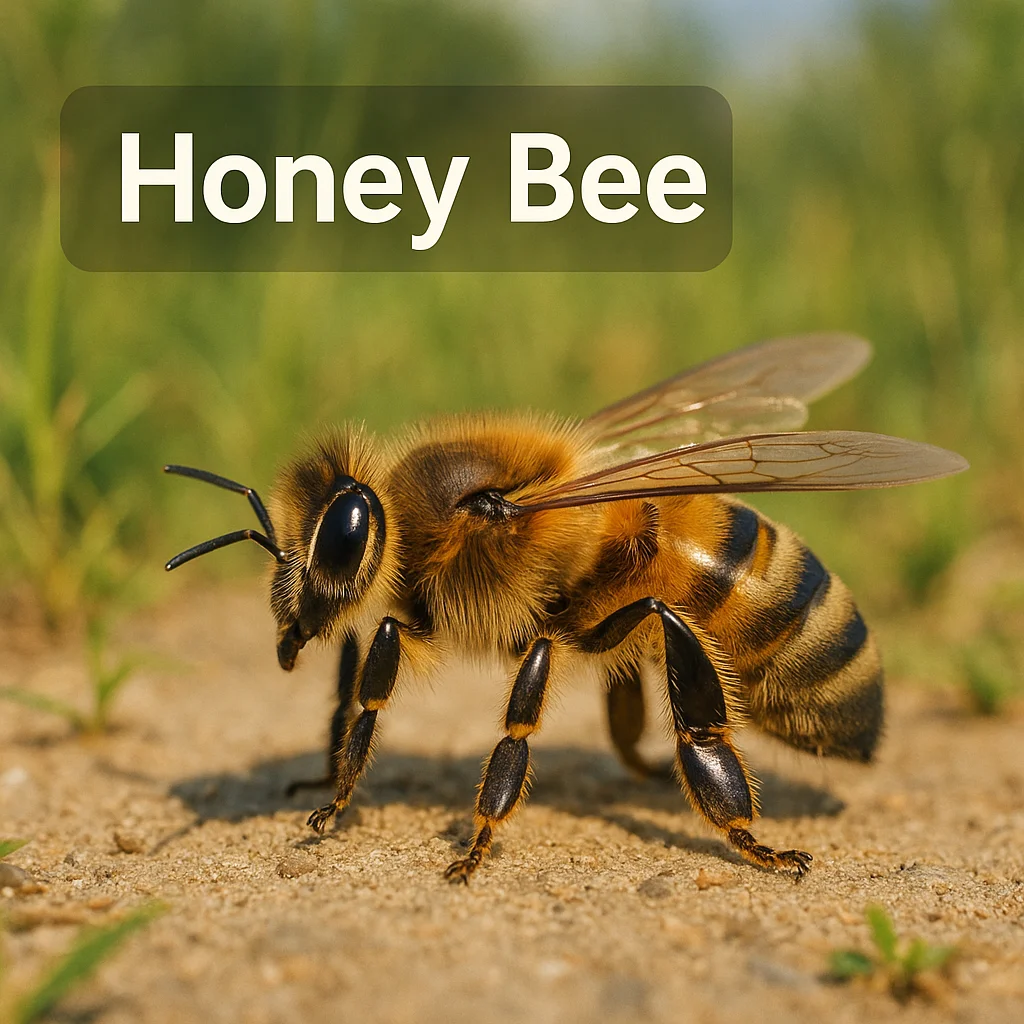
- Common name(s): Honey bee
- Scientific name: Often listed as Apis spp., primarily Apis mellifera
- Animal type: Invertebrate
- Typical adult size: 1-2 cm in length
- Typical lifespan: Workers live a few weeks to months; queens can live several years
- Diet type: Herbivore; primarily nectar and pollen
- Activity pattern: Diurnal
- Social structure: Highly social, lives in colonies
- Speed / movement highlights: Capable of flying at approximately 24 km/h (15 mph)
- Intelligence/learning: Known for complex communication and learning through experience
- Primary habitats: Forests, gardens, meadows, and agricultural areas
- Geographic range: Originating from Eurasia; now found on every continent except Antarctica
- Predators/threats: Birds, mammals, other insects; human pressures include habitat loss and pesticides
- Conservation status: Varies by region; some populations are declining
🔍 Identification & Appearance
Honey bees are small, robust insects with typical yellow and black banding. Their furry bodies are distinctive, aiding in pollen collection. Most commonly recognized by their sleek, segmented abdomen and translucent wings.
- Body shape and silhouette: Compact with a defined abdomen
- Key colors/patterns: Yellow and black bands
- Distinctive features: Hairy body, small waist, angled wings
- Tracks, scat, or field signs: N/A for invertebrates
- Common look-alikes: Wasps, which generally lack hair and possess a thinner body
- Top ID Tips:
- Look for yellow and black banding
- Notice the hairy body, which aids in pollen collection
- Check for a small, defined waist
- Observe wing positioning at rest, forming a V
- Compare with wasps, which are less hairy and thinner
🧱 Body Structure & Physical Adaptations
Honey bees showcase several physical adaptations for their roles in pollination and hive living. Their small, agile wings allow for efficient flight, and their bodies are structured for foraging and defense.
- Build and proportions: Compact with a slightly elongated abdomen
- Teeth/beak/jaw adaptations: Mandibles adapted for gripping and cutting
- Claws/hooves/wings: Small, transparent wings efficient for rapid and maneuverable flight
- Sensory strengths: Acute vision for detecting flowers; strong sense of smell for communication and foraging
- Key Adaptations:
- Specialized body hair for pollen collection
- Proboscis for nectar extraction
- Ability to regulate hive temperature
- Complex eye structure for detecting patterns
- Stinger for colony defense
🌍 Range & Distribution
Honey bees, originally native to Eurasia, have been transported globally due to their significance in pollination and agriculture. They thrive in various climates, adapting to local environments where they establish colonies.
- Where You Might Find It:
- European meadows and gardens
- North American farmlands and forests
- Asian temperate and tropical regions
- African savannas and cultivated lands
- Australian natural ecosystems and plantations
🏞️ Habitat & Shelter
Honey bees prefer environments abundant in flowering plants, offering ample nectar and pollen. They often build colonies in sheltered locations such as tree hollows or human-made hives, providing protection against weather changes.
Understanding their habitat is essential for successful beekeeping practices and supporting healthy ecosystems. Seasonal changes, like the availability of flowers, greatly influence their foraging behaviors and hive activities.
🧭 Behavior & Ecology
Honey bees are known for their complex behaviors and ecological impacts. They follow a daily routine centered around foraging and hive maintenance, displaying remarkable coordination within the colony. Their communication involves pheromones and the famous "waggle dance," a dance that conveys information about resources.
- Behavior Highlights:
- Highly structured colony life
- Efficient division of labor
- Complex foraging strategies
- Sophisticated communication methods
- Integral role in pollination
👥 Social Life & Group Dynamics
Living in colonies, honey bees have a defined social structure. The hive is centered around a queen, with workers and drones fulfilling various roles. Workers care for the hive, foraging and tending to the brood, while drones focus on mating.
- Social Structure Notes:
- Colonies can house up to 60,000 individuals
- Queen dominates the reproductive hierarchy
- Worker bees exhibit task specialization
- Drones are primarily focused on reproduction
- Colony cohesion maintained through pheromones
🍽️ Diet, Prey & Predators
Honey bees are herbivores, feeding on nectar and pollen from flowers. Nectar provides carbohydrates, while pollen supplies proteins and fats. They may face threats from birds, mammals, and other insects, adapting strategies to protect their hive.
- Feeding Notes:
- Nectar gathered from diverse flowering species
- Pollen collected as a crucial protein source
- Predators include birds like bee-eaters
- Deploy defensive stinging when threatened
- Hive cooperation in deterring larger predators
🦌 Hunting, Foraging & Movement
Honey bees are adept foragers, capable of navigating complex environments. They demonstrate efficient flight abilities and energy management. Their primary foraging occurs during daylight, with bees visiting myriad flowers in search of resources.
- Movement & Strategy:
- Foraging range varies; up to several kilometers from the hive
- Flight patterns optimized for resource discovery
- Waggle dance guides other bees to food sources
- Daylight foraging increases survival chances
- Consistent routes developed for efficient resource use
🧠 Intelligence & Senses
Honey bees exhibit impressive cognitive abilities and sensory adaptions. They are capable of learning from experience and remembering locations. Their compound eyes and antennas are vital for interpreting environmental cues.
- Notable Abilities:
- Strong spatial memory for effective foraging
- Ability to learn complex patterns and shapes
- Acute sense of smell for flower detection
- Efficient problem-solving skills within hive
- Group intelligence for adapting to environmental challenges
🪺 Reproduction, Pregnancy & Parenting
Queen honey bees are the only reproducing females in the colony. Mating occurs during flights, with a single queen capable of laying thousands of eggs. Subsequently, worker bees nurture the eggs, ensuring colony sustainability.
- Reproduction Snapshot:
- Mating flights conducted by queens
- Polygyny system within a single queen’s colony
- Rapid laying ability, up to 1,500 eggs daily
- Worker bees manage egg incubation and care
- Lifespan variations between castes in the colony
♀️♂️ Male vs Female Differences
Differences between male and female honey bees are primarily seen in size and roles within the colony. The queen, larger and more robust, differs from the smaller worker bees and even larger but less numerous drones. Males primarily focus on reproduction, while females engage in all other tiered roles.
- Sex Differences at a Glance:
- Queens are significantly larger than workers
- Drones are larger but fewer than worker females
- Queens possess elongated abdomens for egg-laying
- Workers develop special adaptations for multiple tasks
- Behavioral roles distinct between males and females
🧬 Subspecies & Variation
Honey bees include several subspecies, each exhibiting adaptations specific to their environment. These variations may result in differences in behavior, size, and resilience to environmental changes.
- Variation Notes:
- Apis mellifera has multiple recognized subspecies
- Subspecies adapted to diverse climates
- Variation in hairiness according to temperature
- Behavioral variations in defensive reactions
- Ability to optimize resource use based on region
⚠️ Threats, Conservation & Human Interaction
Natural threats to honey bees include predators and environmental fluctuations. Human-induced pressures, such as pesticides, habitat loss, and climate change, continue to impact their populations. A sustained effort in conservation and awareness is required to promote coexistence and ensure ecological balance.
- Responsible Notes:
- Support local beekeeping initiatives
- Minimize pesticide use near gardens
- Promote biodiversity by planting native flowers
- Participate in community awareness programs
- Monitor and report declines in populations
✨ Fun Facts & Unique Traits
- Honey bees use the sun as a compass during navigation
- Each bee contributes a mere teaspoon of honey in its lifetime
- Facial recognition abilities allow bees to remember feeding spots
- The waggle dance is a sophisticated communication method
- Beeswax has antibacterial properties, aiding hive health
- The shapes of honeycombs are remarkably energy efficient
- Strains of honey bees can develop "language" adaptations
📌 Summary
- Honey bees are vital pollinators with global distribution
- Characterized by their banded, hairy bodies and social structure
- Live in large colonies with diverse cooperative behaviors
- Produce honey and support food crops through pollination
- Demonstrate sophisticated navigation and communication
- Face threats from both natural predators and human activities
- Notable for their extensive role in agriculture and ecosystems
- Subspecies exhibit specialization based on regional conditions