🦁 Emperor Scorpion
🧾 Quick Facts
The Emperor Scorpion, one of the largest scorpions in the world, is a fascinating invertebrate known for its impressive size and docile nature. Often found in the lush rainforests and savannas of West Africa, it captivates with its striking appearance and mysterious allure. Despite its formidable look, it plays a unique role in its ecosystem.
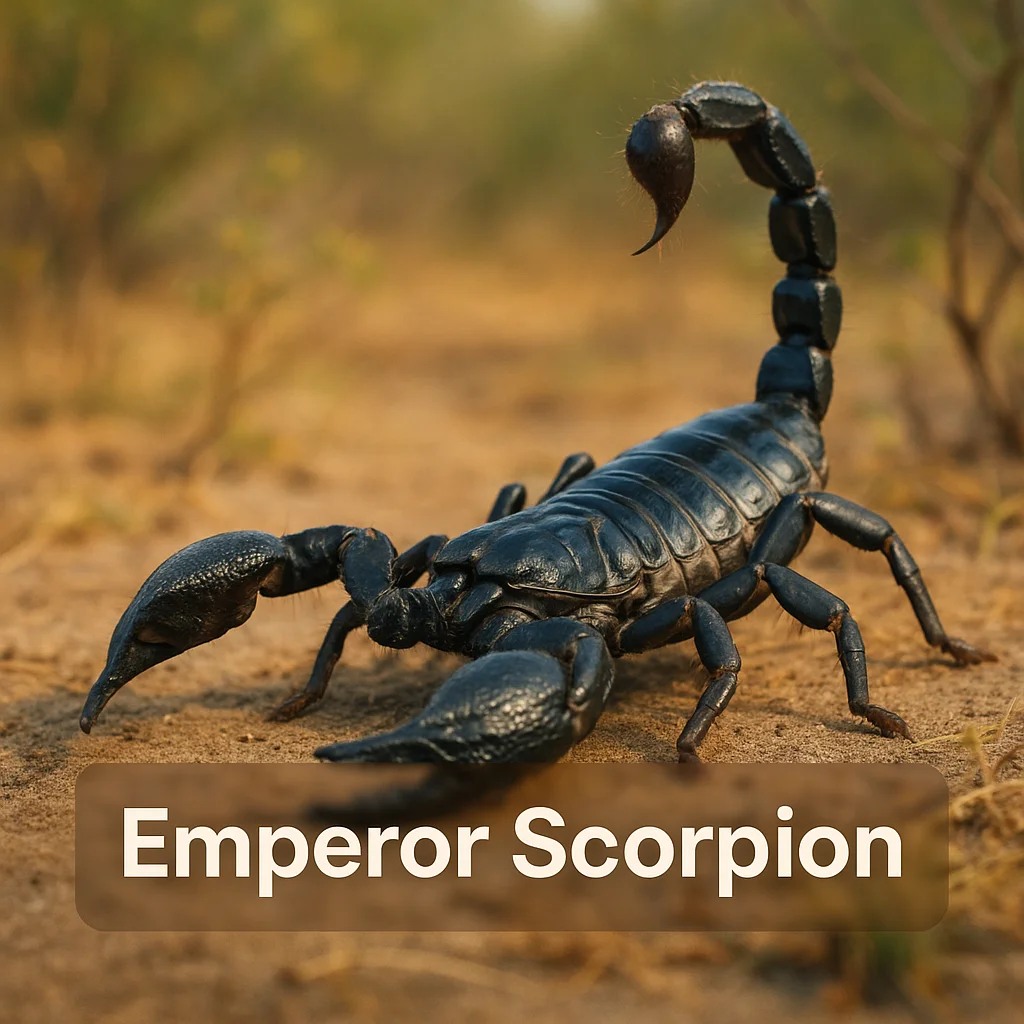
- Common name: Emperor Scorpion
- Scientific name: Pandinus imperator
- Animal type: Invertebrate
- Typical adult size: 15–23 cm (6–9 inches) in length
- Typical lifespan: Varies, often up to 8 years in captivity
- Diet type: Carnivore; feeds primarily on insects
- Activity pattern: Nocturnal
- Social structure: Generally solitary
- Speed / movement highlights: Slow walker
- Intelligence/learning: Exhibits basic problem-solving
- Primary habitats: Rainforest and savanna
- Geographic range: Western Africa
- Predators/threats: Birds, mammals, and human encroachment
- Conservation status: Not currently endangered
🔍 Identification & Appearance
The Emperor Scorpion is unmistakable, thanks to its large, robust body and vivid black coloration. Its glossy exoskeleton can display a bluish-black sheen, particularly under ultraviolet light. The thick, powerful pincers are a key feature, helping to distinguish it from other scorpion species.
- Top ID Tips
- Large, sturdy body
- Prominent, powerful pincers
- Glossy black or dark blue exoskeleton
- Long, curled tail with a venomous sting
- Slightly flattened body silhouette
- Shines under ultraviolet light
- Juveniles are lighter, brownish in color
- Movement: slow and deliberate
🧱 Body Structure & Physical Adaptations
The Emperor Scorpion is robust and well-adapted for survival. Its body is divided into three parts: the cephalothorax, abdomen, and long, curled tail with a venomous stinger at the end. Its pincers are designed for gripping and crushing prey. Despite popular misconceptions, its venom is relatively mild and rarely harmful to humans.
- Key Adaptations
- Strong exoskeleton for protection
- Venomous sting for defense and subduing prey
- Powerful pincers for capturing food
- UV reflecting exoskeleton
- Sensitive hairs on legs for detecting vibrations
- Camouflaged appearance in natural habitat
- Nocturnal to avoid predators and heat
- Simple eyes with limited vision, relying on tactile senses
🌍 Range & Distribution
The Emperor Scorpion is native to the rainforests and savannas of West Africa. It thrives in warm, humid environments, though it can occasionally adapt to slightly drier regions. Unlike many species, it typically remains in a relatively small home range throughout its life.
- Where You Might Find It
- West African countries like Nigeria and Ghana
- Tropical rainforests
- Savanna regions with adequate shelter
- Forested areas with lots of leaf litter
- Underground burrows or natural crevices
- Near water sources within its habitat
- Lowland areas
- Rarely in open, dry areas
🏞️ Habitat & Shelter
The Emperor Scorpion's habitat often consists of rainforests and savannas, where it seeks shelter under rocks, logs, and in underground burrows. It favors environments that offer abundant cover and humidity, relying on its natural habitats to provide essential resources for survival.
Seasonal weather changes can influence its behavior, especially regarding activity levels and moisture availability. Habitat knowledge is crucial for understanding its predator avoidance strategies and prey capture techniques.
🧭 Behavior & Ecology
Emperor Scorpions are primarily nocturnal, resting in their burrows or shelters during the day. They rely heavily on tactile and chemical cues to communicate and sense their surroundings. Despite their fierce appearance, they generally avoid confrontation, using their pincers as a defense mechanism.
- Behavior Highlights
- Nocturnality helps avoid predators
- Uses burrows for shelter and protection
- Relatively docile disposition
- Semi-colonial behavior observed in captivity
- Sensitive to ground vibrations
- Minimal vocalizations
- Infrequent molting in adults
- Exhibits solitary hunting behavior
👥 Social Life & Group Dynamics
While primarily solitary, Emperor Scorpions may exhibit semi-colonial tendencies under specific conditions, particularly in captivity, where multiple individuals may share a space without significant aggression. In their natural habitat, they are frequently found alone, defending their territories against intrusions.
- Social Structure Notes
- Primarily solitary in the wild
- Semi-colonial behavior in captivity
- Defends territories from rivals
- Low levels of social interaction
- Young stay with mother briefly
- Tolerance increases with abundant resources
🍽️ Diet, Prey & Predators
The Emperor Scorpion primarily preys on insects, though it may consume small vertebrates when available. Utilizing its pincers and venomous sting, it subdues prey effectively. Despite its size, it faces threats from birds and larger mammals. Its black coloration provides some degree of camouflage in its natural environment.
- Feeding Notes
- Carnivorous diet
- Hunts insects such as crickets
- Occasionally consumes small rodents
- Uses pincers to grip prey
- Venom used to immobilize food
- Can fast for extended periods
- Faces predation from birds of prey
- Employs hiding as anti-predator strategy
🦌 Hunting, Foraging & Movement
Emperor Scorpions are ambush predators, waiting patiently for prey to approach. They rely on stealth and slow movements to avoid detection. Best suited for slow, deliberative hunting, they primarily hunt at night, using their keen senses to detect vibrations and chemical signals of nearby prey.
- Movement & Strategy
- Ambush predator
- Prefers nocturnal hunting
- Slow and steady movement
- Utilizes camouflage for stealth
- Relies on tactile senses for navigation
- Home range is small and well-defended
- Generally avoids open spaces
🧠 Intelligence & Senses
While not possessing high intelligence levels, Emperor Scorpions display basic problem-solving abilities. Their senses are well-adapted for their nocturnal lifestyle, relying on keen tactile perception to locate prey and detect threats. Although their eyesight is poor, they have sensitive hairs for detecting movement and vibrations.
- Notable Abilities
- Sensitive to ground vibrations
- Relies on chemical sensing
- Basic problem-solving observed
- Poor eyesight compensated by tactile senses
- Senses help detect both prey and predators
🪺 Reproduction, Pregnancy & Parenting
Emperor Scorpions engage in a captivating courtship behavior, where males and females perform a "dance," called the promenade à deux. Reproduction tends to occur year-round in favorable conditions. Males deposit a spermatophore, which females pick up to fertilize their eggs. After about nine months of gestation, females give birth to live young, which they carry on their back until the first molt.
- Reproduction Snapshot
- Gestation: Around 9 months
- Live birth with an average of 10–12 young
- Young are altricial
- Maternal care until first molt
- Courtship involves complex "dancing"
- Females are wholly responsible for young
♀️♂️ Male vs Female Differences
Among Emperor Scorpions, sexual dimorphism is subtle. Males are slightly smaller but have larger pincers relative to their body size. Females, on the other hand, are known for being slightly larger and having a rounder abdomen, which aids in carrying offspring.
- Sex Differences at a Glance
- Males have proportionally larger pincers
- Females are slightly larger overall
- Females have a rounder abdomen
- Males usually engage in courtship dance
- Females exhibit maternal behaviors
🧬 Subspecies & Variation
While the Emperor Scorpion is generally recognized as a single species, there may be local variations in size or color based on regional habitats. However, no formally recognized subspecies exist, and any changes are subject to environmental influences rather than significant genetic differentiation.
- Variation Notes
- Size varies slightly by region
- Coloration can differ under lighting conditions
- Variations linked to habitat conditions
- No recognized subspecies currently
- Regional adaptations are minimal
⚠️ Threats, Conservation & Human Interaction
Despite being well-adapted to their environment, Emperor Scorpions face pressure from habitat destruction and accidental collection for the pet trade. In captivity, it is essential to provide conditions that mimic their natural habitat as closely as possible to ensure their wellbeing.
- Responsible Notes
- Susceptible to habitat destruction
- Accidental capture and trade affect wild populations
- Beneficial as pest control agents
- Require specific conditions in captivity
- Not considered endangered at present
- Research required for conservation needs
✨ Fun Facts & Unique Traits
- Emperor Scorpions glow under UV light due to substances in their exoskeleton.
- They can fast for periods extending over a year if necessary.
- Females can be seen carrying young on their backs for protection.
- The "dance" used during mating is a unique courtship ritual.
- They are one of the longest-living scorpion species.
- Their venom is primarily used to subdue prey rather than to kill.
- They play a vital role in controlling insect populations.
- Their robust pincers are more crucial for hunting than their sting.
📌 Summary
- Large and black with powerful pincers, the Emperor Scorpion is a captivating arachnid from West Africa.
- Its habitats include rainforest and savanna, where it seeks shelter in natural covers.
- Primarily nocturnal and solitary, though it can show semi-colonial tendencies in captivity.
- Feeds on insects and small vertebrates, using pincers and venom for capturing prey.
- Undergoes a unique courtship ritual and provides extensive maternal care.
- Habitat destruction and pet trade pressures require mindful human interaction.
- Adaptations include nocturnal habits, robust exoskeleton, and a potent but relatively mild venom.
- Their role as pest controllers highlights their ecological importance.