🦁 Dragonfly
🧾 Quick Facts
Dragonflies are captivating and agile flyers that belong to the order Odonata. They are often admired for their brilliant colors and impressive flying abilities. Their ecological role as predators makes them significant in controlling insect populations.
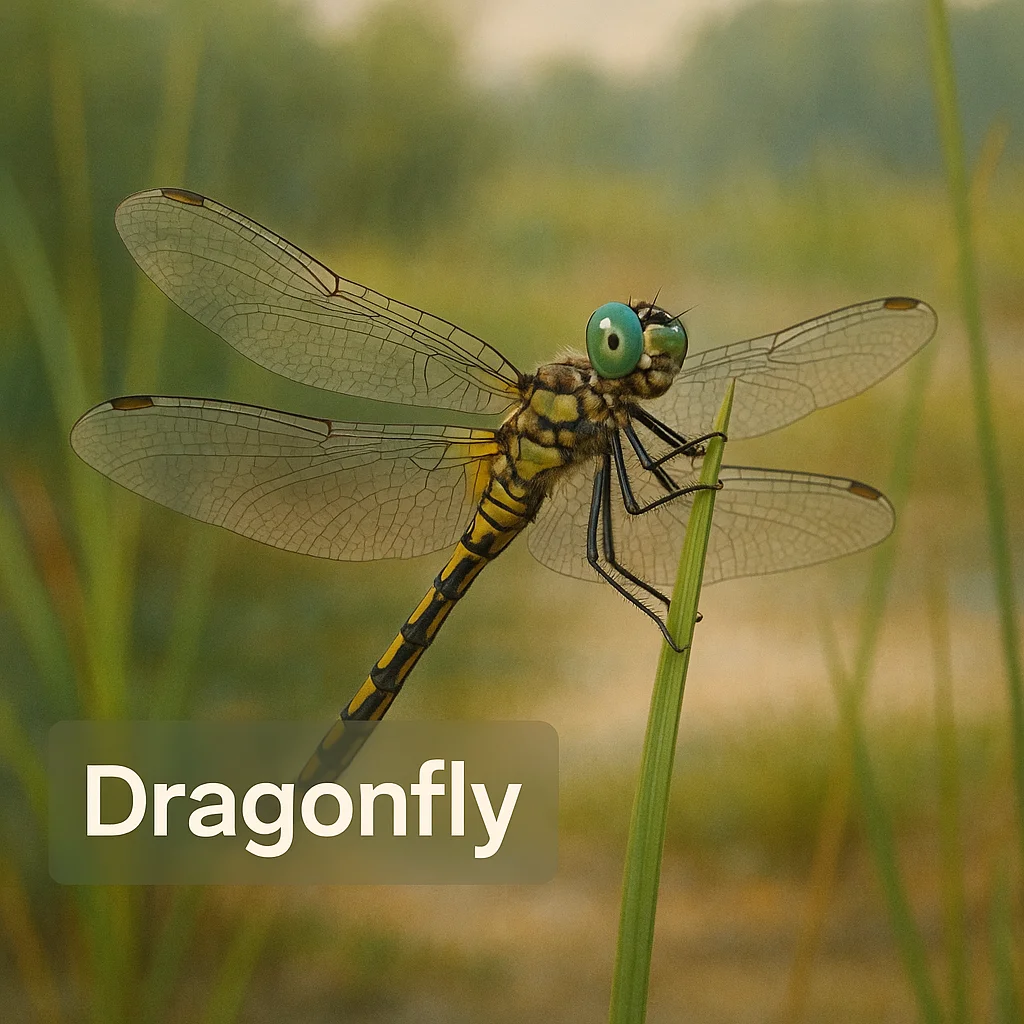
- Common name(s): Dragonfly
- Scientific name: Varies by species (e.g., Anax imperator, Libellula depressa)
- Animal type: Invertebrate
- Typical adult size: 2–6 inches (5–15 cm) wingspan
- Typical lifespan: Several months to a year, varies by species
- Diet type: Carnivore; feeds on insects like mosquitoes and flies
- Activity pattern: Diurnal
- Social structure: Solitary predators
- Speed / movement highlights: Can fly up to 18 mph (29 km/h)
- Intelligence/learning: Capable of learning and memory; expert hunters
- Primary habitats: Wetlands, ponds, lakes, rivers
- Geographic range: Worldwide, except Antarctica
- Predators/threats: Birds, larger insects; habitat loss
- Conservation status: Varies by region; many species not currently threatened
🔍 Identification & Appearance
Dragonflies are easily recognized by their elongated bodies, large multifaceted eyes, and two pairs of strong, transparent wings. Their bodies are often colorful, displaying iridescent blues, greens, and reds, depending on the species and environmental conditions. The body segments and wing veins are integral for species distinction.
- Top ID Tips:
- Elongated body with distinct segments
- Large, rounded eyes that occupy most of the head
- Transparent wings with visible veins
- Variety of colors, often metallic or iridescent
- Perch with wings held out horizontally
- Observe near water bodies
- Swift and agile flight patterns
- Presence of pterostigma spots on wings
- Each wing operates independently for agile movement
🧱 Body Structure & Physical Adaptations
Dragonflies have slender, elongated bodies optimized for speed and agility in flight. Their two pairs of wings allow for remarkable maneuverability. The eyes offer a wide field of vision, crucial for detecting prey and evading danger. This combination of features supports their predatory lifestyle.
- Key Adaptations:
- Slender body for high-speed flight
- Independent movement of all four wings
- Large eyes with nearly 360-degree vision
- Sharp mandibles to capture and consume prey
- Strong legs for perching
- Hard exoskeleton for protection
- Colorful body to blend into vegetative backgrounds
- Specialized thorax muscle arrangement for wing control
🌍 Range & Distribution
Dragonflies are found on every continent except Antarctica. They occupy a variety of freshwater habitats, including ponds, lakes, rivers, and wetlands. Some species are also found in urban environments where suitable water sources exist. Dragonflies are primarily non-migratory, with some exceptions.
- Where You Might Find It:
- Tropical rainforests
- Temperate forests and woodlands
- Freshwater wetlands and marshes
- Near slow-moving or still water bodies
- Gardens with ponds or water features
- Urban parks with water access
- Open fields and meadows adjacent to water
- Throughout the Americas, Africa, Asia, Europe, and Australia
🏞️ Habitat & Shelter
Dragonflies prefer habitats that are close to freshwater sources since their larval stages require aquatic environments. The presence of water plants and open sunlight areas also contributes to ideal conditions for breeding, hunting, and resting. Seasonal changes may affect water levels and influence dragonfly distribution, highlighting the importance of habitat knowledge for understanding species behavior and survival.
🧭 Behavior & Ecology
Dragonflies are predators that exhibit territoriality, especially males. They spend much of their time flying during the day, hunting for insects or patrolling territories. Communication is primarily visual, involving flight displays to deter rivals or attract mates. They play a role as both predators and prey in the ecosystem, helping to manage mosquito populations while serving as food for birds and larger insects.
- Behavior Highlights:
- Daytime flying and hunting
- Visual communication with flight displays
- Defend territories against rivals
- Help control insect populations
- Serve as prey for birds and larger insects
- Feed while in flight
- Detect movement and evade quickly
- Short resting periods between flights
👥 Social Life & Group Dynamics
Dragonflies are generally solitary creatures, but during breeding seasons, they can be observed in groups near water bodies. Males are known for aggressive territorial defenses and mating displays. Although they do not form long-term bonds or social groups like mammals, these interactions are crucial for reproduction.
- Social Structure Notes:
- Solitary outside of breeding or migration periods
- Temporary aggregations near breeding sites
- Individual territories defended aggressively
- No inter-individual cooperation
- Short-lived pair bonds during mating
🍽️ Diet, Prey & Predators
Dragonflies are insectivorous predators, feeding on a variety of small insects such as mosquitoes, flies, and other small arthropods. They capture prey mid-flight using their legs to form a basket shape. Natural predators include birds and frogs, while their agile flight is a key defense mechanism against these threats.
- Feeding Notes:
- Diverse insect diet helps control pest populations
- Agile aerial hunters with a high success rate
- Hunt and feed in the air
- Natural predators include birds and frogs
- Capture method involves using legs as a basket
- Minimum feeding interaction with other dragonflies
🦌 Hunting, Foraging & Movement
Primarily airborne, dragonflies exhibit exceptional flight capabilities, characterized by swift maneuvers and hover flight. They are capable of rapid acceleration and can change direction almost instantaneously. These traits aid in hunting prey and dodging potential threats. Dragonflies usually hunt during the day when insect activity is at its peak.
- Movement & Strategy:
- Masterful aerial navigation and hunting
- Can hover in place like a helicopter
- Capable of rapid acceleration and sudden direction changes
- Most active during warm daylight hours
- Utilize both eyesight and body adaptations for movement
🧠 Intelligence & Senses
Dragonflies possess compound eyes that give them exceptional vision, covering almost their entire head. This enables them to detect motion and detail crucial for hunting. Although less is known about their problem-solving abilities, their skills in prey detection and navigation suggest a high level of adaptation to their ecological niche.
- Notable Abilities:
- Sophisticated compound eyes for detecting movement
- Quick reflexes to avoid predators
- Vision adapted for color detection in various light levels
- Hunting skills indicate advanced visual processing
- Specialized for an aerial, predatory lifestyle
🪺 Reproduction, Pregnancy & Parenting
Dragonflies engage in complex mating rituals that involve flight displays and territorial competitions. They are predominantly promiscuous, with mating typically occurring near water bodies where females lay their eggs. Unlike mammals, dragonfly parenting is absent; they do not exhibit care for their offspring once eggs are laid.
- Reproduction Snapshot:
- Mating typically involves elaborate flight displays
- Eggs are laid on or near water surfaces
- Larval (nymph) stage is aquatic
- Females lay hundreds to thousands of eggs
- Mating system is generally promiscuous
- No parental care given to eggs or offspring
♀️♂️ Male vs Female Differences
Sexual dimorphism in dragonflies varies by species, but males often possess more vibrant colors and longer abdomens than females. Behavioral differences include territorial aggression in males, while females are more focused on egg-laying. Despite these differences, both sexes contribute to their ecological niche effectively.
- Sex Differences at a Glance:
- Males often show more vivid coloration
- Females may have broader abdomens for carrying eggs
- Males more aggressive in territory defense
- Female flight generally more purposeful towards egg-laying
- Mating behavior can vary with environmental factors
🧬 Subspecies & Variation
There is vast diversity among dragonfly species, with over 3,000 known globally. Differences in wing patterns, body size, and coloration can be observed due to ecological adaptations. While some species adapt uniquely to local environments, subspecies classification might be subject to ongoing research and debate.
- Variation Notes:
- More than 3,000 species worldwide
- Color and pattern differences adapt to environments
- Size variation across geographically isolated populations
- Latitude influences developmental rates and timing
- Subspecies classification still debated in science
⚠️ Threats, Conservation & Human Interaction
Dragonflies face threats primarily from habitat loss and environmental changes such as water pollution and climate change. While not all species are endangered, some regional populations decline due to these pressures. Ethical coexistence requires conservation of wetlands and natural spaces essential for their life cycles.
- Responsible Notes:
- Monitor wetland and water development projects
- Minimize pesticide use around water bodies
- Educate about the ecological value of dragonflies
- Conserve natural habitats to support lifecycle stages
- Support environmental policies that protect aquatic ecosystems
✨ Fun Facts & Unique Traits
- Dragonflies predate dinosaurs, with fossils over 300 million years old.
- Some species can migrate long distances, similar to birds.
- Dragonfly larvae, known as nymphs, are aquatic and predatory.
- Their flight ability includes hovering, backward movement, and sharp turns.
- Dragonflies can consume hundreds of mosquitoes daily.
- They play a critical role in freshwater ecosystem health by controlling insect populations.
- Dragonflies have one of the largest compound eyes relative to their body size among insects.
📌 Summary
- Recognizable by elongated bodies, large eyes, and transparent wings
- Found worldwide, predominantly near freshwater
- Diet consists mainly of insects, acting as natural pest control
- Environment influences behavior, breeding, and lifecycle
- Important ecological role as both predator and prey
- Reproduction involves complex flight courtships and laying eggs in water
- Distinctive flying capabilities with exceptional maneuverability
- Subspecies and variations reflect environmental adaptations
- Conservation focuses on habitat protection and pollution control
- Fun facts highlight their evolutionary history and ecological importance