🦁 Cicada
🧾 Quick Facts
The cicada is a fascinating group of insects known for their prominent calls and periodic appearances. With a diverse range of species, cicadas are distributed globally and are primarily recognized for their unique life cycles and cultural significance.
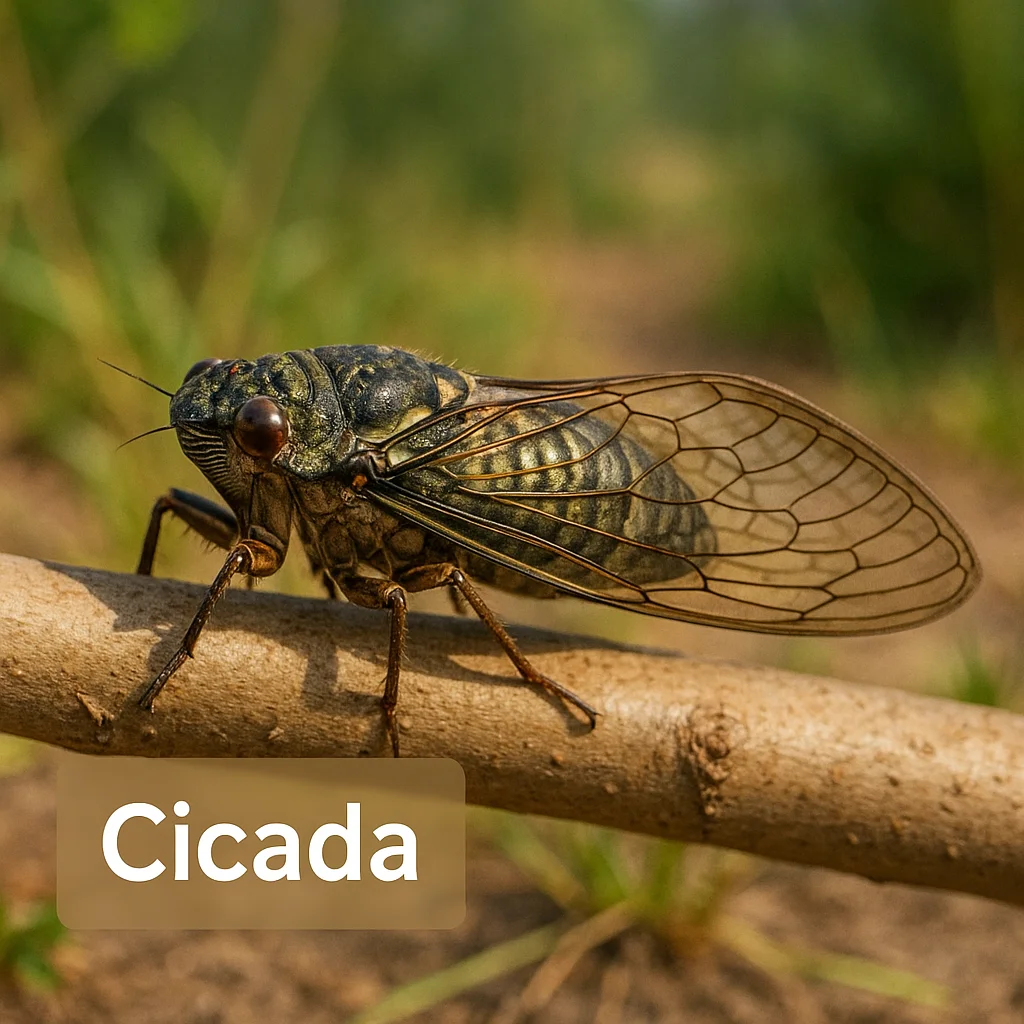
- Common name(s): Cicada
- Scientific name: Cicadidae (Family)
- Animal type: Invertebrate (Insect)
- Typical adult size: 1 to 5 cm in body length
- Typical lifespan: 2 to 17 years; varies
- Diet type: Herbivore; primarily xylem sap from trees and plants
- Activity pattern: Mostly diurnal
- Social structure: Solitary; though they may appear in large groups during emergence
- Speed / movement highlights: Capable of flight; varied speed
- Intelligence/learning: Basic; displays instinctual behaviors
- Primary habitats: Forests, woodlands, and areas with mature trees
- Geographic range: Worldwide; particularly abundant in temperate to tropical climates
- Predators/threats: Birds, bats, reptiles, spiders; habitat loss
- Conservation status: Varies by region; generally not endangered
🔍 Identification & Appearance
Cicadas are easily identified by their stout body, wide head, and prominent eyes. They have membranous wings that lay flat on their bodies when at rest. The body is typically brown, black, or green, with some species exhibiting striking red or orange accents. Males have a special structure called a tymbal that is used for producing their characteristic sound. Cicada skins can often be found clinging to tree bark after molting, serving as field signs of their presence.
- Stout body with a wide head
- Membranous wings that are transparent
- Prominent compound eyes
- Colors ranging from brown to green
- Males have visible tymbals for sound production
- Nymphs leave distinctive shed skins on tree trunks
- Similar to grasshoppers but have shorter antennae
- Red-eyed species are distinctive in the United States
- Body length generally up to 5 cm
🧱 Body Structure & Physical Adaptations
Cicadas are built robustly to facilitate their sedentary lifecycle underground and active life above ground. Their proboscis is adapted to pierce plant tissue to feed on xylem fluids. Their wings are strong yet light, allowing efficient flight. The tymbals of males create loud sounds for attracting mates, an adaptation central to their reproductive success. Cicadas have strong legs for holding onto bark and climbing.
- Robust build for burrowing and terrestrial life
- Adapted proboscis for piercing plant stems
- Light yet strong wings for sustained flight
- Males' tymbals for sound production
- Strong legs for climbing and grasping surfaces
- Bulging eyes positioned for a broad field of vision
- Simple mouthparts for sucking plant fluids
- Tympana used as ears for hearing sounds
🌍 Range & Distribution
Cicadas are found on every continent except Antarctica, thriving in a wide range of environments from tropical rainforests to temperate woodlands and grasslands. They are especially plentiful in regions with seasonal tree growth, which provides abundant resources for nymph development and adult feeding.
- Distributed globally across tropical and temperate regions
- Numerous species in North America, Asia, and Australia
- Typically found in areas with mature trees
- Not commonly found in extreme deserts or tundra
- Migratory behavior is uncommon; primarily resident
- Prefer low to moderate elevations
- Periodic species found in North America demonstrate remarkable synchronized emergences
- Adapted to both humid and semi-arid environments
- Forests, woodlands, and suburban areas are common habitats
🏞️ Habitat & Shelter
Cicadas thrive in environments where they can exploit mature trees and shrubs for food and reproduction. Their nymphs live underground, where they feed on roots, providing a critical part of their development. During dry or cold periods, cicadas lower their activity levels, allowing them to cope with harsh conditions. Understanding their habitat preferences helps predict population outbreaks and supports conservation efforts where they play important ecological roles.
🧭 Behavior & Ecology
Cicadas are most active during warm daylight hours and known for their remarkable chorus, which serves as a mating call. These insects rely heavily on sound for communication, primarily for attracting mates. Their presence benefits ecosystems as they aerate soil during their underground nymph stage and provide food for a variety of predators. Though appearing en masse, cicadas do not form true social structures.
- Active mostly during daylight hours
- Known for loud, resonant calls produced by males
- Engage in extensive soil tunneling as nymphs
- Provide food for many predators like birds and mammals
- Do not generally engage in cooperative behaviors
- Adults do not feed extensively due to short lifespan
- Contribute to nutrient cycling in ecosystems
- Serve as bioindicators of environmental health
- Mass emergences can overwhelm predators, ensuring survival
👥 Social Life & Group Dynamics
Cicadas generally live solitary lives, especially during their lengthy underground nymph stage. However, during emergence events, large aggregations can form, but these do not involve cooperative behaviors typical of other animal groups. Males aggregate in choruses to increase the chance of attracting mates, a temporary assembly that disbands once breeding is over. There is little to no established hierarchy or social structure beyond mating interactions.
- Primarily solitary, especially nymphs underground
- Aggregation during emergence for mating purposes
- Do not establish dominance hierarchies
- Lack true social bonding behaviors
- Emergence can create temporary high population densities
- No cooperative feeding or care of offspring
- Temporary sharing of space without interaction outside mating
- Independence except when attracted by mating calls
🍽️ Diet, Prey & Predators
Cicadas primarily feed on plant fluids using specialized mouthparts adapted for sucking. Nymphs spend years underground feeding on root xylem, while adults feed for shorter periods on stems and branches. Several predators, including birds, mammals, and reptiles, heavily prey on cicadas. Cicadas’ defensive timing strategies, such as mass emergences, help reduce individual predation risks.
- Feed on xylem fluids from various trees and shrubs
- Incapable of chewing, feed solely by sucking fluids
- Predators include birds, bats, and small mammals
- Short adult life decreases risk from long-term predation
- Mass appearance helps saturate predators’ ability to feed
- Nocturnal bats use echolocation to hunt them at night
- Cicadas are vulnerable to parasitic wasps
🦌 Hunting, Foraging & Movement
Cicadas are equipped for flight and efficient at moving between feeding and mating locations. They are inadvertent travelers as most species do not engage in long migrations. Their emergence from underground is synchronized, aiding their survival through sheer numbers. Once above ground, adults exhibit swift local movements, although their primary focus is reproductive activities.
- Capable of sustained flight over short distances
- Primarily rely on wings for movement
- Emergence from underground synchronizes with species cues
- Active flyers for mate location and predator evasion
- React quickly to predator presence with rapid takeoffs
- Do not migrate long distances; remain close to emergence site
🧠 Intelligence & Senses
Cicadas have well-developed sensory systems that support their survival and reproduction. Their sense of sound is particularly well-defined, using tympana to detect and respond to the calls of others. Their basic intelligence drives instinctual behaviors necessary for reproduction and feeding, showing little evidence of problem-solving or tool use. Visual acuity aids in the perception of motion and light.
- Sensitive to sound and vibrations
- Respond strongly to calls of potential mates
- Visual responses involve detecting changes in light
- Display instinctual responses without learned behaviors
- Relatively basic sensory intelligence
- Minimal engagement with environment beyond necessary acts
🪺 Reproduction, Pregnancy & Parenting
Cicadas are known for their unique, often periodic reproduction cycles. Males produce loud calls to attract females. Once mating occurs, females lay eggs in slits cut into tree branches. The eggs hatch into nymphs, which drop to the ground and burrow into the soil where they may spend several years before emerging as adults. No parental care is provided beyond egg-laying.
- Distinct loud calls are crucial for mate attraction
- Females deposit eggs into twigs and branches
- Nymphs hatch after several weeks, beginning underground phase
- Reproduction heavily synchronized in periodic cicadas
- Life cycle duration varies, famous 17-year and 13-year cycles
- No parental care after egg deposition
- Clutched egg numbers depend on species and conditions
♀️♂️ Male vs Female Differences
Male and female cicadas show some distinct differences, particularly related to reproduction. Males are notable for having tymbals, structures used to produce their iconic mating calls. Females, in contrast, have ovipositors used for laying eggs. Size differences between the sexes are minimal and vary slightly among species.
- Males possess tymbals, females do not
- Females have ovipositors not found in males
- No significant size difference between sexes
- Males engage in calling and courtship displays
- Behavioral roles largely dictated by reproductive activities
- Sexual dimorphism primarily relates to reproductive functions
🧬 Subspecies & Variation
Cicadas are broadly classified in the family Cicadidae, containing numerous genera and species. While they exhibit little subspecies diversity formally recognized, substantial variation exists in life cycle duration, call patterns, and emergence timing across different regions. These traits are adaptive responses to environmental pressures and climates.
- Many species across various regions, each uniquely adapted
- Life cycle timing varies significantly among populations
- Calls differ between species and can aid identification
- Synchronization phenomena observed in periodic cicadas
- Regional adaptations related to climate and vegetation
⚠️ Threats, Conservation & Human Interaction
Cicadas face pressures from habitat destruction and pollution. While not generally endangered, certain species with complex life cycles can be vulnerable to ecological changes. As beneficial organisms in many ecosystems, they support biodiversity and nutrient cycling. Humans can promote healthy cicada populations by maintaining diverse and mature woodland habitats. Ethical considerations should govern how humans observe or study these insects, particularly during emergence events.
- Habitat loss reduces available resources
- Pollution affects soil and plant health, impacting cicadas timing
- Climate change could disrupt life cycles
- Conserve of mature forests supports cicada populations
- Encourage environmental education over intervention
✨ Fun Facts & Unique Traits
- Some cicada species remain underground for up to 17 years, one of the longest-known life cycles in the animal kingdom.
- Cicadas are part of ancient folklore in many cultures, often symbolizing rebirth due to their dramatic life cycle emergence.
- Their calls can reach up to 120 decibels, louder than a rock concert!
- Periodic cicadas emerge in massive groups as a predator satiation strategy.
- Cicada wings have unique anti-bacterial properties, serving as an inspiration for biomimicry in technology.
- Known to vary their songs in response to environmental noise to communicate effectively.
📌 Summary
- Identification: Stout insects with transparent wings and prominent eyes; males produce loud calls.
- Habitat: Forests and woodlands with mature trees, found worldwide except Antarctica.
- Distribution: Global but particularly common in temperate and tropical regions.
- Diet: Feed on xylem from plants using proboscis.
- Predators: Birds, mammals, and reptiles; mass emergence helps overwhelm predators.
- Social Life: Mostly solitary except when aggregating for mating.
- Reproduction: Females lay eggs in tree branches; nymphs develop underground for several years.
- Key adaptations: Loud calls for mating, robust build, wings for short-distance flight.
- Unique traits: Long underground life cycles, cultural significance, loud mating calls.