🦁 Sturgeon
🧾 Quick Facts
Sturgeons are ancient fish often known for their size and unique appearance. These remarkable creatures belong to the family Acipenseridae, comprising several species that have thrived for over 200 million years.
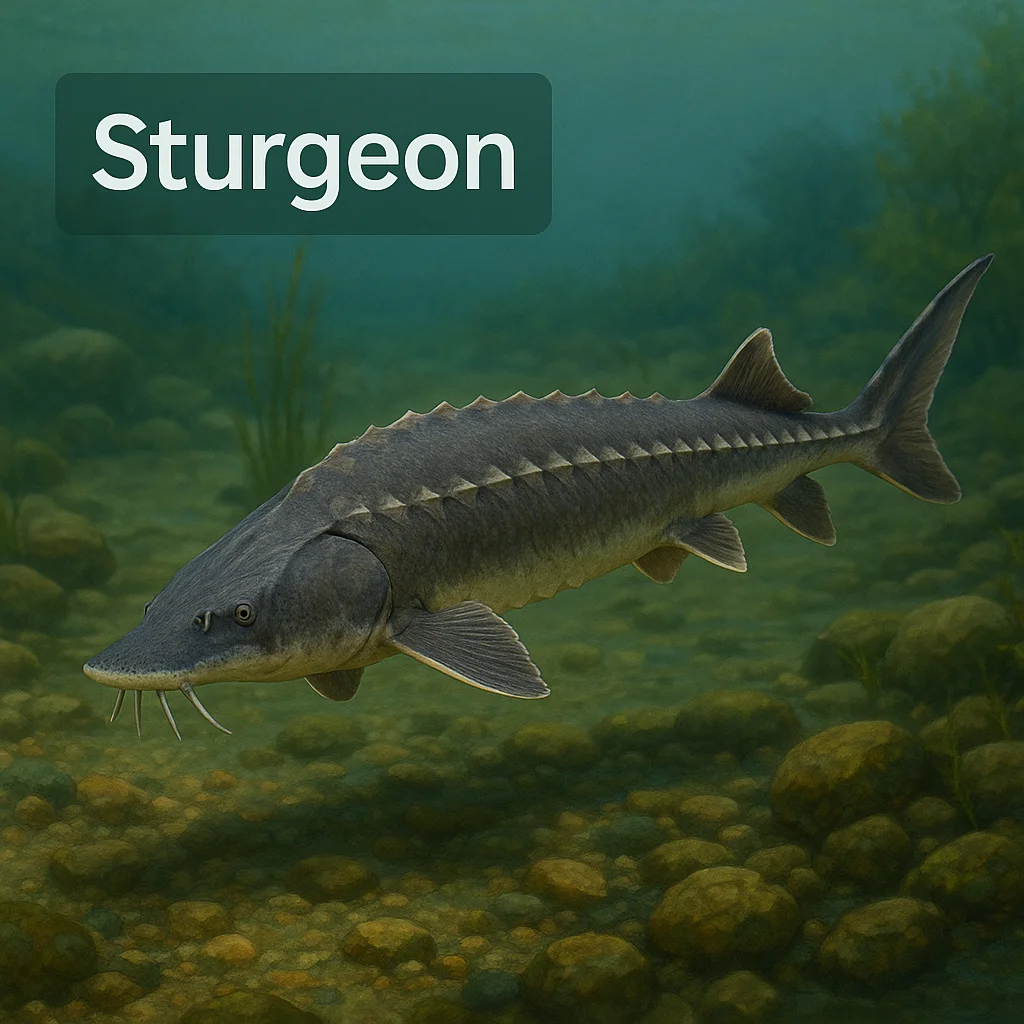
- Common name(s): Sturgeon
- Scientific name: Varies (family Acipenseridae)
- Animal type: Fish
- Typical adult size: Up to 20 feet (6 meters) in length, depending on the species
- Typical lifespan: 50 to 100 years in the wild
- Diet type: Carnivore; feeds on small fish, crustaceans, and aquatic insects
- Activity pattern: Mostly nocturnal
- Social structure: Solitary or small groups
- Speed / movement highlights: Slow swimmers; capable of powerful bursts when threatened
- Intelligence/learning: Good problem-solving skills observed
- Primary habitats: Rivers, lakes, and coastal areas
- Geographic range: Northern Hemisphere; Europe, Asia, North America
- Predators/threats: Large predatory fish, humans (fishing and habitat destruction)
- Conservation status: Varies by region; many species are endangered
🔍 Identification & Appearance
Sturgeons have a distinctive elongate body with a slightly flattened head, known for their armored scutes—bony plates along their body. The coloration typically ranges from gray to olive-green, aiding them in blending with their aquatic environment. Juveniles may display more vividly contrasting colors, which dull as they mature.
- Long, streamlined body
- Bony plates known as scutes on the body
- Prominent barbels near the mouth
- Cartilaginous skeleton
- Heterocercal tail (lobes of different lengths)
- Mouth located under the snout
- Distinctive snout shapes vary by species
- Top ID Tips
- Look for the long, shark-like body and scutes
- Notice the barbels that help in detecting prey
- Identify the flattened, wedge-shaped head
- Check the underside for a sucker-like mouth
- Note the olive-green to gray color with subtle striping
- Look for the distinctively shaped tail
🧱 Body Structure & Physical Adaptations
Sturgeons have evolved unique physical adaptations that enable them to thrive in both freshwater and marine environments. Their cartilaginous skeleton is reminiscent of ancestral shark species, contributing to their agility in water.
- Build: Long, torpedo-shaped body optimized for slow but efficient swimming
- Jaws: Protrusible jaw suited for bottom-feeding
- Fins: Pectoral fins help in stabilization and movement
- Sensory strengths: Acute sense of touch and electroreception to detect prey
- Large swim bladder for buoyancy control
- Barbels with sensory organs to locate prey on the riverbed
- Capability to swim against strong currents for spawning
- Key Adaptations
- Cartilaginous skeleton providing flexibility
- Bony scutes offering protection against predators
- Hydrodynamic shape for efficient swimming
- Suction-based feeding for bottom-dwelling prey
- Well-adapted sensory barbels for foraging in low visibility
- Swim bladder aiding in neutral buoyancy
🌍 Range & Distribution
Sturgeons are predominantly found in the Northern Hemisphere, inhabiting both freshwater and coastal marine areas. They often migrate long distances in search of suitable spawning grounds or food resources.
- Geographic range: Europe, Asia, and North America
- Biomes: Rivers, lakes, estuaries, and coastal marine environments
- Climate range: Temperate to subarctic regions
- Elevation range: Sea level to moderate elevations in large river systems
- Mostly residents of their aquatic environments but migrate for spawning
- Where You Might Find It
- Large river systems like the Danube and Volga
- Great Lakes in North America
- Caspian and Black Sea regions
- Coastal waters during migration
- Estuarine areas with rich food supply
🏞️ Habitat & Shelter
Sturgeons use a variety of aquatic habitats, from freshwater rivers to oceanic coastal zones. Their preference for deep, slow-moving waters with a sandy or muddy bottom provides them with ample food and cover from predators.
Understanding their habitat also helps explain their migratory behaviors, especially in relation to spawning.
🧭 Behavior & Ecology
Sturgeons are largely solitary creatures, known for their sluggish movement and bottom-dwelling habits. These ancient fish navigate their world using a network of electroreceptors, rendering them efficient foragers despite murky waters.
- Primarily nocturnal activity patterns
- Emit low frequency sounds for communication
- Solitary or form loose groups when young
- Role as bottom feeders, cleaning the riverbed
- Predominantly involves searching for bottom-dwelling prey
- Electroreception helps detect prey and other environmental cues
- Behavior Highlights
- Nocturnal foraging with slow movements
- Solitary existence for most of its life
- Environment-sensitive electroreception
- Avoids predators with camouflaged skin
- Plays an ecological role in keeping water bodies clean
👥 Social Life & Group Dynamics
Generally, sturgeons are solitary creatures, only interacting significantly during spawning seasons. Young sturgeons may form loose congregations, but this tendency dissipates as they age. They do not form complex social hierarchies and rely heavily on instinctual behaviors.
- Social Structure Notes
- Mostly solitary adult life
- Cohesive groups seen in young stages
- Minimal cooperation or group dynamics
- Pair bonds only during brief spawning periods
🍽️ Diet, Prey & Predators
Sturgeons are opportunistic carnivores, feeding on the benthic organisms of their aquatic environments. Their diet primarily includes small fish, mollusks, crustaceans, and insects, obtained using their specialized jaws and keen senses.
Although they are robust creatures, sturgeons face predation from larger fish when young and suffer human-related threats as adults.
- Feeding Notes
- Nocturnal feeding when prey activity is high
- Suction feeding to capture bottom-dwelling creatures
- Diverse diet supports flexible nutrition sources
- Predators include sharks, large fish, and human activities
- Camouflage offers defenses against natural predators
🦌 Hunting, Foraging & Movement
Known for their slow, steady swimming, sturgeons forage by sifting through sediment with their specialized mouths. Their movements are largely dictated by the availability of food and the need to migrate to spawning grounds.
- Bottom-dwelling foraging behavior
- Rely on swal movement rather than speed
- Ability to sense prey in murky waters
- Suction feeding to extract prey from the substrate
- Seasonal migrations for breeding and feeding
- Movement & Strategy
- Prefer slow currents for energy efficiency
- Navigate large distances in search of spawning sites
- Use of electroreception to detect prey
- Feeding involves sifting riverbed sediments
- Long migrations critical to their life cycle
🧠 Intelligence & Senses
Sturgeons exhibit noteworthy problem-solving skills for fish. They rely extensively on their well-developed sensory systems to survive in turbid waters where visibility is limited. Their electroreceptive capability helps locate prey otherwise challenging to find.
- Notable Abilities
- Acute electroreception for environmental navigation
- Strong tactile sense from barbels
- Sound reception aids communication and predation detection
- Spatial memory helps retrace to spawning grounds
🪺 Reproduction, Pregnancy & Parenting
Sturgeon reproduction includes seasonal migrations to spawning grounds, where they may undergo lengthy upstream travels. Their reproductive methods are typically promiscuous, lacking significant parental investment post-egg laying.
- Reproduction Snapshot
- Sexual maturity occurs around 10 to 15 years
- Spawning occurs once every few years
- Release thousands to millions of eggs per breeding session
- Eggs develop independently with no parental care
♀️♂️ Male vs Female Differences
Sturgeons show observable differences between sexes, notably in size, particularly during the spawning season. Females are often larger, attracting males during breeding.
- Sex Differences at a Glance
- Females larger than males
- Ability to identify females more straightforward during spawning
- Males more adept at courtship displays
🧬 Subspecies & Variation
The sturgeon family comprises more than 25 distinct species, each exhibiting unique adaptations and geographic distribution patterns. These differences reflect adaptations to local environments, with some species being flat-out extirpated or critically endangered.
- Variation Notes
- Notable species include beluga, white sturgeon, and Russian sturgeon
- Geographical variations lead to morphological differences
- Coloration and size vary across subspecies
⚠️ Threats, Conservation & Human Interaction
Sturgeons face various threats, primarily driven by human activities. Habitat modification, pollution, and overfishing for their caviar have pushed many species to the brink of extinction. Conservation efforts focus on habitat restoration and legal protection.
- Responsible Notes
- Habitat degradation through dam construction
- Overfishing for caviar has severely impacted populations
- Bycatch during commercial fishing operations
- Fishing regulations are critical for their survival
- Conservation programs focused on breeding and restocking
✨ Fun Facts & Unique Traits
- Sturgeons are among the most ancient species of fish still in existence
- They can live for more than a century
- Some species, like the beluga sturgeon, are world-record holders for size
- Capable of long migrations exceeding hundreds of kilometers
- Sturgeons have a prehistoric look with their bony scutes
- Amphibious lifestyle: adept in both saltwater and freshwater systems
📌 Summary
- Identification: Large, bony-plated fish with a long body and sensory barbels
- Habitat: Live in rivers, lakes, and coastal areas
- Distribution: Found in the Northern Hemisphere
- Diet: Carnivores primarily feeding on benthos
- Predators: Sharks, larger fish, and human activities
- Social Life: Generally solitary with brief pair formations
- Reproduction: Unique spawning migrations every few years
- Key Adaptations: Electroreception, suction feeding, and long-distance migration
- Distinctive Traits: Prehistoric appearance and long lifespan