🦁 Salmon
🧾 Quick Facts
Salmon are fascinating fish best known for their incredible life cycle, which involves migrating from freshwater to the ocean and back again. They are a crucial part of both aquatic and terrestrial ecosystems.
- Common name(s): Salmon
- Scientific name: Varies; includes genera like Oncorhynchus, Salmo, and Salvelinus
- Animal type: Fish
- Typical adult size: 20–45 inches (51–114 cm) in length
- Typical lifespan: 2–8 years (wild)
- Diet type: Carnivore; primarily consumes insects, plankton, and small fish
- Activity pattern: Diurnal
- Social structure: Generally solitary but form groups during migration
- Speed / movement highlights: Capable swimmers; can leap clear of the water
- Intelligence/learning: Above average for fish; known for navigational abilities
- Primary habitats: Rivers, streams, coastal marine waters
- Geographic range: North America, Europe, Asia, and the North Atlantic and Pacific Oceans
- Predators/threats: Bears, birds, humans, and other vertebrates
- Conservation status: Varies by region and specific population
🔍 Identification & Appearance
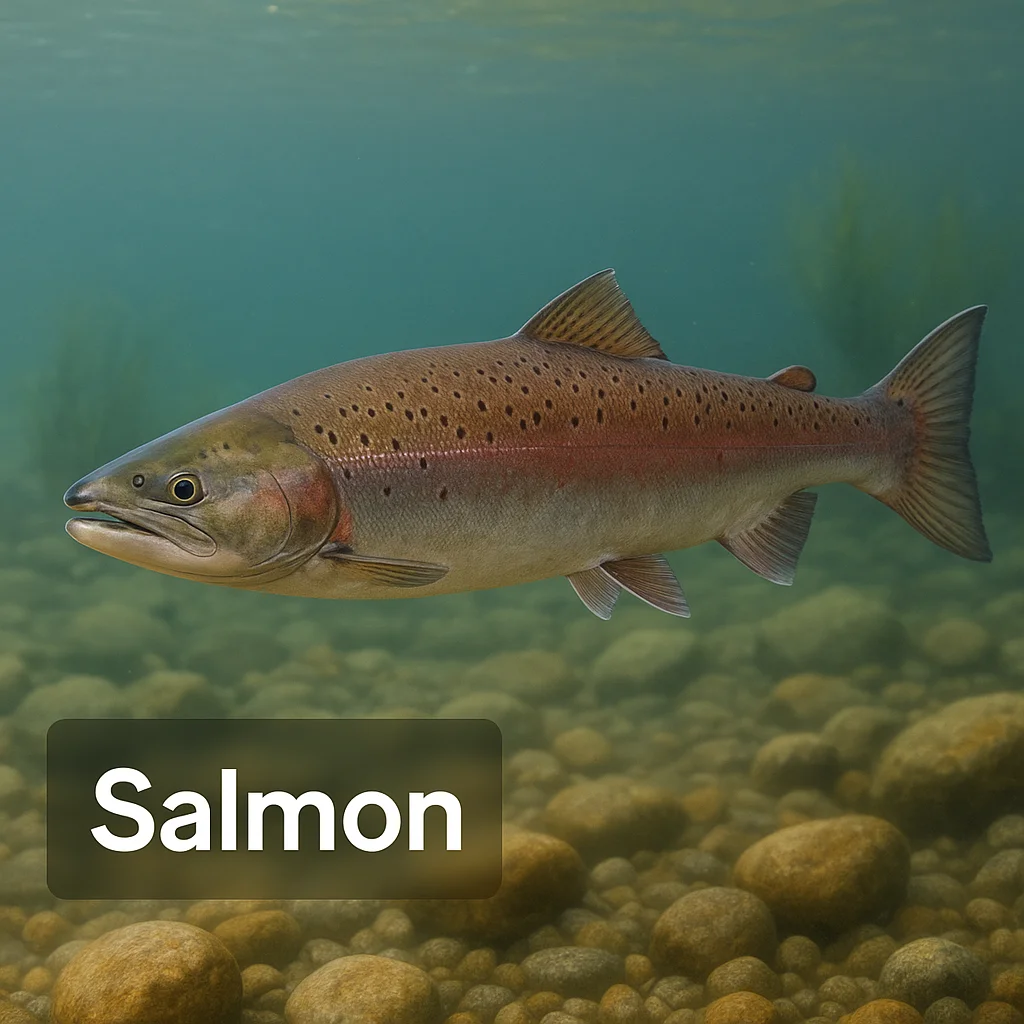
Salmon are streamlined fish with a sleek, torpedo-shaped body allowing them to navigate through water efficiently. They typically display silvery sides with a slight hint of blue, green, or pink, depending on the species. During breeding season, some salmon species, like the sockeye, undergo dramatic color changes.
- Body shape: Torpedo-shaped, streamlined
- Color: Silvery with seasonal variations
- Distinctive features: Forked tail, spots on the back, clear fins
- Age-related changes: Color and size vary with maturity
- Common look-alikes: Trout; differentiate by body size and spot patterns
- Spawn markings: Develop distinct colors during spawning
- Top ID Tips
- Look for a sleek, elongated body
- Identify the forked tail
- Check for distinct spots on the back and tail
- Observe the clear, smooth fins
- Note color changes in spawning season
- Compare size and spot patterns with trout
- During migration, look for schools
- Examine jaw development in mature males
- Look for adipose fin - a small, fatty fin on the back
🧱 Body Structure & Physical Adaptations
Salmon possess numerous adaptations that support their migratory lifestyle. Their streamlined bodies enable efficient movement through water, while powerful muscles allow them to brave strong currents and leap obstacles. Their keen sense of smell is vital for navigating back to their natal stream for spawning.
- Key Adaptations
- Streamlined, slender bodies reduce water resistance
- Strong, muscular tails for powerful swimming
- Keen olfactory senses for finding natal streams
- Color camouflage for protection from predators
- Cartilaginous skeleton provides buoyancy
- Protective scales on their bodies
- Gills adapted for efficient oxygen extraction
- Adipose fin aids in stabilization
- Lateral line system for detecting vibrations
- Sharp teeth for gripping prey
🌍 Range & Distribution
Salmon are found in temperate waters of the Northern Hemisphere. They are native to North America, Europe, and Asia, inhabiting rivers and streams for spawning and moving to the ocean for growth. These anadromous fish rely on both freshwater and saltwater environments during their life cycles.
- Where You Might Find It
- North American Pacific coast
- North Atlantic Ocean
- Rivers and streams in Canada
- Scandinavian rivers
- Japanese coastal waters
- Russian Far East
- Western United States water systems
- Coastal and inland British waterways
- Northern European rivers
🏞️ Habitat & Shelter
Salmon prefer cold freshwater environments for spawning, typically in gravel-bottomed streams and rivers. As juveniles, they often find shelter in the shallower sub-currents and hiding spots among rocks and vegetation. In the ocean, salmon roam coastal marine waters, often returning to the same river where they were born to spawn.
🧭 Behavior & Ecology
Salmon are known for their incredible migratory journeys, often traveling hundreds of miles to return to their natal streams for spawning. They are solitary in the ocean but can be seen in large numbers during upstream migrations. Communication is limited to visual displays and the occasional splash during predator evasion.
- Behavior Highlights
- Spectacular migrations from ocean to river
- Spawning leads to dramatic physical changes
- Juveniles exhibit schooling behavior for protection
- Splashing to navigate over obstacles
- Scent-tracking for natal stream location
- Shift from solitary to social during spawning
- Predator avoidance through rapid movement
- Important prey species for bears and eagles
- Nutrient transport between marine and freshwater ecosystems
- Critical to food web stability in their habitat
👥 Social Life & Group Dynamics
While generally solitary in the ocean, salmon display strong group dynamics during migration. Spawning salmon can be seen in large numbers, with males sometimes displaying aggression to establish dominance. They do not form permanent hierarchies, and cooperation is limited to temporary groupings during upstream travel.
- Social Structure Notes
- Solitary at sea
- Group formation during migrations
- Males may fight for spawning territories
- No lasting dominance hierarchies
- Temporary schools as juveniles
- Pairing typically brief, focused on reproduction
- No parental group care
- Transient social bonds during migration
🍽️ Diet, Prey & Predators
Salmon are carnivorous, feeding on a variety of aquatic organisms, including insects, plankton, and smaller fish. Their diet changes as they mature, with juveniles often feeding on zooplankton in freshwater, and adults consuming crustaceans and other fish in the ocean. Natural predators include bears and eagles, while human factors such as fishing pose modern threats.
- Feeding Notes
- Juveniles eat insects and zooplankton
- Adults prefer fish and crustaceans
- Seasonal diet shifts with migrations
- Predation by larger fish in streams
- Utilize keen vision for hunting
- Nocturnal feeding during migrations
- Avoid predators with rapid escape responses
- Natural diet diversity ensures ecosystem roles
- Primarily ocean predators; prey on herring and krill
- Susceptible to overfishing and habitat disruption
🦌 Hunting, Foraging & Movement
Salmon are powerful swimmers, capable of covering long distances during migrations. Their movement is characterized by endurance and leaping ability, essential for overcoming river obstructions. They forage mainly by sight and have efficient strategies for catching prey in both open water and near the seafloor.
- Movement & Strategy
- Endurance swimming for long migrations
- Leaping to overcome waterfalls and rapids
- Daytime foraging using sight
- Utilizing currents for efficient travel
- Juveniles drift with currents for food collection
- Spatial navigation via olfactory cues
- Regular routes during annual spawning runs
- Collective movement in smolt stage
- Adaptation to different salinity levels during life cycle
🧠 Intelligence & Senses
Salmon have developed remarkable sensory abilities, particularly in their olfactory system, which is key for their navigation back to natal rivers. While not known for complex problem-solving or tool use, their migratory behavior suggests advanced memory and spatial reasoning.
- Notable Abilities
- Highly developed sense of smell for home detection
- Keen eyesight for underwater hunting
- Memory guides migration routes
- Tactile lateral line senses vibrations in water
- Sensitivity to water temperature changes
- Basic communication during migration
- Limited problem-solving but strong spatial abilities
🪺 Reproduction, Pregnancy & Parenting
Salmon are known for their anadromous breeding cycle, where they move from the ocean back to freshwater to spawn. They typically lay thousands of eggs in nest-like depressions called redds. Males often compete for females, showing vibrant colors and developing physical adaptations like kype (a hooked jaw) during this time.
- Reproduction Snapshot
- Breeding season triggers striking color changes
- Males develop a kype during spawning
- Females lay eggs in gravel nests (redds)
- Spawning occurs in freshwater streams
- Large egg quantities improve survival odds
- Lack of parental care post-spawning
- Seasonal timing varies by location
- High fry mortality due to predation
- Females select nest sites carefully
- Die shortly after spawning, contributing nutrients
♀️♂️ Male vs Female Differences
Male and female salmon exhibit several differences, particularly during spawning periods. Males develop more vivid colors and pronounced physical features like a hooked jaw (kype) to compete for mates. Females, on the other hand, prioritize selecting and defending nesting sites for egg-laying.
- Sex Differences at a Glance
- Breeding males have brighter colors
- Males develop a distinctive kype (hooked jaw)
- Females focus on nest (redd) creation
- Slightly larger body in males during spawning
- Behavioral differences notable in breeding season
- Female physical changes less pronounced
🧬 Subspecies & Variation
Salmon encompass numerous species and subspecies, each with unique characteristics and adaptations. Sockeye salmon, for example, are noted for their bright red coloration during spawning, while Atlantic salmon display more subtle differences. Variations arise due to geographical distribution and environmental pressures.
- Variation Notes
- Sockeye: Deep red spawning color
- Chum: Less colorful, large body size
- Coho: Silver body, hooked snout in males
- Atlantic: Display less radical color shifts
- Pink: Smaller size, distinct humpback in males
- Chinook: Largest, diverse ocean routes
- Subspecies distribution influenced by geography
- Adaptive traits for environment-specific survival
⚠️ Threats, Conservation & Human Interaction
Salmon face multiple threats from both natural predators and human activities. Habitat destruction, climate change, overfishing, and pollution are significant issues impacting their populations. Conservation measures focus on sustainable fishing practices, habitat restoration, and understanding ecological needs.
- Responsible Notes
- Habitat protection and restoration critical
- Sustainable fishing reduces overharvesting
- Avoid disruption during spawning in streams
- Pollution control benefits water quality
- Conservation efforts vary by species and region
- Support community-based stewardship initiatives
- Climate adaptation requires regulatory collaboration
- Commercial importance requires management
✨ Fun Facts & Unique Traits
- Salmon can jump over 3 meters to ascend waterfalls
- They use Earth's magnetic field to orient during migration
- Some species perform epic migrations of over 1,200 miles
- Proper tidal and lunar phases trigger mass spawning
- Serves as a keystone species through nutrient cycling
- Spawn and die cycle provides essential ecosystem nutrients
- Record-breaking leap documented at 4.6 meters
- Salmon played a vital role in many indigenous cultures
📌 Summary
- Recognized by their sleek, torpedo-shape and silvery body
- Exist in both marine and freshwater environments
- Massive migrations back to natal rivers for spawning
- Carnivorous diet later shifts to include a wide range of aquatic organisms
- Preyed upon by numerous terrestrial and aquatic animals
- Group migration observed during breeding and juvenile stages
- Sensory and navigational intelligence highly developed
- Reproduction involves large-scale spawning events with distinct physical changes
- Males develop a kype and show vibrant colors during breeding
- Face conservation challenges; efforts focus on sustainable practices