🦁 Piranha
🧾 Quick Facts
Piranhas are a group of fish known for their sharp teeth and a somewhat ferocious reputation. They inhabit various freshwater systems in South America and are a crucial part of their ecosystem. While widely feared in popular culture, their ecological role and behavior are complex and fascinating.
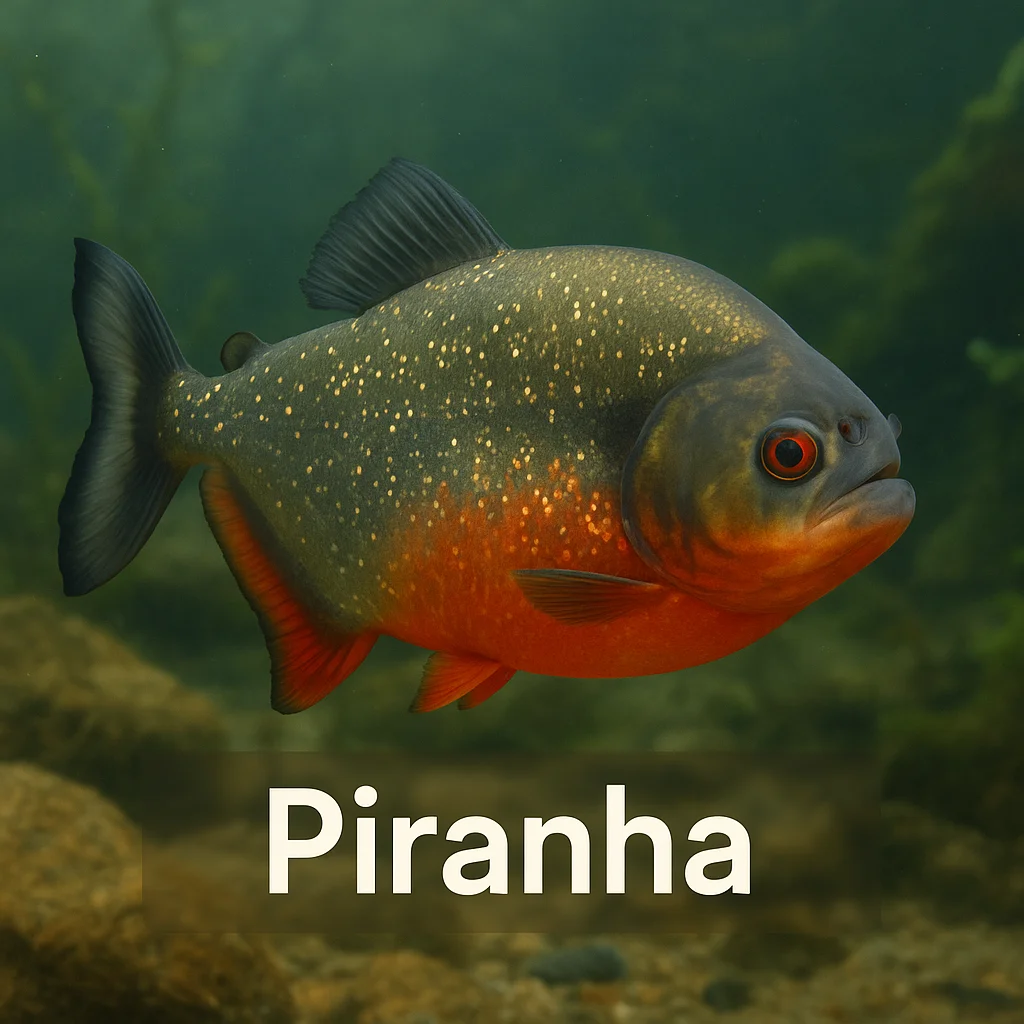
- Common name(s): Piranha
- Scientific name: Varies by species (e.g., Pygocentrus nattereri)
- Animal type: Fish
- Typical adult size: 14 to 26 cm (5.5 to 10.2 inches) in length
- Typical lifespan: 10 to 20 years in the wild
- Diet type: Omnivore; includes insects, fish, crustaceans, and plant material
- Activity pattern: Diurnal
- Social structure: Group (schools)
- Speed / movement highlights: Agile swimmers
- Intelligence/learning: Known for social interactions and group feeding strategies
- Primary habitats: Rivers, floodplains, and lakes
- Geographic range: South America, predominantly in the Amazon Basin
- Predators/threats: Birds, caimans, larger fish; human activities
- Conservation status: Varies by species
🔍 Identification & Appearance
Piranhas can be recognized by their robust, laterally compressed body and a blunt head with powerful jaws and sharp teeth. Their coloration is often silver or gray, sometimes with a reddish hue around the belly, depending on the species. Size and coloration can vary with age and environmental factors.
- Compact, robust body shape
- Sharp, triangular teeth visible in the jaw
- Generally silver-gray with some red accents
- Juveniles may be less vividly colored than adults
- Scales cover the entire body
- Easily confused with other serrasalmids but distinguishable by tooth shape
- Distinctive, prominent lower jaw
- Top ID Tips:
- Note the sharp, interlocking teeth
- Look for a broad, sloped forehead
- Observe body color and patterns
- Check size against other fish for quick ID
- Watch behavior; schooling is typical
- Note any red belly or gil marks
🧱 Body Structure & Physical Adaptations
Piranhas have a strong, muscular build that suits their dynamic swimming lifestyle. Their teeth are razor-sharp, adapted for efficiently slicing through flesh and vegetation. Their jaw structure is powerful, allowing them to exert significant bite force. They possess a lateral line system aiding in detecting water movements, which is vital for hunting and schooling.
- Key Adaptations:
- Muscular, compact build aids in swift swimming
- High bite force due to powerful jaw muscles
- Curved, sharp teeth facilitate diverse diet
- Lateral line system enhances sensitivity to vibrations
- Coloration offers camouflage in murky waters
- Eyes are adapted for seeing in low-light conditions
- Gill structures allow efficient oxygen extraction
🌍 Range & Distribution
Piranhas are native to the freshwater systems of South America. They are particularly prevalent in the Amazon Basin but can be found in various other regions including the Orinoco River and Paraná River. They inhabit warm waters and are predominantly found at low-altitude regions.
- Where You Might Find It:
- Amazon River Basin
- Orinoco River
- Paraná River
- Lowland rivers and streams
- Flooded forests during the wet season
- Large, slow-moving rivers
- Warm, tropical freshwater environments
- Lakes and reservoirs of South America
🏞️ Habitat & Shelter
Piranhas prefer warm, freshwater habitats such as rivers, streams, and lakes. They are found in rainforests and floodplain lakes where vegetation is dense. During the wet season, they may venture into flooded forest areas, exploiting the increased food availability. Their choice of shelter is crucial for avoiding predators and ensuring breeding success.
🧭 Behavior & Ecology
Piranhas are social fish that typically live in schools. This schooling behavior provides them protection from predators and aids in coordinated feeding. They generally feed during daylight hours and utilize a range of vocalizations and physical signals to communicate with each other. In the ecosystem, they play a role as both predator and prey, helping control other fish populations while also serving as food for larger animals.
- Behavior Highlights:
- Group feeding mechanisms
- Diurnal activity pattern
- Cooperative defense against predators
- Role as both predator and prey
- Complex social hierarchies within schools
- Use of vocalizations and movements for communication
- Opportunistic feeding habits
👥 Social Life & Group Dynamics
Piranhas are typically social creatures that form schools. These schools can serve as a mechanism for defense and increase feeding efficiency. The group dynamic often involves intricate hierarchies and coordinated movements. While not known for cooperative hunting, the presence of a swarm can lead to rapid consumption of prey.
- Social Structure Notes:
- Schools range from dozens to hundreds
- Some species mix in multi-species schools
- Hierarchy often based on size and strength
- No known territorial behavior, but schools can be aggressive
- Juvenile fish often stay in edges of the school
- Coordination enhances protection against threats
🍽️ Diet, Prey & Predators
Piranhas are omnivores, meaning their diet includes both animal and plant matter. They consume insects, crustaceans, small fish, and plant material. Their hunting strategy usually involves sensing chemical cues and using cooperative tactics. Natural predators of piranhas include birds, larger fish, and reptiles like the caiman.
- Feeding Notes:
- Diet includes insects and aquatic plants
- Commonly known to feed on small mammals that may venture into waters
- Piranhas use a feeding frenzy to overwhelm prey
- Opportunistic feeders, adapting to food availability
- Feeding patterns may change with seasons
- Frenzied feeding sometimes triggered by blood
🦌 Hunting, Foraging & Movement
As efficient swimmers, piranhas are capable of quick, agile movements to catch prey. Their primary hunting strategy involves schooling tactics whereby individuals work collectively to catch prey. Movement involves both bottom-dwelling scavenging and mid-water pursuits, relying heavily on sensory input from their surroundings.
- Movement & Strategy:
- Efficient swimmers with burst speed
- Participate in group hunting displays
- Predatory strategy includes sudden, rapid approach
- Foraging often near aquatic vegetation
- Utilize jerky swimming motions to confuse prey
- Navigation might inform seasonal distribution shifts
🧠 Intelligence & Senses
Piranhas exhibit basic problem-solving abilities and have been observed utilizing group intelligence during feeding events. Their senses are well adapted for murky freshwater environments, with a keen sense of smell helping them locate food. They also possess specialized vision adapted for dimly lit waters, aiding in navigation and hunting.
- Notable Abilities:
- Strong olfactory sense for detecting prey
- Vision adapted to spot movement in low-light conditions
- Use of chemical and auditory signals in behavior
- Group dynamics may enhance threat assessment abilities
- Capable of rapid, coordinated response to stimuli
🪺 Reproduction, Pregnancy & Parenting
Piranha breeding occurs seasonally, often coordinated with flooding, which provides abundant resources. They exhibit site fidelity for spawning grounds. Mating systems can vary with some evidence of territory defense during spawning. Typically, females lay eggs in submerged nests, which both parents may guard, depending on species.
- Reproduction Snapshot:
- Breeding aligned with flooding season
- Females lay hundreds of eggs in nests
- Parental protection varies by species
- Young are often precocial, quickly becoming independent
- Natal habitats selected for resource abundance
- Pair bonding during breeding season
♀️♂️ Male vs Female Differences
Differences between male and female piranhas can be subtle. Often, males are slightly smaller and may exhibit more vibrant colorations during breeding season. The behavior modifications related to breeding can be observed with territorial and nest-guarding habits.
- Sex Differences at a Glance:
- Males typically smaller, but size can overlap
- Color may intensify in males during breeding
- No significant difference in tooth structure
- Both sexes participate in reproduction-related care
- Behavioral roles may differ slightly during spawning
🧬 Subspecies & Variation
There are several species commonly referred to as piranhas, and their classifications can sometimes overlap or be under debate. Variation within species includes differences in size, coloration, and behaviors, often in response to environmental conditions such as food availability and predation pressures.
- Variation Notes:
- Species differentiation is complex, sometimes debatable
- Freshwater conditions cause variance in physical traits
- Size can vary depending on regional and food sources available
- Species like the Red-Bellied Piranha are widely recognized
- Unique behavioral patterns by locale
⚠️ Threats, Conservation & Human Interaction
Piranhas face pressures from habitat loss due to deforestation and damming in their native regions. Fishing for the aquarium trade and fear-based eradication efforts pose additional threats. While iconic, they are often misunderstood, needing careful management for both conservation and local community coexistence.
- Responsible Notes:
- Monitor and protect natural habitats
- Promote understanding to dispel myths
- Acknowledge their ecological roles
- Ensure regulations for aquarium trade sustainability
- Adoption of harmless scare tactics over harmful control
✨ Fun Facts & Unique Traits
- Piranhas have one of the strongest bite forces among fish
- They contribute to the health of river ecosystems by consuming weak and dead animals
- Piranhas are often falsely portrayed as mindless predators
- Some piranha species primarily consume plant material
- They communicate through sounds produced by air bladders
- Piranhas have inspired numerous depictions in literature and film
- Some species can exhibit dramatic color changes during mating
📌 Summary
- Piranhas are a complex group of freshwater fish known for their sharp teeth
- Inhabit river systems predominantly in South America
- Exist in schools which afford them protection and collective feeding strategies
- Omnivorous diet with a reliance on aquatic insects and fish
- Natural predators include birds and larger fish
- Breeding corresponds with the regional rainy season
- Sex differences are subtle, primarily noted during mating behaviors
- Known for strong bite force which aids in feeding efficiency
- Piranhas play a key role in aquatic ecosystems