🦁 Neon Tetra
🧾 Quick Facts
The neon tetra is a vibrant and popular freshwater fish, renowned in the aquarium hobby for its striking colors and peaceful nature. Native to South America, this species is a favorite among fish enthusiasts for its ease of care and captivating appearance.
- Common name(s): Neon Tetra
- Scientific name: Paracheirodon innesi
- Animal type: Fish
- Typical adult size: 1.2 to 1.5 inches (3 to 4 cm)
- Typical lifespan: 5 to 10 years in captivity
- Diet type: Omnivore; primarily eats small invertebrates and plant matter
- Activity pattern: Diurnal
- Social structure: Group, often in schools
- Speed / movement highlights: Agile swimmer
- Intelligence/learning: Basic learning and environmental awareness
- Primary habitats: Freshwater rivers and streams
- Geographic range: Amazon Basin, specifically in Peru, Colombia, and Brazil
- Predators/threats: Larger fish, human collection for aquarium trade
- Conservation status: Not currently threatened, varies by region
🔍 Identification & Appearance
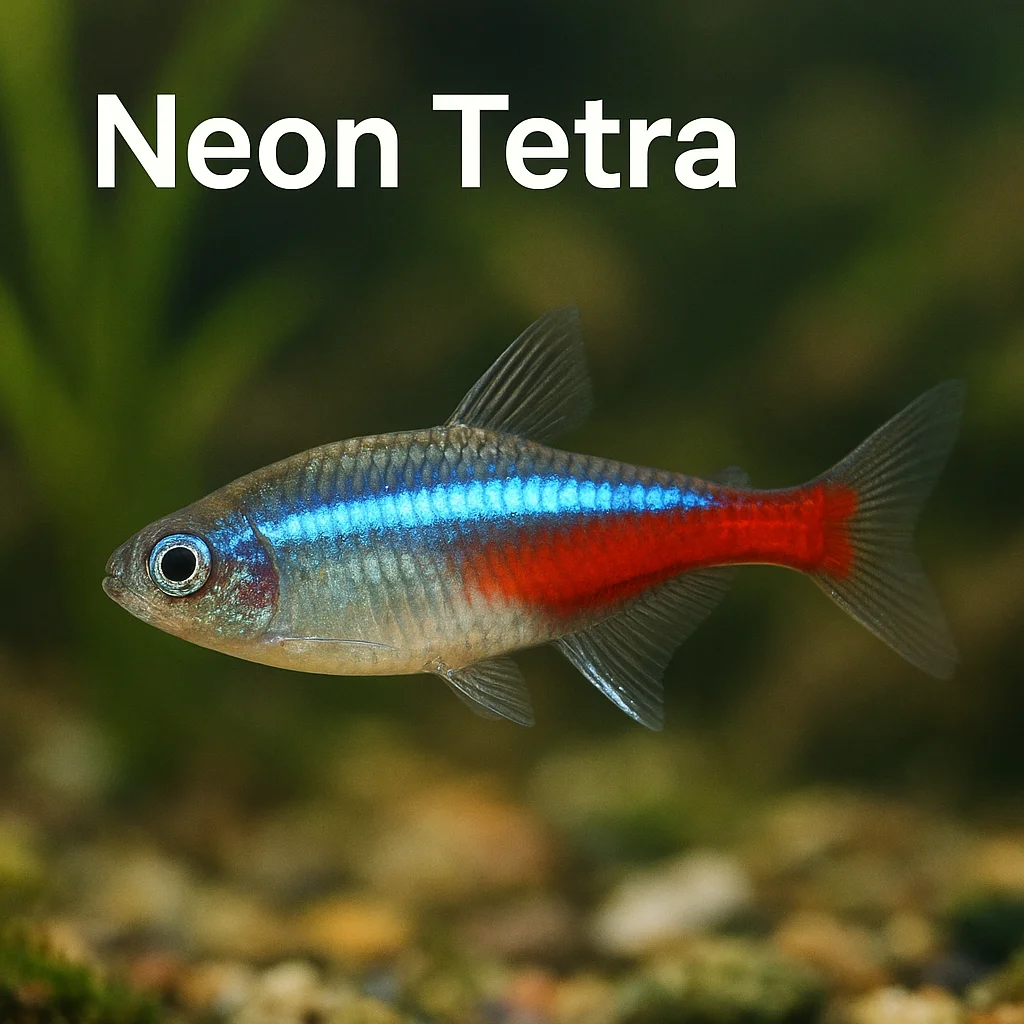
The neon tetra is easily recognized by its slender body and the vibrant iridescent blue and red stripe that runs along its length. The distinctive blue stripe covers the top half of the body, while a red stripe dominates the lower half towards the tail. This coloration is a signature feature, making it readily identifiable even in large aquariums.
- Top ID Tips:
- Slender, torpedo-shaped body
- Bright iridescent blue and red horizontal stripes
- Small, upturned mouth
- Transparent fins
- No significant morphological changes with age or season
- Commonly mistaken for the cardinal tetra, which has a more extensive red stripe
🧱 Body Structure & Physical Adaptations
The neon tetra's body is built for agility and speed, allowing it to navigate dense aquatic vegetation and avoid predators effectively. Its mouth is adapted to pick small foods from various surfaces, and its transparent fins provide stealth movement in the wild.
- Key Adaptations:
- Streamlined body reduces drag
- Body stripes provide camouflage among aquatic plants
- Transparent fins minimize detection in water
- Mouth positioned for surface feeding
- Large eyes aid in detecting predators and food
🌍 Range & Distribution
The neon tetra inhabits the freshwater rivers and streams of the Amazon basin, particularly in areas with soft, acidic water and dense vegetation that provides plenty of cover and food resources.
- Where You Might Find It:
- Amazon River basin
- Regions of Peru, Colombia, and Brazil
- Flooded forest areas during the rainy season
- Clearwater and blackwater streams
- Shaded areas with abundant plant cover
🏞️ Habitat & Shelter
Neon tetras thrive in warm, soft, and acidic water environments typically found in the Amazon. They prefer shaded waters, often under the canopy of trees or among dense aquatic plants, which provide ample hiding spots from predators and offer feeding grounds.
The knowledge of their natural habitat helps aquarists mimic conditions in captivity, ensuring health and longevity for these vibrant fish.
🧭 Behavior & Ecology
Neon tetras are highly social and display a preference for schooling behavior, which helps reduce stress and offers protection from predators. They engage in continuous swimming throughout the day, foraging for small insects and plant matter. Communication is mostly visual, picking up cues from conspecifics regarding movement and feeding opportunities.
- Behavior Highlights:
- Social schooling for protection and sociability
- Diurnal foraging routine
- Observation of group dynamics influences behavior
- Relies on speed and schooling to evade threats
- Contributes to aquatic ecosystem as both prey and consumer of small organisms
👥 Social Life & Group Dynamics
Neon tetras are gregarious fish, forming schools that provide safety in numbers. These schools consist typically of several dozen individuals, but smaller captive groups of six to ten can mimic this natural behavior. Within the school, there is little hierarchy, with interactions mainly focused on coordination in movement and feeding strategies.
- Social Structure Notes:
- Forms schools in the wild
- Group sizes can vary widely
- Schooling reduces predation risk
- Cooperative movement during foraging
- Non-aggressive, peaceful co-inhabitants
🍽️ Diet, Prey & Predators
Neon tetras are omnivores, consuming a diet rich in small crustaceans, insect larvae, and algae. Their feeding behavior involves grazing throughout the day on available food. Predatory threats include larger fish species that inhabit the same waters. Tetras utilize their speed and schooling behavior as primary defense mechanisms.
- Feeding Notes:
- Omnivorous diet
- Includes insect larvae and algae
- Continuous, opportunistic foragers
- Employs group escapement strategies
- Acts as a prey species in the ecosystem
🦌 Hunting, Foraging & Movement
Neon tetras are agile swimmers that rely on schooling and rapid darting movements to forage and avoid predation. They are surface and mid-water feeders, utilizing their lateral movement capabilities to navigate dense vegetation and pick food from the water column and surfaces.
- Movement & Strategy:
- Agile and rapid swimming
- Schooling enhances foraging efficiency
- Darts quickly to avoid threats
- Forages at various water column levels
🧠 Intelligence & Senses
The neon tetra's senses are well-attuned for survival in the dynamic riverine environments of the Amazon. Though not known for high-level problem-solving skills, their group behavior showcases efficient synchronization and coordination, which aids in successful foraging and predator evasion.
- Notable Abilities:
- Sharp visual acuity for detecting movement
- Synchronized schooling behavior
- Basic learning from environmental changes
- Effective response to visual and hydrodynamic cues
🪺 Reproduction, Pregnancy & Parenting
Neon tetras breed in soft, slightly acidic waters, often stimulated by environmental cues such as temperature and water chemistry changes. The species is oviparous, with females scattering eggs among plants. There is no parental care, and the young are left to fend for themselves upon hatching.
- Reproduction Snapshot:
- Spawns in groups
- Lays up to 130 eggs per event
- No parental investment post-spawning
- Environmental cues trigger spawning
- Young are self-sufficient from hatching
♀️♂️ Male vs Female Differences
Sexual dimorphism in neon tetras is subtle, with females generally appearing slightly rounder due to egg carrying. During breeding readiness, males may exhibit slightly more intense coloration as part of their courtship behavior.
- Sex Differences at a Glance:
- Females have rounder abdomens
- Males may show brighter colors when ready to spawn
- Subtle behavioral courtship displays
- No significant size difference
🧬 Subspecies & Variation
While the neon tetra is a single recognized species, variations in coloration intensity and subtle morphological differences can be observed due to differences in local environmental conditions across its range. However, the classification within subspecies is not well-documented.
- Variation Notes:
- Color intensity may vary by locality
- Possible regional size variation
- Debate exists on subspecific distinctions
- Environmental conditions influence appearance
⚠️ Threats, Conservation & Human Interaction
Though not currently endangered, neon tetras face pressures from habitat destruction and the aquarium trade. Sustainable fishery practices and habitat conservation are essential for maintaining wild populations. In aquariums, ethical care includes maintaining appropriate water conditions and avoiding overstocking.
- Responsible Notes:
- Aquarium trade is a major human pressure
- Loss of natural habitat due to deforestation
- Encourage sustainable aquarium breeding
- Maintain suitable water conditions in captivity
✨ Fun Facts & Unique Traits
- The neon tetra's name comes from its glowing blue and red stripes reflective under ambient light, giving it a dazzling appearance.
- Neon tetras have been popular in the aquarium trade since the 1930s.
- They can adjust their iridescence based on light intensity, aiding in camouflage.
- Neon tetras are one of the most studied ornamental fish due to their popularity.
- The peaceful nature of neon tetras makes them ideal for community aquariums.
📌 Summary
- Neon tetras are small, vibrant freshwater fish.
- Distinctive iridescent blue and red stripes are key features.
- They inhabit the Amazon basin's warm and shaded waters.
- Neon tetras eat small invertebrates and plant material.
- They form schools of up to dozens of individuals for protection.
- Reproduction involves environmental triggers and no parental care post-spawning.
- They bring unique beauty and life to aquariums worldwide.